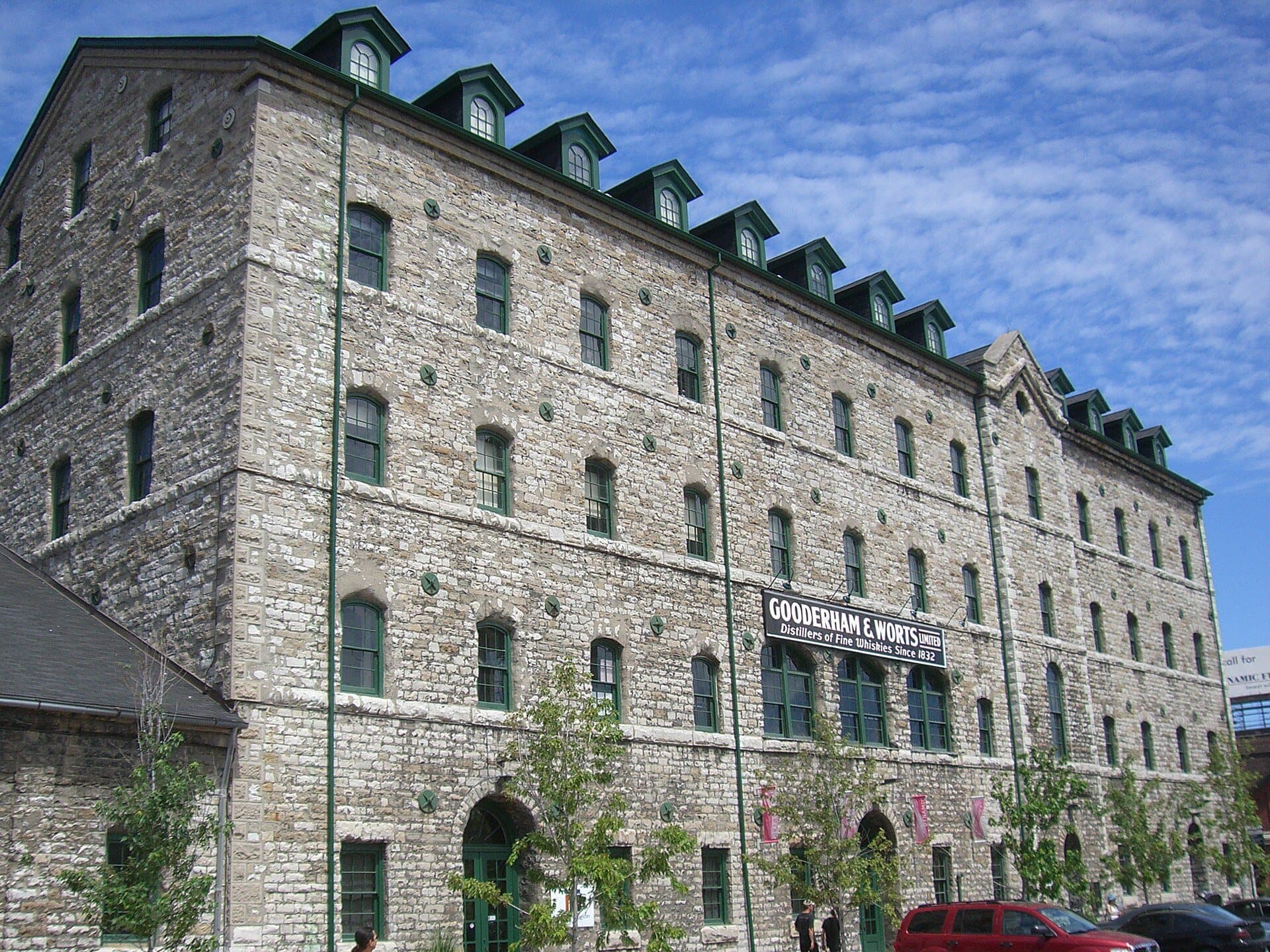
Near the south end of the Distillery District stands a long grey stone building, five storeys high, set at a slight angle to the lanes around it. This is the Stone Distillery, the oldest surviving building of the Gooderham and Worts works and still the largest on the site. It was begun in 1859, eight years before Confederation.
Built of Kingston limestone
The Distillery's own heritage material says the building was designed by David Roberts Senior and built in 1859 and 1860. The City of Toronto's heritage report describes Roberts as an Irish engineer and millwright, and calls the Stone Distillery his most prominent and widely recognized work. The Dictionary of Canadian Biography records that William Gooderham's major expansion began in 1859 with a new, five-storey distillery built under Roberts's direction, and that the new buildings had cost an estimated $200,000 by early 1862.
The stone came from Kingston. A Toronto newspaper of 1859 reported that four schooners were kept constantly busy carrying it from the Kingston quarries. The walls are three and a half feet thick at the base. Inside, the L-shaped building housed three related jobs: milling, fermenting and distilling.
With the new plant working, the Distillery's guide says, the firm's production capacity grew from 80,000 gallons a year to two million. By 1861, the Dictionary of Canadian Biography says, it could produce 7,500 gallons of spirits in a day.
Turned toward a vanished shore
Hear a stop from this walk
Tank House Lane: Buildings for Waiting
The building's angle is the clue to its setting. The City's heritage report describes it as set at an oblique angle almost parallel to the former shoreline of Lake Ontario. It was served by lake ships on one side and railway cars on the other, along what is now Stone House Walk. The lake has since been filled far to the south, but the building still lines up with the old water's edge.
The fire of 1869
On the evening of 26 October 1869, the Dictionary of Canadian Biography records, a fire gutted the interior of the main milling and distillery building, causing about $100,000 in damage. The stone walls and the machinery survived. Roberts Senior worked with his son, David Roberts Junior, on the rebuilding, and the distillery was back in business by the spring of 1870. The dormer windows in the roof were added in the 1870s.
What to look for
The City's list of heritage attributes reads like a guide to the walls. Find:
- The quoins, the corner stones that stand out from the wall.
- Belt courses, stone bands marking each storey.
- Iron tie rods, whose ends dot the walls.
- Massive stone sills and lintels around the openings.
- Doors with iron hinges, straps and bolts.
The Distillery's material notes that the south facade, toward the railway, remains much as it was in 1860, while the north face has changed more over time.
On the walk
The Stone Distillery is stop ten of the Old Town walk, eleven stops over about three kilometres, about 110 minutes at an easy pace, from St James Cathedral to Tank House Lane. The stop before it, at Trinity and Mill, introduces the firm; the last stop, Tank House Lane, shows the storehouses the son built for whisky that the law said had to age. For the story of how the works became a pedestrian district, read Preservation as a Verb.
Ready to experience it?
Old Town: St Lawrence Market to the Distillery District
110 min · 3.2 km · easy
More from Toronto
Explore more at your own pace.
Royal Ontario Museum: What to See, Floor by Floor
The ROM Crystal: Daniel Libeskind's Shard on Bloor Street
The ROM's Totem Poles: Crest Poles Built Into the Building
Zuul: The ROM's Armoured Dinosaur, Skin and All
Garrison Creek: The Buried River Under Trinity Bellwoods