Preservation as a Verb: How Gooderham and Worts Became a Brand
The Distillery District is the cleanest surviving piece of Victorian industrial architecture in North America. It is also the most curated. Both facts are produced by the same decision, made in 2001 by a single consortium, about what to do with a campus that had stopped making whisky. Walk into the District from the Mill Street gate and stand in the central courtyard facing the Stone Distillery, and the first thing your eye does is read the limestone as old. It is. The Stone Distillery was begun in 1859 and opened in early 1861, eight years before Confederation. The limestone in the walls was sailed across Lake Ontario from Kingston quarries on schooners, which was the cheapest way to move building stone in the period. The iron tie-rods you can see at the second-floor beam line held the structure together against the outward thrust of fermenting whisky in tanks the size of small rooms.
The second thing your eye should do is read the interior. The room behind the Stone Distillery's south facade has, at the time of writing, a margarita menu. It is a Mexican restaurant. The contradiction is not an accident of tenancy. It is the thesis of the campus. The shell is 1859 limestone, preserved with statutory force. The interior is 2003. Between the shell and the interior, there is no industrial function at all. The trade that produced this gap is the story this article tells.
The firm
Gooderham and Worts began as a windmill on the lakefront in 1832. James Worts, a Yorkshire-born miller, arrived in York (the town renamed Toronto in 1834) in 1831 and built the mill. He drowned in a well in 1834. His brother-in-law William Gooderham took over the operation and added a distillery to use the surplus grain that came in for milling. Over the next four decades the firm grew from a single mill into the largest industrial undertaking in Upper Canada. By 1871, according to Sally Gibson's Toronto's Distillery District: History by the Lake (Cormorant, 2008), the firm was producing roughly 2.1 million gallons of whisky a year. By the late nineteenth century, by output, Gooderham and Worts was the largest distilling operation in the British Empire.
The campus that produced this scale was not a single building. By the 1890s it comprised more than forty structures on roughly thirteen acres, including grain elevators, malt houses, the Stone Distillery, barrel works, racking houses, cattle byres for the thousands of cattle that ate the spent grain on the adjacent waterfront, worker housing, and rail spurs that linked the site to the harbour and the Grand Trunk line. The campus is now the largest surviving collection of Victorian industrial architecture in North America. The phrase appears in Parks Canada designation language and in the ERA Architects Heritage Conservation District documentation.
The firm was sold to Hiram Walker-Gooderham and Worts in 1926, the post-Prohibition consolidation that reshaped Canadian distilling. Production continued in reduced form for sixty more years. The last spirits left the Stone Distillery in 1990.
The thirteen-year gap
What happened between 1990 and 2003 is the part of the story most easily flattened into "the buildings sat empty." They did not. The campus became, for thirteen years, a substitute ruin. The buildings were partly mothballed, partly used as a film location, partly used as warehouse space, partly squatted in. Distillery District promotional material asserts that more than 1,700 productions were shot on site in this period. Verified counts from production databases are closer to 800 to 1,000 productions of all kinds. Either number is meaningful. The campus was not abandoned. It was used as the visual idea of abandonment by an industry that needed nineteenth-century brick on call.
That distinction matters because a true ruin and a working film set are different objects. A true ruin decays. A film-set ruin gets repainted and re-weathered as needed. The campus's facades survived the thirteen-year gap in better condition than they would have if they had been actually abandoned. The film tenancy kept the roofs watertight and the brick intact. When the consortium walked the site in 2000, they were not looking at a wreck. They were looking at a preserved object in need of a tenant strategy.
The 2001 decision
In 2001, a consortium led by Cityscape Holdings, with the developer Mathew Rosenblatt at the front, bought the campus from Allied Domecq for approximately sixteen million dollars. The purchase agreement closed in late 2001. The consortium spent eighteen months designing the leasing rules and rebuilding the streetscape before the gates opened to the public on 1 May 2003.
The leasing rule is what made the Distillery District the Distillery District. No national chain retail. Every tenant juried by the developer. Restaurants would be independent. Galleries would be juried. The cobblestones on Trinity Street would be relaid to a specification that read as nineteenth century. The signage would be small and unbacklit. The development would be pedestrian-only inside the gates. Most of the cobblestones the visitor walks on today were laid in 2002 and 2003. Patches of original 1860s surfacing survive, mostly under the rail-spur trace through the central courtyard. What looks like a found nineteenth-century street is mostly a 2003 reconstruction of one.
The Heritage Conservation District plan that governs every facade modification, every infill building, and every signage decision was adopted by the City of Toronto in 2015. ERA Architects wrote it. The HCD plan is the document that holds the curatorial decision in legal force. Without it, the rules Cityscape wrote in 2001 would have softened by now under tenant pressure. With it, the rules are statutory.
The condos visible at the perimeter of the campus, on the eastern and southern edges, are what made the trade financially possible. The land value those towers added to the broader parcel is part of what funded the facade restorations and the cobblestone relaying. The campus and the condos are the same balance sheet, viewed from two angles. This is the part of the story the brochures do not tell. The preserved cobblestones are paid for by the towers you cannot see from inside the gates.
What "preserved exactly the wrong way" means
The argument the Distillery District tour is built on is that the campus was preserved exactly the wrong way. The phrasing is precise. There are three other ways a North American industrial-heritage district has typically been preserved. The Brooklyn Navy Yard kept some original tenants and layered new ones on top, so the working life never fully ended. The Meatpacking District in Manhattan lost the meatpackers but layered new uses behind the preserved facades, so the buildings retained variable occupancy. The Pearl District in Portland turned warehouses into lofts while keeping the original brewery operating. Each of those three models preserved working function alongside the architecture.
The Distillery District did something different. It evicted the last industrial tenant, a confectionery, before the 2003 reopening. It restored the facades to a curated state of weathered authenticity. And it replaced the working function with a juried tenant list that would have been impossible under organic re-tenanting. The campus was not preserved by adapting it to new working uses. It was preserved by making it into a brand. The phrase "preserved exactly the wrong way" is shorthand for this trade, not a value judgment on it. The trade worked. The brand attracted tenants. The tenants justified the rents. The rents justified the preservation. The loop closed on 1 May 2003.
The exception that pressure-tests the rule
The cleanest counter-evidence inside the campus is Mill Street Brewery, which opened in Rack House M in 2002 before the public opening. Mill Street is a craft brewery in a former whisky rack house. The building's original function (fermentation, aging, beverage production) was returned by a different beverage. For a few years it looked like the curated environment had produced one organic re-tenancy that pressure-tested the no-chain rule.
The catch is the part the brochures also do not tell. Mill Street was acquired by Labatt, owned by Anheuser-Busch InBev, in 2015. The brewery scaled. The brand expanded across Ontario, then across Canada. The taproom in Rack House M is now the flagship of a regional beer brand owned by the world's largest brewing conglomerate. The exception became its own kind of scale. The campus preserved the building. The brewery returned the verb. The verb grew into a brand. The brand outgrew the building. Mill Street is not the counter-example. It is the thesis at one-tenant scale.
Why this matters for the walk
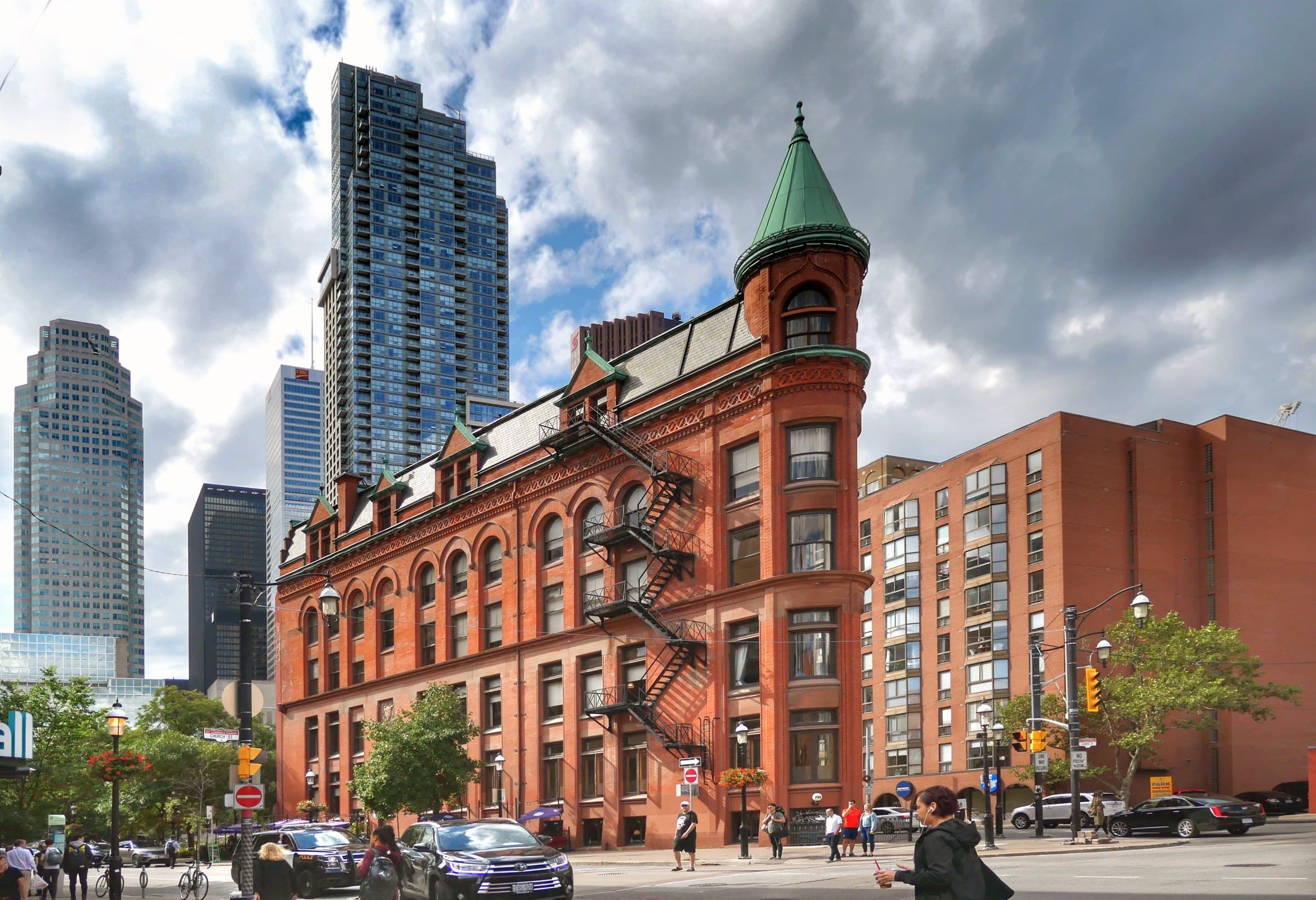
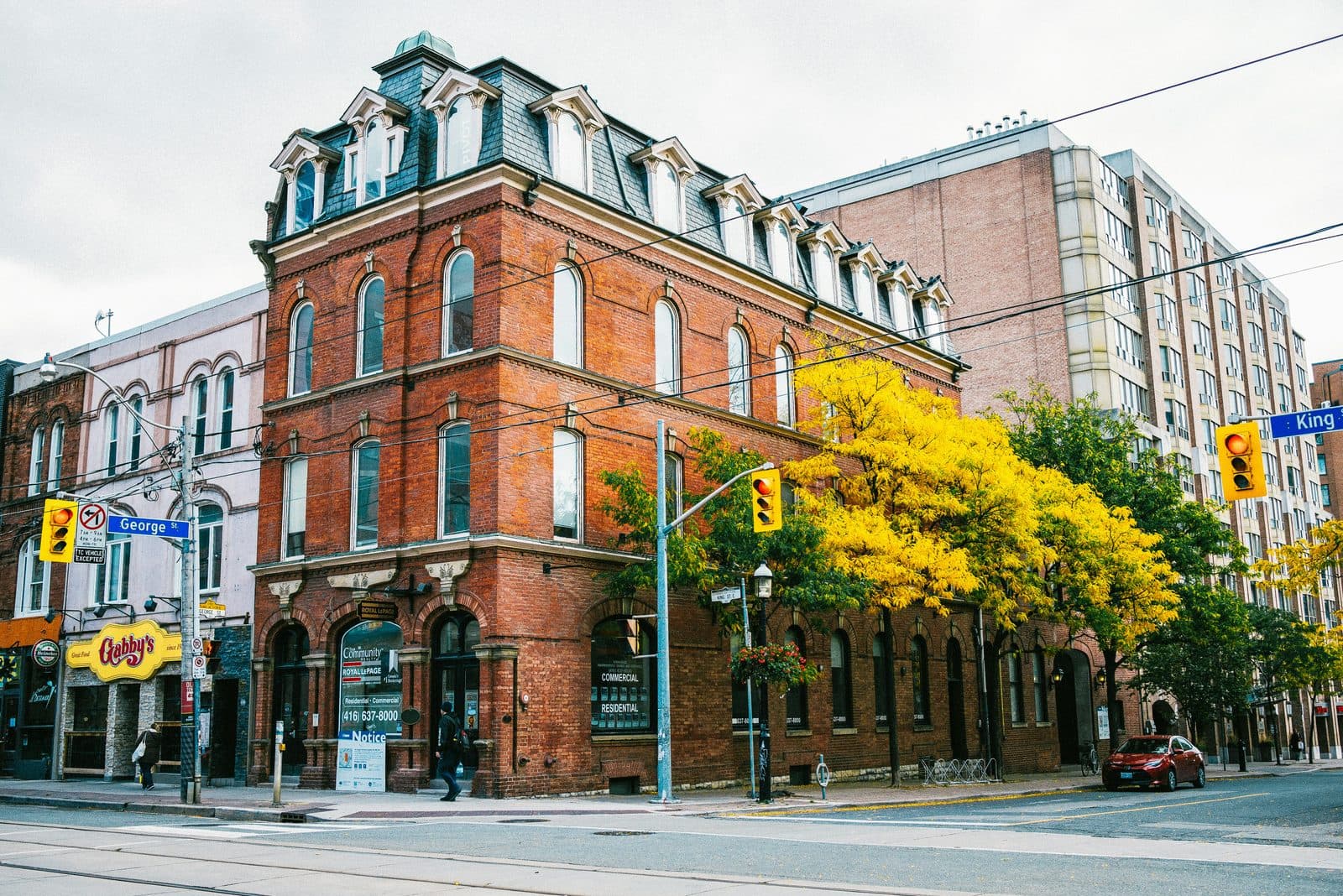
Walk the eight stops of the Distillery and Old Toronto tour and the thesis is visible at every stage. The St. Lawrence Market is the foil: a working food market that has held the same trade on the same block since 1803, the version of preservation that the Distillery deliberately is not. The Gooderham Flatiron at Berczy Park is the corporate headquarters that ran the empire from a distance, with the G&W keystone carved above the Front Street entrance for anyone who can be persuaded to look up past the famous trompe-l'oeil mural. The Front Street East warehouse rows are the missing middle: the working merchant strip that connected the market to the factory in 1880. The Esplanade is where the railways filled in the lake to give themselves a corridor. The Stone Distillery is the thesis at full volume. Trinity Street is the cobblestone form of the curatorial decision. Mill Street Brewery is the exception that proves the rule. Corktown Common is the park sitting on capped industrial soil at the Don River mouth, framed by the rail viaduct and the new condos that paid for the preservation.
The corridor is three kilometres. The argument is one sentence. The largest distillery in the British Empire, by late-nineteenth-century output, became a luxury district by being preserved exactly the wrong way: too valuable to demolish, too obsolete to restore, so it became a brand instead of a building. Once you can read the trade, the Distillery District stops being charming and starts being instructive. The brick survived. The whisky did not. The market still sells fish. The factory sells cobblestones. That is working Toronto in 1880, read backwards through the trade that was made in 2001 and locked into statute in 2015. The walk is the trade made visible.
Explore Toronto with Roamer
Take these audio tours to experience the stories mentioned in this guide