Historic Center: The City That Keeps Coming Back
65 min · 1.1 km · easy
The first thing to know about San Salvador is that it sits on top of a volcano. Not near one. On one. The lower slopes of the San Salvador Volcano begin a few kilometres west of the historic center and rise to roughly two thousand metres above sea level. The crater is still classified as active. The volcano has erupted, by the most conservative count, more than two dozen times in the last several thousand years. The most recent significant eruption was in 1917.
The second thing to know is that the volcano is not the only piece of geology that has a vote. San Salvador sits along the boundary where the Cocos Plate slides under the Caribbean Plate at a rate of about seven centimetres a year. That subduction generates frequent earthquakes, several of them severe. A list of the worst, just from the last two hundred years, would include 1854, which destroyed nearly every standing structure in the city, 1873, 1917, 1986, and 2001. Each of those years is a hinge in the city's architectural history. The buildings you see today are, almost without exception, what was rebuilt after one of them.
The third thing is that the city is wedged between two bodies of water that have nothing to do with each other. To the southwest, Lake Ilopango, a caldera left by a catastrophic eruption around the fifth century that buried a Maya population in volcanic ash and rerouted the trade networks of the region for a century. To the south, the Acelhuate River, which still drains the volcanic slopes through the historic center on its way to the Pacific. The city is laid out on the watershed between them.
This is a geography that produces a particular kind of capital. The buildings get rebuilt often. The grand monuments get rebuilt once. The civic memory is short, because the physical memory has been knocked down too many times to be continuous. And the city's relationship with the volcano is not symbolic. It is something residents check on the way to work.
A capital that decided to be a capital
For the first three centuries of its existence, San Salvador was a minor administrative town inside a larger Spanish colonial system. It was founded in 1525 by one of Hernán Cortés's lieutenants, relocated twice in its first few decades because the original sites were not viable, and spent the colonial era under the authority of the Captaincy General of Guatemala. The city was small, walkable, and unimportant. The wealth of the region was somewhere else, mostly indigo plantations spread across the interior.
Independence in 1821, and the slow breakup of the Central American Federation through the 1830s and 1840s, left El Salvador as the smallest viable republic in the region. By the 1850s the country had to make a decision about its capital. The 1854 earthquake settled the question by levelling the existing San Salvador and giving the elite the chance to rebuild the city deliberately, on the same site, at a deliberately larger scale.
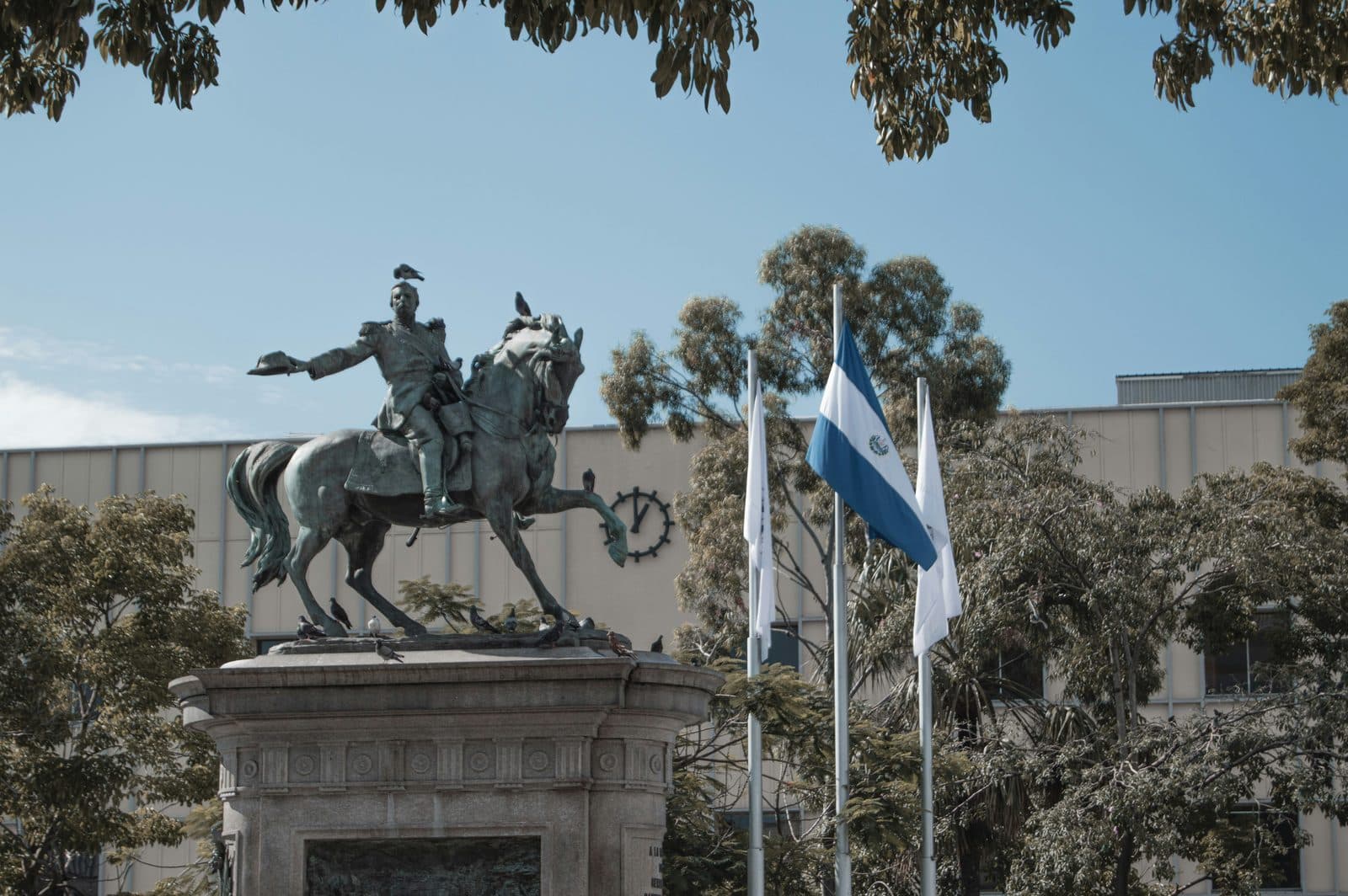
The Salvadoran elite of the late nineteenth century looked at Mexico City, Guatemala City, and the Havana of the same period, and decided that San Salvador needed to look like a peer. They built the institutions of a capital ahead of the population that would justify them. The Plaza Gerardo Barrios, four hectares of paved civic space at the center of downtown, is the most legible piece of that ambition. It is roughly twice the area of Mexico City's Zócalo, in a country with one-twentieth the population. The plaza was built for crowds the city did not yet have.
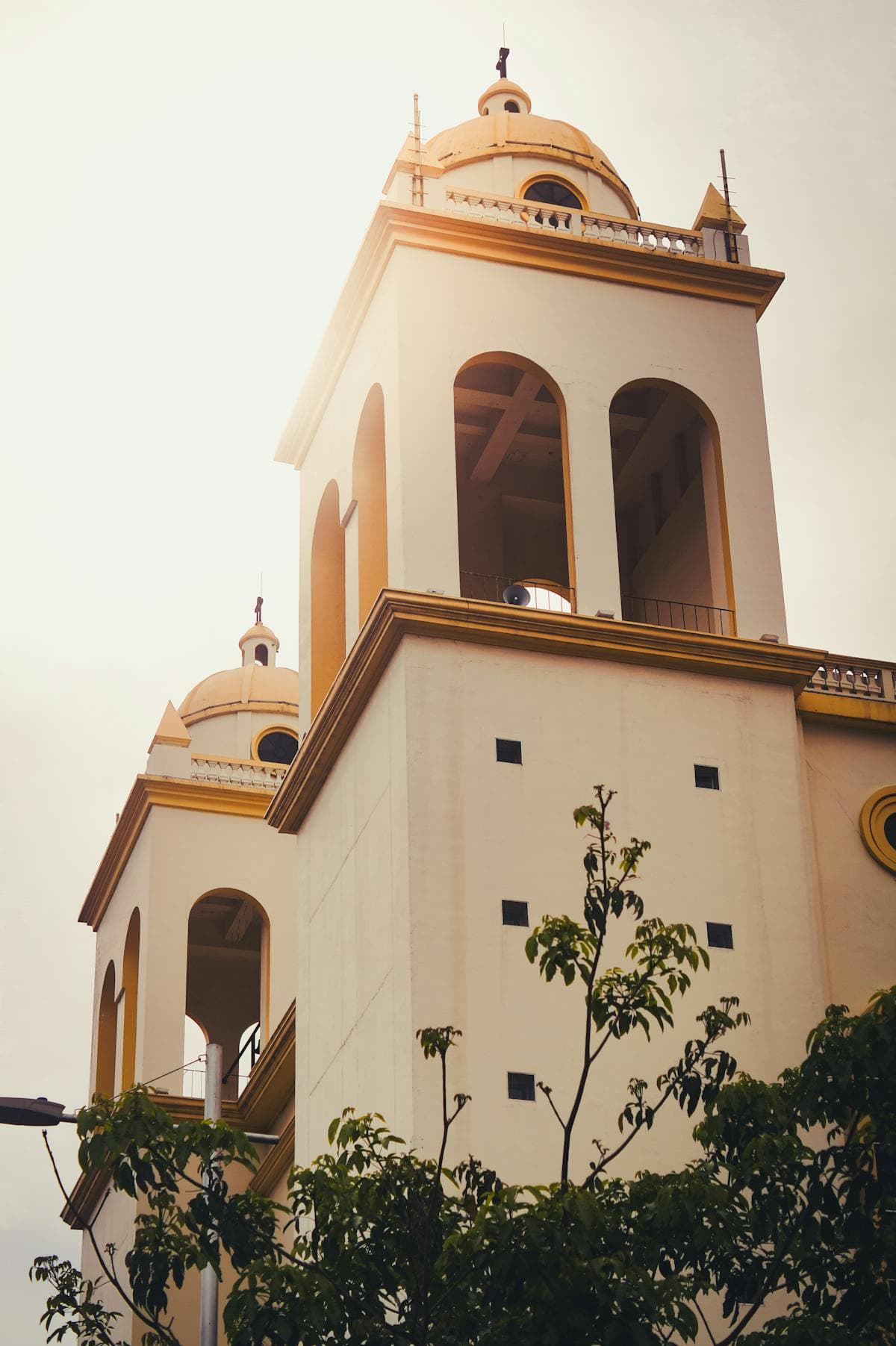
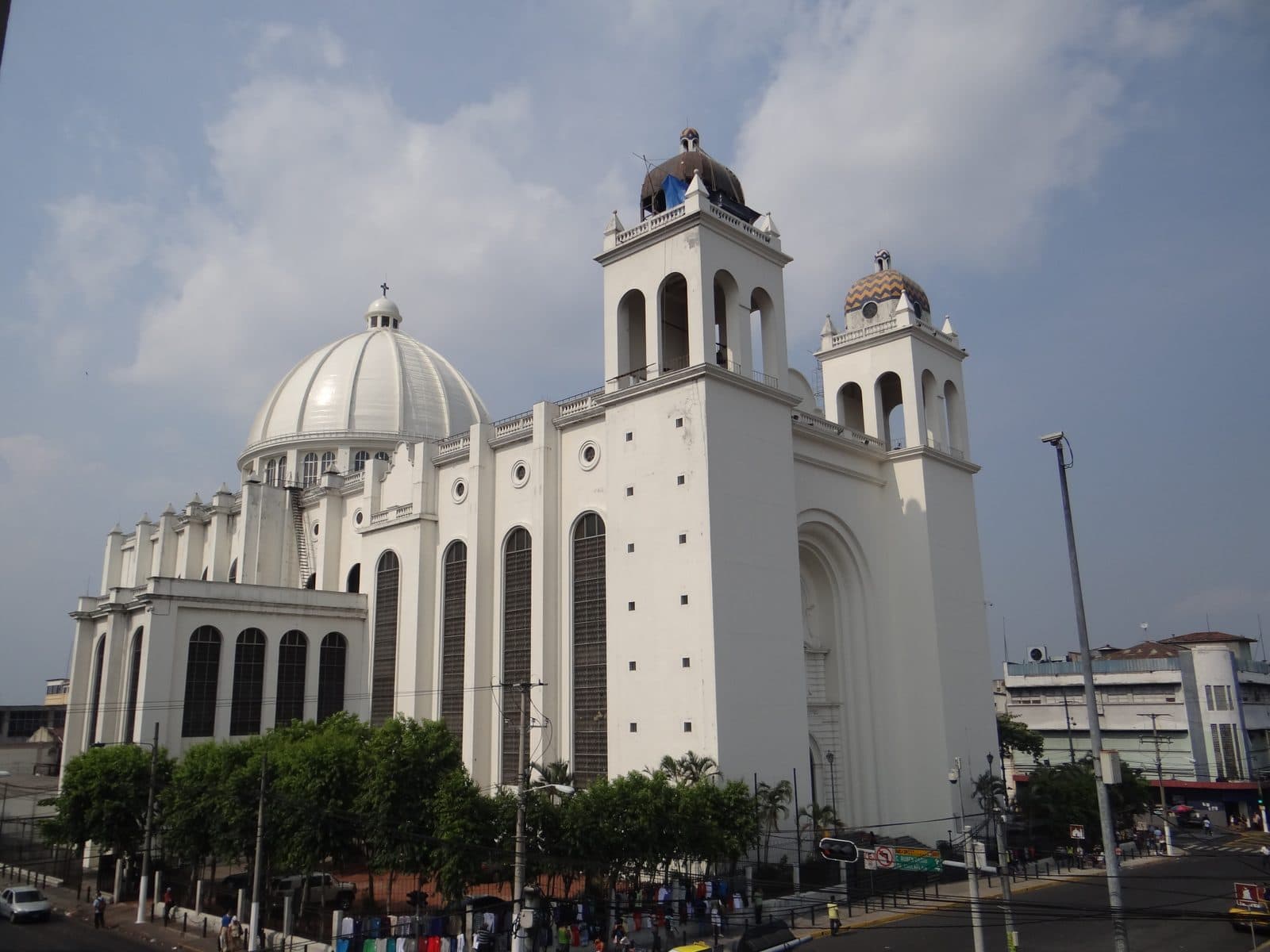
Around the plaza, the same generation funded a Palacio Nacional with a French iron frame imported from Belgium, a Teatro Nacional finished in the late 1910s, a Catedral Metropolitana that took most of the twentieth century to complete, and Iglesia El Rosario, a poured-concrete chapel from the 1970s that contains the most extraordinary stained-glass interior in the Americas. The historic center is the result of that hundred-year-long act of will.
The civil war shadow
Hear a stop from this walk
Iglesia El Rosario: The Rainbow in Concrete
For most of the second half of the twentieth century, San Salvador was a city under stress. Land in El Salvador had been concentrated in the hands of a small number of coffee families, the so-called Catorce Familias, since the late nineteenth century. By the 1970s the inequality had produced a serious left-wing insurgency in the countryside and an even more serious response from a military government in the capital.
Between 1980 and 1992, El Salvador fought a civil war that killed roughly seventy-five thousand people in a country of about five million. The war was fought mostly in the countryside, but San Salvador was where the political infrastructure of the war lived. Three pieces of that infrastructure left permanent marks on the city. The first was the assassination of Archbishop Óscar Romero in March 1980, shot at the altar of a hospital chapel a few kilometres from the cathedral. His tomb is now in the crypt of the Catedral Metropolitana, and the cathedral is where the Romero Revolution tour ends. The second was the funeral of Romero a week later, when government forces opened fire on the mourners in Plaza Barrios. The third was the urban war of 1989, when guerrilla forces launched a final offensive that brought the war into the streets of the capital for the first and only time.
The 1992 peace accords ended the war and rewrote the rules of the political system, but the social geography of the city did not reset. The downtown emptied out through the 1990s. The wealthy parts of the city pushed west, into the gated neighbourhoods on the volcano's lower slopes. For a decade or so, the historic center was a place locals avoided after dark.
The reinvention
The current downtown is the third or fourth San Salvador. Beginning around 2018, a sustained municipal effort restored the colonial-era plazas, rebuilt the lighting, brought back vendors, and, controversially, removed informal settlements from the historic core. Tourists have started returning. The Iglesia El Rosario has become an Instagram pilgrimage site for its stained-glass spectrum. The Palacio Nacional has reopened to visitors after years of closure. A small but visible community of Salvadoran artists and entrepreneurs has moved back into the historic blocks.
The reinvention is not finished, and the political context surrounding it is contested. But the architecture is what it has always been. The aspirations of the 1880s elite, the violence of the 1980s civil war, and the optimism of the 2020s reinvention are all visible inside the same four-block radius around the Plaza Barrios.
A walk through the historic center is a walk through those layers in sequence. The Romero Revolution tour traces one specific layer, the assassination and its aftermath. The Historic Center tour traces the larger layer, the question the city asks every visitor about what kind of capital it was meant to be. Both tours start from the same paved plaza, and both end somewhere different because the city is still arguing with itself about what it is.
Walk it once and the answer is not a single sentence. The answer is a stack.
Frequently asked questions
- How many self-guided walking tours are there in San Salvador?
- Roamer currently has 2 self-guided audio walking tours in San Salvador. Every tour is free to start: the introduction and first stop play in full, and every later stop plays a short preview before you decide to buy.
- How much does a self-guided walking tour in San Salvador cost?
- Each tour is free to preview and $4.99 for lifetime access. If you want more than one, a 7-day pass is $12.99 and a 30-day pass covering every tour is $19.99, which works out to well under a dollar a day.
- Can I do the San Salvador tours offline?
- Yes. Tours can be downloaded in advance in the Roamer app and played with no signal, which is useful when you are travelling without mobile data.
- How long are the San Salvador walking tours?
- They run about 90 to 120 minutes, covering 2.5 to 4.5 km on foot, with up to 8 stops on the longest route. You set the pace and can pause any time.
Ready to experience it?
Historic Center: The City That Keeps Coming Back
65 min · 1.1 km · easy
More from San Salvador
Explore more at your own pace.
Best Self-Guided Walking Tours in San Salvador (2026)
How to See San Salvador: A Capital That Aspired to Be a Capital
One Day in San Salvador: A Walkable Historic-Center Itinerary (2026)
San Salvador Travel Guide: How Many Days, Getting Around, Is It Safe (2026)
Best History Walking Tours in San Salvador (2026)