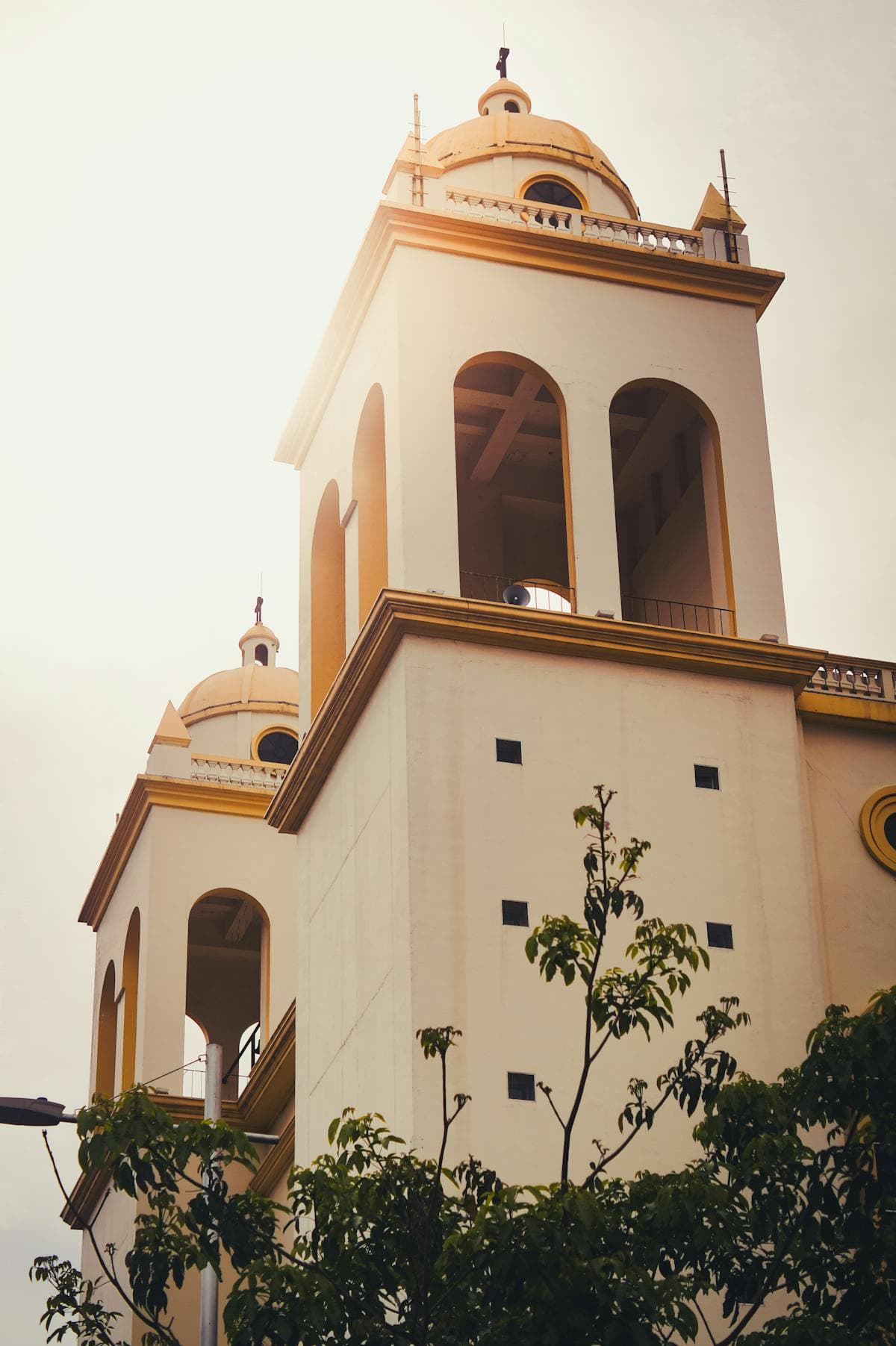
A compact walk through the heart of San Salvador's Centro Histórico: a capital rebuilt again and again on the same ground, long shadowed by fear, and now being reclaimed street by street. Nine stops from the civic plaza to the rainbow-lit concrete of El Rosario.
Start · Palacio Nacional: Four Coloured Halls
DirectionsStops
- 1
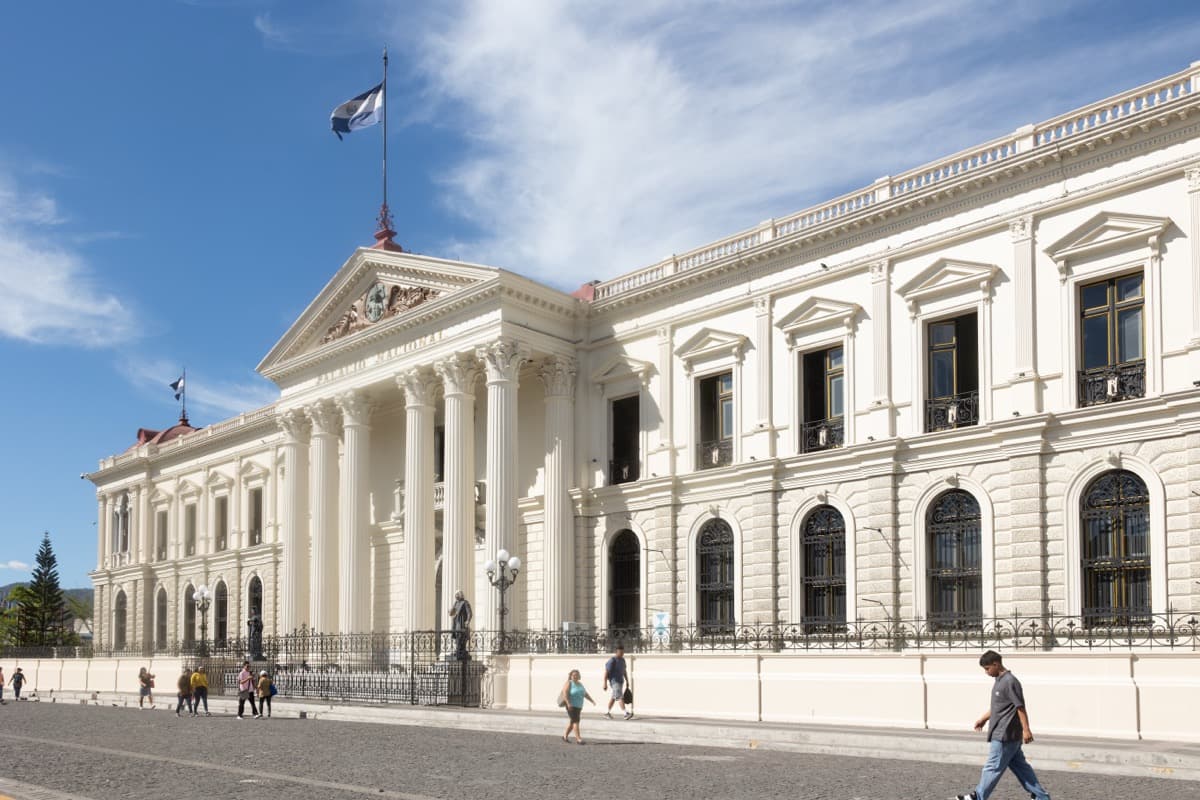
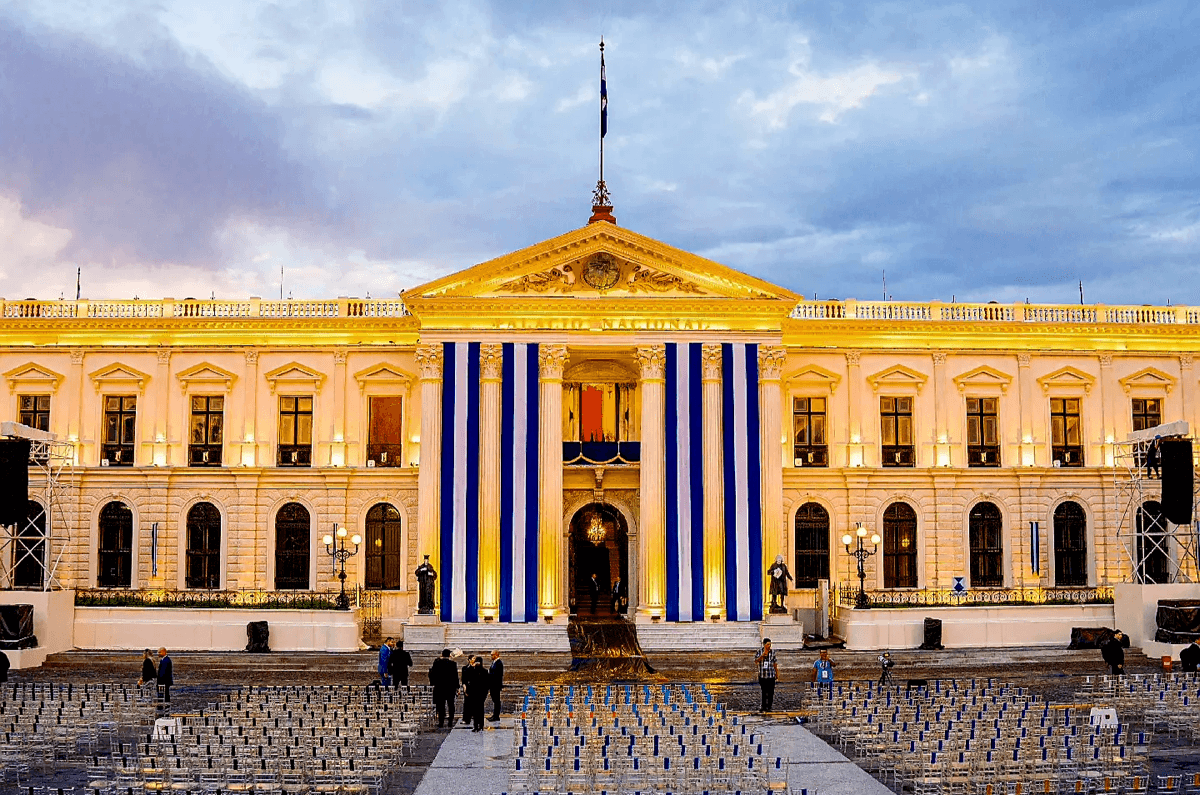
Palacio Nacional: Four Coloured Halls
The 1911 palace that once held all three branches of government, its ceremonial halls known only by their colors.
- 2
Plaza Gerardo Barrios: The Heart Reclaimed
The civic heart of the country, ringed by church, state and library, and the clearest place to feel how far the city has come back.
- 3
Biblioteca Nacional: The Newest Old Thing
This gleaming national library was a gift from China, opened in 2023 and dropped onto the historic plaza to make the old city matter again.
- 4
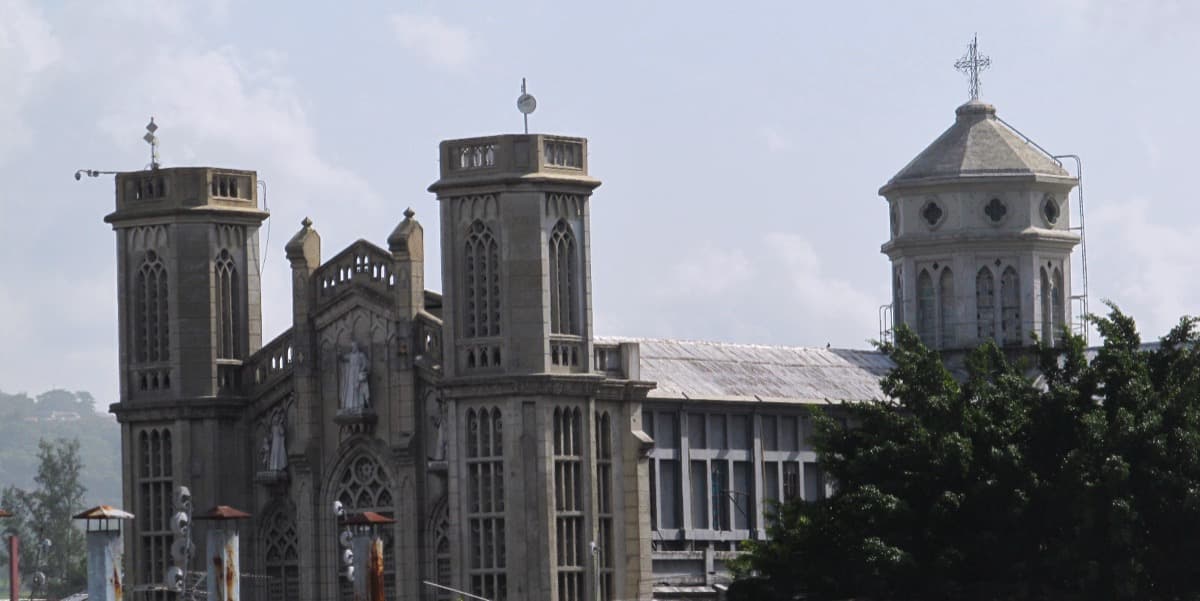
Catedral Metropolitana: Romero's Ground
The country's spiritual and political center, rebuilt over 43 years, holding the tomb of a saint and the ghost of a lost mural.
- 5
The Reclaimed Streets: A Downtown Returned
The pedestrianized commercial streets of the historic center, the frontline where the city was physically taken back for people on foot.
- 6
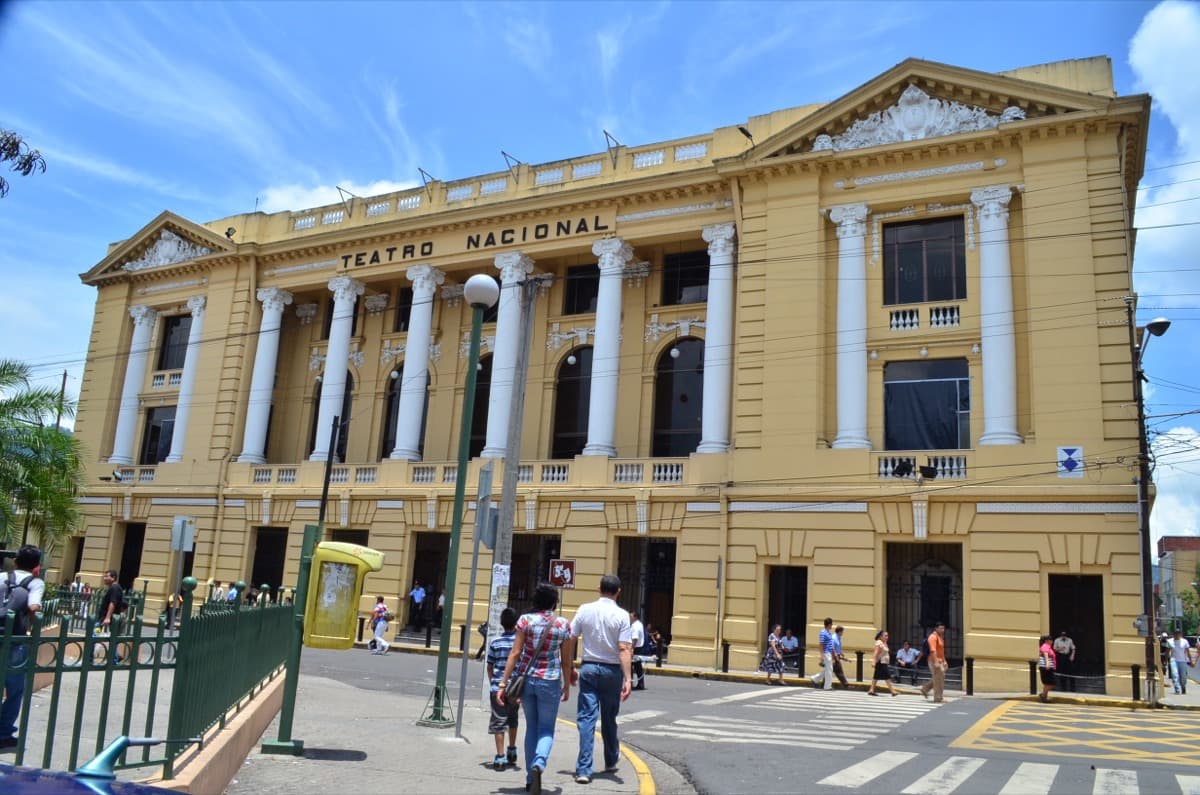
Teatro Nacional: Built by Coffee
A 1917 French-designed theatre raised by coffee wealth, engineered early to bend with the earthquakes and still in use.
- 7
Plaza Morazán: The General Who Lost
A modest square honoring the champion of a united Central America, a monument to the beautiful thing that did not survive.
- 8
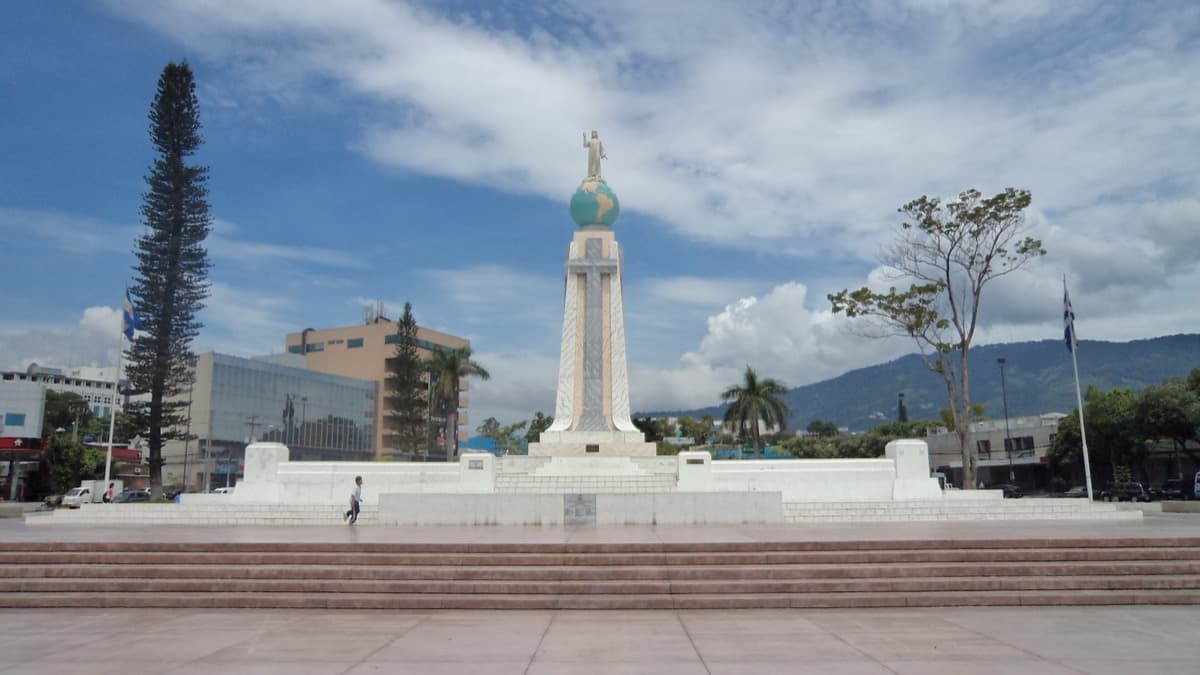
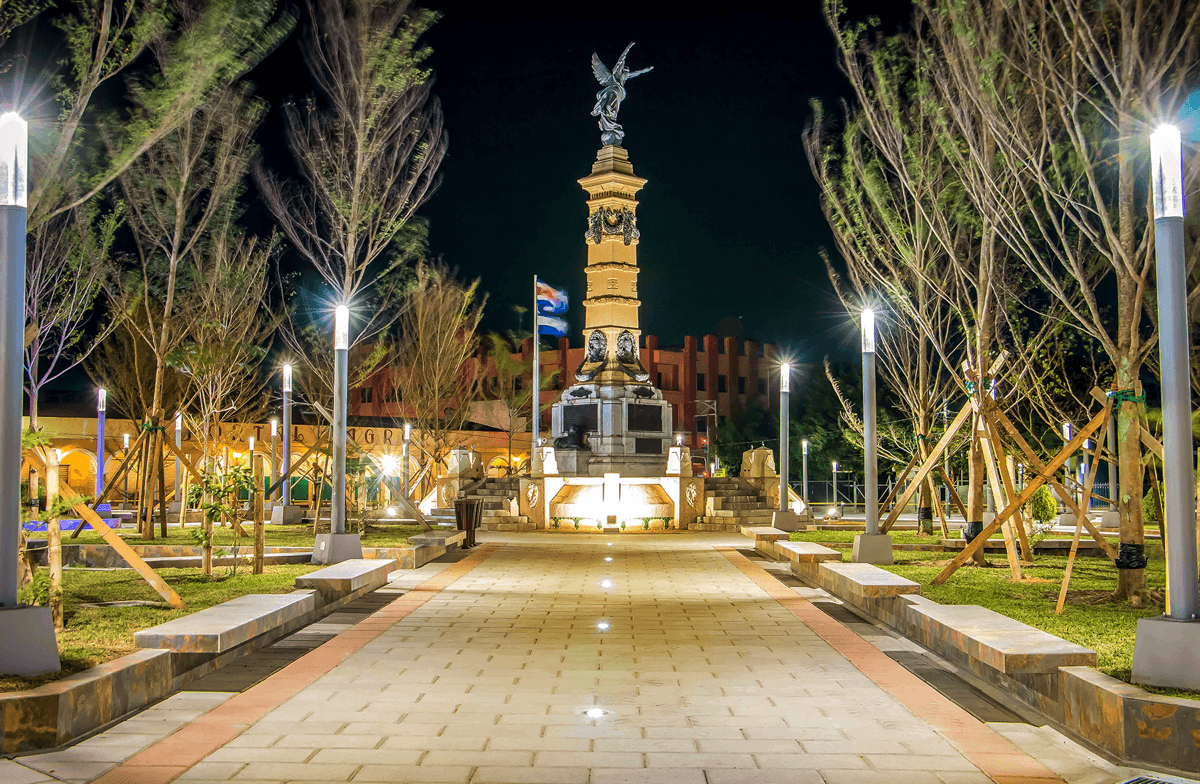
Plaza Libertad: The Angel and the Cry
The city's oldest square and the showpiece of the revival, crowned by a winged monument to the 1811 cry for independence.
- 9
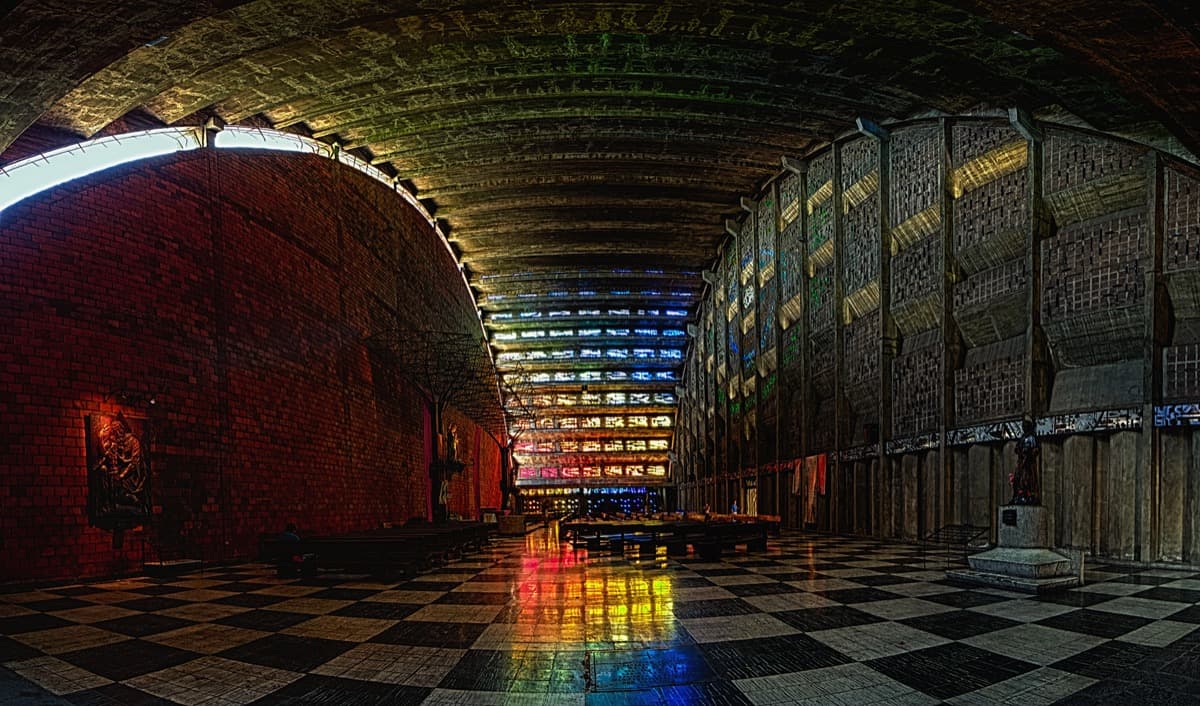
Iglesia El Rosario: The Rainbow in Concrete
A brutalist concrete shell that floods with rainbow light inside, holding the tomb of an independence founder, and the perfect last word on a city that rebuilds.
Details
Best Time to Visit
Mid to late morning is ideal. Start early enough to stay ahead of the midday tropical heat, and you will reach Iglesia El Rosario, the walk's visual climax, when the late-morning sun lights its eastern colored glass and fills the concrete shell with shifting rainbow light. The historic center is busiest and most alive on weekday mornings; Sundays are quieter, with some churches and the National Palace on reduced hours. Avoid the middle of the afternoon, when the sun is punishing. The dry season, from November to April, gives the most reliable walking weather.
Pro Tips
- •The whole route is compact and almost entirely flat, a little over a kilometre through the tight historic core, easy to walk at any pace.
- •El Rosario's rainbow light is the highlight; time your walk to reach it in the late morning, when the eastern glass is lit.
- •The historic center is far safer and more walkable than its old reputation suggests, thanks to the revitalization, pedestrianized streets and a visible tourist-police presence.
- •Pupusas, the national dish, cost about a dollar at nearby stalls and are worth seeking out.
- •El Salvador uses the US dollar, so no currency exchange is needed.
- •The churches are active places of worship; dress modestly and keep quiet during any service.
- •Give yourself extra time inside BINAES, the new national library, and the Palacio Nacional museum if they are open; both reward a longer look.
Safety & Precautions
- •The midday tropical sun is intense; bring water, a hat and sunscreen, as much of the walk is in the open.
- •As in any busy downtown, keep bags zipped and valuables out of sight, especially where the streets are crowded.
- •Stay within the revitalized historic core and its main streets; the neighborhoods immediately beyond it are less oriented to visitors.
- •Some monuments and museum interiors keep limited or changing hours; check ahead if entering the Palacio Nacional or the theatre matters to you.
- •Watch for traffic on streets that look pedestrian; not every block is fully closed to cars.
Travel advisory: Exercise Normal Precautions (Level 1).
Gallery
Read the walk
The full story of Historic Center: The City That Keeps Coming Back, in words. Prefer to listen? Play it narrated, from home or on location.
Introduction
San Salvador is a city that has never been allowed to finish. Earthquakes flattened it in 1854, 1873, 1917 and 1986. Fire gutted its cathedral in 1951. A twelve year civil war emptied its streets in the 1980s. And for years afterward, this was known to the world as one of the most dangerous countries on earth, its capital by some measures the most homicidal city anywhere. People here once measured their days by which streets were safe to walk. That is the weight this downtown has carried, and it is why its recent turn matters so much. El Salvador now reports one of the lowest homicide rates in the Americas, visitors are returning in record numbers, and, however debated the path, the people of San Salvador are walking their own city again. So the reclamation you are about to see is not only restored plazas and pedestrian streets. It is a place that people can once more simply be. Over a little more than a kilometre and about an hour, nine stops cross the compact heart of the Centro Histórico of San Salvador, El Salvador, from the civic plaza ringed by palace, library and cathedral, along the reclaimed streets to the grand theatre, the restored independence square, and a church that turns raw concrete into rainbow light. Each stop is something this city lost and chose to build back. When you arrive at the Palacio Nacional, begin with stop one.
1. Palacio Nacional: Four Coloured Halls
Begin here, on the west side of the great civic plaza, in front of this pale, colonnaded building. This is the Palacio Nacional, the National Palace. It was built between 1905 and 1911 to the design of the Salvadoran architect José Emilio Alcaine, on the site of an earlier national palace. Like almost everything grand in this part of the city, it was paid for by coffee. In the early twentieth century El Salvador's economy ran on coffee exports, and the wealth that crop generated was poured into monuments meant to make a small country look like a serious republic. For decades this one building held all three branches of the Salvadoran state at once. Its four ceremonial halls are known simply by their colors. The Blue Hall hosted the National Assembly, the Red Hall was for presidential protocol, and the others served the Supreme Court and the president's own office. Inside, the halls are a riot of imported European detail, marble and tile and glass, the shopping list of a nation buying respectability abroad. Government eventually outgrew the palace and moved on, and the building became a museum you can walk through today. It makes a fitting place to start, because the whole story of this downtown is here in miniature: enormous ambition, hard times, and a careful bringing-back. Step out into the open square in front of it now, the civic heart of the country, and we will read the city from its center.
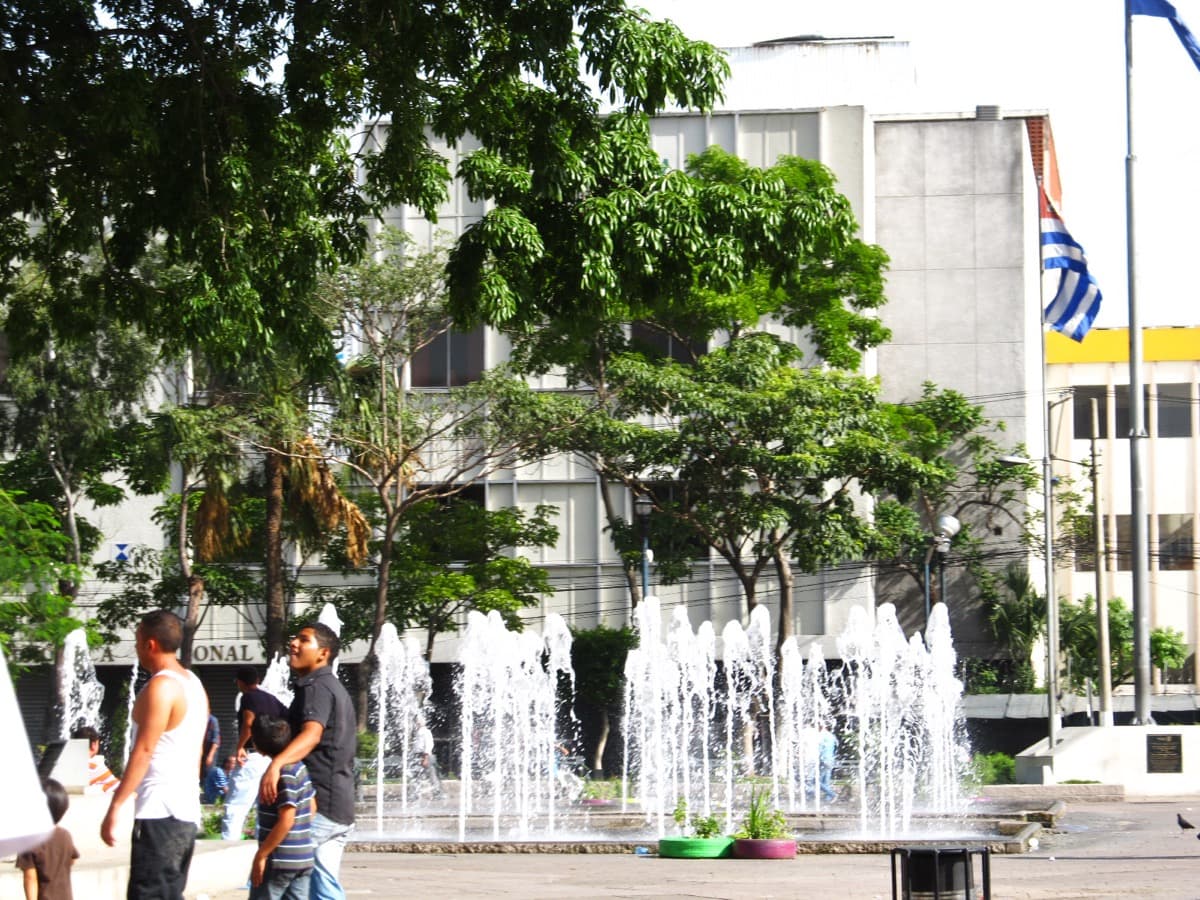
2. Plaza Gerardo Barrios: The Heart Reclaimed
Now you are standing in the middle of it, the Plaza Gerardo Barrios, the ceremonial heart of San Salvador. Turn slowly and you can read the whole nation in the buildings around the square: the cathedral for the church, the National Palace for the state, and, to the south, a gleaming new library for a modern idea of the country. At the center rides the man the plaza is named for. The bronze equestrian statue of Gerardo Barrios was unveiled in 1909. Barrios was president around 1860, and he is remembered for one decision that shaped everything here: he championed coffee as the national crop, and the wealth that followed built these palaces and monuments a generation later. But look at the square itself, and think about what it means that you can stand in it so easily. For years this plaza was buried under market stalls and traffic. And for longer than that, this was a country the world knew mainly for danger. People here once measured their days by which streets were safe to walk. That has changed, dramatically, in just the last few years. Homicides have fallen to among the lowest in the Americas, in a security transformation that drew the world's attention, and, however debated the path, the result on this plaza is undeniable. Families fill it again in the evenings. The deeper reclamation you are walking is not really about stone and paving. It is about a city that is theirs again. The cathedral stands just to the north, but first, step south to the newest thing on the square.
3. Biblioteca Nacional: The Newest Old Thing
If any single building explains what this walk is about, it is this one. This is BINAES, the new Biblioteca Nacional de El Salvador, the national library, and it did not exist a few years ago. It opened in November 2023, a sleek glass and steel block of seven levels and twenty four thousand square metres, dropped right onto the edge of the historic plaza and facing the old cathedral across the square. The contrast is deliberate and startling. On one side of the plaza, a stone cathedral rebuilt over decades; on the other, a gleaming contemporary library that went up in under two years. The building was a gift. It was designed, financed and constructed by the People's Republic of China, at a cost of around fifty four million dollars, part of a wave of Chinese investment that followed El Salvador's decision to switch diplomatic recognition from Taiwan to Beijing in 2018. The library it replaced, the old Biblioteca Nacional named for the poet Francisco Gavidia, had served since 1870 in a cramped historic building nearby. This one holds hundreds of thousands of items across airy reading floors, digital labs and children's areas, and it was promoted at its opening as a library that would keep its doors open around the clock. Whatever you make of the politics behind it, and Salvadorans argue about them, the effect is undeniable. A square once surrendered to stalls and neglect now draws students and families back into the historic center after dark. Cross the plaza now to the oldest institution on it, the cathedral to the north.
4. Catedral Metropolitana: Romero's Ground
This is the Catedral Metropolitana, and it is the spiritual and political center of gravity for the whole country. Stand at its front, facing the plaza, and you can see most of where you have just walked. What rises above you is actually the third cathedral to stand on this…
Full narration for this stop unlocks with the tour.
5. The Reclaimed Streets: A Downtown Returned
Pause here in the middle of the street, because the street itself is the point. For decades the historic center's roads belonged almost entirely to informal vendors. Stalls packed the pavement so tightly that in places you could not see the ground, let alone the facades above,…
Full narration for this stop unlocks with the tour.
6. Teatro Nacional: Built by Coffee
Here is the purest expression of the coffee money that built this downtown. The Teatro Nacional, the National Theatre, was begun in 1911 and opened in 1917, and it was built for one reason, to prove that San Salvador was a cultured, European facing capital and not a provincial…
Full narration for this stop unlocks with the tour.
7. Plaza Morazán: The General Who Lost
This modest square is the Plaza Morazán, and the figure on the column is one of the most important people in Central American history, Francisco Morazán. In the decades after independence from Spain, the five states of Central America briefly joined into a single federal…
Full narration for this stop unlocks with the tour.
8. Plaza Libertad: The Angel and the Cry
This is Plaza Libertad, Liberty Square, one of the oldest public squares in the city and long its ceremonial heart. Crowning it is the monument that gives the square its meaning, a tall column topped by a bronze winged figure, the Angel of Liberty, holding out laurel crowns. It…
Full narration for this stop unlocks with the tour.
9. Iglesia El Rosario: The Rainbow in Concrete
From the outside, El Rosario looks like an aircraft hangar, or a bomb shelter, a long low tunnel of raw grey concrete that many people walk past without a glance. Step inside and it becomes one of the most beautiful modern churches in the Americas. This is Iglesia El Rosario,…
Full narration for this stop unlocks with the tour.
- Palacio Nacional — Arne Müseler, CC BY-SA 3.0 de · source
- Plaza Gerardo Barrios — ClauH0288, CC BY-SA 3.0 · source
- Biblioteca Nacional de El Salvador — Arne Müseler, CC BY-SA 3.0 de · source
- Catedral Metropolitana — Alex Romero, CC BY-SA 3.0 · source
- Teatro Nacional — Cesar Lainez, CC BY-SA 3.0 · source
- Plaza Morazán — Johnson Wisconsin, CC BY-SA 4.0 · source
- Plaza Libertad — Idea SV, CC BY-SA 4.0 · source
- Iglesia El Rosario — Rodet7, CC BY-SA 3.0 · source
Images may be cropped or resized. Other photos via Unsplash and Pexels.