A short biography of the country's polarization sits underneath every stop on the Romero Revolution tour. The audio names the major events as you walk past them. The relationships between those events, why one led to the next, why the country could not avoid the war that followed, take longer to lay out than ninety minutes of walking permit. The walk asks you to feel the weight of March 24, 1980. The reading that follows asks why that date carries the weight it does.
The fifty years before
El Salvador in the 1970s was a country whose social structure had been frozen in place for almost half a century. The freeze had begun in 1932 with La Matanza, the massacre of ten to forty thousand indigenous and peasant Salvadorans by the military government of General Hernández Martínez after a coffee-zone uprising. The Matanza did two things. It destroyed organized rural labor for a generation, and it began a continuous fifty-year sequence of military-led governments. Civilian opposition existed, but every meaningful electoral attempt to change the country, including the 1972 presidential election that the Christian Democrat José Napoleón Duarte appears to have won and was robbed of through fraud, was extinguished.
The Catholic church in El Salvador through most of this period was institutionally aligned with the military and landowning elite. Bishops were chosen for compatibility with the government. Priests who organized peasants were pressured, exiled, or threatened. By the late 1960s, that consensus had begun to fracture. The Second Vatican Council in the early 1960s, and the 1968 Medellín conference of Latin American bishops, opened space for a Catholic theology that prioritized the poor and challenged structural injustice. Salvadoran priests like Rutilio Grande and Ignacio Ellacuría began applying this theology in rural parishes and at the Universidad Centroamericana, the Jesuit university in San Salvador known as the UCA.
The state response was violent. By the late 1970s, paramilitary death squads, operating with the protection of the security services, were killing priests, catechists, peasant organizers, and university faculty. The country was not yet at war, but its civil society was being murdered.
Romero
Hear a stop from this walk
Centro Monseñor Romero (UCA)
Óscar Arnulfo Romero was appointed Archbishop of San Salvador in February 1977. He was sixty years old, a careful institutional cleric who had spent decades writing for the church paper and avoiding controversy. The Salvadoran oligarchy and the apostolic nuncio considered the appointment a safe choice. The progressive clergy expected a crackdown.
Three weeks after his installation, the Jesuit priest Rutilio Grande was ambushed and killed on a rural road near Aguilares, along with two campesinos riding with him. Grande had been Romero's friend for two decades. Romero went to the village, sat with the bodies, and emerged a different archbishop. His first major public act was to cancel all Sunday masses in the archdiocese for the following week and hold a single unified mass at the Catedral Metropolitana on the plaza. About one hundred thousand people attended. The unified mass was a deliberate signal that the institutional church would no longer maintain its accommodation with the government.
The three years that followed are the period the tour walks through. Romero broadcast a weekly Sunday homily on the diocesan radio station YSAX. Each homily began with a meticulous accounting of the previous week's killings, disappearances, and tortures, naming victims when their families had given permission and naming the security units responsible when the evidence supported it. The broadcasts became the most listened-to radio program in the country.
In February 1980, Romero wrote a letter to U.S. President Jimmy Carter asking him to stop sending military aid to the Salvadoran government on the grounds that the aid was directly enabling the killings. The Carter administration declined. On March 23, Romero delivered the most famous homily of his life, addressing Salvadoran soldiers directly: in the name of God, in the name of this suffering people, I order you, stop the repression.
The next evening, March 24, 1980, while celebrating the offertory of a memorial mass in the small chapel of the Hospital de la Divina Providencia, where he had chosen to live to be close to terminal cancer patients, Romero was shot through the chest. He died within minutes. The chapel is the fifth stop on the tour.
The war that followed
The assassination did not start the war by itself. Guerrilla organizations had been operating in the countryside since the early 1970s and had carried out occasional urban attacks. What Romero's death did was end the possibility that the country's polarization could be resolved by political means. The five major guerrilla organizations formally merged in October 1980 to form the Farabundo Martí National Liberation Front, the FMLN. Full civil war began in early 1981.
The U.S. response was the largest military aid program to a Latin American country in the Cold War. Roughly six billion dollars in U.S. military and economic aid flowed to the Salvadoran government over twelve years. The aid funded counterinsurgency operations that produced the war's signature events: the El Mozote massacre in December 1981, where soldiers from the U.S.-trained Atlacatl Battalion killed nearly one thousand peasants in a single weekend; the assassination of four American churchwomen by National Guardsmen in December 1980; the murder of the six Jesuit priests, their housekeeper, and her daughter at the UCA in November 1989. The names of the dead from these events are on the Monument to Memory and Truth, the third stop on the tour.
The war ended in January 1992 with the Chapultepec Peace Accords, signed in Mexico City. The accords created a UN Truth Commission that produced a report in March 1993 naming individual perpetrators of major atrocities. Five days after the report was published, the Salvadoran legislature passed a blanket amnesty law that protected those perpetrators from prosecution. The amnesty stood for twenty-three years before being struck down by the Salvadoran Supreme Court in 2016. Prosecutions remain rare.
What the tour walks through
The six stops on the Romero Revolution tour are the visible record of this history.
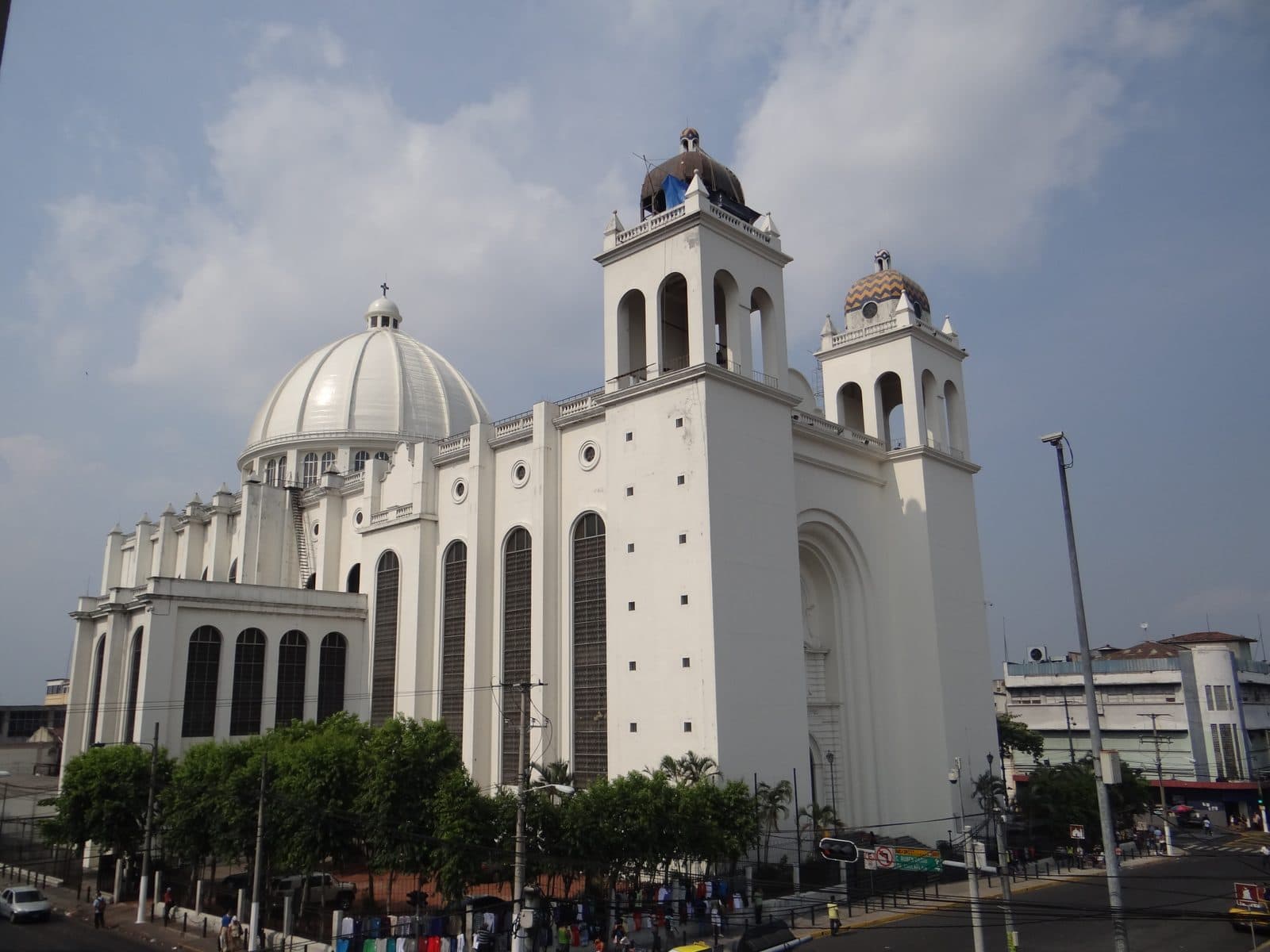
The Catedral Metropolitana, the first stop, holds Romero's tomb in the crypt below the main floor. The cathedral remains unfinished as a deliberate statement.
The Iglesia El Rosario, the second stop, was the Dominican church whose congregation included many of the lay activists who organized through the 1970s and were targeted during the war. Its 1971 modernist interior is unrelated to the war chronologically but related theologically.
The Monumento a la Memoria y la Verdad, the third stop, sits in Cuscatlán Park, a forty-minute walk west of the historic center. Eighty-five meters of black granite, more than thirty thousand names. Inaugurated in 2003. The model is the Vietnam Veterans Memorial in Washington.
The Monumento al Divino Salvador del Mundo, the fourth stop, is a Christ figure on a globe at the Plaza Las Américas, a major roundabout on Avenida Cuscatlán. The plaza was the site of one of the largest pre-war massacres of demonstrators, in January 1980.
The Capilla del Hospitalito Divina Providencia, the fifth stop, preserves the chapel where Romero was killed largely as it was that evening. Romero's blood-stained vestments are on display.
The Centro Monseñor Romero at the UCA, the final stop, was built on the grounds where the six Jesuits were murdered in 1989. A rose garden marks the exact location of the killings. The Centro is a museum, an archive, and an active research institution that continues to investigate war-era cases.
The route is not a single walking loop. There is a taxi or rideshare segment between the historic center and the western stops. Set aside two hours minimum. The tour is structured as a pilgrimage, not a walking tour, and the country's recent history rewards that structure.
Ready to experience it?
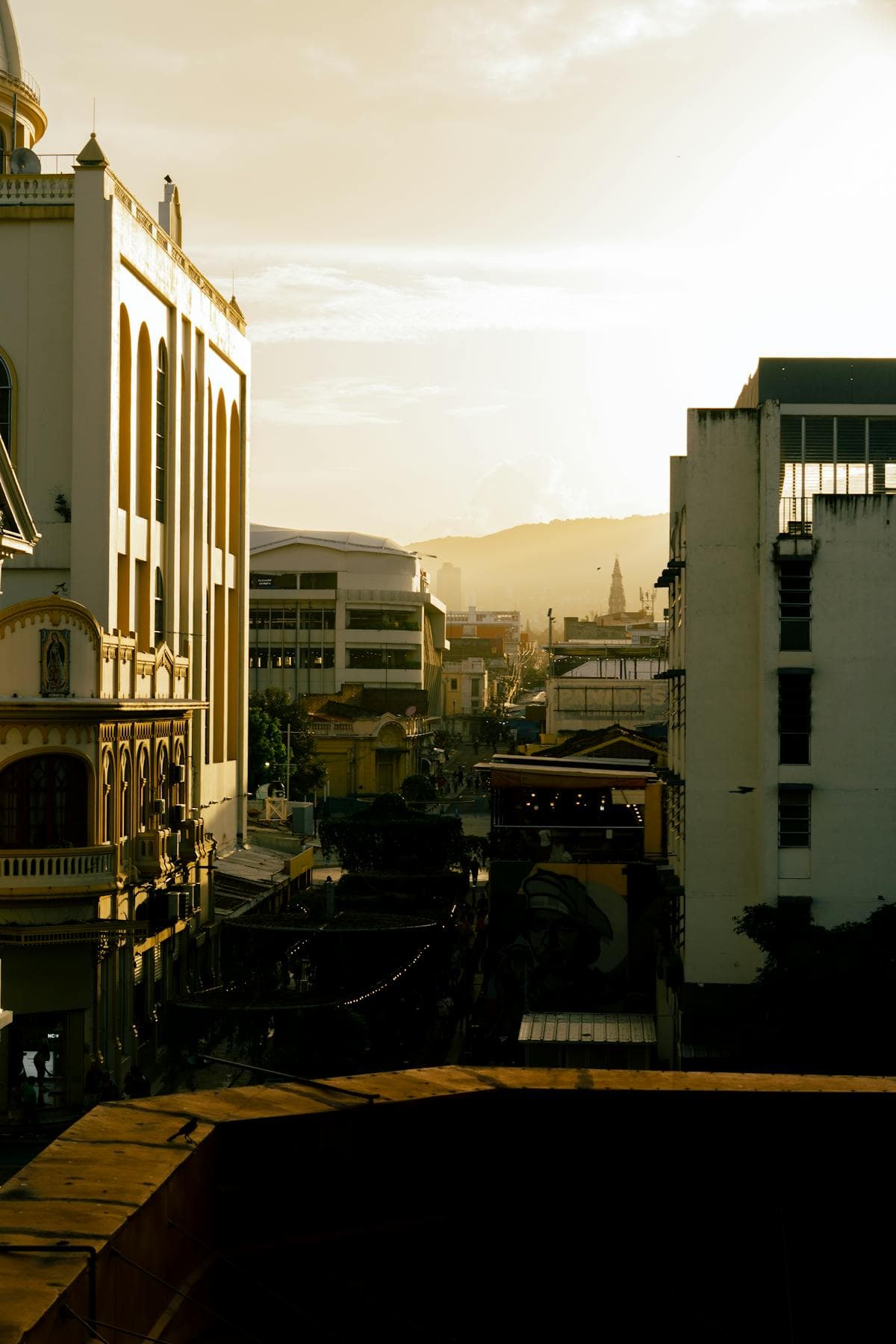
San Salvador: Romero, March 24, 1980
120 min · 4.5 km · moderate
More from San Salvador
Explore more at your own pace.
Best Self-Guided Walking Tours in San Salvador (2026)
How to See San Salvador: A Capital That Aspired to Be a Capital
One Day in San Salvador: A Walkable Historic-Center Itinerary (2026)
San Salvador Travel Guide: How Many Days, Getting Around, Is It Safe (2026)
Best History Walking Tours in San Salvador (2026)