The historic center of San Salvador is small enough that you can cross it on foot in twenty minutes. The Plaza Gerardo Barrios, the Catedral Metropolitana, and the Iglesia El Rosario sit within a few blocks of each other, on or near the same east-west axis. The walking tour visits all three in sequence. If you only had time for three buildings in the city, these would be them, because each one is the most complete answer that its generation could give to the question of what a Salvadoran capital ought to look like.
The three answers do not agree. That disagreement is the point.
Plaza Gerardo Barrios: the late nineteenth century answer
The plaza is four hectares of open paved space. To put that number in context: Mexico City's Zócalo, the central plaza of a country of one hundred and twenty million people, is roughly half this size. Plaza Barrios serves a country of about six million. The dimensional mismatch is the first thing the plaza tells you about the city.
It was laid out in its current form in the late nineteenth century, after the 1854 earthquake destroyed the previous city center and forced a rebuild from foundations. The Salvadoran elite of that period, riding the early years of the coffee economy and the dying years of the indigo economy, made a deliberate decision to build a civic space larger than the country needed. The model was the great European plazas: Madrid's Plaza Mayor, Paris's Place de la Concorde, the Roman Forum reimagined for the New World. The plaza was meant to host the kind of civic life, the parades, the rallies, the executions, the funerals, that a serious capital was supposed to host.
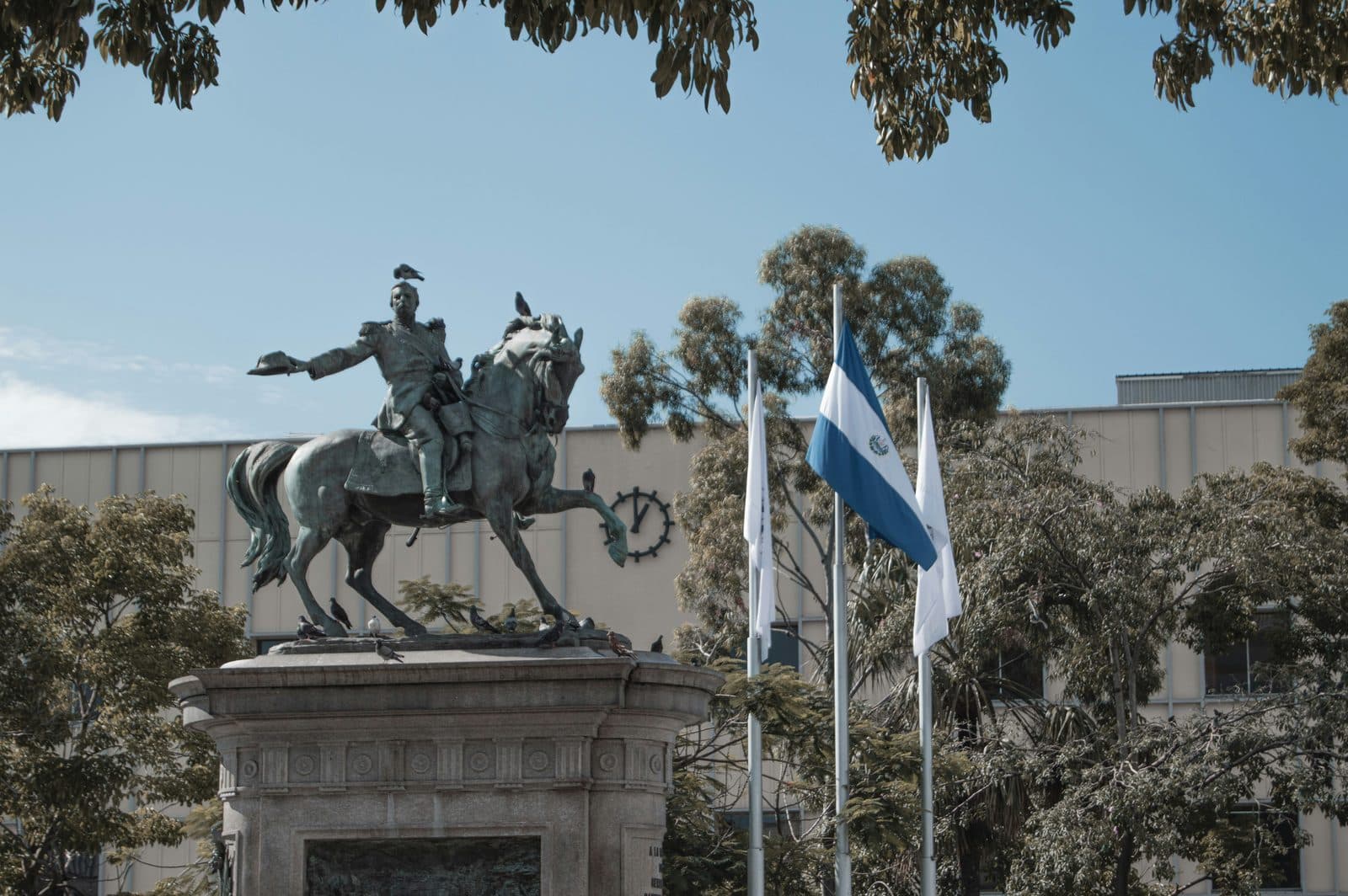
At the plaza's center stands a bronze equestrian statue of Gerardo Barrios, the nineteenth-century president who is the country's national hero and the figure for whom the plaza is named. Barrios was president from 1859 to 1863, oversaw the expansion of the coffee economy, fought a war with neighbouring Guatemala, lost, was captured, and was executed by firing squad in 1865. The plaza, finished and renamed in his honour decades after his death, is a piece of late-Victorian historical reconstruction. It treats Barrios as a founding hero. The actual record is more contested.
The plaza has hosted the major events of the country's political life. The funeral of Archbishop Óscar Romero in March 1980, attended by a quarter of a million mourners, was held on the cathedral steps facing this plaza. Government snipers and unidentified gunmen opened fire on the crowd, killing somewhere between thirty and forty people in what is now known as the Plaza Barrios massacre. The 1992 peace accords were celebrated here. The 2019 inauguration of Nayib Bukele drew tens of thousands here. The plaza is the city's civic stage, in the technical sense.
Catedral Metropolitana: the twentieth-century answer
Hear a stop from this walk
Iglesia El Rosario: The Rainbow in Concrete
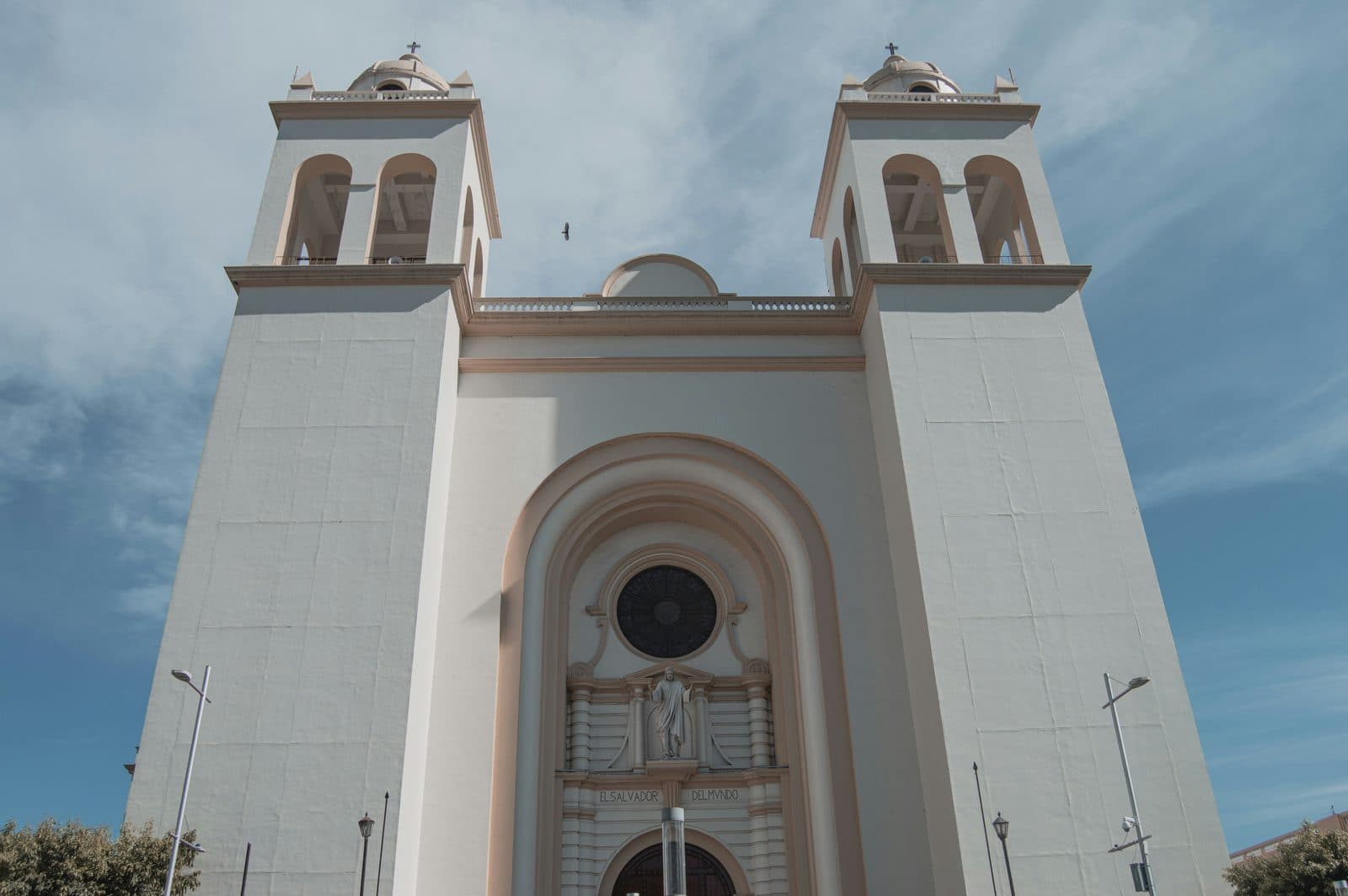
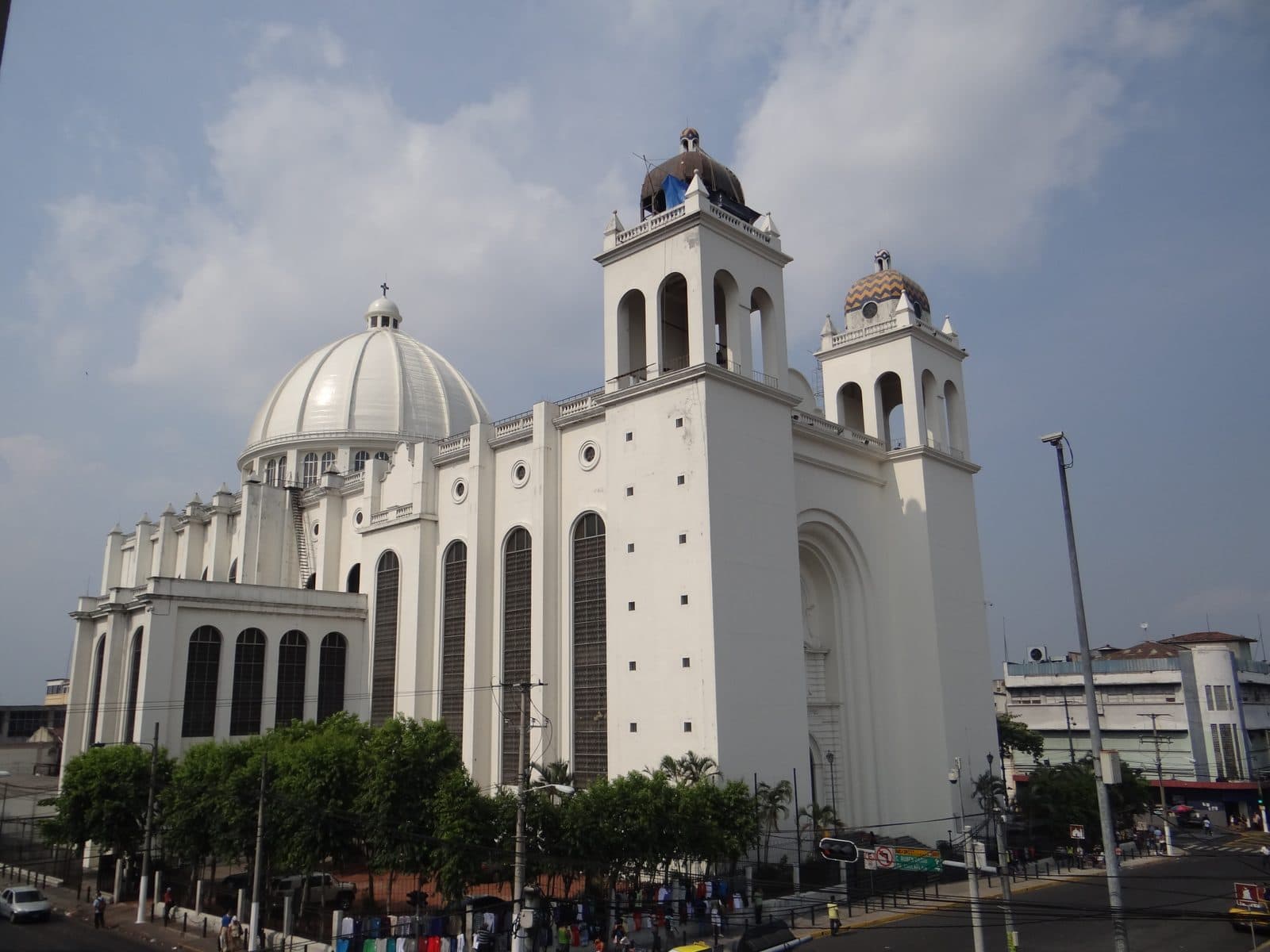
The cathedral that anchors the north side of the plaza is the city's third or fourth on the same site. The previous building, a wooden colonial church, burned down in the 1950s. The current building was begun in the late 1950s and finished, in the practical sense, by the late 1990s. The construction was interrupted, slowed, and complicated by the civil war, the assassination of Romero, an earthquake, and a long-running dispute about the design and the cost.
The result is a cathedral that does not quite belong to any architectural century. The exterior is white, gabled, with a row of three large bronze doors decorated by the Salvadoran painter Fernando Llort in folk-art motifs. The interior is a long, high nave with a barrel vault. The decoration is restrained. The building, considered as architecture, is somewhere between the late colonial revival and a kind of mid-century institutional simplicity. It is not a building anyone would call beautiful in the way that the cathedrals of Mexico City or Guatemala City are beautiful. It is the building that El Salvador, given its means and its history, could afford to build.
What makes the Catedral Metropolitana the building it is, regardless of its architectural ambition, is the crypt. Archbishop Óscar Romero, shot at the altar of the chapel of the Hospital Divina Providencia in March 1980 in the middle of a homily, is buried there. The tomb, designed by the Salvadoran artist Paolo Borghi, depicts Romero in bronze, lying on a slab, surrounded by four evangelists. Visitors from across Latin America come to the crypt to pray, to leave flowers, and to spend a few quiet minutes with the country's most consequential modern figure.
The decision to entomb Romero in the cathedral was made in 1980 and ratified by his canonization in 2018. The cathedral, considered as a piece of religious architecture, is a building that was rebuilt and finished around its tomb.
Iglesia El Rosario: the twentieth-century answer that the twentieth century should have given
A few blocks east of the cathedral, at the eastern edge of the historic center, sits Iglesia El Rosario, finished in 1971 to the design of the Salvadoran sculptor and architect Rubén Martínez. From the outside, the church looks almost industrial. The structure is a long, low concrete barrel vault, ribbed, unornamented, the colour of unfinished concrete. There is no portico, no spire, no façade in the conventional sense. The entrance is a small doorway in what looks like an aircraft hangar.
The interior is, by a margin, the most extraordinary religious space in Central America.
The entire concrete vault is pierced by panels of coloured glass arranged in a continuous spectrum that runs the length of the building. Red and orange at the entrance. Yellow and green through the middle. Blue and violet at the altar. The light that falls into the church is the light that falls through that spectrum, shifting in tone and intensity according to the time of day and the angle of the sun. On a clear morning, the interior is a slow gradient of coloured light running over rough concrete. There is no equivalent building anywhere in the Americas.
The sculptures inside, designed by Martínez and his collaborators, are made of welded iron and rebar, recovered scrap and industrial offcuts. They are figurative, modern, and unsettling. The crucifix above the altar is a tortured industrial form that has more in common with European postwar sculpture than with any Catholic devotional tradition.
El Rosario was finished a decade before the civil war began. Martínez and his colleagues built it for a Dominican congregation that wanted, deliberately, a modern church. The choice is the most radical architectural statement in the country's twentieth century. It is the answer that says: we are not a colonial outpost. We are not a coffee aristocracy's reflection of Europe. We are a country in 1971, with the materials we have, making the church we need.
How they fit
Plaza Barrios, the cathedral, and Iglesia El Rosario are three answers to one question, posed by three generations. The plaza answers in the language of nineteenth-century European civic grandeur. The cathedral answers in the language of twentieth-century institutional Catholicism, complicated by martyrdom. El Rosario answers in the language of postwar modernism, refusing both of the previous answers.
Walked in sequence, on the same morning, they read as an argument. The walking tour ends with that argument unresolved, which is the right place to leave it. The historic center is not a finished statement. It is a record of three generations failing to agree on what their capital should look like, and building anyway.
Ready to experience it?
Historic Center: The City That Keeps Coming Back
65 min · 1.1 km · easy
More from San Salvador
Explore more at your own pace.
Best Self-Guided Walking Tours in San Salvador (2026)
How to See San Salvador: A Capital That Aspired to Be a Capital
One Day in San Salvador: A Walkable Historic-Center Itinerary (2026)
San Salvador Travel Guide: How Many Days, Getting Around, Is It Safe (2026)
Best History Walking Tours in San Salvador (2026)