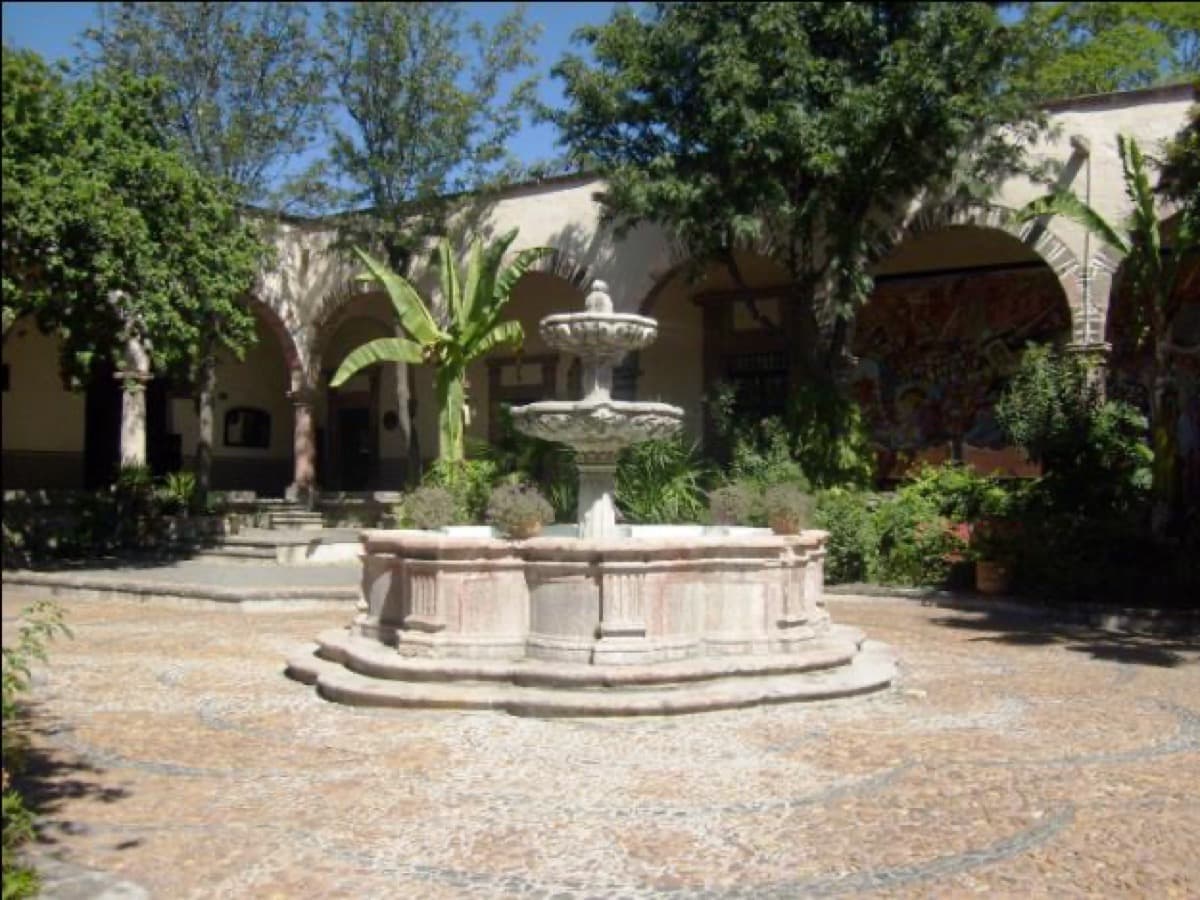
The building you walked through occupies almost three city blocks on the northwestern edge of San Miguel's centro historico, at the corner of Calzada de la Aurora and Calle de la Aurora. It is the largest single structure in the historic city. From outside, the long brick walls, the flat industrial roofline, and the small uniform windows announce a factory and not a gallery. That announcement is correct. La Aurora was a working cotton mill for eighty-nine years and the architecture has not been edited to disguise that. What has changed is what happens inside.
The mill opened in 1902. The conversion completed in 2005. Between those two dates is the story of a building that survived three Mexican economic regimes without being demolished and a city that, almost by accident, ended up with the right kind of industrial container at the right moment.
What was made here
The Porfiriato, the long presidency of Porfirio Díaz from 1876 to 1911, was the period when Mexico built most of its first industrial infrastructure. Railroads, electricity, textile mills. Capital came largely from foreign investors with Mexican partners. The Bajío, the agricultural plateau north of Mexico City, was a natural site for textile manufacturing: cotton from the warm Veracruz lowlands and from the United States could be brought in by rail, water for the dye and finishing processes came from local springs, and labour was abundant and cheap.
La Aurora was financed in 1900 by a consortium called Garay y Compañía, made up of San Miguel families with money in silver and cattle who wanted a manufacturing asset. Construction took two years. The mill opened in 1902 with imported English looms and Mexican workers. At peak operation in the 1940s it employed roughly six hundred people, in a town whose total population was around twelve thousand. The factory produced cotton and woollen cloth, denim, and finer woven goods that were sold both regionally and to Mexico City markets. The mill is named for the dawn, an aspirational gesture toward Mexican industrial modernization that was the official ideology of the era.
The factory operated through the Mexican Revolution (1910 to 1920) with only brief interruptions, partly because Allende's hometown was tactically peripheral to the fighting and partly because the owners had local political connections. It operated through the Cristero War of the late 1920s. It operated through the import-substitution period from the 1940s through the 1970s, when Mexican textiles benefited from tariff protection. The mill's slow decline began in the 1980s and accelerated after NAFTA was signed in 1992, opening the market to cheaper imports from the United States and, indirectly, from East Asia.
The mill closed in 1991. The last shift went home and the gates were locked.
What happened between 1991 and 2003
Hear a stop from this walk
Bellas Artes: A Convent, a Dome and an Unfinished Mural
For roughly twelve years La Aurora sat largely empty. The owning families, by then a third generation removed from the founders, did not want to demolish the building but also did not have a clear use for it. Industrial reuse was not viable because the textile sector was contracting nationally. Conversion to housing required gutting the interior, which the family resisted. The structure was rented out in pieces, to storage operations, to a small leather workshop, to a few caretakers.
This is the period during which the building's survival was an accident. There was no preservation order. There was no zoning protection that would have prevented demolition. A different owning family might have sold the site for redevelopment, in which case it would now be a supermarket or a residential complex. The Garay descendants happened to keep the building intact. That decision, almost certainly made without any anticipation of what the building would become, is the load-bearing decision in the whole subsequent story.
In 2003, two gallery owners then operating in the centro, Charlotte Bell and her partner, approached the family with a proposal to lease the entire south wing as gallery space. The lease was signed. The wing was cleaned, painted, and divided into galleries while leaving the brick walls, the iron columns, and the saw-tooth roof intact. The first wave of galleries opened in 2005. By 2008 the entire complex had been leased to roughly thirty tenants. By 2020 the number stabilized at over fifty.
Why the building works
A textile mill from this period has a specific geometry that turns out to be unusually well suited to contemporary gallery and studio use. Three features matter.
The first is ceiling height. Industrial looms had to clear the warping mechanism above and the delivery shuttle below. The minimum ceiling clearance in a working mill of this size was four and a half metres. La Aurora's main weaving hall has a clearance of nearly six metres. Galleries showing contemporary work require ceiling height to hang large canvases and to fit sculpture without crowding. A converted residential building rarely offers more than three metres. La Aurora offers six.
The second is natural light. The saw-tooth roof, a sequence of vertical glazed sections facing north interspersed with sloping sections facing south, was a standard industrial roof in the early twentieth century because it brought diffuse natural light into the factory floor without direct solar gain on the working surfaces. It is also exactly the lighting condition that painters and gallerists prefer. The galleries in La Aurora rarely need overhead artificial lighting during the day.
The third is structural openness. The mill's load was carried by cast iron columns spaced at roughly six-metre intervals, not by interior walls. Tenant partitions could be placed anywhere without engineering implications. A new gallery could be carved out of a corner of the weaving hall without any structural drawing. This kept conversion costs low and made the building economically viable as a multi-tenant space at modest rents.
A purpose-built gallery complex matching these three properties would cost roughly a thousand dollars per square metre in 2026 Mexican currency. La Aurora delivered the same properties for the cost of cleaning and partitioning, perhaps fifty dollars per square metre. That cost differential is what made the conversion economically possible at rents low enough for working artists and small galleries to occupy the space.
What is inside now
The current tenant mix, walking through, is roughly half commercial galleries, a quarter working studios, and a quarter ancillary businesses that the gallery economy needs to function. There are framers. There are stretcher-bar fabricators. There are pigment and canvas suppliers. There are restorers and conservators. There are two restaurants. There is a small bookshop specializing in art monographs.
The commercial galleries span a range. At the high end, a few galleries represent named Mexican contemporary artists and sell internationally. At the middle, galleries show competent regional artists at prices that San Miguel's foreign resident community can afford. At the low end, working studios open their doors and sell directly to visitors who come through. The price gradient is part of what makes the building work; a single visitor can in one afternoon see a hundred-thousand-dollar oil painting and meet the artist who is selling small watercolours for forty dollars in the next room.
The ancillary businesses are what most visitors do not register but what makes the complex sustainable. A gallery district that is just galleries dies when the gallery market shifts. A gallery district that includes framers, stretcher fabricators, restorers, and supply houses is harder to dislodge because the support services anchor the working artists, who anchor the galleries.
What the building is not
La Aurora is not a museum. None of the work on display is part of a permanent collection. Nothing is loaned from elsewhere. Every object in the building is, in principle, for sale. The building is a commercial real estate proposition that has been organized around the art economy. This is worth holding in mind because it sets the building apart from the more familiar model of an industrial conversion that becomes a public cultural institution, the way the Tate Modern in London became a public museum out of a closed power station.
The implication is that La Aurora can change again. The owning family still owns the property. The leases are commercial. If a different use became more lucrative, the building could be reorganized. The art-economy use is contingent on the relative profitability of art galleries against other possible tenants, and on the family's continued willingness to lease to a sector whose rents are lower than the alternatives.
It is also worth noting that the building has been remarkably stable for twenty years. The economic conditions that made the conversion work, a steady flow of foreign collectors, a productive Mexican art scene, and a city economy in which gallery rents are sustainable, have all held. As long as they hold, La Aurora is the most important physical asset the San Miguel art colony owns. It is the working back of house that lets the polished front of house on Calle Aldama and around the Jardín function.
Stand in the central courtyard. The brick walls were laid in 1901. The cast iron columns came from a foundry in Monterrey. The saw-tooth roof glass was installed when Porfirio Díaz was still in power. None of that has been altered. What has been altered is which kind of skilled labour walks through the doors every morning. The looms are gone. The painters are here. The building did not have to change for that to happen, and that is why it worked.
Mexico eSIM· 10% off with ROAMER10
Ready to experience it?
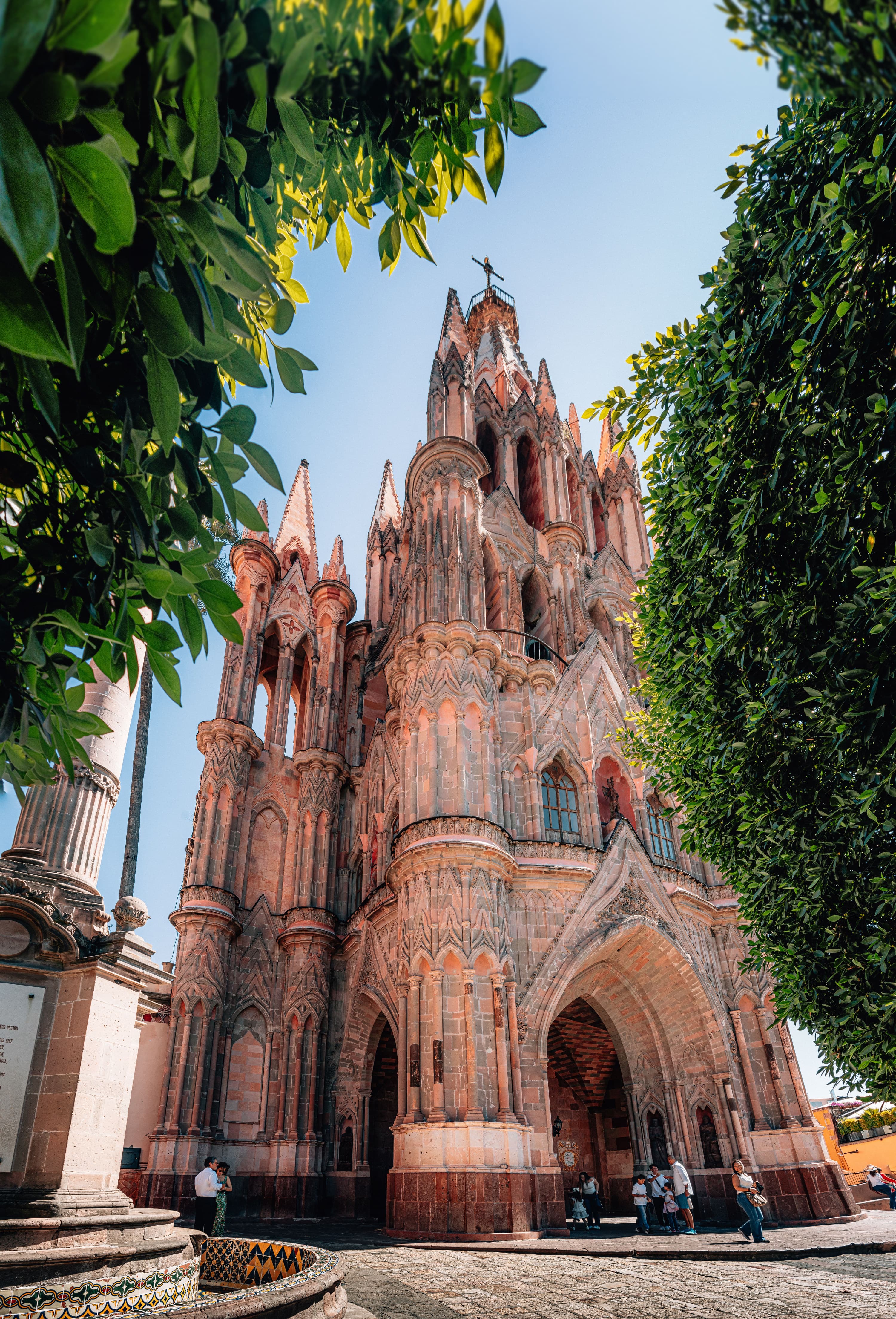
Historic Center: San Miguel in Pink Stone
90 min · 2.7 km · easy
More from San Miguel
Explore more at your own pace.
How San Miguel Became an American Town in Mexico
One Day in San Miguel de Allende: A Walkable Itinerary (2026)
San Miguel de Allende Travel Guide: How Many Days, Getting Around, When to Go (2026)

What to Eat in San Miguel de Allende: A Food Guide (2026)
How San Miguel Stayed an Art Colony When Every Other Mexican Town Became a Souvenir