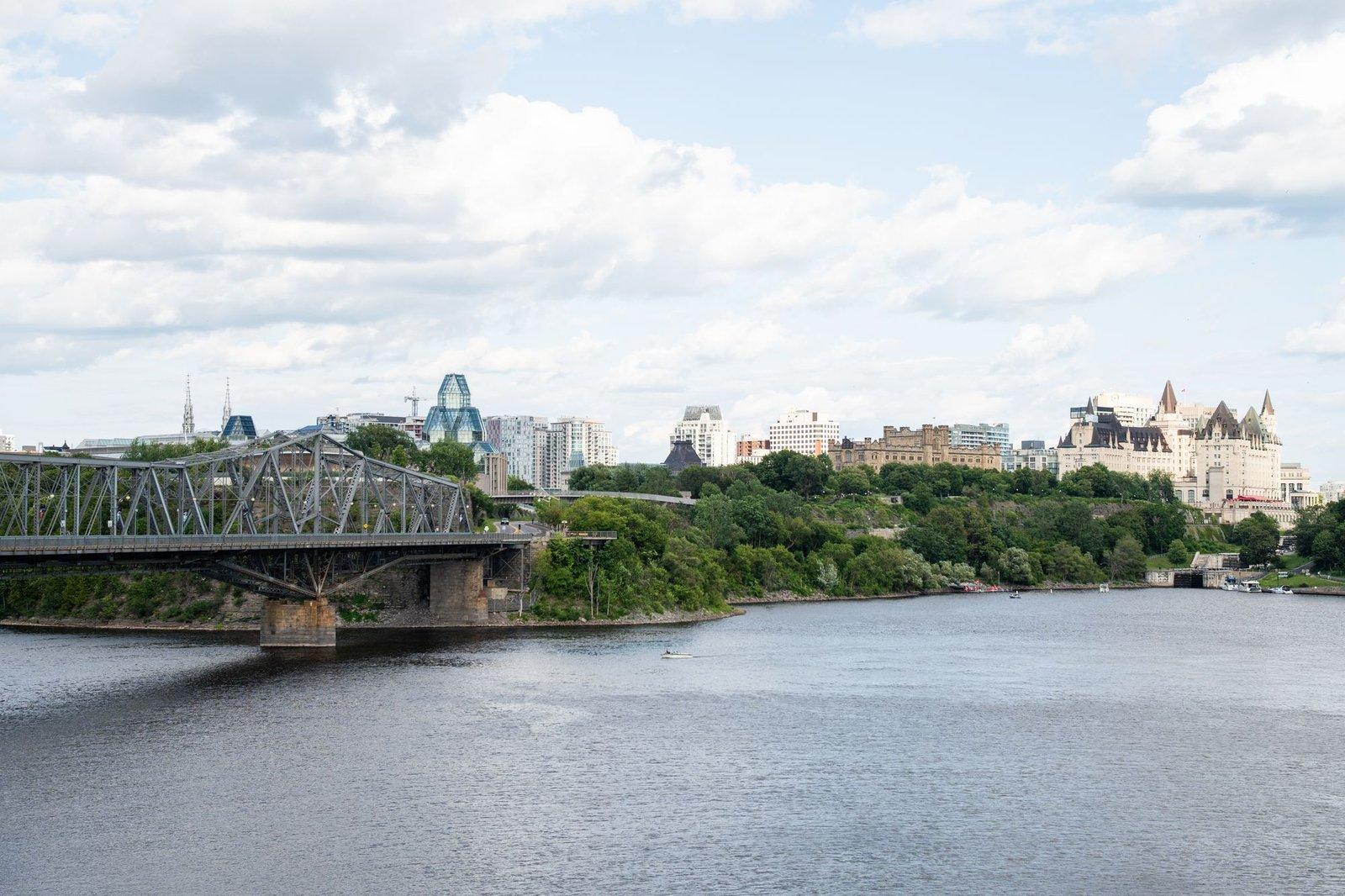
The Parliament visitors photograph is not the Parliament of Confederation. The Centre Block on Parliament Hill, with the Peace Tower rising from its middle, is a reconstruction built between 1916 and 1927 by the architects John A. Pearson and Jean-Omer Marchand, after the original burned to the ground. And the tower everyone frames as the symbol of the country is a memorial to the First World War, the war in which Canada came to see itself as a country. Once you know that, the Hill stops reading as one building group and starts reading as two generations of stone, with a fire as the hinge.
The illusion from the street
Stand on Wellington Street at Metcalfe and the three Gothic Revival blocks look like a set designed and finished together. The original group was indeed a single competition: in 1859 Thomas Fuller and Chilion Jones won the Centre Block and the Library of Parliament, and Thomas Stent and Augustus Laver won the East and West Blocks. The Prince of Wales laid the first Centre Block cornerstone on 1 September 1860, and Parliament moved in from 1866.
On the evening of 3 February 1916 that Centre Block burned in under twelve hours. Seven people died. What survived on either side was the Library, sealed off behind iron doors, and the East Block, about a hundred metres away. The West Block, damaged, also stood. Everything in the middle is the rebuild.
A Beaux-Arts plan in a Gothic skin
Hear a stop from this walk
Centre Block: The Reconstruction
The pairing chosen to rebuild it is worth a look. Pearson was English-born and practised in Toronto. Marchand was a Montrealer and the first Canadian to graduate from the Ecole des Beaux-Arts in Paris. The new building's plan is symmetrical and biaxial, its major and minor corridors laid out on the principles Marchand had learned in Paris. Outside, the walls continue the Gothic Revival of the surviving Library and East Block. Inside, the plan is Paris. The new building was also larger than the old one, and plainer in ornament. It was not a like-for-like restoration but a new building that performs continuity.
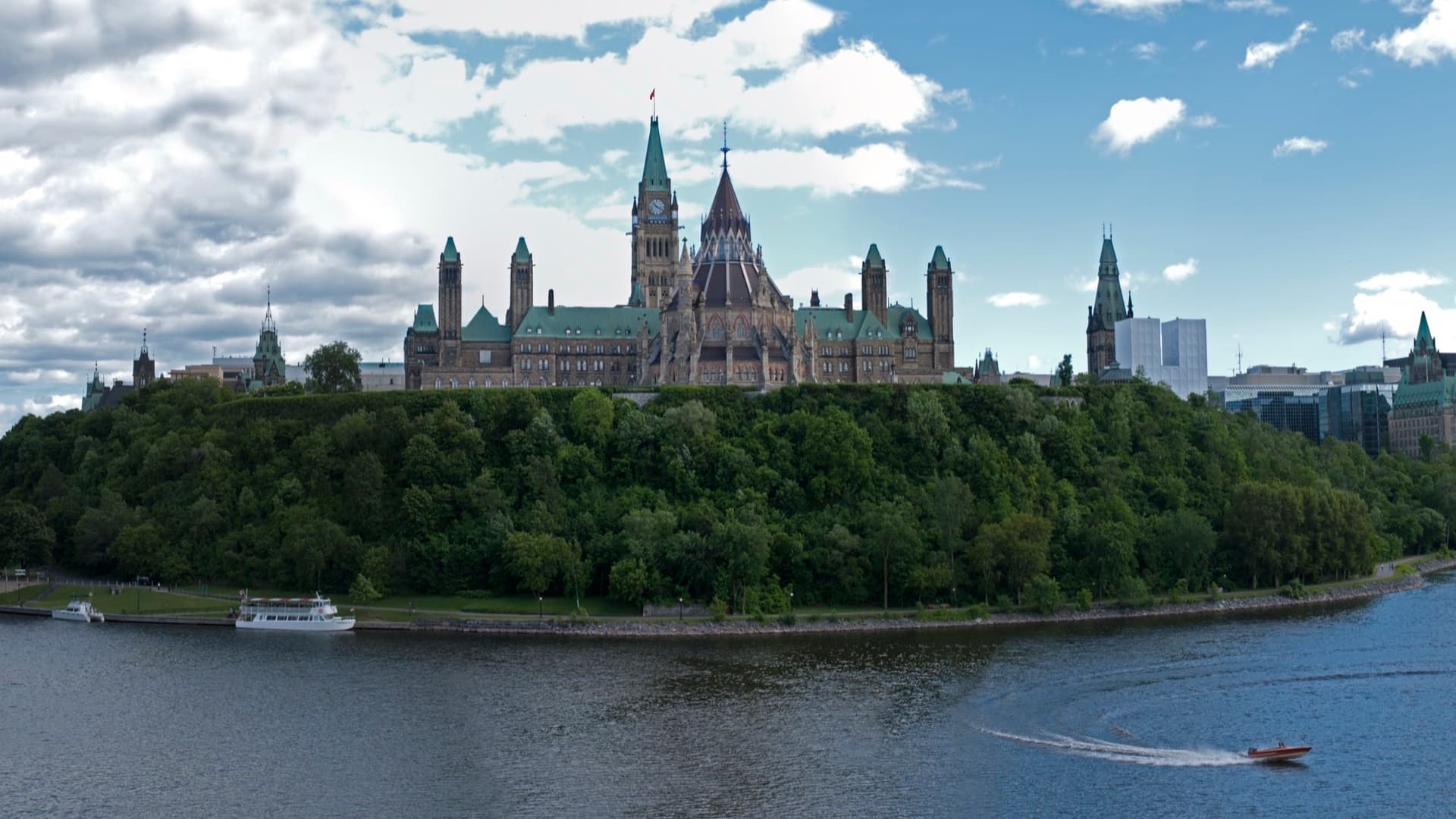
The dates show how deliberately that continuity was staged. A new cornerstone went down on 1 September 1916, fifty-six years to the day after the first. Parliament sat in the rebuilt Centre Block from January 1920. The Peace Tower's cornerstone was laid on 1 September 1919. Prime Minister Robert Borden had already dedicated the future tower on 1 July 1917, the fiftieth anniversary of Confederation and the middle of the war, as a memorial to the valour of Canadians in the Great War. The tower was finished in 1927 and its carillon rang on 1 July of that year. It stands about 92 metres tall, and the Memorial Chamber in its base holds the Books of Remembrance.
The war register below the Hill
The walk opens that reading outward. At Confederation Square, the National War Memorial by the English sculptor Vernon March was unveiled by King George the Sixth on 21 May 1939, four months before the Second World War began; the Tomb of the Unknown Soldier was added in front of it in 2000, and the dates carved on the base now span conflicts from South Africa to Afghanistan. Inside the gates, the Centennial Flame was lit on 1 January 1967 for Confederation's hundredth year, by Prime Minister Lester B. Pearson, no relation to the architect. The flame celebrates a centennial in front of a building that had already been rebuilt fifty years earlier.
The two survivors
Then the tour walks behind the reconstruction to the stones that are genuinely from the 1860s. The Library of Parliament, round and copper-domed, was modelled on the British Museum Reading Room and completed in 1876. Its first librarian, Alpheus Todd, had seen the 1849 fire that destroyed the legislature in Montreal, and he insisted on a single connecting corridor closed by iron doors. In 1916 the library clerk Michael MacCormac pulled those doors shut ahead of the flames. The East Block, a Victorian High Gothic building completed in 1866 at roughly four and a half times its budget, survived simply by being far enough away.
The walk ends across the Rideau Canal at Major's Hill Park, Ottawa's first park, where Colonel John By built his residence in 1826. From the overlook you can see the whole argument in one frame: the Library and the East Block, original, and between them the 1920s Centre Block and its memorial tower. The Centre Block itself is currently closed for a renovation that Public Services and Procurement Canada calls the largest, most complex heritage building project ever undertaken in Canada, so the outside view is the one the walk is built around.
Walking it
Every stop works from public paths and lawns, so you can take it at your own pace, pause for the details on the cenotaph or the provincial shields around the flame, and skip ahead whenever you like. The walk is Parliament Hill: The Country That Rebuilt Itself, eight stops over about 2.4 kilometres in roughly 90 minutes, from Wellington at Metcalfe to the Major's Hill Park overlook. See all routes on the Ottawa page.
Sources
- Dictionary of Canadian Biography, Jean-Omer Marchand: Marchand as the first Canadian graduate of the Ecole des Beaux-Arts in 1902, and his 1916 partnership with Pearson on the Centre Block.
- Public Services and Procurement Canada, Centre Block project: the current renovation and its scale.
- Senate of Canada, Disaster and determination: the heroes of the 1916 Parliament Hill fire: the fire night, the seven dead, and MacCormac heaving the Library's iron doors shut.
- Roamer's audited tour transcript for the biaxial plan, the dates of the cornerstones, the Peace Tower dedication, the War Memorial, the Centennial Flame and the East Block.
Ready to experience it?
Parliament Hill: The Country That Rebuilt Itself
90 min · 2.4 km · easy
More from Ottawa
Explore more at your own pace.
One Day in Ottawa: A Walkable Capital Itinerary (2026)
Ottawa Travel Guide: How Many Days, Getting Around, When to Go (2026)
Best Architecture Walking Tours in Ottawa (2026)

What to Eat in Ottawa: A Food Guide (2026)
Lower Town and the ByWard Market: The Working City Below Parliament Hill