The High Line is an easy walk. A mile and a half of elevated park, planted to look as if it grew wild on the old tracks, with views down the avenues and out over the Hudson. On a sunny Sunday it feels like a secret everyone happens to know. It is also physical evidence in an argument New York is still having: how a city pays for its future, and who carries the cost when a neighbourhood changes around a new park.
The line nobody wanted
Freight trains once ran at street level on the West Side, and, according to Friends of the High Line, Tenth Avenue became known as Death Avenue; by 1910 more than 540 people had been killed by trains. The fix was part of the West Side Improvement, authorised in 1928. The New York Central's elevated freight line was built from 1931 to 1934 and, the Landmarks Preservation Commission says, passed through some thirty buildings on its way south. It cut straight through factories such as the National Biscuit Company's, so freight could be loaded inside.
Nabisco's complex is now Chelsea Market. Mondelez, which owns the brand, says the Oreo was first made there on the sixth of March, 1912, and West 15th Street between Ninth and Tenth Avenues is now signed Oreo Way. The elevated line came two decades later, so the famous story that the first Oreos were made with flour delivered by these trains cannot be true.
Freight ran on the line from 1934 to 1980, carrying meat, farm goods and mail. Friends of the High Line says the last train carried frozen turkeys. The southern section, from Spring Street up to Bank Street, had already been demolished in the 1960s, and five more blocks went in 1991. As one of his last acts in office, Mayor Rudolph Giuliani signed an order to demolish the rest.
In 1999 two neighbours, Joshua David and Robert Hammond, met at a community board meeting about the structure and found they were the only two people there who wanted to save it. They founded Friends of the High Line that year. In 2002 the Bloomberg administration endorsed the project, the city used a federal law that lets unused rail lines become trails, and in November 2005 the railroad company CSX donated the structure south of 30th Street to the city. The design team, chosen in 2004, was James Corner Field Operations with Diller Scofidio + Renfro and the planting designer Piet Oudolf. The first section opened in June 2009, the next in 2011, the rail yards section in 2014, the Spur in 2019 and the Moynihan Connector in 2023. Today it is one continuous greenway of 1.45 miles, owned by the city, with Friends of the High Line raising nearly all of its annual budget.
The catalyst
Hear a stop from this walk
Hudson Yards and the Vessel: A City on a Lid
What happened around the park is harder to fit into a sentence. West Chelsea became one of the most expensive parts of Manhattan within a decade. The designers say the city invested $115 million in the park and that it has stimulated over $6 billion in development. Supporters call that success. Critics see the same numbers as the problem.
At the north end, Hudson Yards was built on platforms over a working rail yard. Its developer says the platforms span 30 active train tracks and that the trains kept running throughout construction, with the No. 7 subway extension opening in 2015. A 2018 working paper by Bridget Fisher and Flavia Leite of the New School's Schwartz Center estimated the public cost of the project at $5.6 billion.
The founder's verdict
Some of the sharpest criticism came from one of the founders. In a 2017 interview with CityLab, Robert Hammond reflected on what the park did to its neighbourhood: "We were from the community. We wanted to do it for the neighborhood. Ultimately, we failed." Reviewing Hudson Yards in the New York Times in March 2019, the critic Michael Kimmelman called it "a supersized suburban-style office park."
The other reading is also true
The structure was scheduled for demolition. Without the campaign, it would be scrap. The park is free, open from early morning to late evening, and planted to a standard few public parks match, with more than 500 species along the line. The designers say more than a hundred cities have been inspired to convert their own obsolete infrastructure. Both readings hold up, and walking the line you can see the evidence for each.
The end of the line
The walk ends among the towers of Hudson Yards. The Vessel, Heatherwick Studio's sculpture of 154 flights of stairs and 2,500 steps, opened in 2019. It closed in 2021 after a series of deaths by suicide and reopened in October 2024 with floor-to-ceiling steel mesh on the retrofitted sections. Entry now needs a timed ticket, from $10, free for New York City residents on Thursdays. The full path is open on the lowest levels, and above them only the retrofitted areas, about half the walkable area, plus a single platform at the top. The Edge observation deck at 30 Hudson Yards, about 1,100 feet up, is ticketed separately.
Walking it
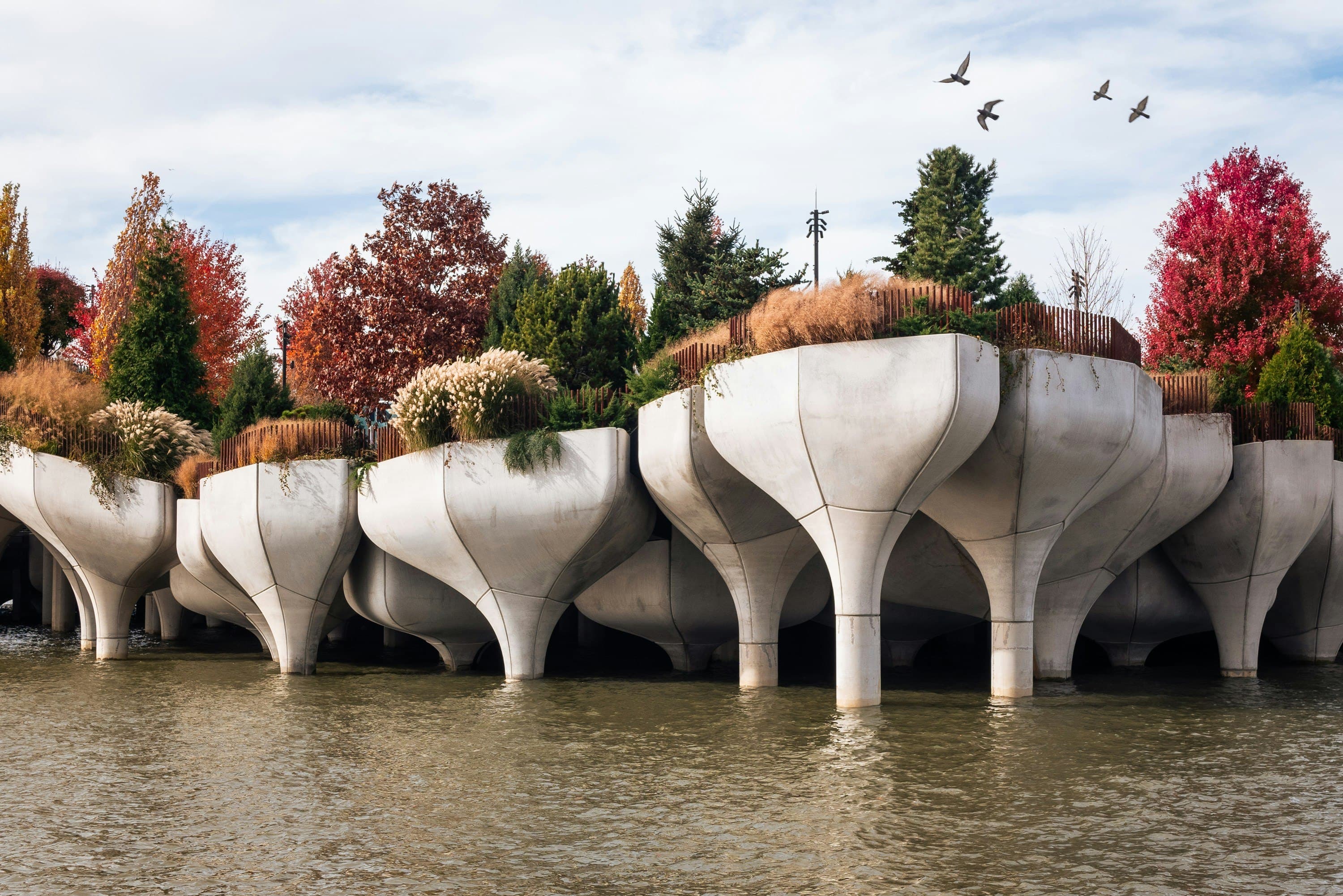
The High Line and Hudson Yards walk is ten stops and about two and a half kilometres, roughly an hour and twenty minutes. It starts on Little Island, a park in the Hudson among the stumps of old piers, crosses the old meat market streets at Gansevoort, climbs onto the line past the Standard hotel and the Chelsea Market passage, the window over Tenth Avenue, the thicket, the only lawn and the 26th Street viewing spur, and ends at the Spur and the Vessel. The High Line is open daily, 7 a.m. to 10 p.m. from April to November and to 8 p.m. in winter. Walk it slowly, and watch both what is planted on the line and what has been built beside it.
Ready to experience it?
High Line and Hudson Yards: The Freight Railway That Became a Park
80 min · 2.4 km · easy
More from New York
Explore more at your own pace.
New York Travel Guide: How Many Days, Getting Around, When to Go
One Day in New York: A Walkable Itinerary That Actually Works
MoMA: What to See, Floor by Floor, and Where the Famous Paintings Hang

Monet's Water Lilies at MoMA: The Room, the Fire and the Pond
The Starry Night at MoMA: Where It Hangs and What to Look For