Mérida: A Maya City the Spanish Broke Apart and Rebuilt
95 min · 2.5 km · easy
On a map of Mexico, the Yucatán looks like an afterthought. A thumb of limestone hanging off the country's south-eastern edge, surrounded on three sides by water, separated from the central highlands by hundreds of kilometres of dense jungle. For most of recorded history, the peninsula was easier to reach from Cuba or New Orleans than from Mexico City. Until the railway connected Mérida to the rest of the country in 1957, the Yucatán was effectively an island.
That single fact, the peninsular isolation, has shaped almost everything you experience when you walk through Mérida today. The city does not look like central Mexico. It does not speak quite like central Mexico, since Maya is still the first language of roughly a quarter of the state. It does not eat like central Mexico. Its history is structured differently. Its boom periods came at different moments. Its colonial conquest was on a different timeline.
To understand Mérida is, to a large extent, to understand what happens to a place when the easiest way to leave it is by ship.
The Maya the Spanish could not finish
In 1521, Hernán Cortés took Tenochtitlán, the Aztec capital, and the central Mexican phase of the Spanish conquest was effectively over within a generation. The Yucatán took twenty years longer. The reason was structural. The Aztec empire had a centre. Capture Tenochtitlán, and the political infrastructure of central Mexico collapsed. The Maya peninsula had no equivalent capital. Power was distributed across dozens of independent city-states, each one resisting on its own terms. There was no single decapitation strike that could win the war.
The Spanish conquest of the Yucatán was attempted by Francisco de Montejo the Elder beginning in 1527 and was repeatedly defeated. His son, Francisco de Montejo the Younger, finally succeeded in 1542, when Mérida was founded on the ruins of the Maya city of T'hó. The Maya, however, did not stop resisting. The Caste War of the Yucatán, fought between Maya rebels and the Yucatecan state from 1847 to 1901, was one of the longest indigenous uprisings in the history of the Americas. The Spanish broadly won the Yucatán in 1542. The Mexican state did not fully assert control over the eastern peninsula until the early twentieth century.
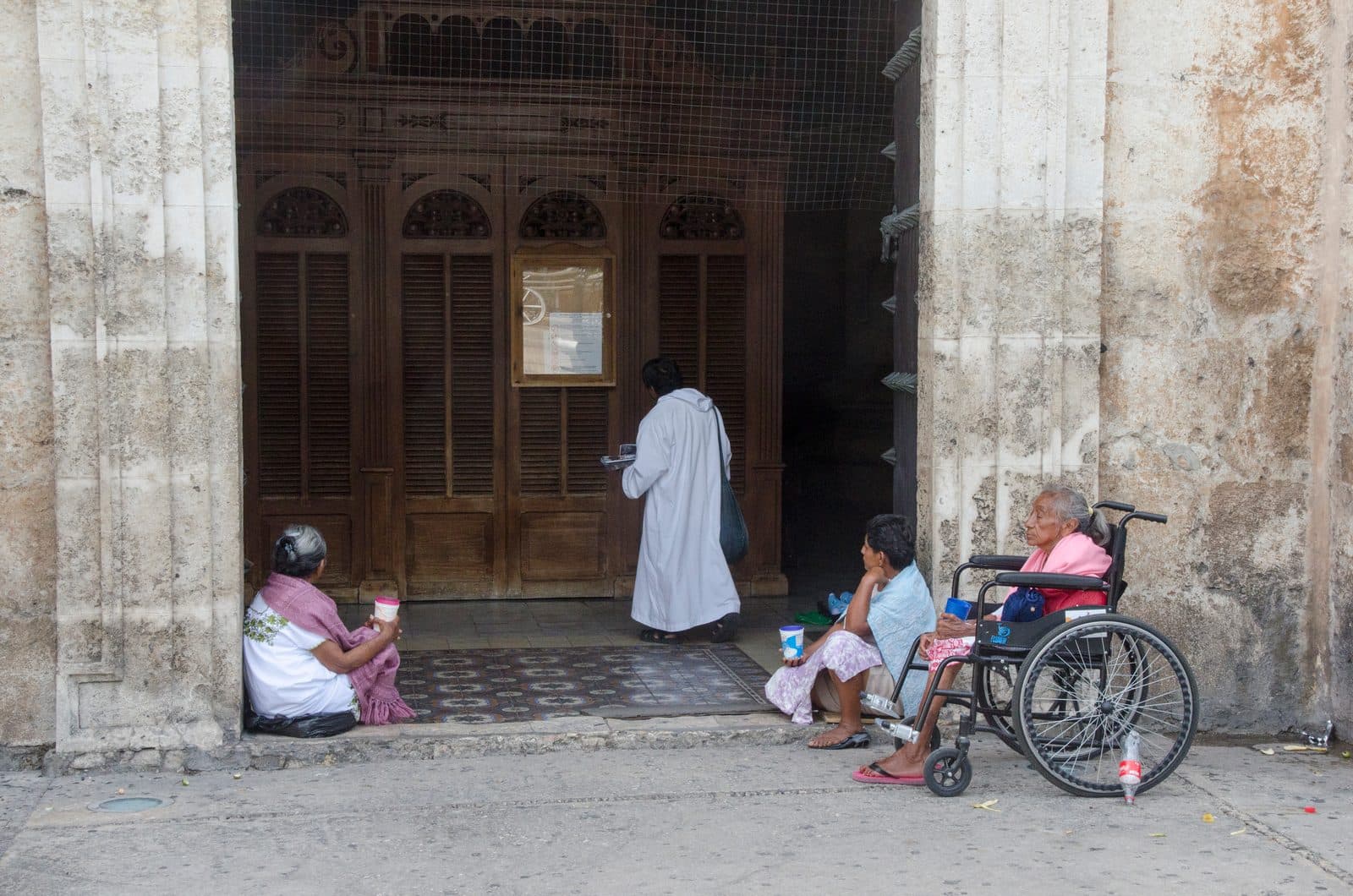
The consequence today is that Yucatecan Maya identity is unusually intact. Maya is the everyday language of villages outside the cities. Maya foodways, embroidery patterns, weaving techniques, hammock construction, religious syncretism, all persist. Walk through the Museo de Arte Popular in Mérida's Mejorada barrio and you can read the regional variations in a Maya woman's embroidered huipil dress like a map of where she is from. The continuity is not a museum exhibit. It is a living culture that did not get fully overwritten because the overwriting force never managed to push that far.
Mérida built from the city it replaced
Hear a stop from this walk
Plaza Grande
The conquest, when it succeeded in 1542, was structural and physical. The Montejos chose the Maya city of T'hó for their new colonial capital partly because of its location and partly because the existing Maya buildings provided ready-made building stone. The conquistadors demolished the pyramids and temples of T'hó and used the limestone blocks to build their cathedral, their mansions, their convents, and their government palaces. Mérida is, in a literal architectural sense, a Spanish colonial city physically constructed from the Maya city it replaced.
The visible evidence is in the Cathedral of San Ildefonso, built between 1561 and 1598, which has carved Maya glyphs embedded in some of its lower courses where the masons did not bother to dress the stones smooth. It is in the Casa de Montejo on the south side of the Plaza Grande, finished in 1549, whose Plateresque facade shows Spanish conquistadors standing on the severed heads of Maya warriors. It is in the Iglesia de Jesús, where Maya carvings sometimes face inward, walled into the colonial church. The two civilisations are not adjacent in Mérida. They are inside each other.
The Mérida: A Maya City the Spanish Broke Apart and Rebuilt tour reads the city through this lens. It is the more historical of the two Mérida tours and traces the conquest through eight stops in the colonial centre.
Why Mérida is called the White City
The colonial city that the Montejos built had several features that distinguished it from the highland Mexican cities. The limestone is unusually white, and the long-standing practice of lime-washing the lower-storey walls keeps the streets bright. The architectural language is more restrained than central Mexico, partly because the religious orders that dominated early Yucatán, primarily Franciscans, favoured austerity, and partly because the regional economy was not wealthy enough to fund Pueblan-scale gilded chapels.
The name Mérida itself comes from the Roman ruins in the Spanish city of Mérida in Extremadura, which the conquistadors believed the Maya ruins of T'hó resembled. The naming is itself a small act of imaginative recoding: the Maya city is reframed, in the colonial mind, as a kind of New World Rome, with the Montejos as the new Romans.
For three hundred years after the conquest, Mérida was a regional capital of modest prosperity. The Yucatán did not have silver. It did not have a major export crop. It had cattle, salt, dyewood, and trade with Cuba and the Gulf coast. It was not poor, but it was not central. The transformation came in the second half of the nineteenth century.
The henequén boom
In the 1870s, a single agave plant turned the Yucatán into one of the richest regions on Earth, briefly. The plant is henequén, called sisal abroad after the small Yucatecan port through which it was shipped. The fibre extracted from its leaves is twisted into rope and twine, and in the late nineteenth century, before synthetic fibres existed, henequén twine was essential to industrial agriculture. The mechanical grain binder, invented in the United States in the 1870s, required millions of metres of twine annually to bind wheat sheaves on American Midwestern farms. The McCormick Company and the International Harvester Company eventually controlled the supply chain. Yucatecan henequén supplied it.
Between approximately 1880 and 1915, the Yucatán produced around ninety percent of the world's sisal. About two hundred families owned almost all of it. The wealth those families accumulated was extraordinary. Per capita, the Yucatán was wealthier than the rest of Mexico combined during the peak of the boom. Mérida had more millionaires per capita than New York City for several years around 1900. It was also a wealth built on debt peonage, a system that bound Maya labourers and their children to the henequén haciendas in conditions close to slavery. The Mexican Revolution would eventually break the hacienda system in the 1910s and 1920s, and the global market would be destroyed by the invention of nylon and polypropylene in the 1930s and 1940s. The Yucatán went from one of the richest regions in Mexico to one of the poorest in a single generation.
The mansions survived.
The boulevard the boom built
The henequén families, with no available aristocracy to marry into and no existing palace district to colonise, did what newly-rich people often do. They built. In the 1890s they laid out Paseo de Montejo, a grand boulevard north of the colonial centre, designed as a deliberate Yucatecan answer to the Champs-Élysées. They hired European architects, primarily French and Italian, to design Beaux-Arts mansions in styles imported wholesale from Paris and Rome. Italian marble. French ironwork. Belgian stained glass. Catalan floor tiles. Every piece of European luxury arrived through the port of Progreso on the Gulf coast and was hauled to Mérida by a narrow-gauge railway that the henequén barons had built to move their fibre to port.
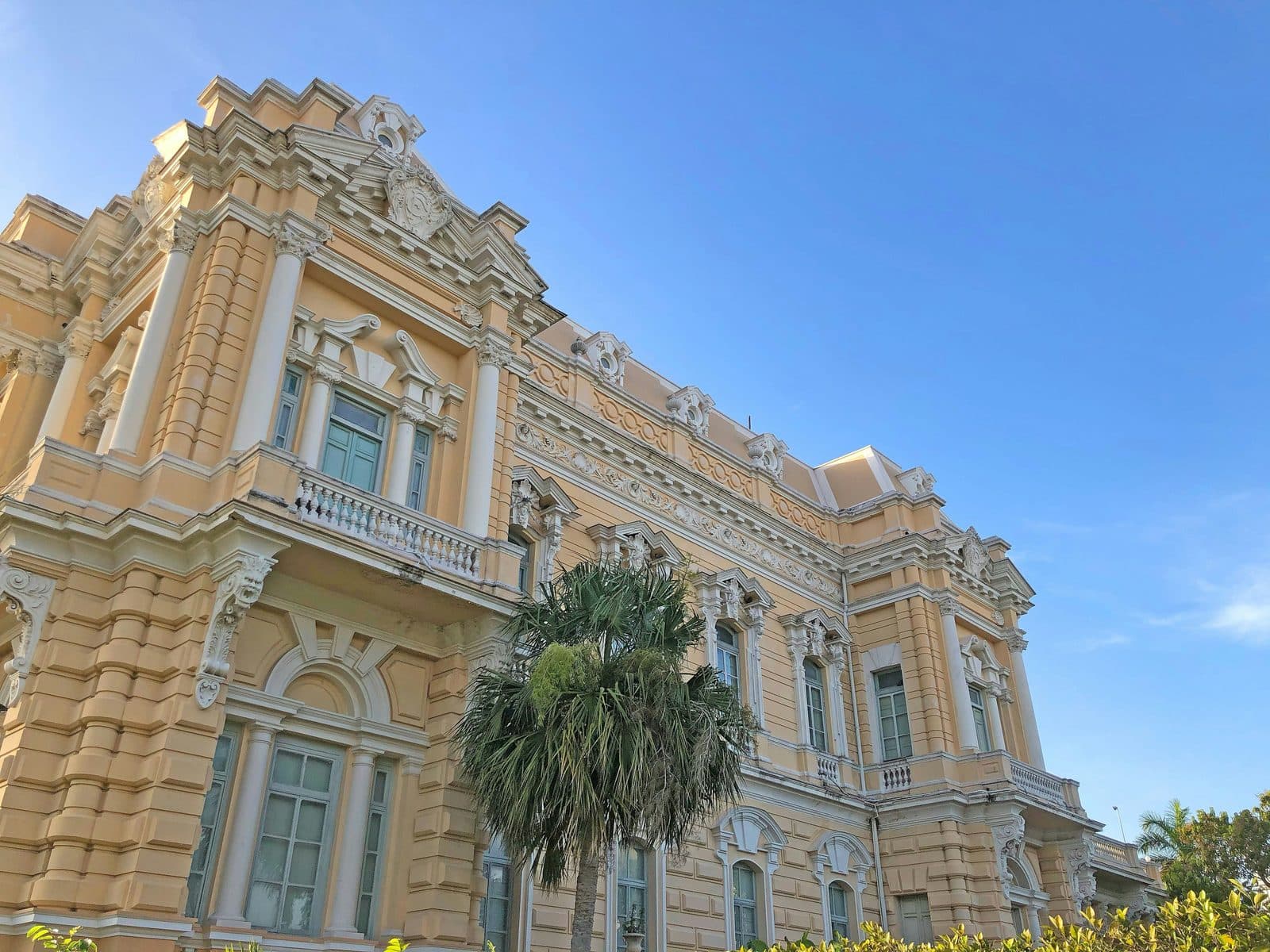
The boom ended around 1920. The mansions stayed. Many of them were donated, sold, or repurposed. The Palacio Cantón became the regional anthropology museum. The Teatro Peón Contreras became the home of the Yucatán symphony orchestra. The Casas Gemelas, the Twin Houses commissioned by the Cámara family, became museums and offices. Quinta Montes Molina remained in private hands and is now a guided-tour museum. The boulevard is, in effect, a several-kilometre architectural record of a thirty-year period of extreme wealth.
The Mérida: The Mansions Sisal Built tour traces the boulevard's surviving structures across eight stops, from the gateway barrio of Santa Ana to the marble staircase of the Teatro Peón Contreras.
What the two layers do to the city
Modern Mérida sits at the intersection of these two histories: a colonial city built on a Maya capital that was never fully conquered, and a brief Belle Époque boom that overlaid French and Italian architecture on a tropical limestone plain. The city today is neither one nor the other. It is both at once, and the layers are visible if you know what to look for. The Plaza Grande and Paseo de Montejo are eight blocks apart. The Maya stones in the cathedral are about two hundred metres from the French neoclassical facade of the Cámara House. The Serenata Yucateca, the weekly outdoor concert of traditional Yucatecan music at Parque Santa Lucía, is performed in a colonial square that the colonial caste system designated for Maya and Black worshippers.
The peninsular isolation that produced all of this has largely ended. The highway south to Campeche was completed in the 1950s. The railway connected the peninsula to central Mexico in 1957. The tourism boom on the Cancún Riviera, which began in the 1970s and accelerated through the 1990s, has remade the eastern Yucatán in ways that Mérida has largely been spared. The city today is still recognisably itself, slower than central Mexico, more Maya, hotter, built on its own grammar. The two Roamer tours cover the two big stories the colonial centre and the boulevard have to tell. The third story, the living Maya present, is in the food, the language, and the embroidery, and you find it walking off the tour routes between stops.
Frequently asked questions
- How many self-guided walking tours are there in Mérida?
- Roamer currently has 2 self-guided audio walking tours in Mérida. Every tour is free to start: the introduction and first stop play in full, and every later stop plays a short preview before you decide to buy.
- How much does a self-guided walking tour in Mérida cost?
- Each tour is free to preview and $4.99 for lifetime access. If you want more than one, a 7-day pass is $12.99 and a 30-day pass covering every tour is $19.99, which works out to well under a dollar a day.
- Can I do the Mérida tours offline?
- Yes. Tours can be downloaded in advance in the Roamer app and played with no signal, which is useful when you are travelling without mobile data.
- How long are the Mérida walking tours?
- They run about 95 to 100 minutes, covering 2.5 to 3.5 km on foot, with up to 8 stops on the longest route. You set the pace and can pause any time.
Mexico eSIM· 10% off with ROAMER10
Ready to experience it?
Mérida: A Maya City the Spanish Broke Apart and Rebuilt
95 min · 2.5 km · easy
More from Merida
Explore more at your own pace.
Best Self-Guided Walking Tours in Mérida (2026)
Mérida Travel Guide: How Many Days, Getting Around, When to Go, Is It Safe (2026)
One Day in Mérida: A Walkable Centro-to-Paseo Itinerary (2026)
What to Eat in Mérida: A Yucatecan Food Guide (2026)
Green Gold: How One Agave Plant Built a Belle Époque Boulevard in the Tropics