Stand in the Plaza Grande of Mérida and look at the four institutions arranged around it. The Cathedral of San Ildefonso on the east side. The Palacio de Gobierno on the north. The Casa de Montejo on the south. The Palacio Municipal on the west. Four buildings of colonial Spanish power, organised around a single rectangular plaza in the conventional New World pattern.
Now consider what was here in 1542. The same plaza, in roughly the same shape, served as the ceremonial centre of T'hó, a Maya city that had been continuously occupied since the late preclassic period. There were pyramids here, temples, raised platforms where priests carried out ceremonies tied to the cycles of the Maya calendar. Some of the structures were active. Some had been abandoned for centuries and were already overgrown by the time the Spanish arrived. T'hó was a recognisable Maya urban centre, with population estimates of around five thousand at the time of contact, smaller than Chichén Itzá had been at its height but still substantial.
The Spanish did not build their city beside the Maya one. They built their city on top of the Maya one, using its stones.
This is the structural fact at the centre of the Mérida: A Maya City the Spanish Broke Apart and Rebuilt tour. It is not metaphor. It is architecture, and it is visible if you know what to look for.
The conquest that took twenty years
Francisco de Montejo the Elder first attempted to conquer the Yucatán in 1527, with around four hundred and fifty men. The expedition failed. He tried again in 1531. That expedition also failed. He never personally succeeded. The conquest was finally completed by his son, Francisco de Montejo the Younger, who founded Mérida on 6 January 1542 on the site of T'hó.
The reason the Yucatán took twenty years longer than central Mexico to fall has been touched on elsewhere. Maya political organisation lacked a single capital to capture. The conquest had to proceed city-state by city-state, treaty by treaty, sometimes by force, sometimes by alliance with one Maya group against another. The Itzá city of Nojpetén in the southern peninsula did not fall to the Spanish until 1697, a full hundred and fifty-five years after Mérida was founded. The Maya resisted longer and more successfully than any other major civilisation of the Americas. The Caste War of the Yucatán, fought between 1847 and 1901, was a late phase of the same long resistance.
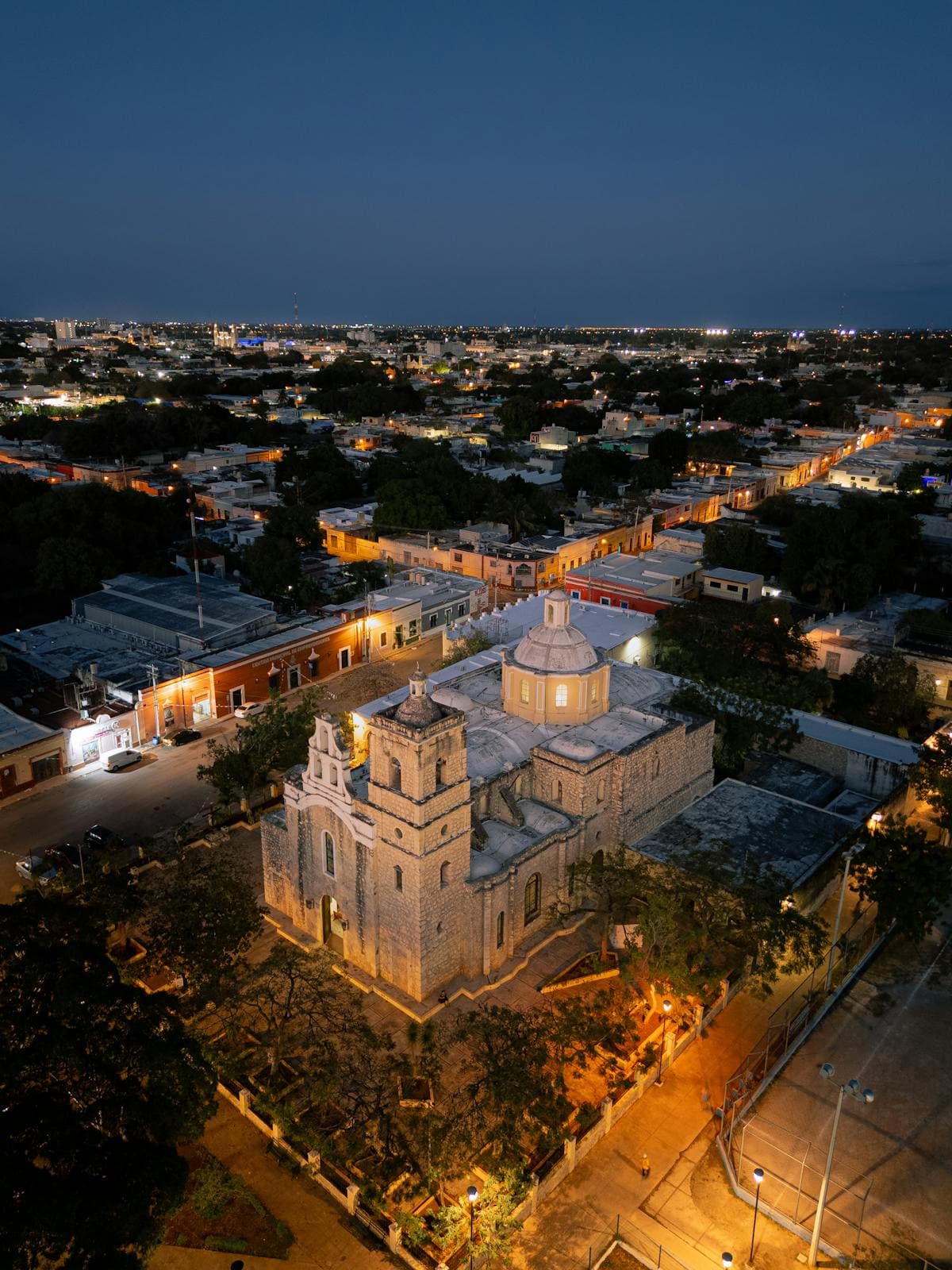
Mérida itself was founded by demolishing the Maya structures on the site and converting their stones into Spanish buildings. The cathedral was started around 1561 and completed in 1598. The Casa de Montejo, the conquistador family's mansion on the south side of the plaza, was finished in 1549. The Iglesia de Jesús (Tercera Orden) was completed in 1618. The Iglesia de Santa Lucía dates to 1575. All of these buildings contain Maya stonework in their walls.
The cathedral, in particular, is one of the most direct examples of architectural recycling in the colonial Americas. Look closely at the older courses of stone in its walls and you will sometimes see Maya carving on individual blocks, the glyphs facing inward, walled into the Spanish replacement, occasionally turned sideways or upside down because the masons did not care to preserve the orientation. The same limestone blocks that had been quarried and shaped to build pyramids dedicated to Chaac, the rain god, and Kukulkán, the feathered serpent, were re-used to build a cathedral dedicated to a Christian saint.
The Casa de Montejo and the facade
Hear a stop from this walk
Plaza Grande
If the cathedral is the largest example of conversion, the Casa de Montejo is the most explicit statement of conquest. The Plateresque facade above the main entrance, carved in 1549, shows two Spanish conquistadors in full armour standing with their feet on the severed heads of defeated figures. The defeated figures are Maya. The carving is not subtle.
Plateresque, the style of the facade, was the dominant Spanish Renaissance decorative idiom of the early sixteenth century, named because its dense ornament resembled the work of silversmiths. The Casa de Montejo facade is one of the finest surviving Plateresque facades in the Americas. The technical execution is at the level of contemporary work in Salamanca or Toledo. The content is what makes it specifically colonial: the iconography is unambiguously about military conquest.
The Montejo family lived in the house, in unbroken succession, from 1549 until the 1970s, which is an extraordinary fact in itself. The house was acquired by the bank Banamex (now Citibanamex) in the 1980s and converted into a museum and bank branch. You can walk through the restored rooms and see the courtyard, the European furnishings, the colonial-era tile floors. The facade is the most important thing to look at. Stand on the street side and read the carving slowly. The message that the conquerors wanted everyone passing through the plaza to absorb is still legible four hundred and seventy-six years later.
Diego de Landa and the burning of the books
The other figure worth understanding when you walk this tour is Bishop Diego de Landa, the Franciscan friar who oversaw the early phases of cathedral construction and who left the deepest mark on Maya cultural history of any colonial figure.
Landa arrived in the Yucatán in 1549. He learned Maya. He recorded Maya customs, religious practices, calendar systems, and writing with a level of detail that, in retrospect, made him one of the most important early sources on Maya civilisation. His treatise Relación de las cosas de Yucatán, written around 1566, contains the only surviving early colonial description of the Maya hieroglyphic writing system. The book is essential to the modern decipherment of Maya glyphs, which only fully succeeded in the late twentieth century with significant help from Landa's notes.
In July 1562, Landa also ordered an auto-da-fé at the Maya town of Maní in which thousands of Maya cult images and an unknown number of hieroglyphic codices, possibly twenty-seven, were burned. The exact count is disputed. The fact of the burning is not. The Maya hieroglyphic writing system had been used to record astronomical observations, historical chronicles, calendrical knowledge, and religious texts for over a thousand years. Today, four pre-conquest Maya codices survive in the entire world: the Dresden, the Madrid, the Paris, and the Grolier. Everything else was destroyed. A significant portion of that destruction occurred in a single afternoon in Maní under Landa's order.
The contradiction of Landa is sharp. He was simultaneously the most important early documenter of Maya civilisation and one of the most catastrophic destroyers of its written record. The mural cycle inside the Palacio de Gobierno by the Yucatecan artist Fernando Castro Pacheco, painted between 1953 and 1978, includes a panel depicting the Maní burning. Castro Pacheco painted the scene with the destruction at the centre and Maya elders watching in anguish, in a building that houses the government of the state Landa helped found. It is one of the more deliberate acts of historical accountability you will find in any working government palace in the Americas. The murals are free to enter and view.
What the layering produces today
The historical centre of Mérida is, in this sense, three civilisations compressed into a few blocks. The Maya substrate, occasionally visible in carved glyphs walled into colonial masonry. The Spanish colonial overlay, in the cathedral and the Casa de Montejo and the various churches. And the modern Mexican layer, in the murals of the Palacio de Gobierno, the contemporary art at MACAY, and the indigenous craft traditions documented at the Museo de Arte Popular. None of the three has fully replaced the others. They coexist as physical strata in the same buildings, and the buildings make the coexistence visible when you know where to look.
The walking tour traces this through eight stops in roughly two kilometres, beginning at Plaza Grande and looping through the cathedral, the Palacio de Gobierno, the Casa de Montejo, the Iglesia de Jesús, the Parque Santa Lucía, the Museo de Arte Popular, and ending at MACAY. The route is flat. The heat is intense, especially between 11 in the morning and 4 in the afternoon, and the standard advice is to start early. The cathedral, the Palacio de Gobierno, and the Casa de Montejo facade are free. The two museums charge small entry fees. The Parque Santa Lucía is most alive on Thursday evenings, when the Serenata Yucateca, a weekly concert of traditional Yucatecan music, fills the square in the same colonial space that the eighteenth-century caste system once designated specifically for Maya and Black worshippers.
The structural reading the tour offers is that Mérida is not, despite appearances, a Spanish city. It is a Spanish-built city that contains a Maya city inside it, made from the literal materials of the Maya city, and that what remains of the Maya identity of the place did not survive in spite of the colonial overlay but in symbiosis with it. The cathedral was built from temple stones. The colonial caste-system church now hosts Yucatecan music every Thursday. The Maya carvings face inward in the colonial walls. The two worlds did not separate. They fused, sometimes violently, and sometimes the fusion is now what you are looking at when you think you are looking at a single building.
Mexico eSIM· 10% off with ROAMER10
Ready to experience it?
Mérida: A Maya City the Spanish Broke Apart and Rebuilt
95 min · 2.5 km · easy
More from Merida
Explore more at your own pace.
Best Self-Guided Walking Tours in Mérida (2026)
Mérida Travel Guide: How Many Days, Getting Around, When to Go, Is It Safe (2026)
One Day in Mérida: A Walkable Centro-to-Paseo Itinerary (2026)
What to Eat in Mérida: A Yucatecan Food Guide (2026)
Green Gold: How One Agave Plant Built a Belle Époque Boulevard in the Tropics