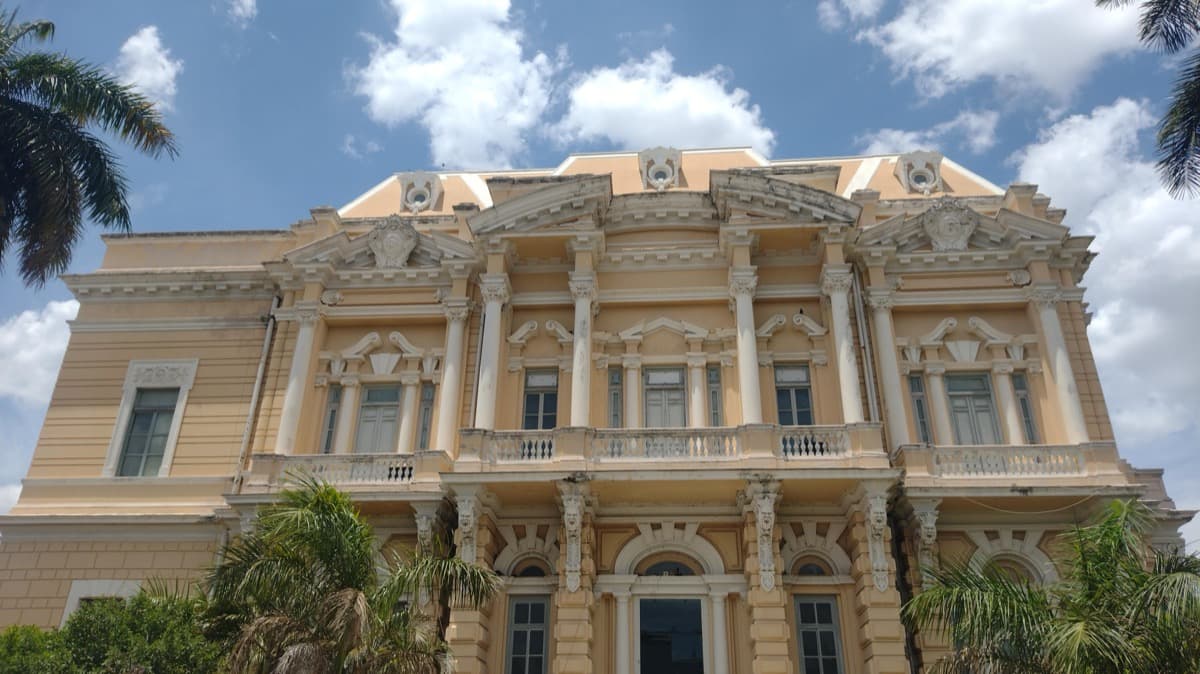
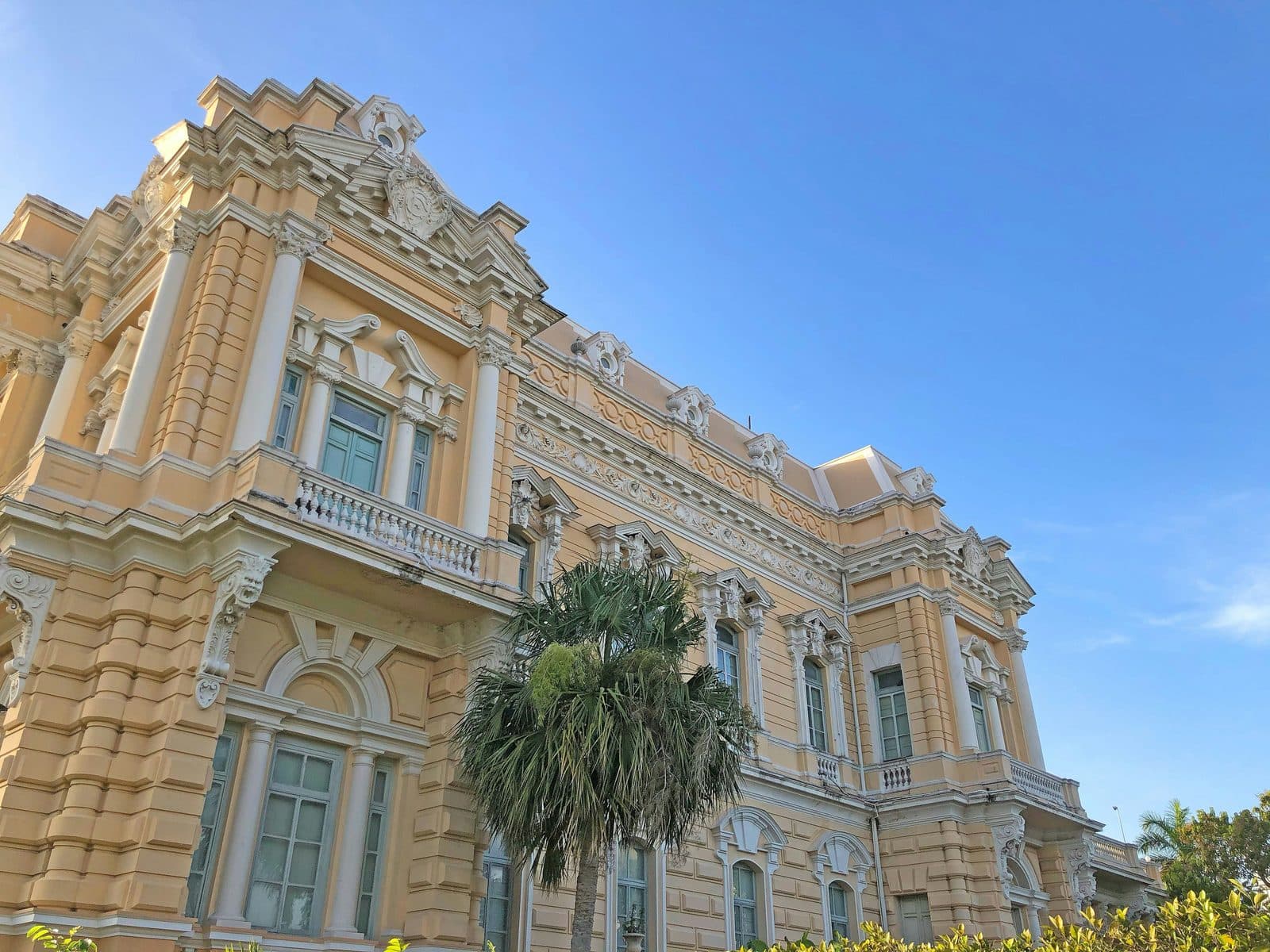
The Palacio Cantón sits at the corner of Paseo de Montejo and Calle 43, about a kilometre north of the Plaza Grande and roughly halfway down the historic stretch of the boulevard. It is the most imposing single building on the Paseo, and almost certainly the most architecturally ambitious. Symmetrical Beaux-Arts facade. Ornamental balustrades. Carved limestone garlands and pilasters. A sweeping entrance staircase that broadcasts ceremonial weight before you have even climbed it. The kind of building that would not look out of place on the Avenue Foch in Paris in 1910, except for the limestone, which is local.
It was built between 1904 and 1911 for General Francisco Cantón Rosado, a Yucatecan military officer and politician who served as governor of the state from 1898 to 1902 and who was one of the largest henequén producers of his generation. He commissioned the building as his retirement residence. He moved in shortly after its completion in 1911, lived in it for about six years, and died in 1917.
Today the building houses the Museo Regional de Antropología de Yucatán, the regional anthropology museum, which holds one of Mexico's most important collections of Maya artefacts. The conversion happened in 1977. The choice was not coincidental, and what it produces is one of the more pointed pieces of postcolonial repurposing in any working Mexican state.
The architect
The Palacio Cantón was designed by Enrico Deserti, an Italian architect who became the dominant designer of monumental buildings in Mérida during the henequén era. Deserti was born in Italy in 1855, trained in classical and Beaux-Arts traditions, and worked in France before relocating to the Yucatán in the late nineteenth century. He died in Mérida in 1921. His career spanned the absolute peak of the boom and produced two of the most important civic buildings the period left: the Palacio Cantón and the Teatro Peón Contreras.
The Palacio Cantón is, in many ways, Deserti's masterpiece. The proportions of the facade are unusually disciplined for the period, the ornamental programme is restrained where many contemporary Beaux-Arts mansions in Mérida are exuberant, and the relationship between the building and the boulevard is carefully composed. The grand staircase inside, in white marble, climbs through a double-height entrance hall. The reception rooms on the main floor are arranged in the standard ceremonial sequence of a European palatial residence: a series of progressively more intimate spaces opening off the central axis.
The construction techniques were exacting. Deserti specified imported materials throughout: Italian marble for the staircase and main floors, French wrought iron for the railings and balconies, Belgian glass for the leaded windows, Catalan ceramic tiles for the secondary floors. All of the European materials arrived through the port of Progreso and were hauled to Mérida on the narrow-gauge railway the henequén barons had built. The materials chain that supplied the Palacio Cantón was the same chain that produced every comparable mansion on the Paseo, and it tells you, materially, what the boom was buying.
The client
Hear a stop from this walk
Palacio Cantón / Museo Regional de Antropología
Francisco Cantón Rosado was a complicated figure even by the standards of late-Porfirian Yucatán. He was born in 1833 in the eastern Yucatán, served as an officer in the conservative forces during the mid-nineteenth-century civil wars between Mexican Liberals and Conservatives, and emerged in the late nineteenth century as one of the dominant landowners and politicians of the henequén era. He was governor of Yucatán from 1898 to 1902 under the Díaz regime. His political faction, conservative and pro-hacienda, was one of the key blocs in the casta divina, the small group of families that controlled the henequén economy.
Cantón's relationship to the henequén labour system was the standard relationship of his class. He owned haciendas. He profited from the debt-peonage labour that operated them. He defended the system politically. His retirement palace was built with money extracted from that system.
He moved into the palace around 1911. The boom was still going. The Mexican Revolution had begun in 1910 but had not yet reached the Yucatán in earnest. Cantón had six years before he died. The palace remained in family hands, in declining condition, through the middle decades of the twentieth century as the henequén economy collapsed and the casta divina families lost their fortunes. The federal government acquired the building in the 1960s.
The conversion
In 1977, the building reopened as the Museo Regional de Antropología de Yucatán. The conversion was, by the standards of Mexican museum architecture, conservative. The major reception rooms of the original mansion were preserved with their period ceilings, marble floors, and ornamental detail. The exhibition cases and lighting were inserted into the existing volumes. The result is that the visitor walks through what is still recognisably a Belle Époque palace but with Maya stelae, jade masks, obsidian tools, ceramic vessels, and scale models of Uxmal and Chichén Itzá installed in the rooms.
The collection itself is excellent. It traces Maya civilisation from the Preclassic period through the Classic and Postclassic, with strong holdings in northern Yucatán material. There are funerary urns from the late Classic, carved stelae from Maya cities of the Puuc region, replicas of the jade death mask of Pakal the Great from Palenque, and detailed reconstructions of construction techniques at Chichén Itzá. The labelling is in Spanish and English. Most visits take ninety minutes if you read the panels.
The pointed quality of the conversion is the juxtaposition. The mansion was built with wealth that depended on a labour system that bound Maya families to henequén haciendas. The collection inside the mansion celebrates and contextualises Maya civilisation, the ancestors of the same families. The reframing is not stated as an explicit thesis in the museum's interpretation. It does not need to be. The space speaks. The Maya artifacts now occupy the rooms the henequén baron built. The building's original ideological content has been inverted by the simple act of changing what is inside it.
This kind of conversion is not unique in postcolonial Mexico. The Palacio Nacional in Mexico City contains Diego Rivera's murals of indigenous resistance to colonial rule, painted on the walls of the building from which the colonial viceroys ruled. The Palacio de Gobierno in Mérida, three blocks from the Plaza Grande, contains the Castro Pacheco mural cycle that includes the depiction of Diego de Landa burning Maya codices. The Palacio Cantón is the architectural-scale version of the same gesture. The building no longer celebrates what it was built to celebrate.
What to look for
The exterior is worth twenty minutes on its own. Stand on the corner opposite the entrance and look at the facade. The proportions of the central pediment are unusually controlled. The window frames on the second floor are carved with floral garlands of a depth and precision that signal European workshop traditions. The grand staircase, visible through the open entrance, is one of the great early-twentieth-century architectural set-pieces in Mexico.
Inside, climb the marble staircase slowly and look up at the painted ceiling of the entrance hall. Notice that the painted programme is straightforwardly classical European, allegorical figures, garlands, putti, with no Yucatecan or Maya content. The original ideological vocabulary of the building was European modernity transplanted to a tropical city. The Maya content of the museum is a later overlay onto an interior that was deliberately scrubbed of any local reference.
The main exhibition rooms are arranged in a clockwise sequence on the upper floor. The chronological organisation works well. By the time you reach the Postclassic galleries, you have walked through six or seven of Cantón's reception rooms and the layering effect is fully active.
The Palacio Cantón is the fourth stop on the Mérida: The Mansions Sisal Built tour, sequenced after the Casas Gemelas and before the more domestic Villa Amira. The placement is correct. The Cantón is the rhetorical peak of the boulevard's architectural ambition, and the museum inside it is the rhetorical peak of the reframing. The remaining stops, the more recent mansions, the contemporary cultural centres, the theatre at the end, all read against this building as the standard.
Open Tuesday through Sunday, closed Monday. Small entry fee that goes to museum upkeep. Photography permitted without flash. The marble staircase alone justifies a stop even if you do not enter the exhibition rooms.
Mexico eSIM· 10% off with ROAMER10
Ready to experience it?
Mérida: The Mansions Sisal Built
100 min · 3.5 km · easy
More from Merida
Explore more at your own pace.
Best Self-Guided Walking Tours in Mérida (2026)
Mérida Travel Guide: How Many Days, Getting Around, When to Go, Is It Safe (2026)
One Day in Mérida: A Walkable Centro-to-Paseo Itinerary (2026)
What to Eat in Mérida: A Yucatecan Food Guide (2026)
Green Gold: How One Agave Plant Built a Belle Époque Boulevard in the Tropics