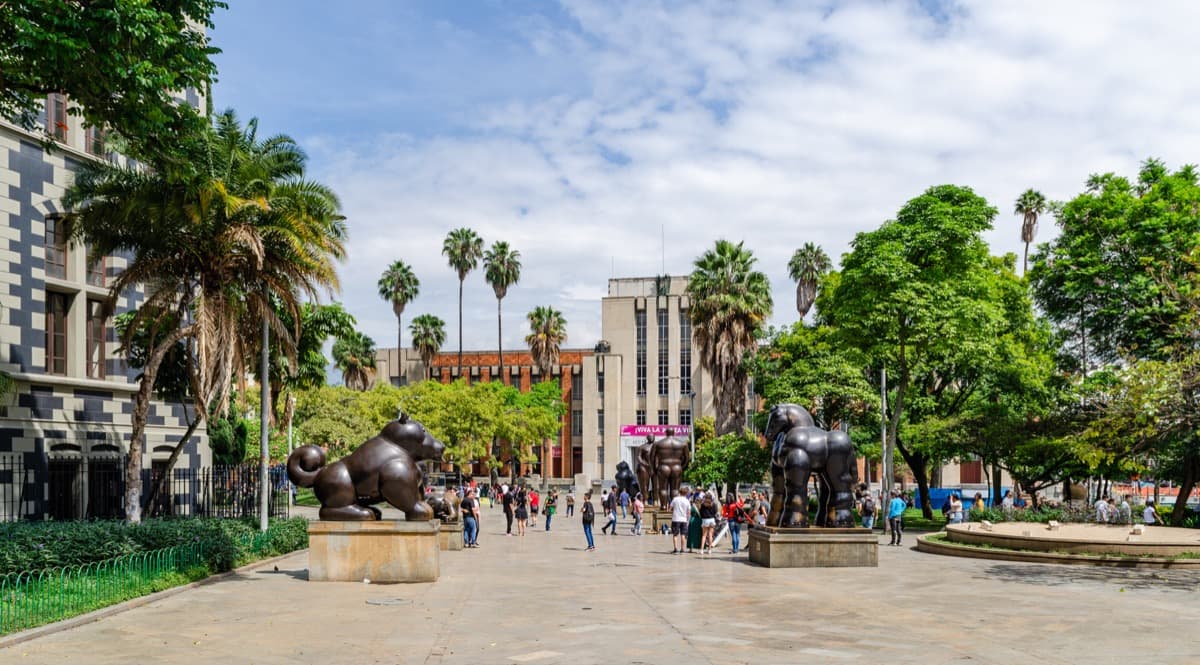
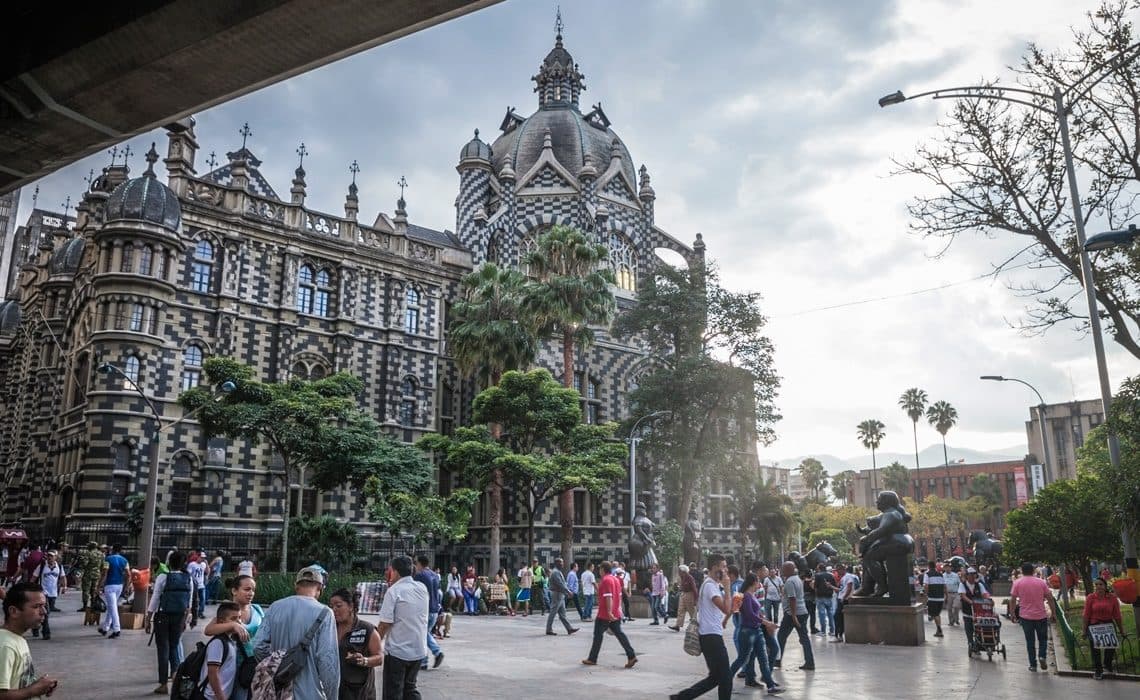
Plaza Botero is a 7,000-square-metre open plaza in the old quarter of central Medellín, bounded on its south side by the Museum of Antioquia and on its north by the Palacio de la Cultura Rafael Uribe Uribe. Twenty-three monumental bronze sculptures stand on the plaza, all of them by Fernando Botero. The sculptures are not arranged behind any barrier. There are no ropes, no glass cases, no platforms above hand height. Visitors can, and constantly do, walk up to the bronzes and touch them. That tactile access is not an oversight. It was the donor's central condition.
The donation, in some detail
Fernando Botero, born in Medellín in 1932, made his international reputation in the 1960s and 1970s with his characteristic style: figures and objects rendered as voluminous, inflated forms, faces and bodies pushed past plausible proportion into a visual register of his own. The work was, and remains, instantly recognisable. He has been the subject of museum retrospectives on six continents.
In 2000 Botero announced a major donation to the city of his birth. The donation included 23 monumental bronze sculptures intended for outdoor display, along with more than 100 paintings, drawings, and prints destined for the Museum of Antioquia. The combined estimated value, in current terms, runs into the hundreds of millions of dollars. Botero asked for no payment. The Wikipedia entry for Botero Plaza notes that the sculptures were donated for the museum's renovation in 2004; the timing reflects how the gift was administered. The bronzes arrived; the plaza around them was redesigned to receive them; the public installation opened in 2002.
The donation came with conditions, of which the most important is the one Botero stated and restated in interviews. The sculptures had to be outdoors. They had to be free of charge. They had to be touchable. The artist's explanation, given many times, was always some version of the same sentence: he wanted the people of Medellín to have contact with art, not observation.
That single condition has shaped the plaza in concrete ways. Each sculpture weighs between 800 kilograms and several tonnes. The plaza's foundations had to be reinforced before installation. There is no plinth tall enough to put the works out of reach. The bronzes sit at hand height. School groups touch them. Tourists hug them. Children climb on them. Vendors selling tinto, the small black coffee that is the city's everyday drink, set up under their shadows. The patina on the most-touched sculptures, the Mujer Reclinada (Reclining Woman), the various horses, the Mano (Hand), is worn lighter on the surfaces that people reach for. The plaza is, in effect, an open-air sculpture park with no security perimeter and no admission fee.
What the sculptures are
Hear a stop from this walk
Catedral Metropolitana
The 23 works span Botero's mature period. They include classical figures (a Roman soldier, a male nude, a horse with rider), domestic subjects (the reclining woman, a cat, a man and woman), and isolated body parts that recur in Botero's late work, most notably the Mano, a single bronze hand of grotesque proportion. Each sculpture is signed and dated. Each is unique. The works were not made for the plaza; they were selected by Botero from his existing output and gifted as a group, on the understanding that the city would build the plaza around them.
The arrangement on the ground is loose. Sculptures are placed across the open paving without strict groupings, and visitors can walk between them in any order. There is no recommended route. This is unusual for a sculpture park of this scale. Most public collections are choreographed. Plaza Botero is, by design, an undirected encounter.
The reclining woman, near the centre of the plaza, is the most-photographed of the 23. Her form is the canonical Botero: voluminous, supine, classical in posture, indifferent to the photographic gaze. Botero's stated theme across his late career was volume rather than weight, the sensuality of pure form pushed past realism. He rejected, throughout his life, the casual label that his style was about fatness. The figures are not overweight people, he said. They are ideas made physical. Whether or not you accept that argument, the reclining woman is the work in the plaza that has been touched by the most hands. The bronze on her shoulder and hip is polished smooth.
Why Medellín
Botero could have donated his sculptures to any major museum in the world. The Reina Sofía in Madrid, MoMA in New York, the Pompidou in Paris, all would have absorbed a Botero donation. Several of those institutions hold pieces of his work. He chose Medellín for the largest single donation of his life. He did so on terms that no major museum could have accepted: outdoor placement, free of charge, accessible to touch.
The reasons he gave, in interviews over the years, were two. The first was personal. He had grown up in this neighborhood. The donation was a return, not an export. The second was political. The Medellín of 2000 had spent the previous fifteen years being the most violent city in the world. The downtown that the sculptures would occupy was, in 2000, still a downtown that wealthy residents avoided after dark. Botero's argument, made repeatedly, was that placing major art in a contested public space changed the meaning of the space. Whether the art changed the neighborhood, or the neighborhood would have changed anyway, is a question impossible to answer cleanly. What is observable is that Plaza Botero, twenty-five years after the donation, is one of the central social spaces of the city. Wedding photographs are taken there. Political demonstrations gather there. Tourist guides start their walks there. It is, by some measures, the most-photographed location in Medellín.
The companion gesture in 1995
The 1992 sculptures were not Botero's only large donation to the city. In June 1995, a bomb hidden inside an earlier Botero bronze, Pájaro, the bird, detonated during a public concert in Parque de San Antonio, eight blocks south of what is now Plaza Botero. At least 23 people were killed. (Some accounts give the figure as 29.) Responsibility was contested and never formally settled.
The city wanted to remove the destroyed sculpture. Botero refused, on the same logic that animates Plaza Botero. The damaged bronze had to remain in place. He offered to cast a second, identical bird and place it directly beside the first. He named the new sculpture the Bird of Peace. The two stand together in Parque de San Antonio today. The damaged one is torn open at the breast; the metal is twisted outward. The undamaged twin is smooth.
The Parque de San Antonio gesture is sometimes treated as separate from Plaza Botero. It is not, structurally. Both donations follow the same logic. Both make the same artistic argument. Place beauty next to damage, in public, at hand height, and let the public decide what to make of the pairing. Plaza Botero is the celebratory side of that argument. The two birds in San Antonio are the wounded side. The same artist made both. They are eight blocks apart.
What to look for on the plaza
A few specific notes.
The reinforced flooring. Look at the joints in the plaza paving around the heaviest sculptures. You can see the reinforced concrete pads beneath the stones. The plaza was rebuilt to carry the weight; the engineering is visible if you look.
The patina patterns. The bronzes' surface coloration is uneven by design and use. The most-touched areas, hands, hooves, the noses of the horses, are worn lighter. The least-touched, the high backs and the rear elevations, retain the original darker patina. The pattern of wear is a record of three decades of public contact.
The Museum of Antioquia behind. The museum, founded in 1881, holds the rest of the donation: paintings, drawings, and prints. It is one of the oldest art museums in Latin America. Admission is modest. If the plaza is the part of the donation Botero wanted in the open, the museum is where he placed everything that needed walls and climate control.
The vendors. The plaza was not pedestrianized; it has been a working public space throughout. Vendors sell coffee, snacks, and souvenirs at the edges. The presence of a small ad-hoc commercial life around the sculptures is part of what Botero asked for. He did not want a museum quarter. He wanted a city plaza that happened to contain 23 of his largest works.
Botero died in September 2023 at the age of 91. The plaza did not change. The sculptures stayed where he placed them. The vendors are still there. The reclining woman is still polishing smooth on her shoulder and hip, one hand at a time.
Colombia eSIM· 10% off with ROAMER10
Ready to experience it?
Medellín: The Botero City
95 min · 3 km · easy
More from Medellin
Explore more at your own pace.
Best Self-Guided Walking Tours in Medellín (2026)
Medellín Travel Guide: How Many Days, Getting Around, Is It Safe (2026)
One Day in Medellín: A Walkable Itinerary (2026)
What to Eat in Medellín: A Paisa Food Guide (2026)
The Escalator as Policy: Reading Comuna 13