The hillside neighborhood of San Javier sits on the western wall of the Aburrá Valley. Around 135,000 people live there. The slope is steep enough that, for most of the second half of the twentieth century, the only way to reach the upper barrios from the valley floor was 350 concrete steps. Carrying groceries up those steps took roughly 35 minutes. Carrying a child up them took longer.
In December 2011 the city of Medellín opened a system of six covered electric escalators that climbs the same hillside in six minutes. They are 384 metres long in total, run continuously during operating hours, are free to use, and are sheltered by bright orange canopies that have become one of the most recognizable images of post-cartel Colombia. The system is usually described as the first outdoor public escalator network in the world. That description is technically true and misses what the escalators actually are.
What was being solved
The official problem statement, in the project documents from the Salazar administration, was mobility. San Javier residents lost roughly an hour and ten minutes a day to the climb. That time was unpaid, exhausting, and uncompensated. Elderly residents stopped leaving their homes. Children arrived at school already tired. The escalator was sold as a transit fix.
The unofficial problem statement was harder to write. San Javier had spent the previous fifteen years being the most fought-over neighborhood in the city. The FARC, the ELN, urban militias, the AUC paramilitaries, and the Colombian army had all claimed pieces of the hillside. The most intense period was 2002, when President Álvaro Uribe's new democratic security policy authorized a sequence of military operations inside Comuna 13. Operation Mariscal in May. Operation Antorcha later. And then, on October 16 and 17, Operation Orion.
Operation Orion was the largest urban military assault in Colombian history. More than a thousand soldiers and police entered Comuna 13, backed by helicopters and armored vehicles. The official goal was clearing out guerrilla cells. What happened during those two days went considerably further. Civilians were caught in crossfire. Homes were raided. And in the months following the operation, people began to disappear. Estimates of the number of forced disappearances from Comuna 13 in 2002 range from 70 to over 300. Many are believed to be buried at La Escombrera, a construction rubble dump higher on the hillside. The first formal excavations there began in 2015. They are still going.
The escalator was not, and could not be, a remedy for any of that. What the city was offering, with this single piece of infrastructure, was a different kind of statement. We cannot return what was taken. We can give you back twelve minutes of every day, and we can build that gesture in a material that announces itself.
Why the material matters
Hear a stop from this walk
Top of Escalators — Community Viewpoint
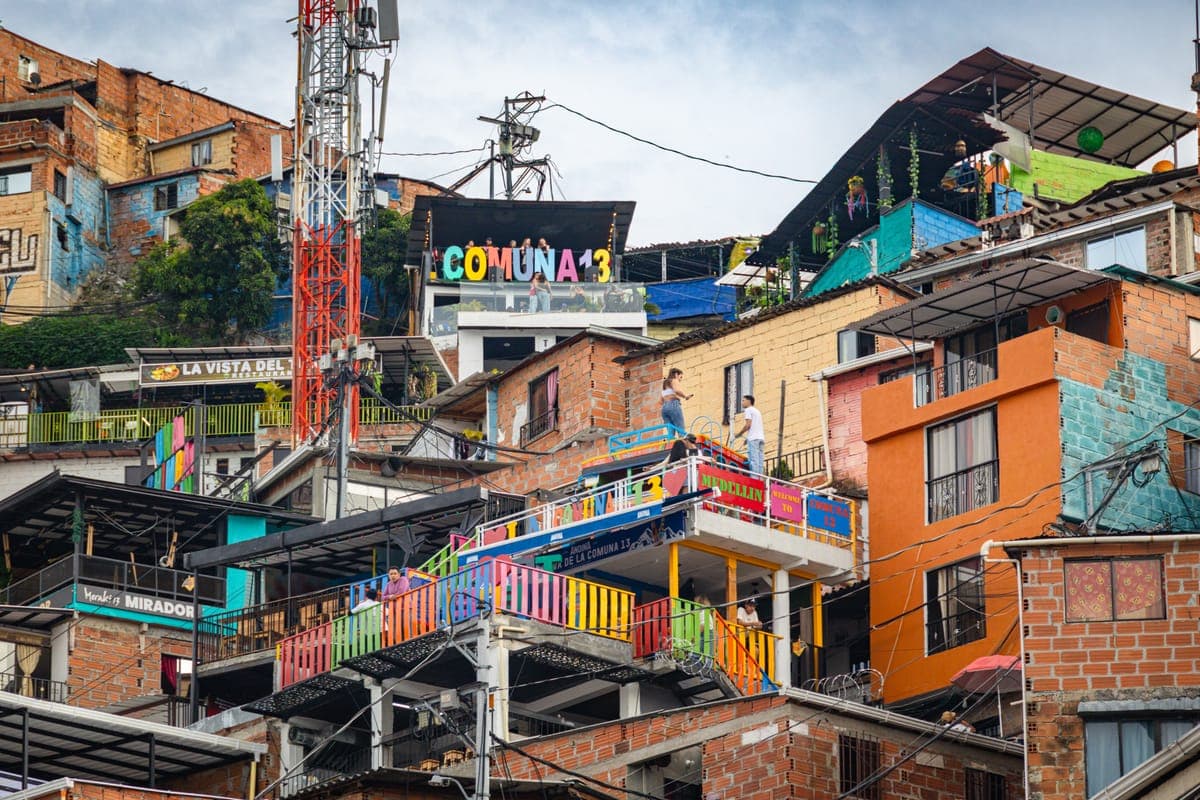
Concrete stairs disappear into a hillside. They are easy to ignore. An orange escalator canopy on a slope is not. From across the valley you can see the line of the system rising up the hill. You can see it from the cable cars to the north. You can see it from El Poblado, the wealthy district on the other side of the city. The escalators are legible from far away, and they are legible to the residents of San Javier as a daily mechanical fact: every morning the canopies are orange, the rubber treads move, and the city is still bothering to maintain them. That visibility is doing real work.
The architect, Carlos Escobar (no relation to the cartel), specified the system as part of a larger Integral Urban Project for Comuna 13, the package of investments the city was making in the neighborhood at the same time. New lighting. Water infrastructure. Community centers along the route. Public plazas at the upper landings. The escalators were the spine, not the whole project. Tour operators sometimes oversimplify by talking only about the moving stairs. The fuller story is that the moving stairs arrived as part of a coordinated package, and the package was the bet.
The mural ecology
The other half of the tour, the one that everyone photographs, is the mural ecology that has grown along and above the escalator route. This is not random. It is governed.
Casa Kolacho, the cultural house founded in the 2010s by a hip-hop pioneer known as Jeihhco, runs much of the wall-space negotiation. The community has informal but real authority over what gets painted and where. International artists who want to contribute do so by invitation. Local artists have priority. Themes are not imposed but tend to clump: portraits of disappeared neighbors, birds in flight (the bird is the recurring Comuna 13 motif, freedom and the choice to stay), flowers pushing through rubble, helicopters as memory rather than as threat.
The estimated number of murals on and around the escalator route is over 250, and the count keeps moving because new works are added during annual painting festivals. UV-reactive paint in some pieces creates a second image at night. Some murals are commercially commissioned by tour companies. Some are funded by the families they commemorate. The wall economy is not informal in the casual sense. Money moves through it. Artists earn livings. The community runs the books.
Hip-hop is the parallel art form, and the older one. Revolución sin Muertos, Revolution without Deaths, is the annual hip-hop festival the neighborhood has held since 2009, declaring openly that the residents chose insurrection through art rather than weapons. The festival's slogan is the cleanest sentence anyone has written about Comuna 13. They chose revolution. They chose to do it without killing anyone.
What the tour is asking you to hold
The tour does not ask you to forget the violence. It asks you to hold two facts at once. The first is that Comuna 13 is one of the most-visited tourist sites in Colombia, with peak-season visitor counts above 4,000 per day. The second is that the families of the disappeared are still excavating La Escombrera and that 4,000 visitors per day is a number that has serious consequences for rents, displacement, and the dignity of residents who did not ask to be a backdrop.
The community's position on this, as best as outsiders can summarize it, is roughly: come, see, listen, spend your money at local businesses run by people who actually live in the neighborhood, and remember whose house you are in. The escalators were not built for you. The murals were not painted for you. They were built and painted by people who refused to let violence be the only story told about them, and they tolerate you because the alternative, your absence, would not bring the disappeared back either.
Walking the route from the San Javier metro station up to the upper viewpoint takes about ninety minutes. The escalators do the climbing. What is left for you is the looking.
Colombia eSIM· 10% off with ROAMER10
Ready to experience it?
Medellín: Comuna 13, The Escalator Intervention
90 min · 2 km · moderate
More from Medellin
Explore more at your own pace.
Best Self-Guided Walking Tours in Medellín (2026)
Eternal Spring and Its Shadows: How Medellín Rewrote Itself
Medellín Travel Guide: How Many Days, Getting Around, Is It Safe (2026)
One Day in Medellín: A Walkable Itinerary (2026)

What to Eat in Medellín: A Paisa Food Guide (2026)