Fernando Botero was born in Medellín in 1932, the second of three sons of a travelling salesman who died when Botero was four. The family was middle-class but precarious. His mother, a seamstress, kept the household together. He grew up in the historic centre of the city, blocks from what is now Plaza Botero. At twelve he was enrolled in a bullfighting school. At sixteen he sold his first painting to pay the tuition. By twenty he was in Bogotá, by twenty-three in Europe. He never lost the habit of returning home, and over the next sixty years his hometown would receive two of the largest single art donations any Latin American city has ever absorbed.
This is the lineage that the Heart of the City tour walks. Central Medellín is older than Botero, of course. The Basílica de la Candelaria's foundations go back to the early 1600s. The Coltejer textile dynasty built the country's industrial capital out of these blocks in the early twentieth century. The Palacio de la Cultura, finished in 1937, was designed by a Belgian architect who never visited the city. The downtown's bones are layered. But what holds the modern civic identity together is Botero. The two donations are the spine.
The 1992 donation
In 1992 Botero offered the city of Medellín a major part of his personal collection. The package included 23 monumental bronze sculptures, intended for outdoor public display, plus over 100 paintings and drawings for the Museo de Antioquia, the city's main fine art museum. The combined value, in current terms, is estimated in the hundreds of millions of dollars. Botero asked for no payment. He stipulated only that the sculptures had to stand outdoors, in a public plaza, free of charge, where any resident could touch them.
The plaza was redesigned to house the gift. The Museum of Antioquia, located on the south side of what is now Plaza Botero, was renovated to display the paintings. The full installation opened to the public in 2002. The plaza was renamed for the artist. Each sculpture weighs between 800 kilograms and several tonnes. The plaza's foundations had to be reinforced to carry them. The plaza is 7,000 square metres, in the old quarter of the city, and on any given afternoon you will see children climbing on the sculptures, couples leaning against them, vendors selling tinto in their shadows. That tactile access was the donation's central condition. Botero, asked later why he had insisted on outdoor placement, said he wanted the people of Medellín to have contact with art. Not observation. Contact.
The timing of this gift mattered. In 1992 Medellín was the most dangerous city in the world. Pablo Escobar was alive and at the height of his terror campaign against the Colombian state. The downtown that the sculptures were arriving in was a downtown that wealthy residents avoided. Botero's bet was that placing major art in a contested public space would change the meaning of the space. The bet was harder to justify in real time than it looks now. It paid off slowly, partly because the city worked in parallel on the surrounding infrastructure, the metro that opened in 1995, the Parque de las Luces installation that replaced one of the most dangerous intersections in the Americas, the cathedral squares that were rehabilitated for foot traffic. The sculptures were one investment among many. But they were the visible one. They were the photograph.
The 1995 bombing and the second bird
Hear a stop from this walk
Catedral Metropolitana
On June 10, 1995, during a public concert in Parque de San Antonio just south of Plaza Botero, a bomb hidden inside one of Botero's earlier sculptures, Pájaro, the bird, detonated. The sculpture, installed in 1992, was a hollow bronze. The bomb killed at least 23 people and injured hundreds more. (Some sources put the death toll at 29.) Responsibility was contested at the time and has never been formally settled. The FARC was the most commonly named suspect, though cartel involvement has also been argued. The investigation produced no satisfying conclusion.
The city's instinct was to remove the destroyed bird and replace it with a new one. Botero refused. The damaged sculpture, he said, had to stay exactly where it was, in its torn condition, on its original pedestal, with its shrapnel wounds open. He offered to cast a second bird, identical to the original, and to place it directly beside the wounded one. He called the new sculpture the Bird of Peace. The damaged one became, by implication, the Bird of Violence. The two stand together in Parque de San Antonio today. The damaged one is the more arresting object. Its bronze skin is ripped at the breast. The metal is twisted outward. The undamaged twin, smooth and round, gleams beside it.
The donation of the second bird, in 2000, was the second great Botero gesture toward the city. It is a different kind of gift from the 1992 package. The first donation gave Medellín a downtown plaza full of celebratory sculpture. The second forced the downtown to keep a wound visible. Together they describe the city's house style. Build something new next to the damage. Do not cover the damage up.
The downtown the tour walks
The Heart of the City tour begins at Parque de las Luces and ends at the Catedral Metropolitana. In between, it crosses what is, by most measures, the most rehabilitated central business district of any city its size in Latin America. Each stop is doing a different job.
The Parque de las Luces, the Park of Lights, sits where the Guayaquil neighborhood used to be. Guayaquil was the city's original commercial heart in the early twentieth century, then became one of the most violent zones in the Western Hemisphere during the cartel decades. The installation, 300 white light poles each about twenty metres tall, opened in 2005. It is a metaphor that you can walk through.
The Edificio Coltejer, the 175-metre tower completed in 1972, was the tallest building in Colombia for decades. Its shape is a sewing needle. The needle is a monument to the textile industry that Alejandro Echavarría founded in 1907 with the Compañía Colombiana de Tejidos, the company that gave the building its name. Before the cartels, Medellín was a textile city. The Coltejer needle is the downtown's reminder of what came before, and what kind of work built the place.
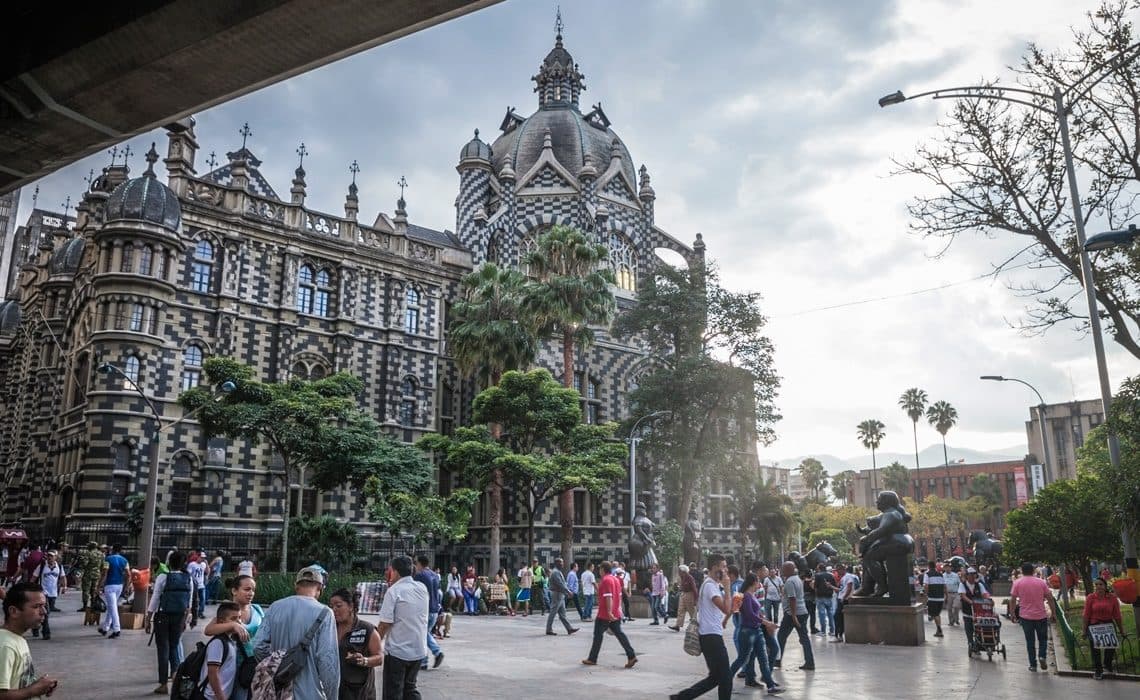
The Palacio de la Cultura, with its dizzying black-and-white checkerboard façade, was designed by the Belgian architect Agustín Goovaerts in the 1920s. Goovaerts worked from plans and photographs sent by mail; he never set foot in Medellín. The building is named for Rafael Uribe Uribe, the Liberal general and reformer who was hacked to death on the steps of the Colombian Capitol in 1914. Scholars have argued for decades that Gabriel García Márquez modelled Colonel Aureliano Buendía, the protagonist of One Hundred Years of Solitude, in part on Uribe Uribe.
The Catedral Metropolitana, the largest brick church in South America, was built between 1890 and 1931 from 1,120,000 locally-fired bricks. The architect, Charles Carré of France, also designed the Catedral de Las Lajas in southern Colombia. Carré died in 1909, more than twenty years before the cathedral he designed was finished.
What holds it together
Walk the route end to end and you have crossed a hundred and forty years of downtown history in about two kilometres. The Botero sculptures are the centre of gravity. The 1995 bird memorial is the wound. The 1992 plaza is the dignity. Without those two donations, the downtown would still be there, but it would not have the figure to organize itself around.
The artist died in 2023. His sculptures stayed.
Colombia eSIM· 10% off with ROAMER10
Ready to experience it?
Medellín: The Botero City
95 min · 3 km · easy
More from Medellin
Explore more at your own pace.
Best Self-Guided Walking Tours in Medellín (2026)
Medellín Travel Guide: How Many Days, Getting Around, Is It Safe (2026)
One Day in Medellín: A Walkable Itinerary (2026)
What to Eat in Medellín: A Paisa Food Guide (2026)
The Escalator as Policy: Reading Comuna 13