Back to Learn
The Catacombs of San Francisco: Seventy Thousand Bones Beneath a Working Church
Tour Companion

The Catacombs of San Francisco: Seventy Thousand Bones Beneath a Working Church

May 15, 2026
8 min read

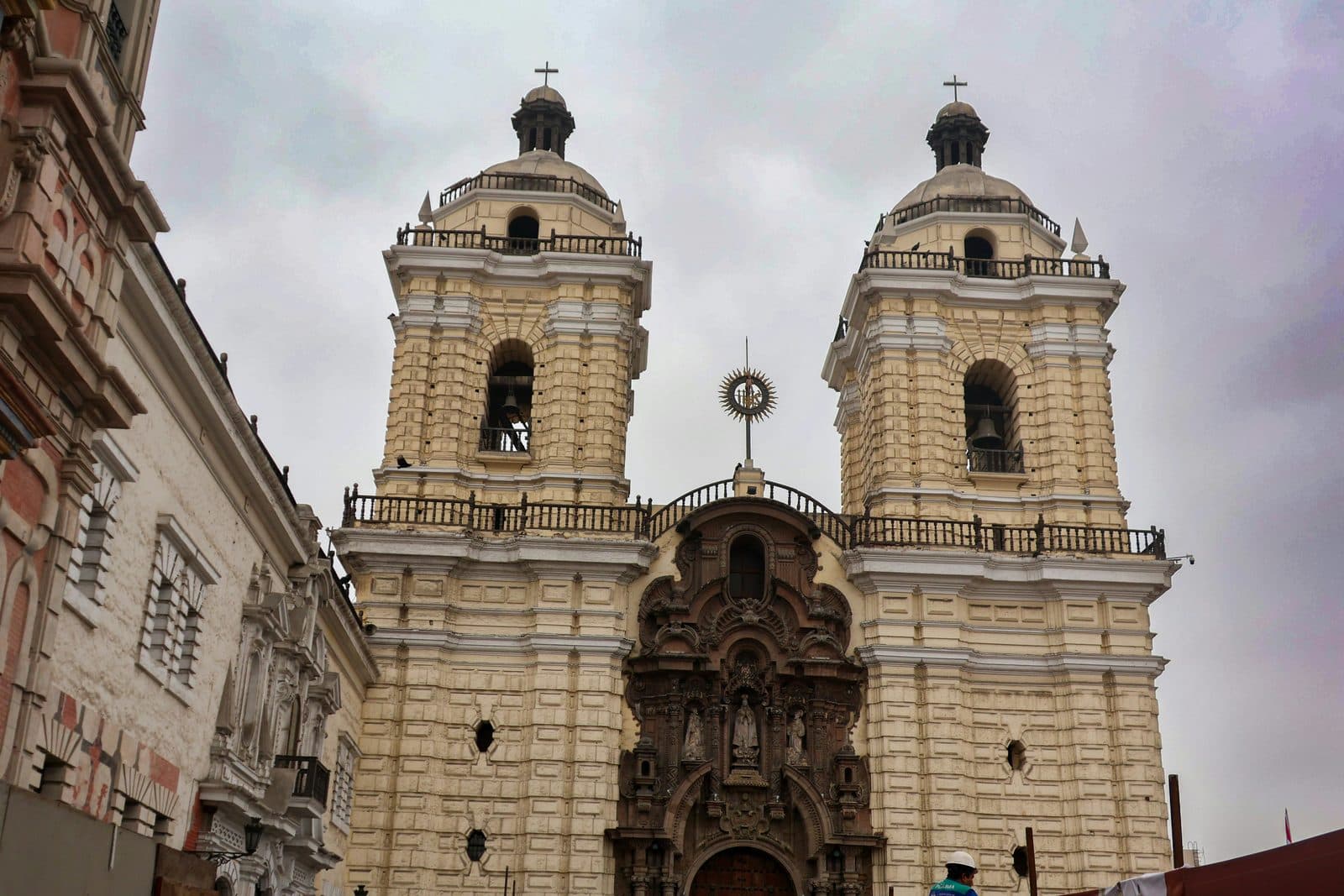
The Basilica and Convent of San Francisco occupies a full block of the historic centre of Lima, two blocks northeast of the Plaza Mayor. From the street it is a long yellow-and-white Baroque façade with twin towers, dramatic but not unusual by colonial-Lima standards. Inside, the church is large and ornate, with carved cedar ceilings, a library of twenty-five thousand antique texts, and a pair of cloisters lined with seventeenth-century Sevillian azulejos. The building, by itself, is one of the finest surviving examples of colonial Baroque in the Americas, and the entire complex was inscribed by UNESCO in 1991 as part of the Historic Centre of Lima.

It is also, beneath the floors, the largest ossuary in South America.

The order and the site

The Franciscans arrived in Peru with the second wave of Spanish conquest in the 1530s and were given land in Pizarro's freshly platted city in 1546, just eleven years after the founding. Construction on the church started immediately. It was destroyed and rebuilt several times. The current building, in the heavy Spanish Baroque called Limeño, was completed in 1672 to designs by Constantino de Vasconcellos, a Portuguese architect, with later modifications by Manuel de Escobar after the 1746 earthquake. What makes the survival remarkable is that San Francisco came through both the 1687 and 1746 earthquakes mostly intact. Most of colonial Lima did not.

The complex contained, and largely still contains, everything a major mendicant convent of the colonial period was expected to contain. A church and chapels for public worship. A larger and a smaller cloister for the friars. A novitiate. A school. A library. A refectory. A series of internal courtyards, gardens, and workshops. And a cemetery, which in seventeenth-century Lima meant a series of underground vaults excavated beneath the church and the surrounding streets.

The vaults are what most visitors come to see.

How a colonial cemetery worked

For most of Lima's first three centuries, the dead were buried inside churches, or in vaults immediately beneath them. The practice was inherited from medieval Spain and was the standard arrangement in Catholic Europe and its colonies until the Enlightenment health reforms of the late eighteenth century. The richer the parishioner, the closer to the altar. The poorer, the further out, in shared chambers. The bones, after a few decades of decomposition, were typically gathered, sorted, and stacked elsewhere in the vault system to make room for new burials. A continuously operating colonial cemetery did not preserve individual graves so much as maintain a rotating storage system for the city's accumulated remains.

San Francisco was Lima's principal Catholic burial site from the late sixteenth century until 1808. In that year, the colonial government, responding to Enlightenment public-health arguments that linked church burials to disease, ordered the opening of the Presbítero Matías Maestro cemetery on the outskirts of the city. Burials beneath San Francisco effectively ended. The vault system sealed.

The total number of people interred in the vaults across the two-and-a-half centuries of active use is not precisely known. Surviving estimates range from twenty-five thousand to seventy thousand. The wide spread reflects the difficulty of counting. The remains had been disarticulated, sorted by bone type, and stacked. A femur in one room had no straightforward relationship to a skull in another. Sometime in the nineteenth century, the bones were reorganised into the geometric patterns visitors see today: circles of skulls, rays of long bones, stacks of tibias and fibulas in dry, neat rows. Who did the arranging, and exactly when, is not documented. The most plausible reconstruction is that it happened during cleanups in the early nineteenth century, possibly to make the vaults more legible or simply to consolidate the chaos of three centuries of rotation. The patterns are not symbolic in the way that the famous bone arrangements in Italian capuchin crypts are. They are an act of tidying.

The 1943 rediscovery

By the late nineteenth century the existence of the vaults had passed out of common knowledge. The 1808 closure had ended new burials. The Franciscans, who had administered the complex since 1546, were expelled and readmitted several times across the nineteenth century during the various secularising waves of the new republic. By the 1900s the catacombs were sealed and largely forgotten. The 1943 rediscovery is usually credited to a chance breakthrough during repair work. A wall was opened. Workers found stairs leading down into the dark. The vault system was found to be intact, with the bones still arranged in their nineteenth-century patterns, the dust of decades on top.

The archaeological exploration that followed has, over the past eighty years, mapped a substantial portion of the underground network. The catacombs extend beyond the footprint of the church itself, beneath the surrounding streets and, almost certainly, connecting at one point or another to vaults under the Cathedral and other religious complexes. The Franciscans of the colonial period are said to have used the tunnels for inter-conventual travel during the periods when the city itself was unsafe at the surface, though the specifics of those claims are difficult to verify. What is verifiable is that the tunnel system was extensive, that it reached beyond the property of any one order, and that the bones in it represent a substantial fraction of the colonial population of Lima.

What to look for in the church above

Before you descend, walk the church. The main nave is approximately eighty metres long and exceptionally tall. Look up at the ceiling: the geometric coffered designs are in the Mudéjar style, the Hispanic-Islamic carpentry tradition that arrived in Spain in the centuries of Moorish rule and survived in Spanish religious architecture long after the Reconquista. The Mudéjar ceiling in San Francisco is one of the finer examples in the Americas. The cloisters are lined with painted tile work, mostly seventeenth-century Sevillian azulejos imported by sea. The library, in the upper level of the main cloister, holds twenty-five thousand bound texts, including incunabula printed before 1500 and the famous fifteenth-century Bible that predates Columbus. The library is unusual not just for its age but for being a working monastic library that has continuously operated since the seventeenth century, with the same shelving and substantially the same collection. It is not a museum reconstruction. It is, in a working sense, still a library.

Note the small iron grates set into the floor of the main church and the cloisters. They open downward into the bone chambers. During colonial Masses, the worshippers were standing on the floor immediately above the dead. The grates were ventilation. They served their purpose. They were also a reminder of what was beneath.

What to look for in the vaults

The standard catacombs tour takes about thirty minutes and descends roughly six metres below street level. The chambers are connected by low, brick-vaulted passages. Lighting is dim, deliberately, to preserve the masonry and avoid encouraging deterioration. The temperature is consistently cool. The air is dry.

The single most visually arresting feature is a circular chamber in which the bones have been arranged in a radial pattern: femurs laid like spokes, skulls placed around the rim, the whole composition arranged around a central point. The pattern is not unique, similar geometric arrangements exist in capuchin ossuaries in Rome and elsewhere, but the scale here is unusual. The chamber is large. The bones are numerous. The visual effect is significant.

Other chambers contain stacked long bones, sorted by length and laid in tight rows, several feet high. Some chambers contain skulls only. The sorting represents not a single moment of arrangement but several centuries of accumulation followed by at least one major cleanup in the nineteenth century.

The catacombs do not represent the most prestigious burials in colonial Lima. The wealthiest parishioners, the viceroys, the bishops, the senior criollo families, were typically interred in private chapels, in the Cathedral, or in their own family vaults. The bones in San Francisco are largely those of ordinary Limeños: tradespeople, artisans, members of the lay confraternities that the Franciscans administered, the urban poor. The vaults are, in that sense, the most democratic record of colonial Lima that survives. The hierarchy of class and race that defined every other institution of viceregal life dissolved in the ossuary. Femurs are femurs.

That is the thing worth carrying out of the chambers and back into the church. The Basilica of San Francisco is a UNESCO World Heritage monument, an example of Limeño Baroque, a working Franciscan convent, and a Mudéjar-ceiling architectural showcase. It is also a record of the everyday people who lived in the City of Kings, kept beneath the church for nearly three centuries, rearranged at some uncertain point in the nineteenth, rediscovered in 1943, and now visited daily by the tourists, the schoolchildren, and the descendants of the same urban families whose bones are stacked, anonymously, in the rooms below.

Explore Lima with Roamer

Take these audio tours to experience the stories mentioned in this guide