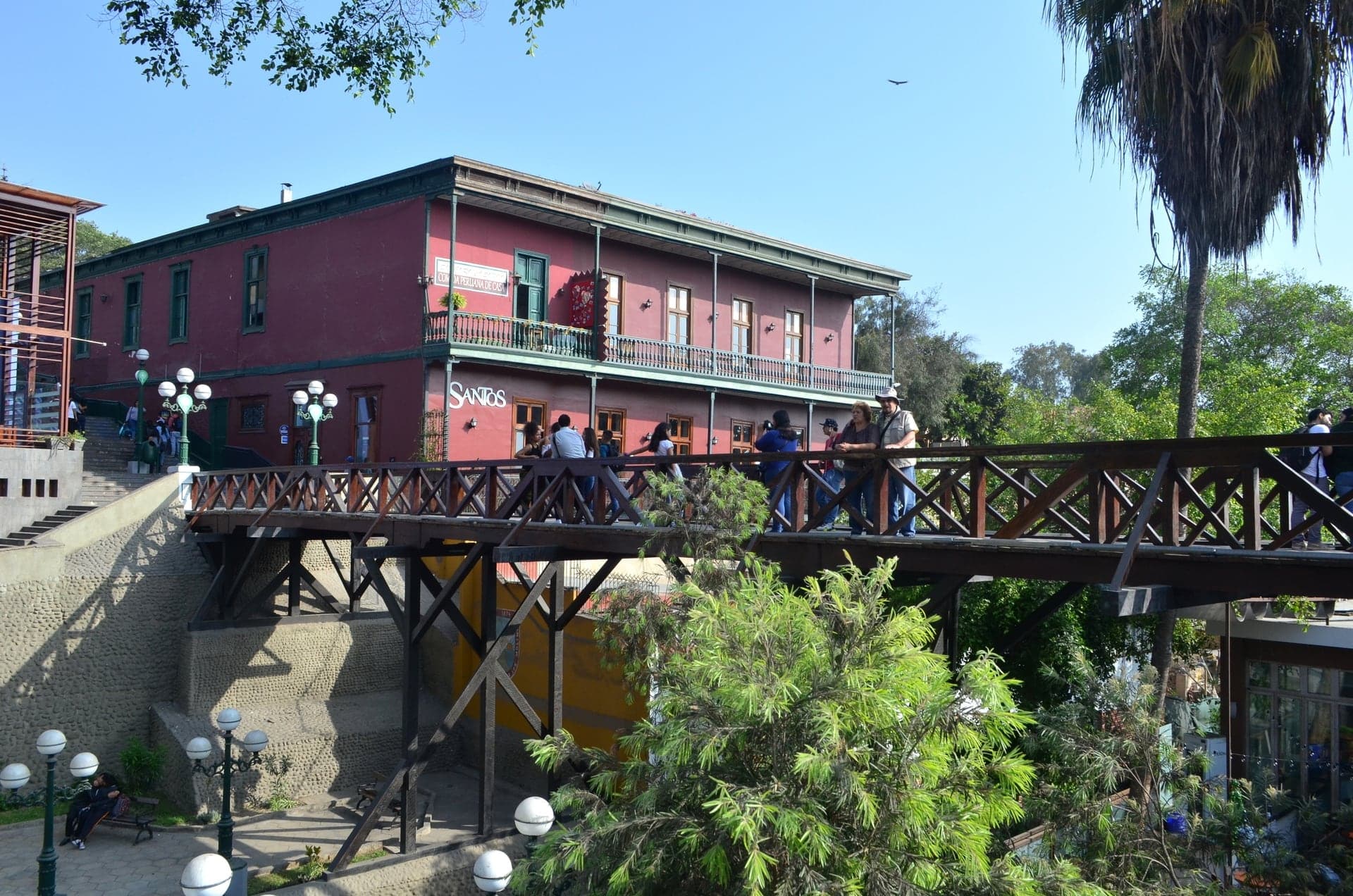
The Puente de los Suspiros is a wooden footbridge in the Barranco district of Lima. It is about thirty-one to thirty-three metres long, three metres wide, and eight and a half metres above the ravine it spans. It carries pedestrians from one side of a small descending lane, the Bajada de los Baños, to the other, allowing them to walk across what would otherwise be a steep dip and climb. As infrastructure, it is modest. As an engineering object, it is unremarkable. It is also not quite the original: the bridge opened in 1876 was forty-four metres long, part of it burned in 1881 and was repaired, and the deck and handrails under your feet date from works that closed the bridge in February 2026 and reopened it on 21 August 2026.
If you were judging the bridge purely by what it is, you would walk over it in thirty seconds and forget it. Nearly nobody does. The Puente de los Suspiros is Barranco's most famous landmark, and effectively the symbol of an entire neighborhood. It got that way through a combination of accident, atmosphere, and one specific song.
What the bridge was for
The 1870s were the high point of Barranco's first life, as the summer suburb where Lima's criollo aristocracy escaped the heat and dust of the colonial centre. Wealthy families built summer houses on the cliffs above the Pacific, which Barranco calls ranchos, of adobe, quincha (cane and mud), timber and clay tile. Above the ravine stood La Ermita, a chapel first built in the second half of the 1700s by a baker named Caicedo. And they laid out a system of streets that descended from the cliff-top houses down to the beach, because the entire point of being in Barranco in the summer was to bathe in the cold Pacific.
The most important of those descending streets was the Bajada de los Baños, the Descent to the Baths, named for the Baños de Barranco, the bathing houses on the beach it led to. It cuts down the cliff face toward the sea through a quebrada, a ravine that fishermen once used to reach the shore. In his 1894 book La línea de Chorrillos, the writer Juan de Arona credits a nineteenth-century chaplain, Manuel Andrés de la Fuente Chávez, with opening the path by releasing dammed water that widened the ravine to the sea. In the early 1900s the mayor Pedro Herouard paved it. At one point the ravine widens enough to create a small valley, and the path from one cliff-top neighborhood to the other would have required descending into the valley and climbing out the other side: an annoying minor effort for someone in evening dress.
The Puente de los Suspiros solved that. Opened on 14 February 1876, it spans the valley directly, allowing pedestrians to cross from one side of Barranco to the other at cliff-top level without going down and up. The original was forty-four metres of wood. Getting to Barranco at all was the railway's job: the line between Lima and Chorrillos had run through the district since 1858, and in 1904 an electric tram line opened that reached Barranco first.
On 14 January 1881, during the War of the Pacific, Chilean troops set much of the town on fire, and part of the bridge burned with it. The mayor, Alberto Lafón, obtained six hundred soles from the Chilean commander to restore La Ermita and the damaged stretch of the bridge, and today it is thirty-one to thirty-three metres long, built of Oregon pine. The tram stopped after a strike in 1965. The bridge is still in use.
Why "Sighs"
Hear a stop from this walk
Mirador Catalina Recavarren: The Edge of the Pacific
The name has nothing to do with Venice. The Bridge of Sighs in Venice, the Ponte dei Sospiri, was a covered limestone bridge built in 1600 connecting the Doge's Palace to the New Prison. The sighs commemorated by the name were the sighs of the condemned, taking what was traditionally their last look at daylight before being walked into the cells. The Venetian bridge is morbid. The name fits.
In Barranco, the sighs are mostly romantic. Barranco tells two stories about them. In one, gentlemen leaned on the rail and sighed at the young women walking to La Ermita, the church at the far end of the bridge. The sighs were longing, the slightly theatrical exhalations of courtship. In the other, closer in mood to Venice, a rejected lover let out one last sigh here before he jumped. Whether actual sighing occurred in any historically documented way is impossible to verify. What is verifiable is that for years the bridge was known by the names of mayors, and the name you know stuck only after 1960.
Today the bridge has a folk tradition: a person crossing it for the first time should hold their breath from one end to the other and make a wish while doing so. If they make it across without exhaling, the wish comes true. The tradition is undated, probably twentieth-century, almost certainly nineteenth-century-themed, and entirely sincere in the way most folk customs eventually become.
Chabuca Granda
The bridge would probably still be locally famous without her. It would not be nationally famous. The reason the Puente de los Suspiros is, for many Peruvians, the visual shorthand for Lima itself is that Chabuca Granda turned it into one.
María Isabel Granda Larco, known as Chabuca Granda, was born in 1920 in the Andean mining town of Cotabambas Auraria. Her family moved to Lima when she was a child, and she grew up in Barranco, in a house on the Bajada de los Baños, where she lived until her teens. She trained as a singer, then as a songwriter, and over the course of a career that lasted until her death in 1983 she became a composer of música criolla, the coastal-Lima musical tradition built around the Peruvian vals, a slow triple-metre waltz played on guitar and cajón.
Her most famous song, "La flor de la canela," composed in 1950, is the unofficial anthem of coastal Lima. It describes a woman walking through Lima at dawn, the city's colonial bridges, the river, the jasmine in the streets. The song is so embedded in Peruvian culture that most Limeños know the lyrics without having ever consciously learned them. The "puente" in the lyrics is the Puente Trujillo over the Rímac River, but the broader Lima geography evoked by the song, the colonial streets, the gas-lamp atmosphere, the bridges, became a kind of imagined landscape that listeners projected onto every old bridge in the city, including Barranco's.
Then she wrote about Barranco's bridge directly. In 1960 she composed El puente de los suspiros. Until then the bridge had been known by the names of mayors; after her song, the nickname stuck for good. Through her, the bridge became a physical image of a musical tradition that defined what Lima sounded like in the mid-twentieth century. Generations of Peruvians who never visited Barranco knew the bridge from her song.
That is the reason a wooden footbridge a little over thirty metres long, with no engineering distinction, is the symbol of a neighborhood and, for many, of an entire city. A composer of national stature wrote a song about it, and the bridge stopped being infrastructure and became image. A statue of Granda by Fausto Jaulis, a sculptor from Ayacucho, stands in the small plaza at the La Ermita end of the bridge, beside José Antonio de Lavalle on a Paso horse, the subject of her 1957 song José Antonio. Buskers play her songs nearby. The relationship is reciprocal: she made the bridge famous, and the bridge keeps her music in the air.
What to do on the bridge
The practical advice is short. The bridge takes well under a minute to cross at a normal walking pace, depending on how crowded it is. Most adults can hold their breath for that long without difficulty, so the wishing custom is achievable rather than aspirational. The view from the centre is of the small ravine path below, paved in the early 1900s, with the descent to the beach visible to the west and the streets of Barranco rising on either side.
The best time to cross is at evening. The lights added in the 2026 works, above and below the deck, switch on by themselves at 6 pm. Couples photograph each other at the railings. Buskers, almost always, are playing música criolla a few metres away. The air smells of jasmine and salt. If you have a song in mind, this is the place to hear it. The bridge is stop eight of the Barranco: The Bridge of Sighs and the Way Down to the Sea walk, between the Bajada de Baños and the little square named for Chabuca Granda.
What you are walking across is a piece of nineteenth-century summer-resort infrastructure that became, accidentally, through the persistence of a single artist's affection for one specific neighborhood, the symbol of a city. Barranco raised Chabuca Granda. Chabuca Granda named the bridge. The two are inseparable, and the wooden deck under your feet is the simplest expression of how a song can outlive its setting, and then keep the setting alive.
Ready to experience it?
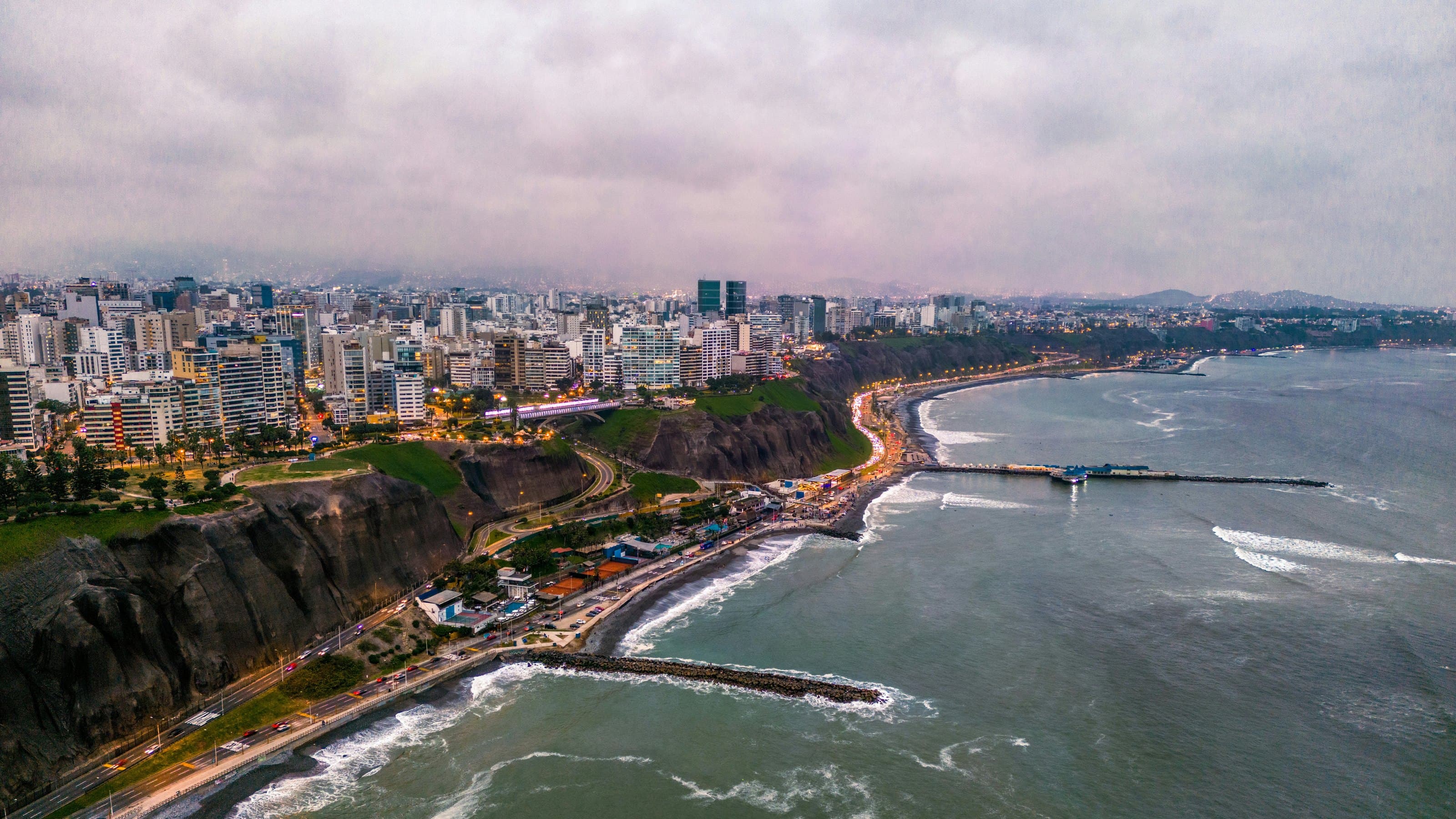
Barranco: The Bridge of Sighs and the Way Down to the Sea
65 min · 1.8 km · easy
More from Lima
Explore more at your own pace.
Best Self-Guided Walking Tours in Lima (2026)
Lima Travel Guide: How Many Days, Getting Around, When to Go (2026)
One Day in Lima: A Coast-to-Colonial Itinerary (2026)
Best Culture Walking Tours in Lima (2026)

What to Eat in Lima: A Food Guide (2026)