Stand in Plaza San Martín and everything around you looks old: white and cream fronts with towers, a general on horseback on a tall stone base, arcades along two sides. None of it is colonial. The square opened on 27 July 1921, for a hundred years of Peruvian independence, on a block where the station of the Lima-Callao railway had stood, and it opened unfinished: the buildings that frame it came over the next two decades. That is the first lesson of Lima's historic center, and the Historic Center: The City of Kings, Rebuilt walk is built on it. Lima is older than it looks, and newer than it looks.
A checkerboard from 1535
Francisco Pizarro founded Lima in January 1535 in the valley of the Rímac, on the lands of a local lord, the curaca Taulichusco. The founding act, dated 18 January 1535, is kept in the city's historical archive. He called the town the City of Kings, probably for the Three Kings of Epiphany: the search party that chose the site had set out on 6 January, and historians still argue whether the name honours the Magi or the Spanish monarchs. The name Lima is older than the Spanish. It comes from an old word meaning "the one who speaks", the name of a pre-Inca oracle that stood here, and sixteenth-century documents call the river the río de Lima.
The streets are the oldest thing you can still walk. The town was laid out as a checkerboard of about 117 blocks, each about 125 metres a side and cut into four lots. The Crown wrote that pattern into law only in 1573, thirty-eight years later, so Lima's grid came before the royal ordinances, not from them. Until the 1860s every block of a street had its own name. Walk the Jirón de la Unión, the old main street between the two squares, and a yellow plaque still tells you that block eight was the Calle de Boza, for the house of the Marquis of Casa Boza. In the 1860s the city renamed its streets after Peru's regions and rivers, which is why you cross Ucayali, a river of the Amazon, and Junín, a highland department.
What the earthquakes left
Hear a stop from this walk
Casa de Osambela: The Lesson of 1746
UNESCO points to the earthquakes of 1586, 1687 and 1746: after them, buildings were stabilized with adobe and brick on the ground floor and quincha above: a light, flexible frame of wood or cane filled with mud. In 1746 the two towers of the cathedral fell, almost every house in Lima was damaged, and the tsunami that followed killed nearly everyone in the port of Callao. The viceroy, José Antonio Manso de Velasco, later Count of Superunda, had advice from the French mathematician Louis Godin: wider streets, lower houses and quincha in place of stone; the rich fought to keep their upper floors, and the city settled on adobe below and quincha above. Light, flat roofs, on a coast where it almost never rains, help explain why the death tolls of 1687 and 1746 were relatively low.
You can read the answer to the earthquakes in stone. La Merced was rebuilt after 1687 with light vaults, and its carved front, attributed to the friar Cristóbal Caballero, was finished around 1702. In January 1697 a muleteer was hired to bring its stone down from a highland quarry, and its upper tiers step back as a guard against earthquakes. The friars say Lima's first Mass was held here before the city was founded; that is their tradition. And the front you see today is a twentieth-century reconstruction by the architect Emilio Harth-Terré, copying the old one.
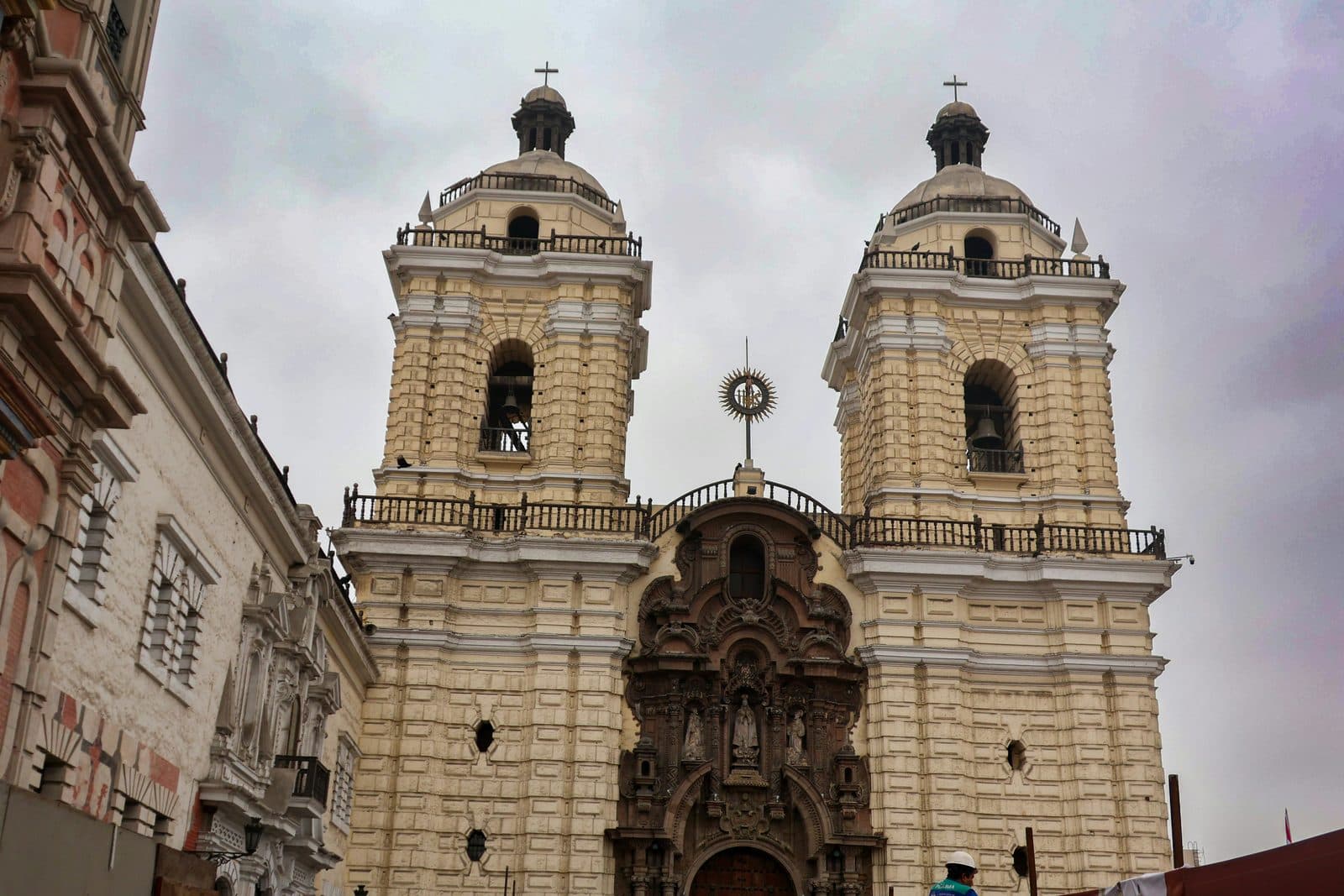
San Francisco tells the same story twice. Its church was begun in 1657 and consecrated in 1672; the earthquake of 1687 broke its brick vaults, and they were rebuilt in wood and cane. Its famous yellow is recent: a colour study by the city's historic-center programme found that it has been yellow for about seventy years and was white and black for far longer.
Balconies, real and copied
Lima's closed wooden balconies are the center's signature. Torre Tagle, begun around 1733 for the first Marquis of Torre Tagle, has two great carved box balconies on a carved stone front, and Peru's Foreign Ministry has used the house since 1920. The wood came by sea, because the coast has almost no forest, and the old balconies were painted blue-green against woodworm before the dark brown of the nineteenth century. The first balconies of the 1500s were open galleries; the lattice that lets people inside watch the street without being seen came later. The popular count of 1,600 balconies and the story that the design came to Lima from Baghdad have no source.
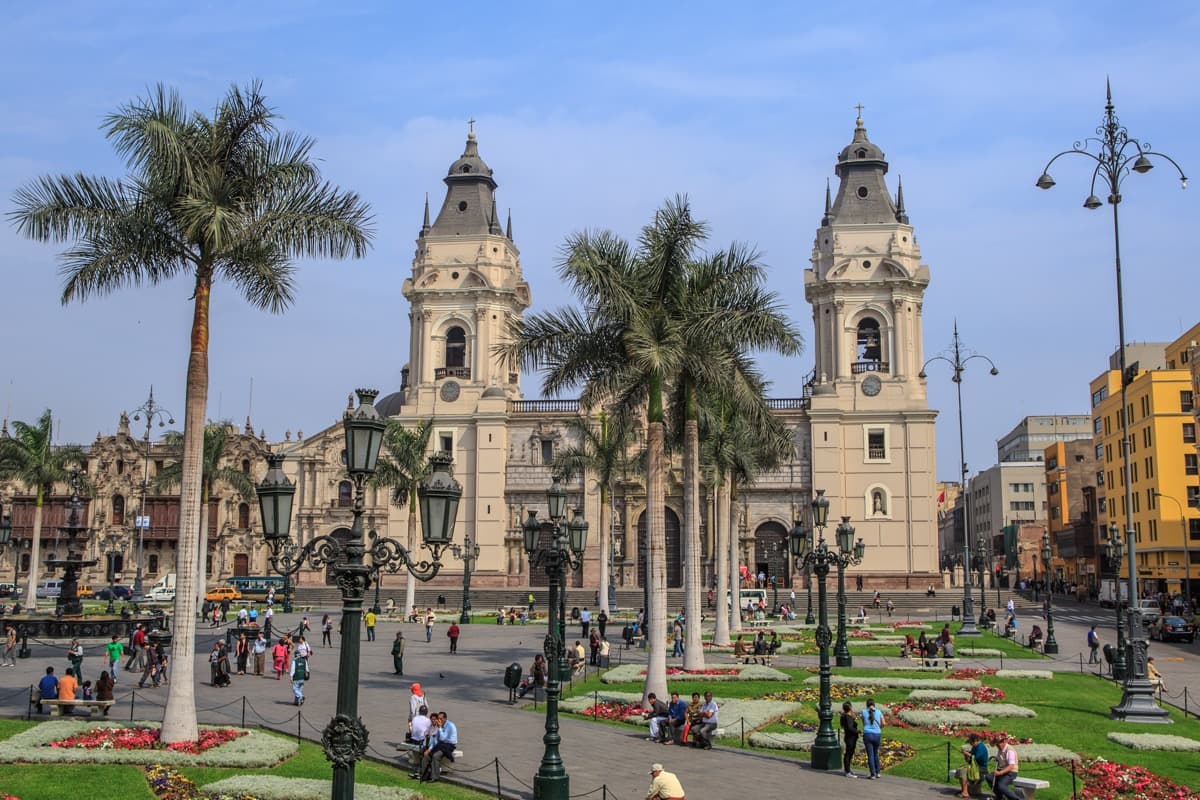
Now look at the Archbishop's Palace on the Plaza Mayor. Its two great balconies are not survivors. The palace was inaugurated on 8 December 1924, designed by Ricardo de Jaxa Malachowski, a Polish architect trained in Paris, with Claude Sahut, and it took Torre Tagle as its model. The Government Palace across the square stands where Pizarro built the first palace in 1536; after a fire in 1921 Sahut began a new one, and Malachowski finished it in 1937 and 1938. The Municipal Palace and its long balcony were rebuilt in the 1940s. A young republic rebuilt the colony it wanted to remember.
The oldest thing in the square
So what in the Plaza Mayor is truly old? The bronze fountain, inaugurated in 1651, though the figure on top has been replaced. The cathedral's first church opened in 1540, and for most of the last century, from 1891 to 1977, the cathedral displayed the wrong body as Pizarro's; in 1977 his bones turned up in a lead box engraved with his name, in a walled-over niche of the crypt. San Martín first proclaimed Peru's independence in this square on 28 July 1821, and the changing of the guard at the Government Palace is usually held around midday. The square itself is often fenced by police, so the walk reads it from the streets round its edge.
The lesson of 1746
The walk ends among Lima's oldest institutions. At Santo Domingo, where the Dominicans built from the 1530s, the University of San Marcos, founded by royal decree on 12 May 1551, held its first classes. The church tower, finished around 1780, was for a time the highest point in the city. A few doors along Conde de Superunda, the street named for the viceroy of the great earthquake, the Casa de Osambela, built around 1800 for a Navarrese merchant, Martín de Osambela, carries a long row of closed wooden balconies and a lookout on the roof. Its front was restored in 2026, and the house now belongs to Peru's national academies.
The walk runs twelve stops over about 2.5 kilometres, roughly an hour and three quarters, from Plaza San Martín to the Casa de Osambela. The San Francisco catacombs, where tens of thousands of Limeños were buried until the city cemetery opened in 1808, are a guided, ticketed visit rather than a stop. Walk the center once for its colonial bones and once more for its 1920s face, and you will start to read every street in it.
Ready to experience it?
Historic Center: The City of Kings, Rebuilt
105 min · 2.5 km · easy
More from Lima
Explore more at your own pace.
Best Self-Guided Walking Tours in Lima (2026)
Lima Travel Guide: How Many Days, Getting Around, When to Go (2026)
One Day in Lima: A Coast-to-Colonial Itinerary (2026)
Best Culture Walking Tours in Lima (2026)
What to Eat in Lima: A Food Guide (2026)