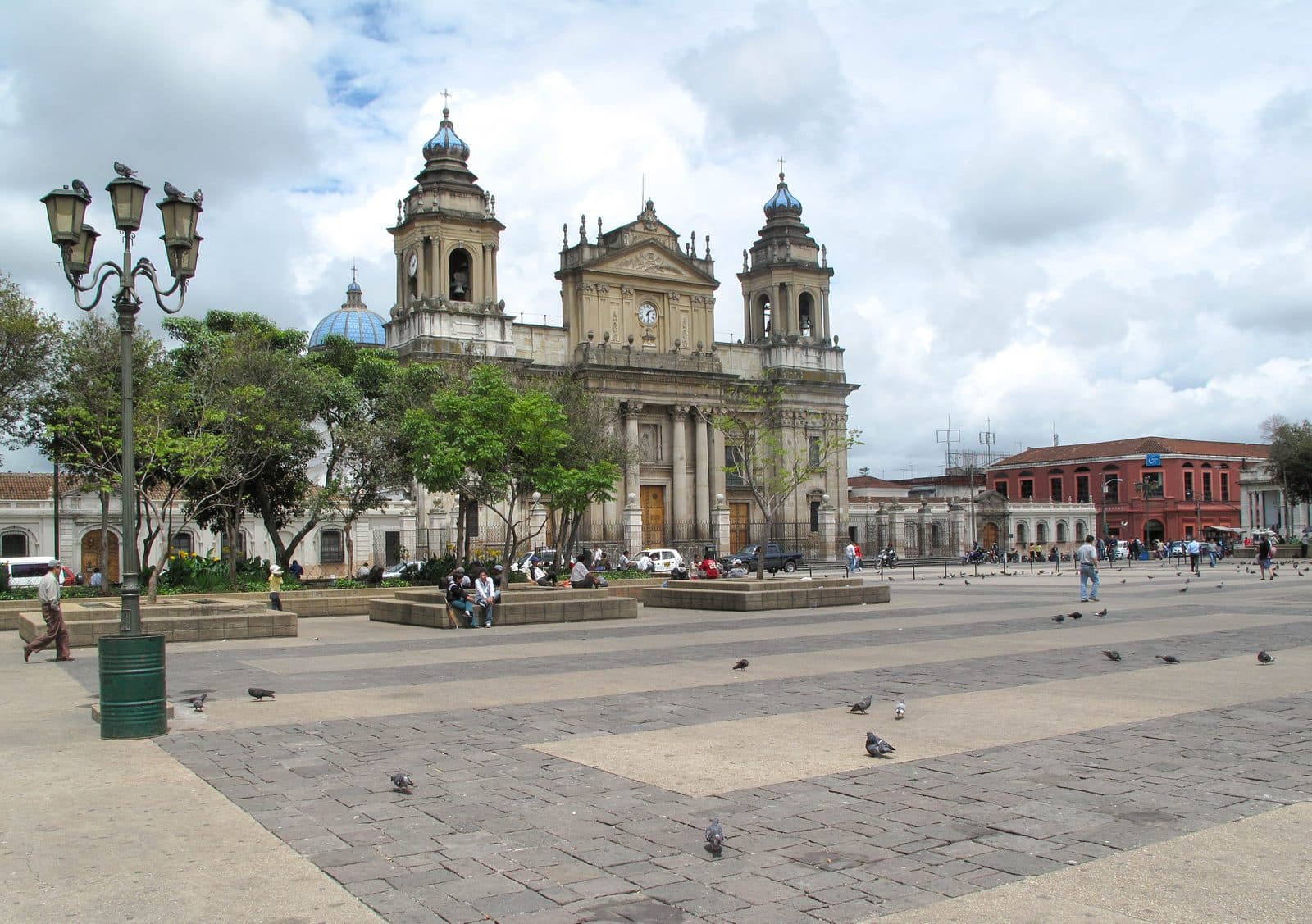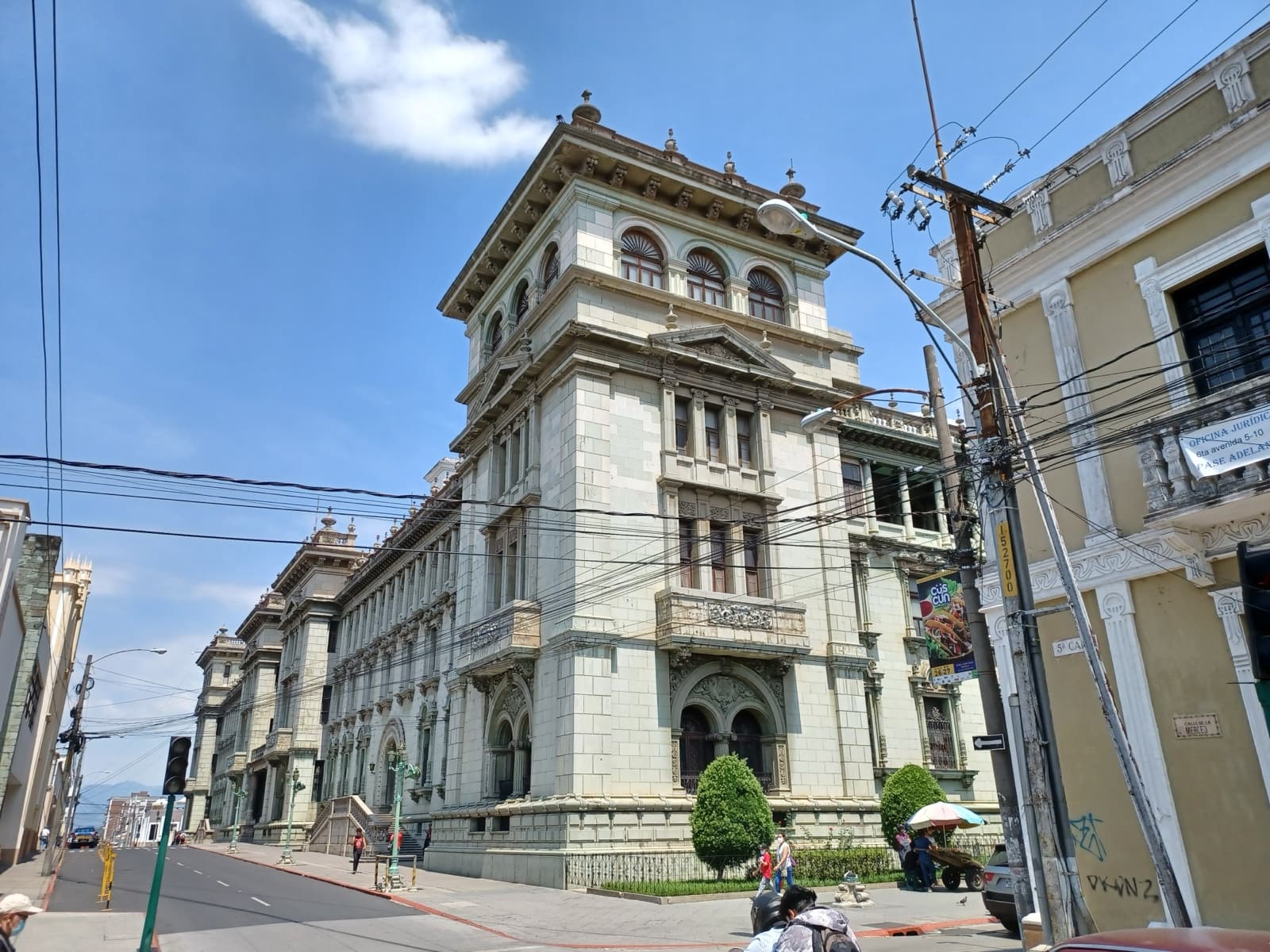
The Palacio Nacional de la Cultura sits on the north side of the Plaza de la Constitución in Guatemala City, facing the Catedral Metropolitana across the open square. It is the third building to occupy this site. The first, a colonial government palace from the late eighteenth century, was destroyed by the 1917 earthquake. A temporary palace built afterward in a different style stood until the 1930s. The current building, with its distinctive green cement façade, was built between 1939 and 1943 by the dictator Jorge Ubico, who inaugurated it on November 10th, 1943, his own birthday.
Ubico occupied his palace for seven months. By July 1944, he had resigned in the face of a popular uprising. Every regime that has governed Guatemala since has used this building. It has been a presidential residence, a ministerial complex, the site of the 1996 peace accord signing, and, since 1999, a designated cultural museum. The building's afterlife is much longer than the dictator's. The afterlife is what this stop is about.
What Ubico thought he was building
Jorge Ubico Castañeda became president of Guatemala in 1931 and ruled as a dictator until 1944. He was an admirer of Napoleon and, increasingly across the 1930s, of European fascism. He had read the German theorists. He had received Mussolini's military attachés. He thought of himself as a national modernizer in the strong-leader mode that the interwar period made common.
The new National Palace was Ubico's signature public works project. It was designed by the engineer Rafael Pérez de León, who had already directed the Obelisco project at the north end of the future Avenida de Las Américas in 1935. Pérez de León was working in a vocabulary that mixed neoclassical proportion with art deco ornament, the same vocabulary that produced government buildings of the same decade in Buenos Aires, Mexico City, and Rome. The result is a square palace, two storeys above grade and one below, organised around two large interior courtyards, with five floors when you count basements and intermediate levels. Ubico was obsessed with the number five. The building has five floors, five arches per courtyard side, five doors opening from the main reception hall onto the presidential balcony, five steps in the formal entries. The dictator did not write his obsession down explicitly, but the building documents it.
The construction labour was provided by prisoners from the Central Penitentiary. They were paid roughly a quarter of a cent per day. The historian Heather Vrana, in her study of Guatemalan state architecture, documents how the labour arrangement was treated by the regime as a form of patriotic contribution rather than as exploitation. The prisoners were not given the option of refusing.
The exterior is a distinctive pale green colour. The colour is not paint applied after construction. It is cement mixed with copper sulphate during pouring, which oxidises the surface to that specific shade. Some accounts, including those of the colonial-period historian Inés Cifuentes, attribute the choice to Ubico's wife, Marta Lainfiesta, whose favourite colour it was said to be. The students at the Universidad de San Carlos quickly nicknamed the building El Guacamolón, the Big Guacamole. The nickname has outlasted Ubico's regime by eighty years.
A persistent piece of palace lore is that hundreds of door handles, some sources say over seven hundred, were cast with the imprint of Ubico's own right thumb. The thumbprint, if it is there, is reproduced on every door. The story has not been fully verified by published metallurgical analysis, but Ubico's documented obsessions are consistent with the claim. It is the kind of detail that would be precisely in character.
The palace was inaugurated on November 10th, 1943, Ubico's sixty-fifth birthday. The dedication ceremony involved military review and a Te Deum in the cathedral across the plaza. Ubico made a speech.
How long the dictator kept the palace
Hear a stop from this walk
Mercado Central: The Invisible Economy
The answer is two hundred and thirty-three days.
On June 25th, 1944, a young teacher named María Chinchilla Recinos was killed by mounted police when government cavalry charged a women's silent march protesting Ubico's regime. She had been carrying the national flag. The killing crystallised opposition. The next day, June 26th, fifty thousand people, by contemporary estimates, filled the Plaza de la Constitución, the square in front of the palace. The crowd did not disperse. By July 1st, 1944, Ubico had submitted his resignation. He left for Mexico, then for New Orleans, and died there of lung cancer in 1946 in a rented house in a city that was not his.
The regime did not collapse immediately. A military junta tried to hold power. On October 20th, 1944, a second uprising, the October Revolution, ousted the junta. Guatemala's first free election followed, and Juan José Arévalo, the philosophy professor who had spent the dictatorship in exile in Argentina, was inaugurated as president on March 15th, 1945.
Arévalo's government occupied the same palace Ubico had built. The country's first democratic government worked from the dictator's desks. The murals inside the palace, painted by Alfredo Gálvez Suárez between 1942 and 1944, depicted scenes from Guatemalan history including the pre-Columbian Maya past, the Spanish conquest, the Liberal reforms, and an idealised image of contemporary Guatemalan agriculture. Gálvez had studied alongside Diego Rivera, David Alfaro Siqueiros, and José Clemente Orozco in the Mexican muralist tradition. His murals inside Ubico's palace celebrated indigenous culture in a regime that had suppressed it. The murals are now treated as part of the building's cultural heritage. Visitors can see them on a guided tour.
Every regime after Ubico
The palace was the executive seat of the Arévalo government (1945 to 1951) and the Jacobo Árbenz government (1951 to 1954). Árbenz, an army officer who had been part of the October Revolution, pushed an ambitious land reform programme. Decree 900, the agrarian reform of 1952, expropriated unused United Fruit Company land for redistribution to peasants. The United Fruit Company, with the backing of the Eisenhower administration in Washington, lobbied for action. In June 1954, the CIA's Operation PBSUCCESS engineered a coup that brought Colonel Carlos Castillo Armas to power. Árbenz fled. The palace passed to the new regime.
The next four decades saw a sequence of military governments, civil war, and intermittent civilian-administered periods. The palace served as executive headquarters across all of them. On September 5th, 1980, in the middle of the civil war, a guerrilla car bomb detonated outside the building's east entrance. The blast killed six adults and a child, all civilians. It shattered most of the original stained-glass windows depicting Ubico's ten civic virtues, including a panel of virtues called "Probity" that, by the dictator's own instruction, had been signed by him personally. The shattered glass was replaced after the war. Some of the original fragments are preserved in the building's archive.
On December 29th, 1996, the Accord for a Firm and Lasting Peace was signed in the palace's reception hall. The signing ended the thirty-six-year civil war. The signatories included President Álvaro Arzú, the URNG guerrilla command, the Catholic Church, and international witnesses. The accords are now inscribed on UNESCO's Memory of the World Register. The signing happened in a room Ubico had built. The same dining room where the dictator had held banquets in 1944 was the room where the URNG commanders sat down with the army that had spent decades trying to destroy them.
In 1999, the building was decommissioned as a working presidential palace. The president and the executive ministries moved to a different complex in Zona 14. The palace was converted to a cultural museum, the Palacio Nacional de la Cultura, open to the public. Tours run daily. Admission is free for Guatemalans and modestly priced for foreigners.
What to look at
The principal courtyard, the patio mayor, is the building's structural heart. It is open to the sky. The walls are organised in five arches per side, supporting an upper gallery. The floor is laid in a five-pointed pattern. Stand in the centre and the building's geometry is fully visible.
The grand staircase, the escalera de honor, climbs from the patio mayor to the second floor. The handrail is bronze. The risers are marble brought from Cobán. The ceiling above the staircase is painted with Gálvez Suárez's murals. Look for the panel depicting the founding of Iximché, the Kaqchikel capital that was the first Spanish-Maya alliance settlement before the relationship turned hostile. The mural was painted in 1943 by a man working under a dictator while honouring an indigenous past the dictator's regime was actively trying to assimilate.
The Salón de Recepciones, the reception hall on the second floor, is the room where the peace accords were signed. A plaque marks the event. The room is otherwise unchanged from its Ubico-era appointments. The chandelier was made in Murano. The wooden floor is original. The same room has hosted the inaugurations of presidents, the lying-in-state of national figures, and now, in its museum afterlife, occasional public concerts.
The basement crypt holds the remains of Pope John Paul the Second's gift to Guatemala, a small reliquary commemorating his 1996 visit. The reliquary is one of the more recent objects in the building.
What the building is for
The Historic Center walking tour treats the palace as the answer to a question the tour keeps asking: who does the rebuilding outlast. The dictator built the building. Fifty thousand people took it away from him within a year. A guerrilla bomb shattered his stained-glass virtues thirty-six years later. Peace was signed in his dining room. The building outlasted every claim made on it.
What the building means now, as the Palacio Nacional de la Cultura, is contested in exactly the way the rest of the city is contested. To some visitors it is a museum of dictatorship. To others it is the architectural shell of the Peace Accords. To architecture students at San Carlos it is still El Guacamolón. To the descendants of the prisoners who built it, it is something else. The walls do not adjudicate. They hold the contradictions and stay standing.
You can walk through the palace in about an hour. Free admission for Guatemalans, modestly priced for foreigners, Tuesday through Sunday. The tour pauses outside this building because the audio only has time to name what happened here. The walls themselves are the longer text. Sit on the steps of the cathedral across the plaza for a while and look at the green façade. The building has been doing the same job for eighty years. It will keep doing it.
Ready to experience it?
Historic Center: Who Rebuilt This City
75 min · 2.33 km · easy
More from Guatemala City
Explore more at your own pace.
Best Self-Guided Walking Tours in Guatemala City (2026)
Guatemala City Travel Guide: How Many Days, Getting Around, Is It Safe (2026)
One Day in Guatemala City: A Walkable Itinerary (2026)
Best History Walking Tours in Guatemala City (2026)
What to Eat in Guatemala City: A Food Guide (2026)