The Historic Center walk takes you through six stops in Zona 1 across two and a half kilometres. You start at the parish house of San Sebastián, the building where Bishop Juan José Gerardi was beaten to death in April 1998, two days after he presented the truth commission report on the civil war. You finish at the Iglesia de San Francisco, the church whose congregation revived a Holy Week tradition that the institutional Catholic Church had nearly extinguished. Between those two endpoints, the audio walks you through four other rebuilds. Each one is the work of a different actor with different motives. The walking tour is short on purpose: the texture sits in the layers, not in the distance.
This is the page where the layers get more time.
Why this city exists in this valley
Guatemala City did not happen by accident or by the natural growth of a small settlement into a regional capital. It was decreed. The 1773 Santa Marta earthquake destroyed Antigua, and the Spanish Crown ordered a new capital in 1775 in the Valle de la Ermita. The plaza you reach at Stop 4 was laid out in 1776 by the architect Marcos Ibáñez. The east-west streets follow the cardinal axis Ibáñez plotted. The grid you walk on was inherited from a colonial bureaucracy operating five thousand miles from the place it was reshaping.
The financier of the move was Fermín de Aycinena, the wealthiest individual in Central America in the late eighteenth century. The Aycinena family had built their fortune on indigo cultivation and on the Atlantic trade, and they used the relocation of the capital to consolidate their position in the new urban geography. They took the lots on the south side of the plaza. They have remained influential ever since. The political historian Greg Grandin, in his work on Central American oligarchies, treats the Aycinenas as a case study in how a single family can hold political weight across the entire arc of independence, liberal reform, and post-civil-war negotiation. The street that runs in front of their original mansions, the Calle Real of the colonial period, is now the Sexta Avenida, the pedestrianised promenade you walk down at Stop 2.
Bishop Gerardi and the document he wrote
Hear a stop from this walk
Mercado Central: The Invisible Economy
Stop 1 is a parish house. There is almost no signage. The audio gives you the basic shape: Bishop Juan José Gerardi Conedera was the auxiliary bishop of Guatemala and the head of the Archdiocese's Office of Human Rights. On April 24th, 1998, he presented the four-volume report Guatemala: Nunca Más in the cathedral. The report attributed eighty percent of the civil war's documented human rights violations to the Guatemalan Army. He was bludgeoned to death in the garage of this parish house forty-eight hours later.
What the audio does not have time to spell out is what the report actually was. The Recovery of Historical Memory Project, the project Gerardi ran, collected testimony from more than five thousand survivors and witnesses over three years. It was a deliberate effort to gather evidence outside the channels of the United Nations Commission for Historical Clarification, which was the official truth commission of the post-war negotiation. The Archdiocese's report came out three months before the UN's. It named perpetrators where the UN report would not. It made a claim about institutional responsibility that the UN's mandate forbid it to make.
Three military officers and a priest were convicted of Gerardi's murder in 2001. None served a full sentence. The reporter Francisco Goldman spent years investigating the case and produced a book, The Art of Political Murder, which remains the most thorough public account. The Archdiocese's Office of Human Rights still exists. The Recovery of Historical Memory archive is preserved at the University of Texas at Austin.
What Gerardi rebuilt was the historical record. The institution that had destroyed the record destroyed the man who rebuilt it. The record survived. That is the tour's first answer to the question of what rebuilding actually outlasts.
The street that was every name
Stop 2 is the Paseo de la Sexta. The avenue has had five names in two hundred and fifty years. The Spanish called it Calle Real because it led from the cathedral plaza to the royal palace. After the Liberal Revolution of 1871, it became the 30 de Junio in honour of the date of the revolution. In 1877, the engineer Raúl Aguilar Batres replaced the city's named-street system with a numerical grid, and the street became Sexta Avenida, the Sixth Avenue. By the twentieth century, Guatemalans had turned the number into a verb. To sextear was to walk and be seen on this street. The avenue's social function was named into the language.
For roughly a century, whatever was modern in Guatemala happened on Sexta first. Public street lighting in 1835. Gas lamps in 1879. A horse-drawn tramway in 1882. Electric lights in 1885. Teatro Lux, the city's grand cinema, opened on the street in 1936. By the 1990s, the wealthy had decamped to Zona 10, and Sexta was congested, its commerce reduced to cheap clothing stalls and informal vendors selling pirated DVDs and shoes off the pavement. The street that had hosted the country's modernity was reading as a market for the poor.
In 2010, Mayor Álvaro Arzú's administration pedestrianised the avenue. The result is what you walk through: jacarandas, benches, sculpture, no cars. The architectural facades of the early twentieth century, restored in many cases for the first time in decades, are visible above. The street is comfortable in a way it has not been for a generation.
The cost is documented. Approximately six hundred and eighty informal vendors were displaced from the avenue. The academic Rodrigo Veliz Estrada published research on the displacement, treating the vendors not as obstacles to urban improvement but as legitimate participants in the public space. The journalist Gabriela Carrera, writing in El Periódico, called the enforcement that followed "the criminalisation of work for subsistence." The vendors were relocated to a purpose-built market called Plaza El Amate, a long bus ride east of the centre. The trade did not survive the relocation at anything close to its original volume.
Arzú is a complicated figure. He was the president who signed the peace accords ending the civil war in 1996. He came back to Guatemala City as a six-term mayor and used the office to push aggressive urban renewal. His family is among the wealthiest in Guatemala. The audio does not call him a villain. The walk asks you instead to hold the two claims he has on this street next to each other: peace signatory, displacer of vendors.
What the cathedral became
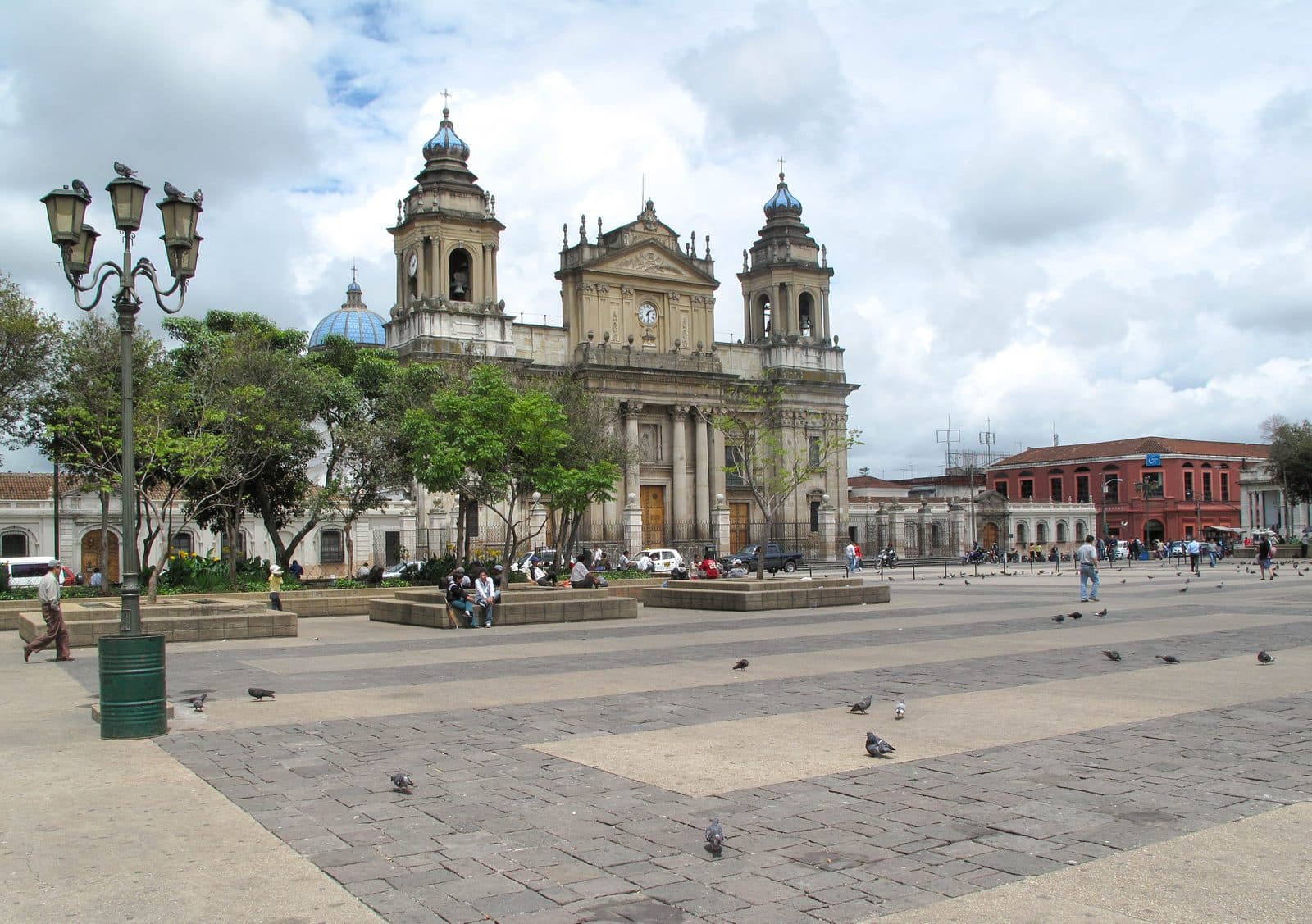
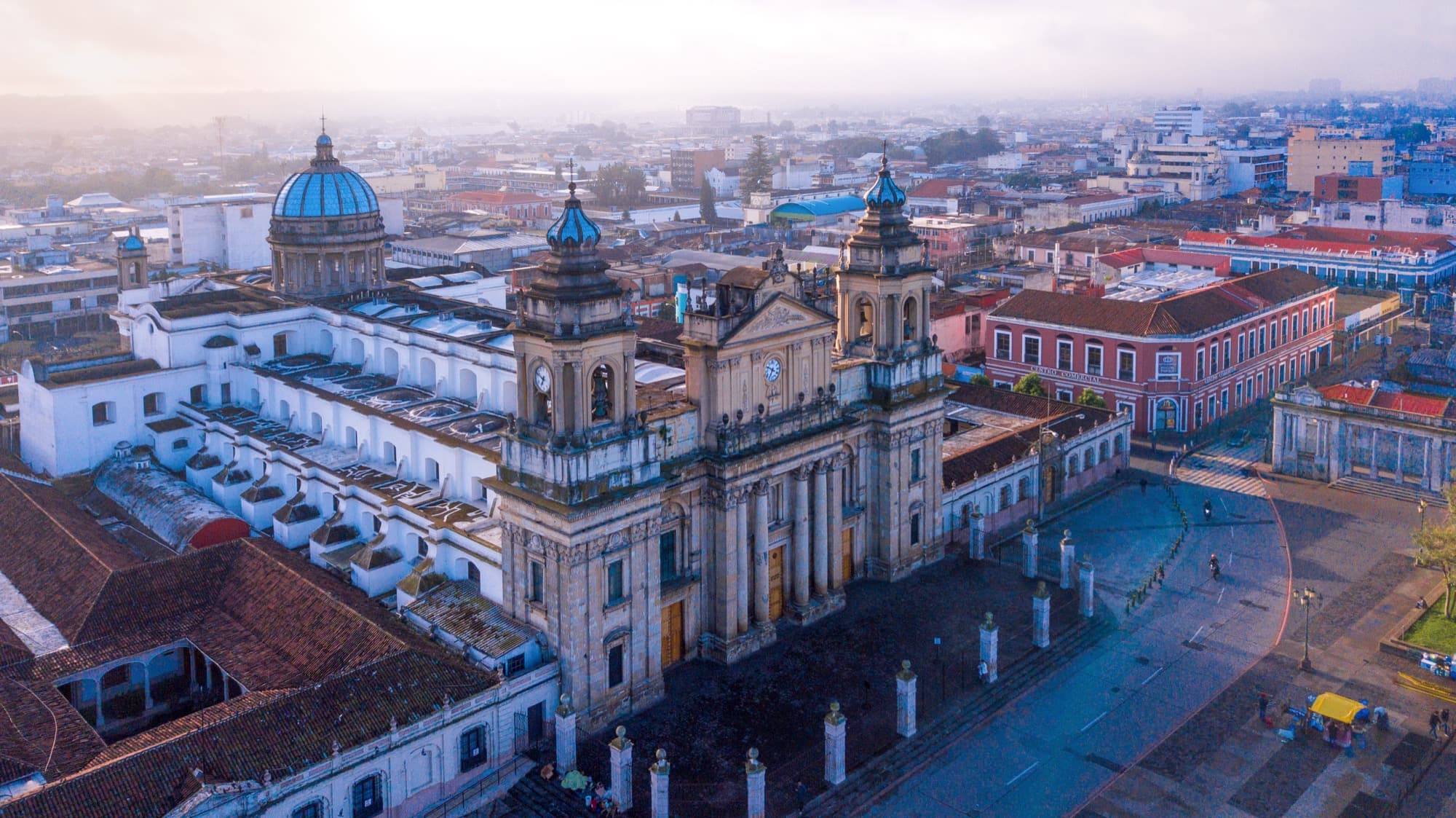
Stop 3 is the Catedral Metropolitana, on the east side of the plaza. The audio gives you the construction history: eighty-five years from the cornerstone in 1782 to the consecration in 1867. Six successive architects. Stonemasons brought in from Oaxaca because Guatemala had no local tradition of neoclassical stone-cutting. The dome and towers rebuilt in reinforced concrete by the Italian engineer Guido Albani after the 1917 earthquake. That concrete saved the building when the 1976 quake hit.
The detail the audio does not have time for is the gilded inscription on the entrance pillars. In 2012, the Archdiocese inscribed the names of people who were disappeared during the civil war on the building's stone. Twelve pillars on the front of the cathedral now carry hundreds of names. The poet and feminist Alaíde Foppa, taken in 1980. Edgar Fernando García, the labour organiser. Jorge Humberto Granados Hernández. Many others. The Amnesty International documentation of the memorial calls the cathedral "the city of the disappeared."
In the crypt beneath your feet, two men with opposite legacies share a chamber. Rafael Carrera, the conservative military caudillo who ruled Guatemala from 1844 to 1865 and shut down most of the country's nineteenth-century reform efforts, is buried in the cathedral he helped finish. Bishop Gerardi, the man from Stop 1, is also buried here. The dictator and the martyr, same room. Two Guatemalas, sharing a floor.
The dictator's palace and the people who took it
Stop 4 is the Plaza de la Constitución and the Palacio Nacional de la Cultura. There is a separate full-length piece on the palace itself, because that one building deserves the depth. For this companion, what matters is the plaza around it. This is where, on the 24th and 25th of June, 1944, fifty thousand people refused the dictator Jorge Ubico. The trigger was the killing of a schoolteacher named María Chinchilla Recinos by cavalry during a women's silent march. By July 1st, Ubico had resigned. The October Revolution that followed brought Juan José Arévalo to power and started Guatemala's brief democratic experiment, which ended in 1954 with a CIA-backed coup.
This plaza is, in the most literal sense, kilometre zero of Guatemalan democratic refusal. It is also where the peace accords were signed in 1996. The square continues to be used for protest. The most recent large protests, against the proposed dissolution of the country's anti-corruption mechanism in 2017 and against the disputed transition of power in 2023, both filled this space. The civic claim on the plaza did not begin with electoral democracy and has not relied on it.
What the vendors built
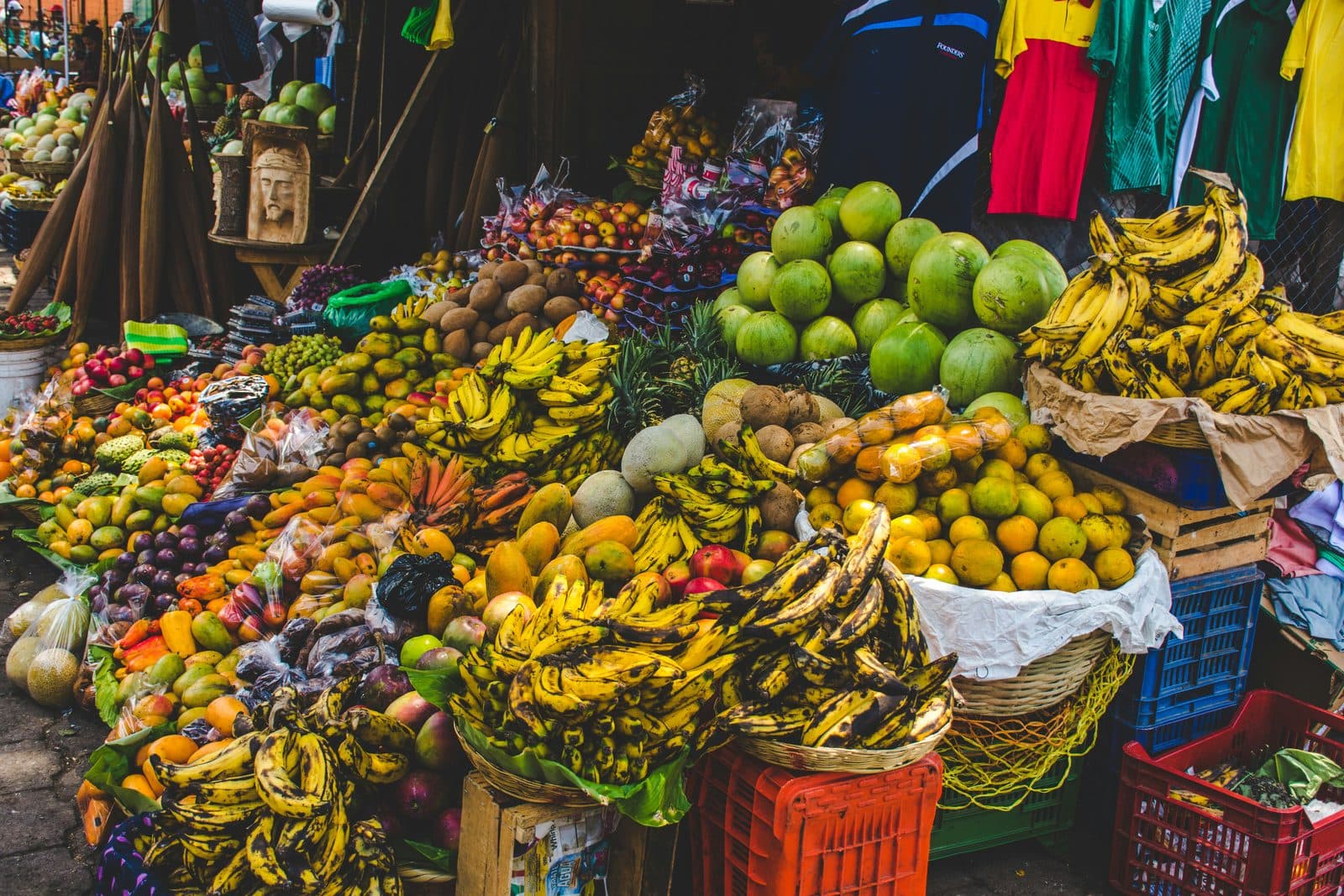
Stop 5 is the Mercado Central, an underground market behind the cathedral that serves roughly forty thousand people a day. The market has no grand entrance. There is no clear signage from the plaza. You walk behind the cathedral, past a parking lot, and you descend three levels.
The audio gives you the historical sequence: the colonial Sagrario cemetery converted to commerce in 1866, the original market opened in 1871, the 1976 earthquake destroying the building, the seven-year gap before reconstruction, the underground market opening in 1983. What the audio does not have time to do is treat the market as a piece of urban planning by people without authority. No government rebuilt it for the vendors. No architect was hired by the displaced merchants. The reconstruction was negotiated. The vendors organised, fought for the site, paid into the construction informally, and re-established their stalls without state subsidy.
The market's informal real estate works through the derechos de llave, the key rights. A stall might rent for two dollars a day, but the right to occupy that stall can cost up to one hundred and thirty thousand dollars. The IMF estimates seventy percent of Guatemala's labour force is employed informally. The Mercado Central is the most legible single example of that economy in the country.
The Holy Week the institution tried to end
Stop 6 is the Iglesia de San Francisco. The church was severely damaged in the 1917 earthquakes, rebuilt by parishioners across the 1920s, damaged again in 1976, and rebuilt again. Each rebuild was funded by the congregation, not by the archdiocese.
The deeper layer is the brotherhood economy of Holy Week. The cofradías, lay brotherhoods that organise the processions and maintain the sacred images, were pushed to the edge of extinction in the late 1960s after the Second Vatican Council. The Council prioritised liturgical modernisation. The cofradías were considered pre-modern, syncretic, insufficiently orthodox. The Cofradía de la Santa Vera Cruz, which has maintained the Señor Sepultado de la Penitencia inside this church for centuries, was nearly dissolved.
Popular devotion revived them. By the 1970s, ordinary Guatemalans had reorganised the brotherhoods and resumed the processions. In 2022, UNESCO inscribed Guatemala's Holy Week processions as Intangible Cultural Heritage of Humanity. The tradition the hierarchy tried to end is now internationally protected.
On Good Friday, the streets around this church fill with sawdust carpets, alfombras, made from coloured flower petals and pine needles. The processions walk over them. The carpets are destroyed within seconds. The sacrifice is the point. The whole production exists because thousands of ordinary residents commit unpaid labour to a tradition the church once wanted gone.
What the walk adds up to
The six stops sit on a line that asks the same question six different ways. The bishop rebuilt the record. The pedestrianisation rebuilt the avenue at someone's expense. The cathedral rebuilt itself across two centuries with foreign stone and Italian concrete and the names of the dead. The plaza is the rebuild that fifty thousand people made by walking into it in 1944. The market is what the vendors rebuilt themselves underground. The church is what the parishioners refused to let the institution take away.
The most durable rebuilds, by some distance, are the ones the people in charge did not author. That is the tour's argument, and it is the argument the city keeps making to itself, in every plaza, every market, every Good Friday, year after year.
Ready to experience it?
Historic Center: Who Rebuilt This City
75 min · 2.33 km · easy
More from Guatemala City
Explore more at your own pace.
Best Self-Guided Walking Tours in Guatemala City (2026)
Guatemala City Travel Guide: How Many Days, Getting Around, Is It Safe (2026)
One Day in Guatemala City: A Walkable Itinerary (2026)
Best History Walking Tours in Guatemala City (2026)
What to Eat in Guatemala City: A Food Guide (2026)