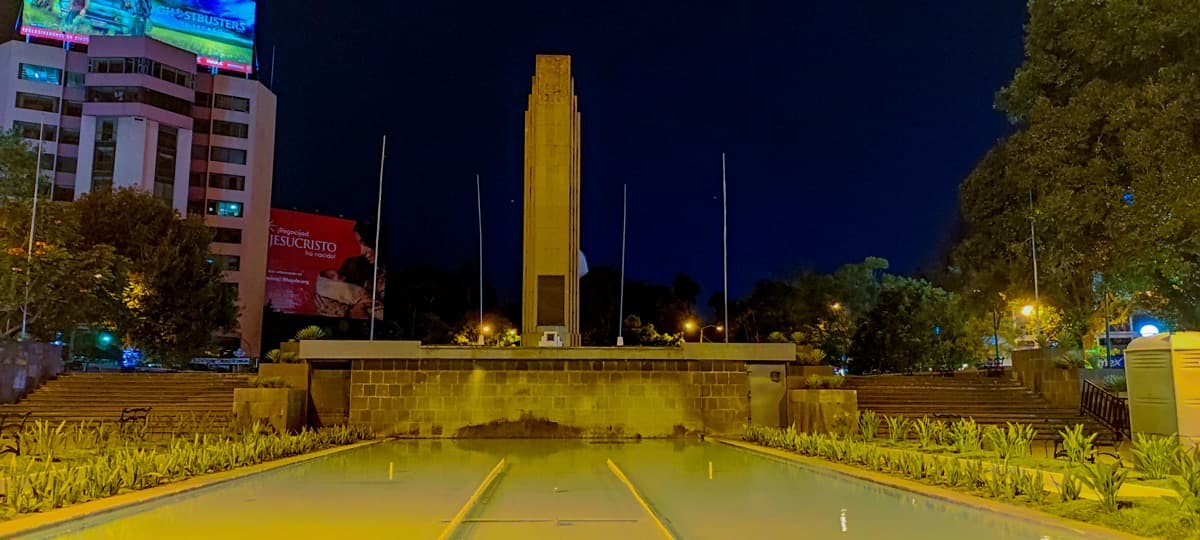
The Obelisco stands at the north end of the Avenida de Las Américas, in the median of a six-lane intersection where the Avenida La Reforma terminates and the Avenida de Las Américas begins. Eighteen metres of concrete and stone, tapered, with a bronze coat of arms at the apex. The plinth carries a series of inscriptions, plaques, and additions accumulated over the last ninety years. At the base, on the south face, a copper brazier, the Altar a la Patria, is set into a recessed alcove with a bronze plaque mounted above it.
The brazier is unlit. It has been unlit for as long as most living Guatemalans can remember. The plaque asks the country to keep the flame burning.
This is the first stop on the Boulevard of the Americas tour, and the audio frames the monument as a palimpsest. The frame is exactly right. The obelisk is one of the most layered objects in the city, and each layer corresponds to a different attempt by a different Guatemalan regime to declare what the country meant. The pillar carries all the attempts. None of them has stuck.
Why Justo Rufino Barrios
The monument was inaugurated on July 19th, 1935. The date was chosen as the centennial of the birth of Justo Rufino Barrios, the Liberal Reform president who governed Guatemala from 1873 until his death in battle in 1885. Barrios is the most consequential figure in nineteenth-century Guatemalan politics. To understand the obelisk you have to understand who he was and why a dictator a half-century later would build a monument to him.
Barrios came to power through the Liberal Revolution of 1871, which overthrew a conservative regime that had governed the country in alliance with the Catholic Church and the rural aristocracy for thirty years. Barrios's Liberal programme was sweeping. He expropriated Church lands and broke up the religious orders, expelling most of them from the country. He secularised the cemeteries and the schools. He imposed the metric system. He opened the country to European immigration, particularly German coffee planters who settled the Verapaces. He built the railway, the telegraph, the first modern roads. He restructured indigenous communal landholdings to make them legally available for purchase, with consequences for highland Maya communities that the historians Greg Grandin and David McCreery have documented in detail. He died in battle in 1885 attempting to forcibly reunify Central America under Guatemalan leadership, an old Liberal dream that did not survive him.
Barrios is, in twentieth-century Guatemalan political memory, the figure on whom Liberal nationalism turned. The 1871 reforms became the founding event of modern Guatemala. The coffee economy he opened became the dominant export. The land laws he passed shaped indigenous communities for the next century. The Liberal Party, in various reorganisations, governed the country for most of the period between 1871 and 1944. Naming a centennial monument to Barrios in 1935 was naming the regime's lineage.
Why Ubico
Hear a stop from this walk
Honduras
Jorge Ubico became president of Guatemala in 1931. He thought of himself as Barrios's heir. The Liberal modernising tradition, the strong-leader-as-modernizer model, ran directly through Ubico's own self-presentation. He travelled the country on motorcycle. He gave radio speeches about national discipline. He was Pan-American in a Cold War sense before there was a Cold War. He admired Mussolini. He was, in 1935, looking for an occasion to monumentalise his own claim to the lineage.
The Barrios centennial was that occasion. The engineer Rafael Pérez de León, who would later direct construction of the National Palace, was commissioned to design the obelisk. The sculptor Rodolfo Galeotti Torres, the most prolific public sculptor of the period, carved the coat of arms at the apex. The location at the head of the Avenida La Reforma was chosen because Reyna Barrios's late-nineteenth-century boulevard had been the most ambitious piece of urban planning before Ubico's regime, and the obelisk would announce that the Liberal axis was being completed.
The monument was unveiled on July 19th, 1935. The military reviewed. The radio broadcast the speeches. Ubico stood at the base of the new column, claimed Barrios's mantle, and was photographed for posterity.
The pillar would outlast his regime by eight decades and counting.
Why Arévalo
Ubico was overthrown in 1944. The October Revolution of that year brought Juan José Arévalo to power in March 1945. Arévalo was a philosophy professor who had spent the dictatorship years in exile in Argentina. He called his ideology "spiritual socialism." His government nationalised the railway, built the social security system, drafted Guatemala's first labour code, and oversaw the country's first free elections.
Arévalo's government was the founding government of the Pan-American period. The Organization of American States was founded in 1948, in part through Guatemalan diplomatic activity. The Avenida de Las Américas was named that year to mark the founding. In 1951, the monumental programme to fill the boulevard with statues of national heroes from each country in the Americas was formally announced in the Diario de Centro América.
Sometime around 1950, the obelisk at the north end of the boulevard was reframed. The base was modified to incorporate the Altar a la Patria, an installation that included a copper brazier designed to hold an eternal flame and a bronze plaque set into the alcove above the brazier. The plaque carried the text that is still there.
"Guatemalteco: esta llama simboliza nuestra suprema aspiración de libertad y de justicia. Venérala. Respétala. No permitas que se extinga nunca."
Guatemalan: this flame symbolises our supreme aspiration for freedom and justice. Venerate it. Respect it. Never allow it to be extinguished.
The flame was lit. The plaque was installed. The democratic government that had inherited the dictator's pillar reframed it. The pillar still belonged to Barrios. The flame at its base now belonged to a different vision of what Barrios's legacy could mean.
When the flame went out
There is no firm date in the public record for when the flame stopped burning. The municipal archives of Guatemala City have not produced a definitive answer. The journalist Ana Coba, in a 2018 article in Plaza Pública, tried to trace the question and could establish only that the flame had been out for at least three decades, possibly four. The CIA-backed coup of 1954 overthrew the Arévalo-Árbenz line. The successor regimes did not maintain the eternal-flame ritual. By the time of the civil war, which intensified through the 1960s and 1970s, the brazier was already cold.
Various proposals have surfaced over the decades to relight the flame. None has been implemented. The maintenance of the Altar a la Patria has been intermittent. The plaque has weathered. The copper of the brazier has darkened.
What sits at the base of the obelisk now is a piece of democratic intention, in physical form, that the country has not been able to keep operational. The plaque is still readable. The instruction is still clear. The flame is still out.
What has been added
The Ubico-Arévalo layering is not the end of the obelisk's history. Successive governments have added to the monument across the past eighty years. A bronze casting of the 1821 Independence Act was set into the plinth at some point in the 1950s or 1960s. A copy of the 1985 Constitution was inscribed on a plaque added during the country's return to civilian rule in the late 1980s. Smaller plaques commemorate specific national anniversaries and the visits of foreign dignitaries.
Galeotti Torres, the sculptor who carved the original coat of arms in 1935, returned to the obelisk repeatedly across his career. He was a recurrent figure in the Ubico-era public art programme, and his work bookends the entire Avenida de Las Américas: his earliest piece at the Obelisco, his last public commission at the Plaza Juan Pablo the Second near the southern end of the boulevard, completed shortly before his death in 1981. The boulevard's first and final acts of carving belong to the same artist.
What you can see standing at the base
The obelisk reads as a single object from a distance. Standing at the base, the layers separate. The 1935 stonework at the lower courses is rougher than the additions above. The bronze coat of arms at the apex, Galeotti's work, is in a different style from the inscribed plaques that were added across the next half-century. The Altar a la Patria itself, the copper brazier and its bronze plaque, sits in an alcove cut into the south face. The plaque is at chest height. The brazier is cold. The bronze is patinated.
Look up the obelisk's south face. You can see where successive bronze plaques have been added. Look at the seams in the stone where the additions were attached. The monument has been continuously edited. Each edit has tried to make the obelisk mean something specific. The pillar holds the cumulative meaning.
What the monument is
The Boulevard of the Americas tour opens here because the obelisk is the single most concentrated example of the boulevard's larger pattern. A dictator built it as a monument to a Liberal predecessor he wanted to claim. A democrat reframed it as a monument to hemispheric freedom. The military governments that followed left it alone. The civilian governments that followed them added pieces. The flame went out and no one has lit it again. The pillar still stands.
This is what the entire boulevard does, on a longer scale. Successive governments add monuments and meanings to a single piece of urban infrastructure. None of them gets to write the final entry. The Obelisco is the boulevard's argument compressed into eighteen vertical metres.
The plaque still asks the country to keep the flame burning. Read it before you walk south. The other eighteen stops on this tour will ask, in different ways, the same question that this stop's brazier already answers: what happens to a national aspiration when the people who declared it are no longer the people in charge.
The pillar has held for ninety years. The aspiration is still there in writing. The lit form of it is gone. The country is still here, still arguing, still walking past.
Ready to experience it?
Boulevard of the Americas: What Survives
120 min · 3.5 km · easy
More from Guatemala City
Explore more at your own pace.
Best Self-Guided Walking Tours in Guatemala City (2026)
Guatemala City Travel Guide: How Many Days, Getting Around, Is It Safe (2026)
One Day in Guatemala City: A Walkable Itinerary (2026)
Best History Walking Tours in Guatemala City (2026)
What to Eat in Guatemala City: A Food Guide (2026)