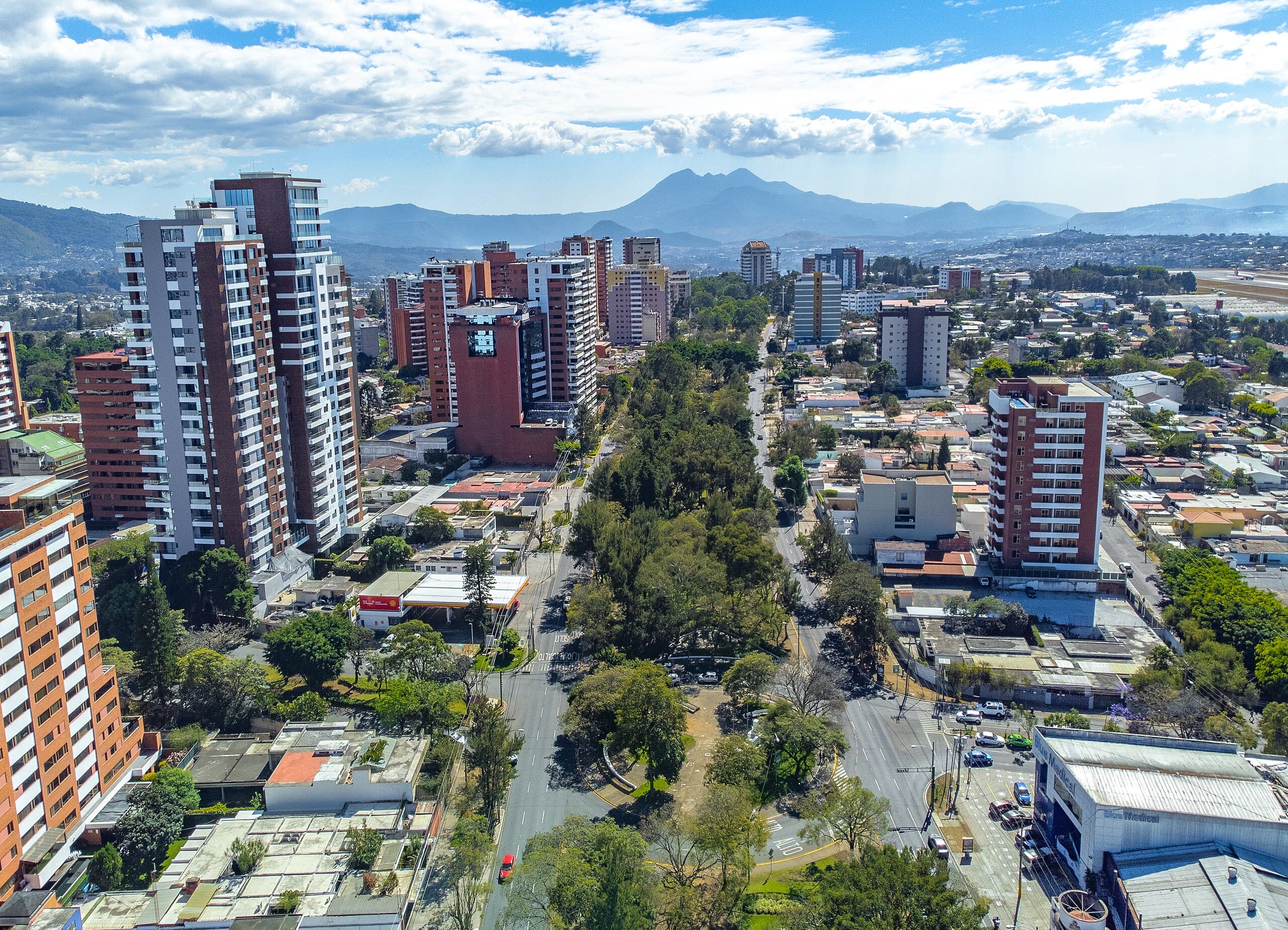
Walk three kilometres where a dictator's pillar meets a democrat's flame, where bronze heroes are stolen for scrap and replaced by murals, and where three slabs of the Berlin Wall close an argument about freedom that started a hundred and thirty years ago. Nineteen stops. No conclusions.
Start · The Obelisk
DirectionsStops
- 1
The Obelisk
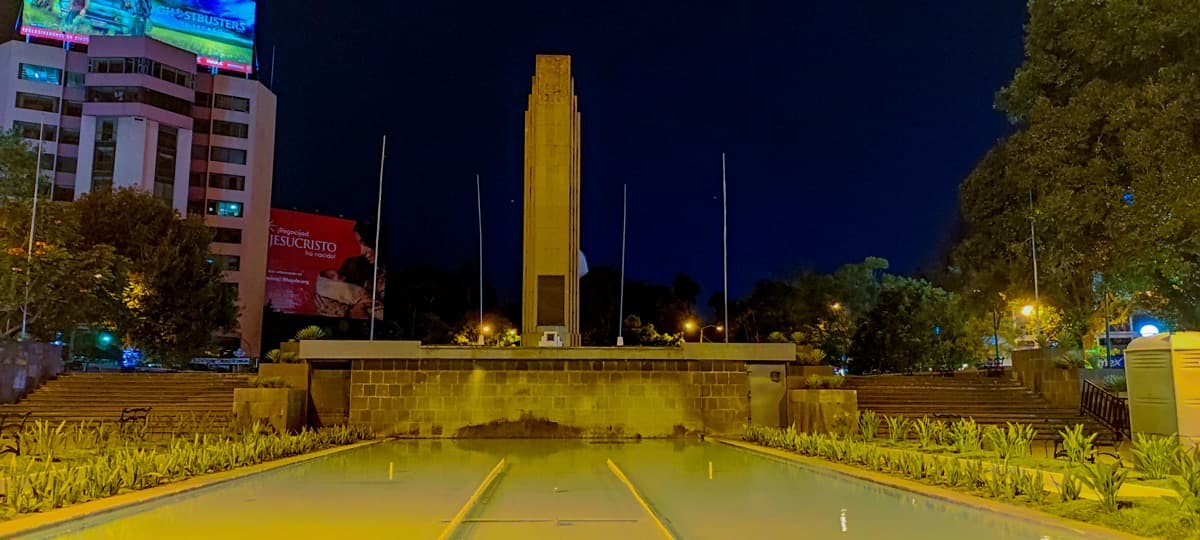
An eighteen-metre obelisk built by a dictator in 1935, with an eternal flame added by Guatemala's first democratic president. The flame is out. The plaque still asks a country to protect it.
- 2
Bolivar
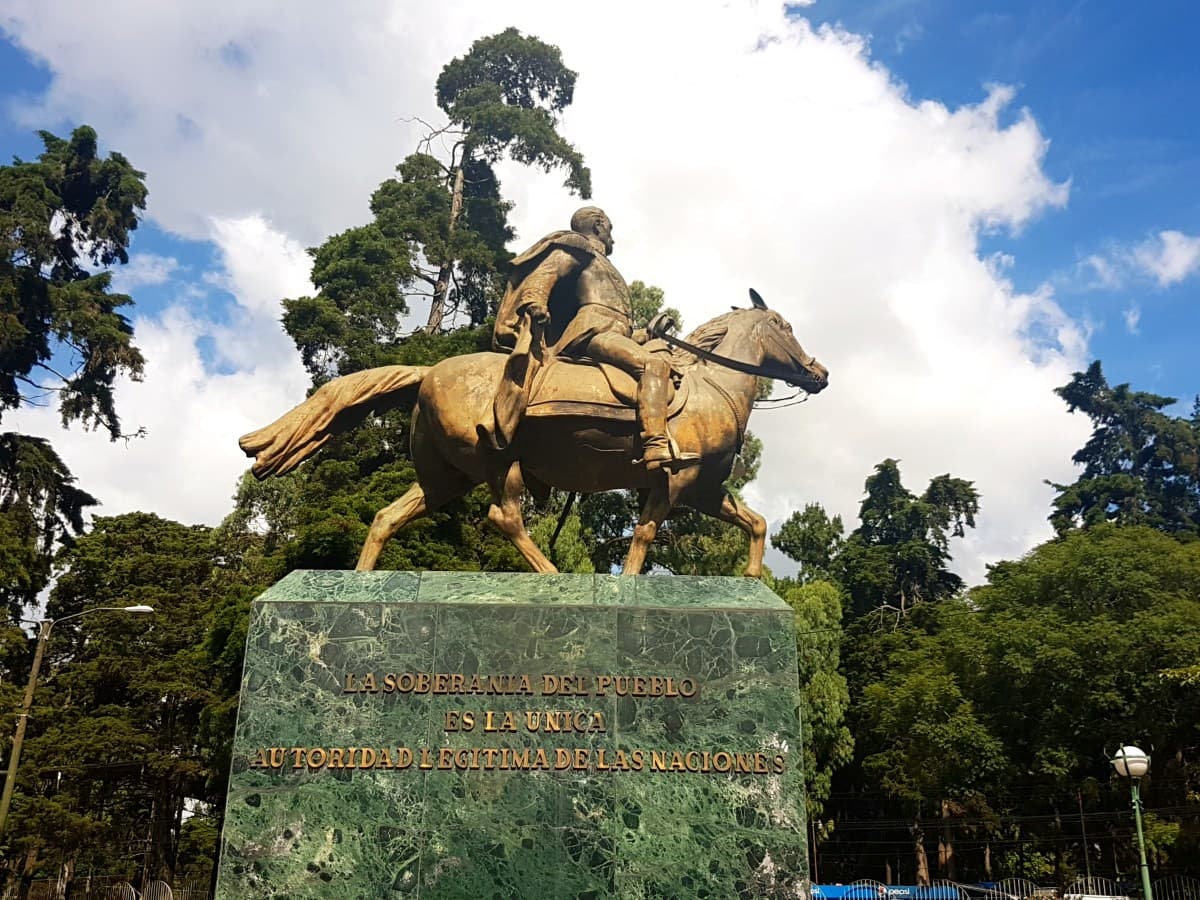
An equestrian statue donated by Venezuela in 1990, honouring the liberator who freed six nations and died owning nothing.
- 3
Colombia
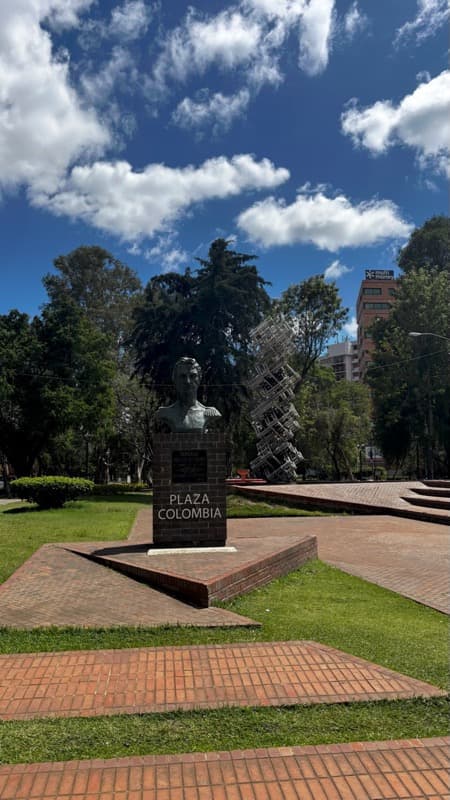
The Man of Laws — Francisco de Paula Santander, who built nations through constitutions while Bolivar built them through force.
- 4
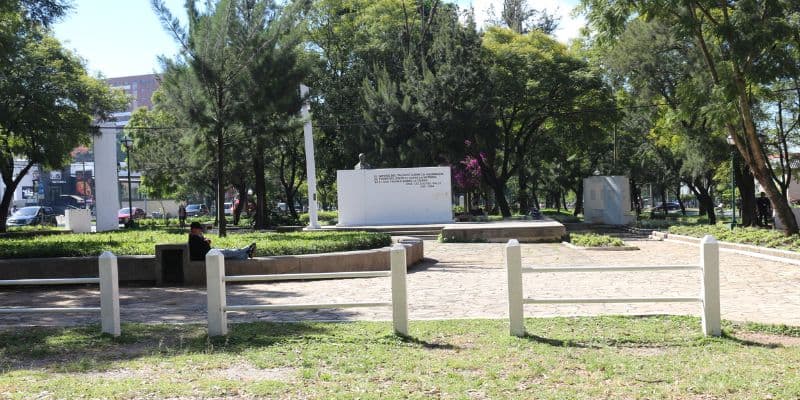
Honduras
Jose Cecilio del Valle drafted the Act of Independence of Central America but was not allowed to sign it. He won the presidency twice and served not a single day.
- 5
Argentina
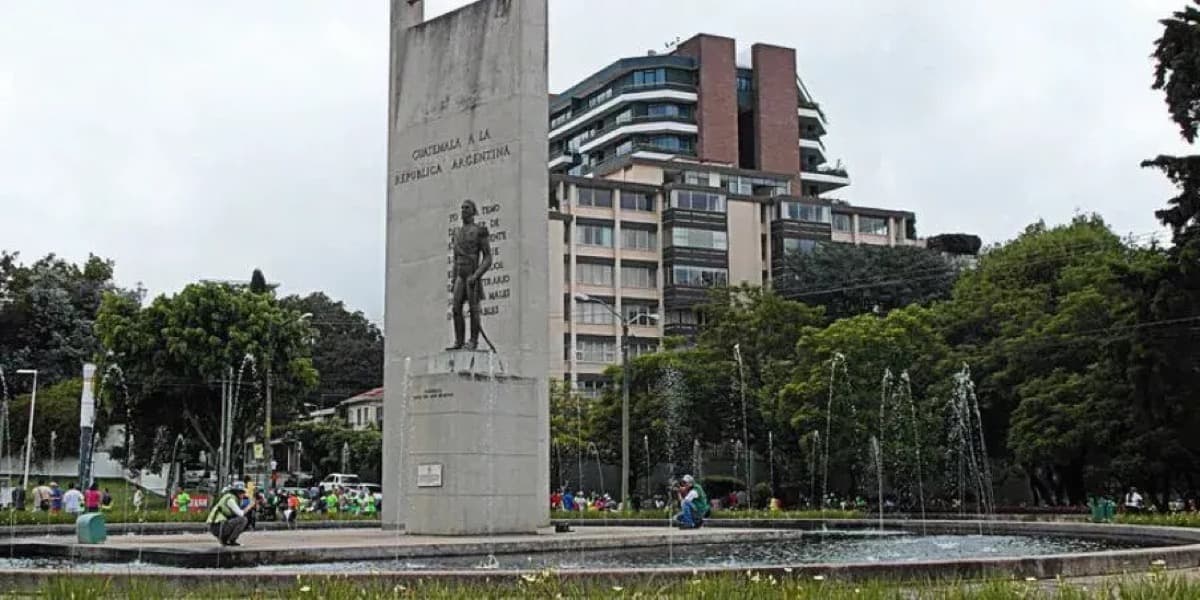
A fifteen-metre Argentine flag built in concrete, with Guatemala's sky showing through the blue. The statue of San Martin was flown in on an Argentine Air Force plane.
- 6
Mexico
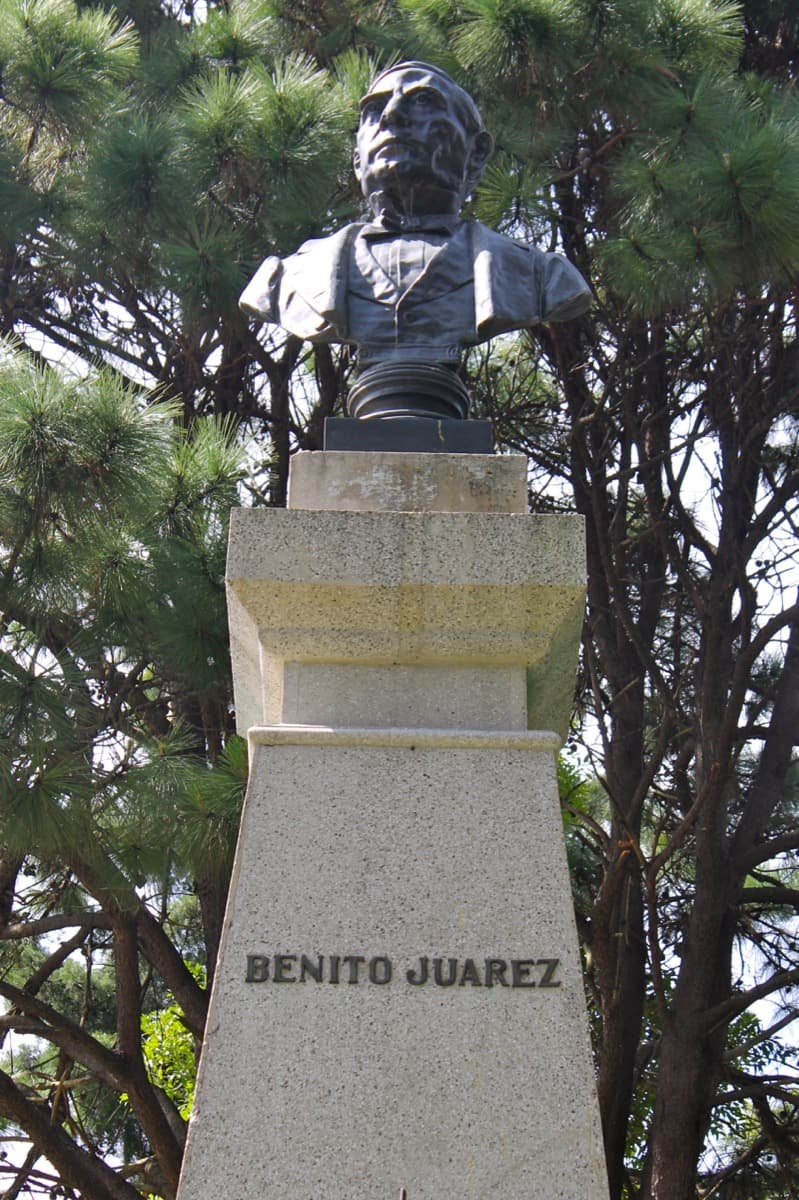
The grandest plaza on the boulevard, holding the first monument Guatemala ever erected to a foreign citizen. A Zapotec orphan who defeated a European emperor.
- 7
El Salvador
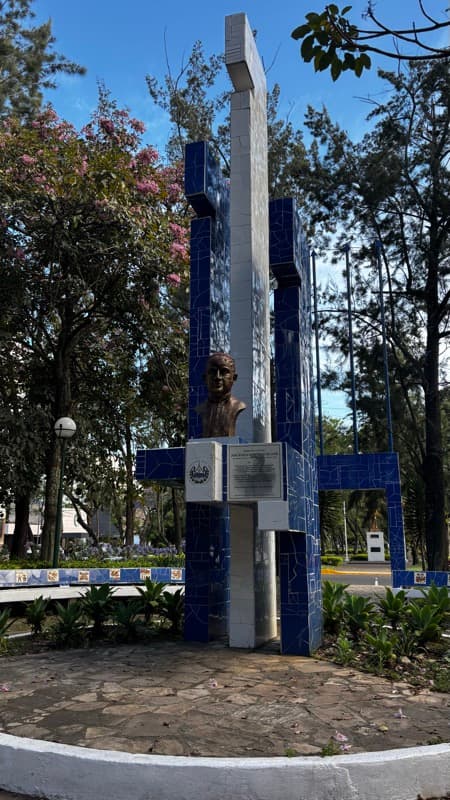
A priest who rang a bell for independence in 1811, and a bishop who was assassinated for demanding peace in 1980. Both demanded freedom. Only one has a bust.
- 8
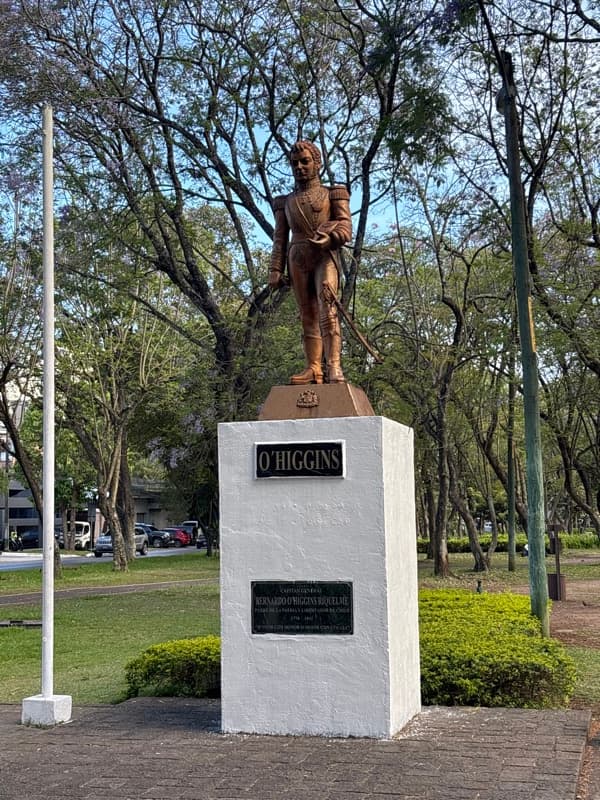
Chile
Bernardo O'Higgins Riquelme — half Irish, half Chilean, the illegitimate son of a Spanish viceroy who overthrew the system his father governed.
- 9
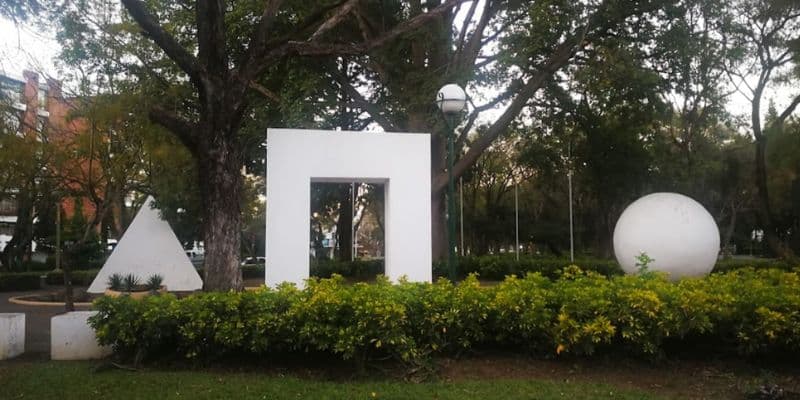
Nicaragua
The only plaza that hedged on the Great Man portrait. An arch, a pyramid, a sphere, and a bust — Nicaragua sent geometry alongside the face of the poet who remade Spanish.
- 10
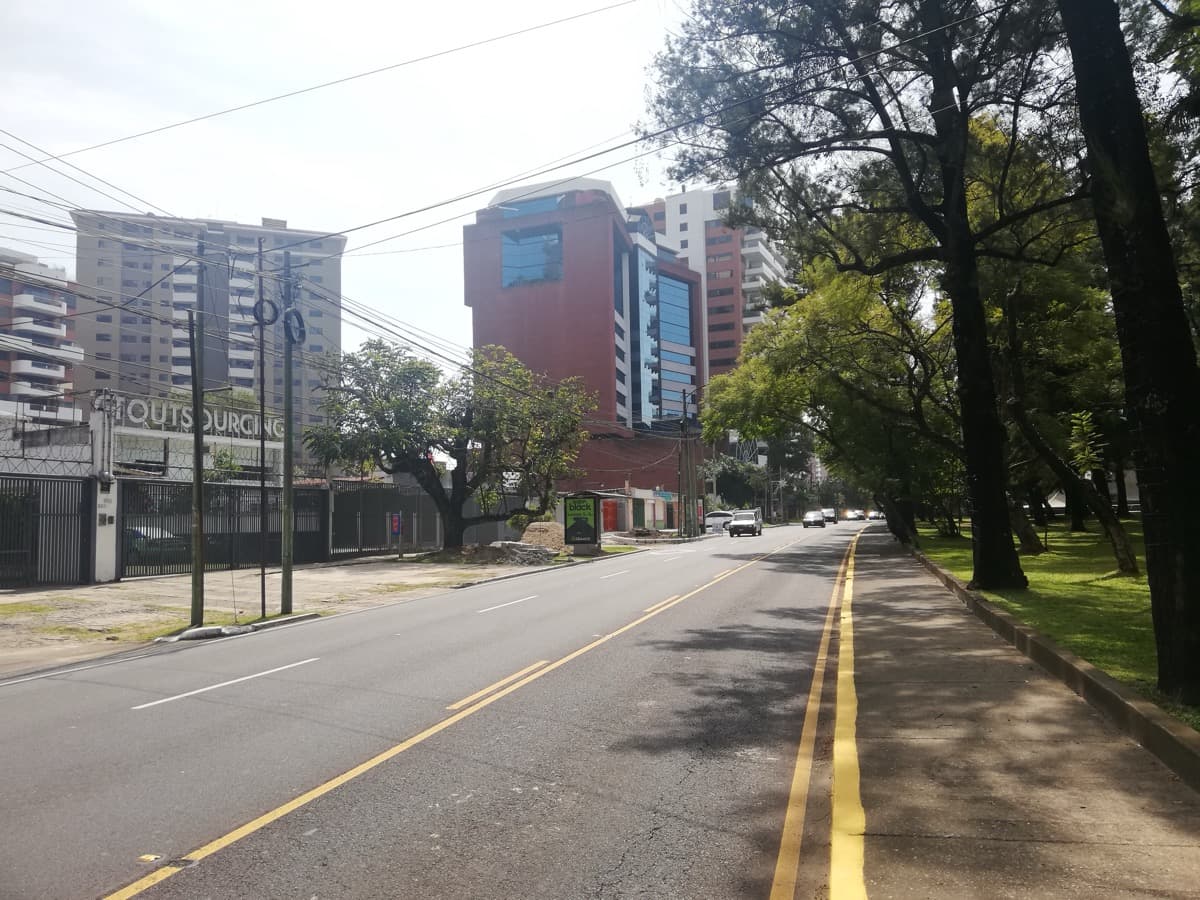
Dominican Republic
Juan Pablo Duarte founded a clandestine revolution in three-person cells and won independence not from Spain but from Haiti. He was exiled before he could govern.
- 11
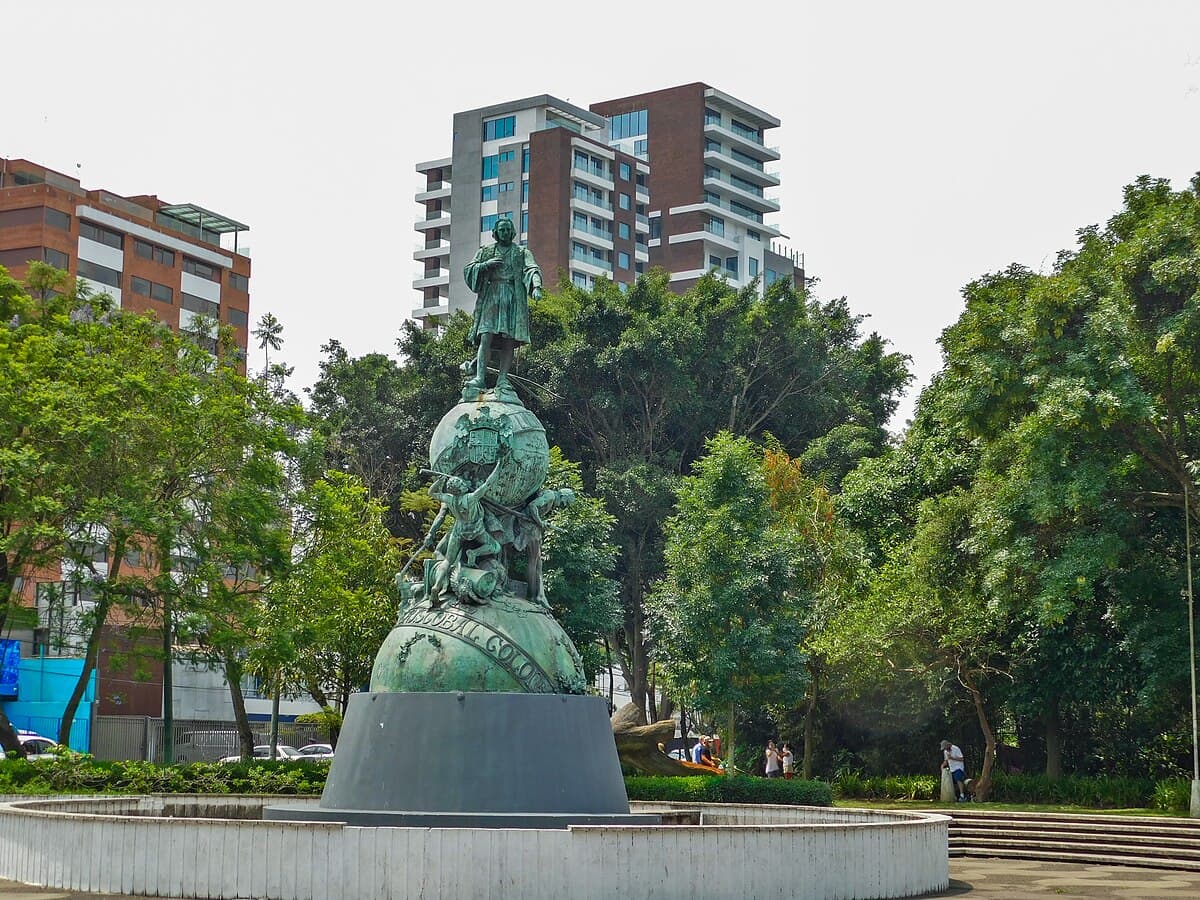
Columbus
The oldest monument on the boulevard, contracted in 1893 and moved three times. Across the Americas, Columbus is being reconsidered. Guatemala City keeps theirs.
- 12
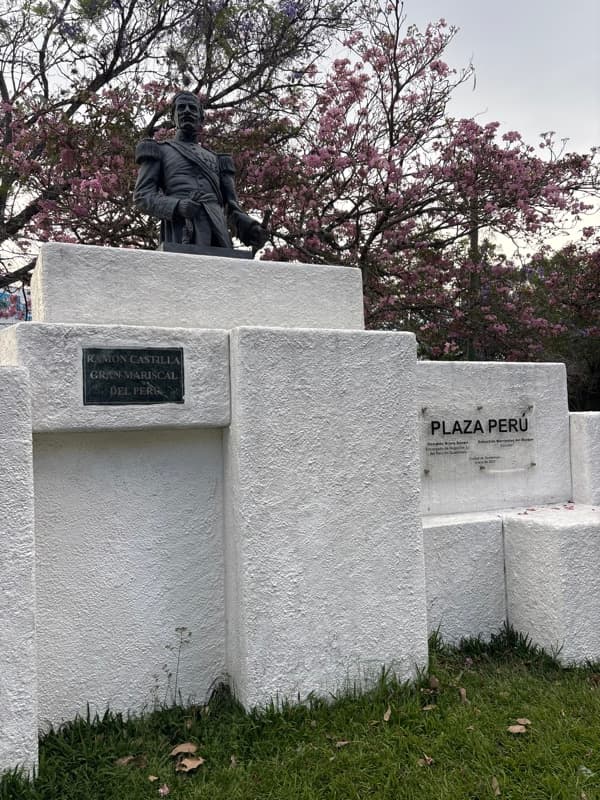
Peru
Ramon Castilla served in Bolivar's army and later, as president, abolished slavery in Peru. The soldier carried the liberator's project forward in ways Bolivar could not have imagined.
- 13
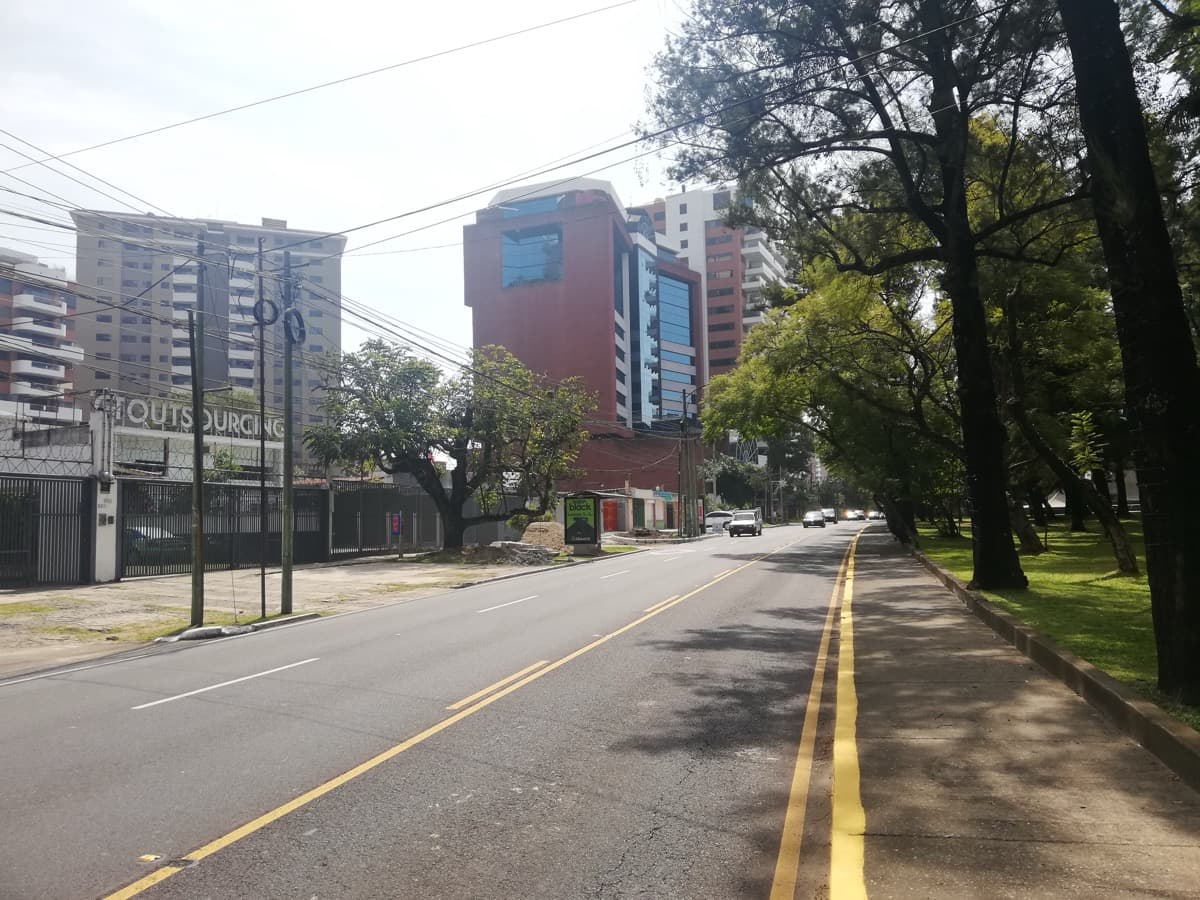
Canada
Every other country sent a portrait. Canada sent a pile of stones in the shape of a human figure — an Inukshuk, the only indigenous art form on the entire boulevard.
- 14
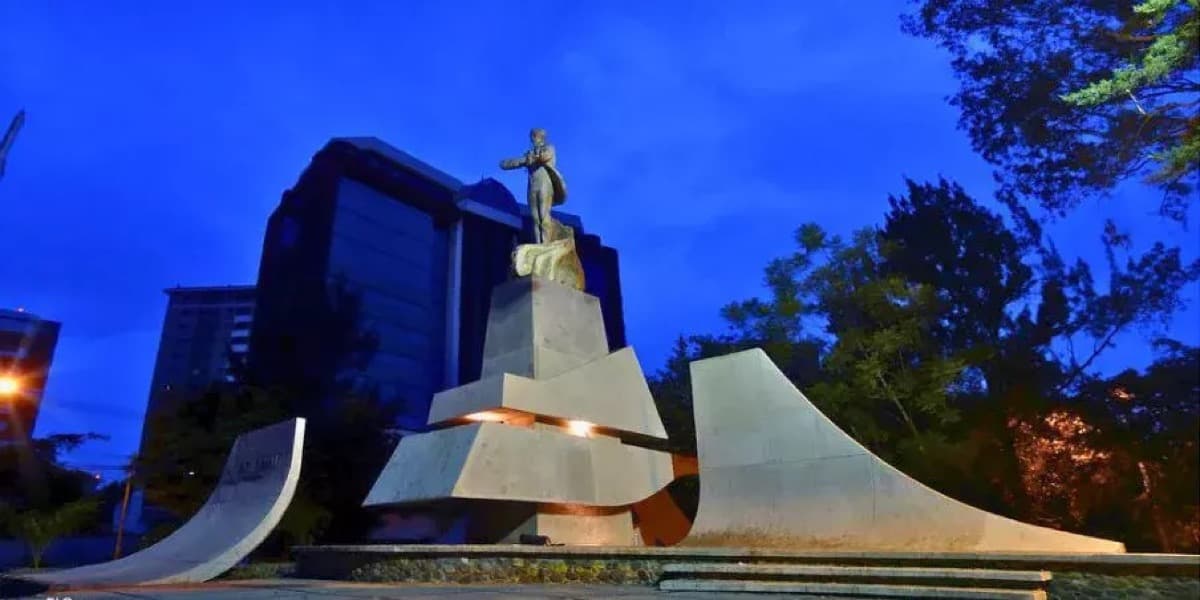
Cuba
Jose Marti lived in Guatemala City, fell in love with a Guatemalan woman, and wrote a poem about her that is carved into this monument's base. The most personal story on the boulevard.
- 15
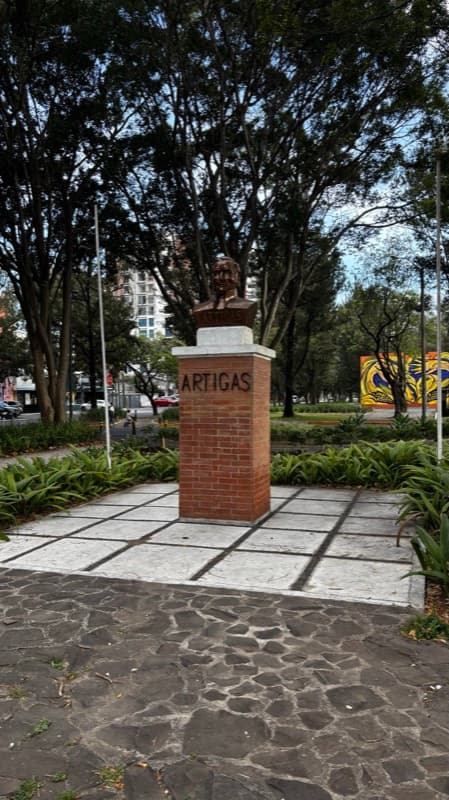
Uruguay
This bust is brand new because the last one was stolen. Uruguay replaced it. The man it honours ordered land redistribution to 'the most unfortunate' in 1815.
- 16
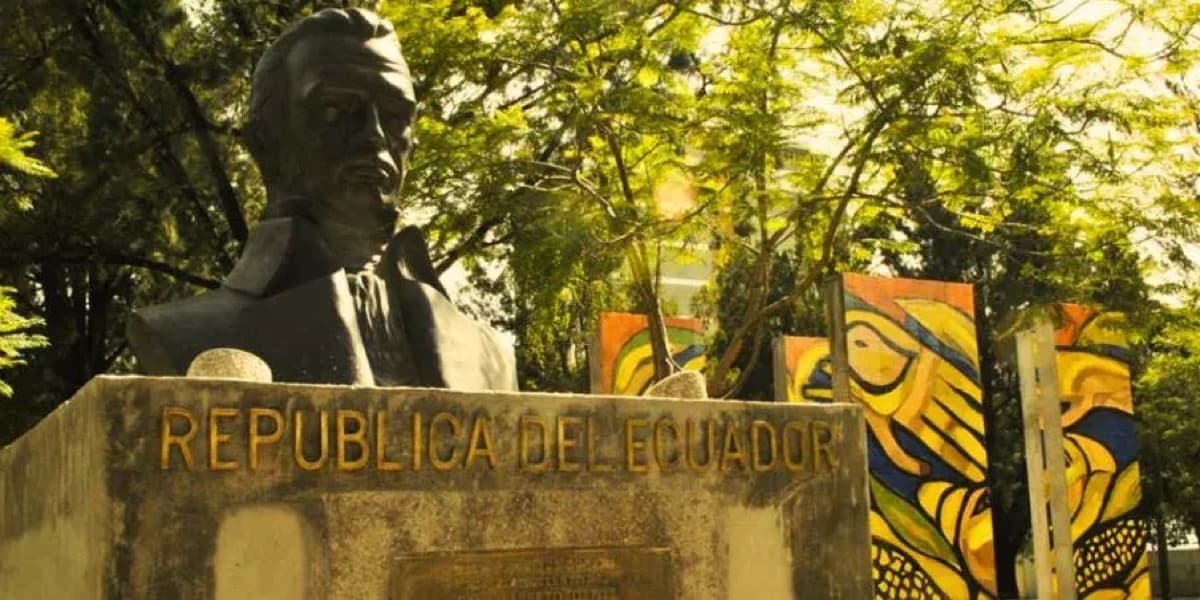
Ecuador
The plaza reinvented more times than any other. A stolen bust led to a mural, a new bust, and a literary garden. The response to vandalism was to go bigger, not backward.
- 17
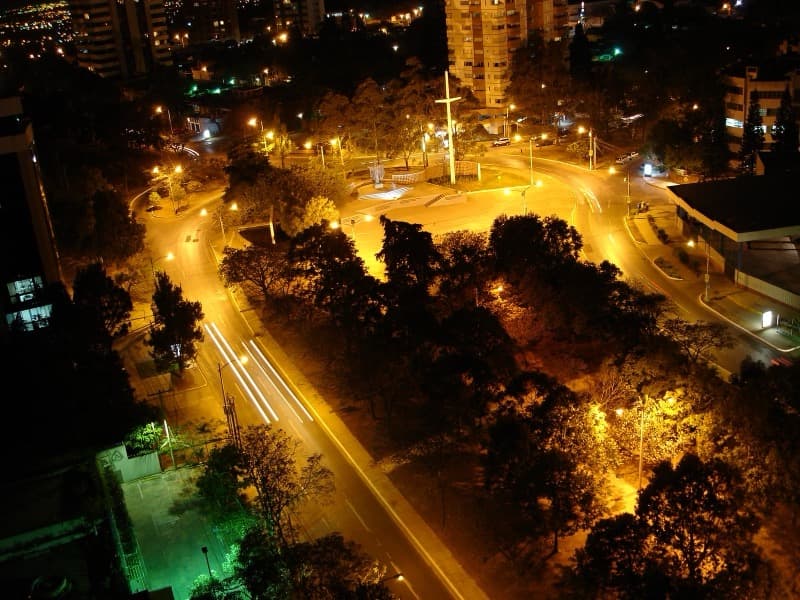
Juan Pablo II
The sculptor who started the boulevard's art in 1935 completed it here in 1985 — a papal statue with a peace manifesto carved into its base during a civil war.
- 18
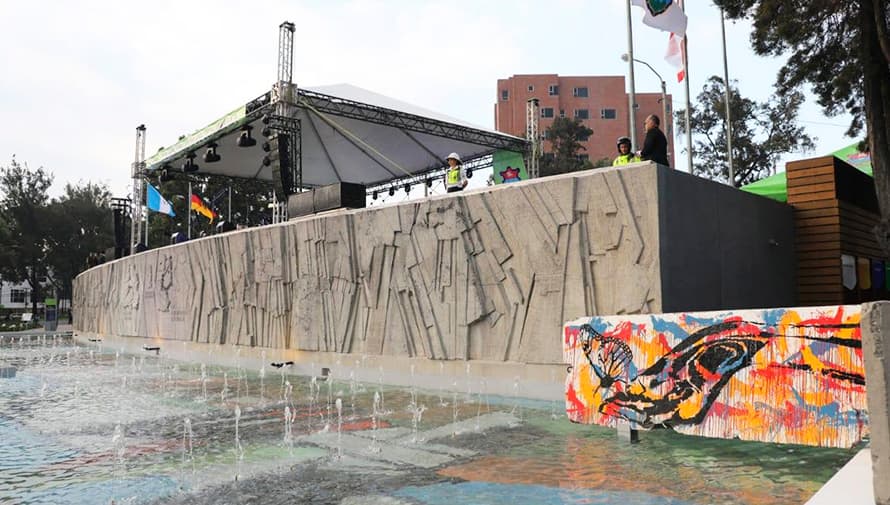
Berlin Wall — Proof That Walls Fall
Three original sections of the Berlin Wall at the southern end of the boulevard. A hundred and thirty years of arguing about freedom, and here, at the end, proof that walls fall. Plus: the full tour wrap-up.
Details
Best Time to Visit
Early morning between 7:00 and 9:00 AM, or late afternoon after 4:00 PM. The boulevard runs north-south with limited shade between plazas.
Pro Tips
- •Start at the Obelisco at the north end and walk south. The narrative builds toward the Berlin Wall at the southern terminus.
- •On Sundays, the boulevard is quieter and some plazas have vendors. The walk is about 3.5 km one way — plan return transport.
- •Bring water. There are few shops along the boulevard itself, though Zone 10 restaurants are a short detour east.
- •Some plazas require crossing the divided highway. Use marked crosswalks and time your crossings carefully.
Safety & Precautions
- •The boulevard runs through Zones 13 and 14. Daytime walking is generally safe, but stay aware of your surroundings and avoid walking after dark.
- •Several plazas sit on traffic islands. Use marked crosswalks and watch for fast-moving vehicles on both sides.
- •Some plazas are poorly maintained with uneven ground. Watch your footing, especially around older pedestals.
Travel advisory: Reconsider Travel (Level 3).
Gallery
Related Reading
Go deeper on what you'll see, hear, and walk through.
Overview
Best Self-Guided Walking Tours in Guatemala City (2026)
3 min
Overview
Guatemala City Travel Guide: How Many Days, Getting Around, Is It Safe (2026)
5 min
Overview
One Day in Guatemala City: A Walkable Itinerary (2026)
5 min
Overview
The Capital After Catastrophe: How to See Guatemala City
9 min
Thematic
Best History Walking Tours in Guatemala City (2026)
2 min
Thematic
What to Eat in Guatemala City: A Food Guide (2026)
4 min
Companion
Monuments of the Americas: Guatemala City's International Boulevard
6 min
Companion
The Argument in Bronze: A Companion to the Boulevard of the Americas
8 min
Deep dive
The Obelisco: A Dictator's Pillar, A Democrat's Flame, A Country's Question
9 min
Read the walk
The full story of Boulevard of the Americas: What Survives, in words. Prefer to listen? Play it narrated, from home or on location.
Introduction
A new monument appeared on this boulevard in twenty twenty-two. Before it, a mural, and a bust replaced. The argument is still going. This boulevard has been assembled piece by piece for more than a century, across revolutions, dictatorships, a civil war, and a fragile peace, and it is not finished.
The Avenida de Las Americas runs two and a half kilometres through southern Guatemala City. On paper, it is a monument to hemispheric solidarity, a plaza for each country of the Americas, each holding a statue of a national hero. Bolivar. Juarez. San Martin. Marti. The hemisphere laid out in bronze and stone.
But this boulevard is really Guatemala's argument with itself about what freedom means. The road was traced in the eighteen nineties as an extension of Avenida La Reforma, by a Liberal president who was assassinated before it was done. It was named "Las Americas" in nineteen forty-eight, under the country's first democratically elected government. Six years later that government was overthrown in a CIA-backed coup. The generals who followed kept building the boulevard, and so did the governments after them. Everybody claims this road.
Some of the busts have been stolen for scrap metal, melted down for a few quetzales. Monuments to prosperity, stripped by poverty. Others have been replaced, or reinvented entirely. This is not a tour about monuments. It is about what survives, and what does not, when a country argues with itself about freedom.
The walk is eighteen stops, about three and a half kilometres and two hours, running north to south from the Obelisco to the Berlin Wall fragment. When you arrive at the Obelisco, begin with stop one.
1. The Obelisk
Welcome to the Obelisco, your first stop on this tour. Stand at the base of this obelisk and you are standing on a palimpsest. Every layer tells you something about who Guatemala was trying to be at the time.
The obelisk itself, eighteen metres of concrete and stone, was inaugurated on July 19th, 1935, by General Jorge Ubico, Guatemala's dictator. The date was chosen deliberately: it was the centennial of the birth of Justo Rufino Barrios, the Liberal Reform president who modernised the country in the 1870s. The engineer was Rafael Perez de Leon, who would go on to direct construction of the National Palace. And the coat of arms at the top was carved by a sculptor named Rodolfo Galeotti Torres. Remember that name. He will appear again before this tour is over.
But here is what the dictator did not build. After the October Revolution of 1944, which overthrew Ubico's successor, Guatemala held its first free election. The winner was Juan Jose Arevalo, a philosophy professor who called his ideology "spiritual socialism." Under Arevalo, sometime around 1950, the Altar a la Patria was added to the obelisk's base, a copper brazier designed to hold an eternal flame, and a bronze plaque.
The plaque reads: "Guatemalteco: esta llama simboliza nuestra suprema aspiracion de libertad y de justicia. Venerala. Respetala. No permitas que se extinga nunca."
"Guatemalan: this flame symbolises our supreme aspiration for freedom and justice. Venerate it. Respect it. Never allow it to be extinguished."
The flame is not lit. I do not know when it went out. But the plaque is still there, asking a country to protect something it has already lost.
A dictator built the pillar. A democrat lit the flame. The flame is out. That tension, between the monument and its meaning, between the structure and the soul poured into it, runs the entire length of this boulevard.
Look south. The boulevard stretches ahead under a canopy of jacaranda and palm trees. Nineteen stops between here and the Berlin Wall fragments at the far end. Let us start walking.
2. Bolivar
Welcome to the Plaza Bolívar. The equestrian statue in front of you was donated by the people of Venezuela and inaugurated on April 30th, 1990, forty-two years after the boulevard was named, and one hundred and sixty years after the man it depicts died penniless in a borrowed house.
Simon Bolivar liberated what are now Venezuela, Colombia, Ecuador, Peru, Bolivia, and Panama from Spanish rule. He did it through military campaigns so unlikely that his own officers questioned his sanity, marching armies over the Andes in conditions that killed a third of his soldiers before they reached the battlefield. He won. Repeatedly. And then he tried to hold it all together.
His vision was Gran Colombia, a single republic stretching from the Caribbean to the southern Andes. It lasted twelve years. By 1829, Venezuela had broken away. Ecuador followed. The generals turned on each other. The unifier watched his creation fragment along every line he had tried to erase.
On November 9th, 1830, five weeks before his death, Bolivar wrote a letter to General Juan Jose Flores. In it, he wrote what may be the most quoted sentence in Latin American history: "El que sirve una revolucion ara en el mar." He who serves a revolution plows the sea. The Oxford edition of his writings, edited by the historian David Bushnell, places this letter in the context of a man who had given away his family's fortune, resigned the presidency, and was heading for European exile when his body gave out. He died of tuberculosis on December 17th, 1830, in the Quinta de San Pedro Alejandrino near Santa Marta, Colombia. He was forty-seven. He owned nothing.
This is the first monument on the boulevard. A man who built everything and held nothing. Walk south and you will see the pattern repeat, country by country, liberator by liberator. Freedom is the project. Fragmentation is the result. And you will meet a man at Stop 12 who was in Bolivar's army and carried that project forward in ways Bolivar could not have imagined.
3. Colombia
Welcome to the Plaza Colombia. After Bolivar, the man of war, here is his opposite. Francisco de Paula Santander was born in 1792 in Rosario de Cucuta, in what is now northeastern Colombia. He fought alongside Bolivar during the independence wars and became Vice President of Gran Colombia. But where Bolivar was a military visionary who wanted to build nations through force of personality, Santander was a lawyer who wanted to build them through laws.
The two men clashed bitterly. Bolivar wanted a strong executive, a president with near-dictatorial powers who could hold the fractious republics together. Santander wanted a constitution, a congress, an independent judiciary. Bolivar called Santander the "Man of Laws." He did not always mean it as a compliment. By 1828, Santander was accused of involvement in an assassination attempt against Bolivar and exiled to Europe.
But here is the thing. Santander was right. Bolivar's vision collapsed precisely because it depended on one man's authority rather than institutional structures. Gran Colombia fell apart. The nations that survived did so because they eventually built the legal frameworks that Santander had argued for all along.
Santander returned to Colombia in 1832 and served as president until 1837. He founded universities. He established public schools. He codified Colombian law. He was not glamorous. He did not cross the Andes on horseback. But he gave Colombia something Bolivar could not: a system that outlasted any individual leader.
Notice the sculpture here, a Botero-style figure representing past and future. Two visions of the same country. Every nation on this boulevard had its Bolivar. Most of them needed a Santander too. Not all of them got one.
As you walk south, the boulevard's green median widens ahead of you. The trees thicken. This next stretch is one of the most pleasant walks in the city.
4. Honduras
Welcome to the Plaza Honduras. The bust in front of you is Jose Cecilio del Valle, and his story is one of the most bitterly ironic on this boulevard.
Valle was born in Choluteca, Honduras, in 1780, but spent his entire adult life in Guatemala City. He arrived at age nine because Tegucigalpa did not have adequate schools. He studied at the University of San Carlos, Guatemala's oldest university, founded in 1676, earned degrees in civil and canonical law, and became one of the most formidable intellectuals in Central America.
On September 15th, 1821, when the moment came, Valle was the man who drafted the Act of Independence of Central America. He wrote the document that made five nations free. But here is the detail the historian Franklin Parker documented in the Hispanic American Historical Review in 1952: Valle drafted the act but did not sign it. He was not a signatory to the freedom he authored.
It gets worse. In 1825, Valle won the popular vote for president of the Federal Republic of Central America. Congress overruled the vote and gave the presidency to his opponent, Manuel Jose Arce. Nine years later, in 1834, Valle won again, outright this time, defeating the incumbent Francisco Morazan. He never took office. He died on March 2nd, 1834, on the road from his farm to Guatemala City, being transported for medical treatment.
He won the presidency twice and served not a single day. He wrote a nation's independence and was not allowed to sign it. If you want to understand what Central American politics has looked like for two centuries, the gap between what is written on paper and what actually happens, Valle's story is the template.
One more detail. Valle corresponded with Jeremy Bentham, the English philosopher. Before Bentham died, he sent Valle a lock of his hair and a gold ring. Valle was painted wearing it. The intellectual reach of this man, from Guatemala City to London and back, and still, he was denied the office he earned.
This bust was established on July 10th, 1980. It stands under the Honduras flag because of where Valle was born. But this city is where he lived, worked, and died. He belongs here. Remember that when we reach the Marti stop later, Valle is not the only figure on this boulevard with a personal connection to Guatemala City.
5. Argentina
Welcome to the Plaza Argentina. Look at the wall behind the statue. It is fifteen metres high and five metres wide, and it is not just a wall, it is the Argentine flag, built in concrete. The middle stripe is white mosaic with a golden sun. But the blue stripes, look closely, they are open. Perforated concrete lattice. The blue is Guatemala's sky, showing through.
The Argentines designed their flag on this boulevard so that Guatemala would complete it. That is either diplomatic poetry or the most generous piece of public art on this avenue. Probably both.
The statue is Jose de San Martin, Argentina's liberator, who crossed the Andes with an army in 1817 to liberate Chile and then sailed north to liberate Peru. The sculptor was Luis Perlotti, and the statue was flown from Buenos Aires to Guatemala City on a special Argentine Air Force plane. It was donated by Argentina's Minister of Defence in 1961, for the 150th anniversary of the May Revolution of 1810.
San Martin's story has a detail that Bolivar's does not. After liberating Chile and Peru, San Martin met Bolivar at Guayaquil in July 1822. What they discussed is one of the great mysteries of Latin American history, no official record survives. What we know is that San Martin walked away. He left his command, left South America, and spent the last twenty-eight years of his life in European exile. He died in Boulogne-sur-Mer, France, in 1850.
Sealed inside the wall behind you is a fragment of correspondence between San Martin and Bernardo O'Higgins: "Yo nada temo del poder, de este continente siempre que estemos unidos." I fear nothing from power on this continent so long as we remain united.
United. That word again. Bolivar dreamed it. San Martin walked away from it. And if you look up from here, you can see why someone might stay, the jacaranda canopy over this stretch of the boulevard turns purple in February and March. The city planted beauty between the monuments, even if the planners did not intend a lesson in it.
6. Mexico
Welcome to the Plaza México. This is the grandest plaza on the boulevard, and it holds the first monument Guatemala ever erected to a foreign citizen. That distinction matters. Every other country on this road was invited. Mexico claimed the space first.
The figure is Benito Juarez, and his biography is one of the most improbable in the Western Hemisphere.
He was born in 1806 in San Pablo Guelatao, a Zapotec village in the mountains of Oaxaca. Orphaned at three. He spoke only Zapotec, no Spanish, until he was twelve, when he walked to Oaxaca City to find work. A lay Franciscan bookbinder named Antonio Salanueva took him in, sponsored his education, and changed the trajectory of a continent. Juarez studied for the priesthood, switched to law, married the daughter of the household where he had once worked as a servant, and by 1858 was president of Mexico.
Then Napoleon the Third invaded. The French installed an Austrian archduke, Maximilian, as Emperor of Mexico. Juarez refused to surrender. He governed a resistance from whatever territory he could hold, sometimes barely more than a single northern province. When the French withdrew in 1867, Maximilian was captured and executed by firing squad at Cerro de las Campanas, Queretaro.
A Zapotec orphan who was illiterate at twelve defeated a European emperor backed by one of the world's most powerful armies. That happened. It is not legend, it is the historical record, documented by the historian Brian Hamnett in his 1994 biography.
Look at the base of this monument. The inscription reads: "Entre los pueblos y entre los individuos, el respeto al derecho ajeno es la paz." Among nations and among individuals, respect for the rights of others is peace. That sentence is as close to a foreign policy as Latin America has ever agreed on.
The base reportedly contains a sealed capsule of soil from Guelatao, Zapotec earth, inside a monument on a Guatemalan boulevard. The monument was relocated here from Avenida Reforma in 1970.
Walk south. The plazas ahead come faster now, and the stories begin to complicate each other.
7. El Salvador
Welcome to the Plaza El Salvador. You are looking at a plaza where our research got something wrong. Previous versions of this tour said the bust of Jose Matias Delgado was stolen. It is here. The bronze face is present on the pedestal. Sometimes the story you prepare for is not…
Full narration for this stop unlocks with the tour.
8. Chile
Welcome to the Plaza Chile. The name on this monument is one of the more unexpected combinations in Latin American history: Bernardo O'Higgins Riquelme. An Irish surname, a Spanish surname, and a first name that could go either way. The man who liberated Chile was half…
Full narration for this stop unlocks with the tour.
9. Nicaragua
Welcome to the Plaza Nicaragua. Stop. Look carefully. Something is different here. Every other plaza on this boulevard has, or had, a bronze bust on a pedestal. A hero rendered in metal, staring over traffic. This plaza has none. Instead, you are looking at three geometric…
Full narration for this stop unlocks with the tour.
10. Dominican Republic
Welcome to the Plaza República Dominicana. Most countries on this boulevard fought for independence from Spain. This one fought for independence from Haiti. The bust you are looking at, damaged, weathered, but still present, is Juan Pablo Duarte, the father of the Dominican…
Full narration for this stop unlocks with the tour.
11. Columbus
Welcome to the Plaza Cristóbal Colón. This is the oldest monument on the boulevard, and it has never stayed in one place. In January 1893, Guatemala's Secretary of Development, Prospero Morales Reina, signed a contract with the Spanish sculptor Tomas Mur to create a monument to…
Full narration for this stop unlocks with the tour.
12. Peru
Welcome to the Plaza Perú. If you started this tour at the Bolivar monument, you are now standing in front of a man who was in Bolivar's army. This is Ramon Castilla, seated in bronze on a white stepped monument. It is an unusually grand installation for this boulevard, most…
Full narration for this stop unlocks with the tour.
13. Canada
Welcome to the Plaza Canadá. Every other country on this boulevard sent a portrait. A Great Man in bronze or marble, mounted on a pedestal, gazing heroically over traffic. Canada sent a pile of stones in the shape of a human figure. This is an Inukshuk, an Inuit stone cairn,…
Full narration for this stop unlocks with the tour.
14. Cuba
Welcome to the Plaza Cuba. Every other figure on this boulevard is connected to Guatemala by ideology or diplomacy. Jose Marti is connected by something more personal. He lived here. In 1877, Marti arrived in Guatemala City at the age of twenty-four. He had already been exiled…
Full narration for this stop unlocks with the tour.
15. Uruguay
Welcome to the Plaza Uruguay. This bust is brand new. You can tell, the bronze is still bright, the plaque still sharp. It reads: "Jose Gervasio Artigas, Jefe de los Orientales y Protector de los Pueblos Libres." Installed August 2020, by the Uruguayan Embassy and the…
Full narration for this stop unlocks with the tour.
16. Ecuador
Welcome to the Plaza Ecuador. This plaza has been reinvented more times than any other on the boulevard. And each reinvention tells you something about what happens when a country refuses to accept that memory can be erased. The original monument honoured Eugenio Espejo, one of…
Full narration for this stop unlocks with the tour.
17. Juan Pablo II
Welcome to the Plaza Juan Pablo II. Remember the name I asked you to hold from the very first stop? Rodolfo Galeotti Torres, the sculptor who carved the coat of arms on the Obelisco in 1935, under the dictator Ubico. You have now walked the full length of this boulevard, and you…
Full narration for this stop unlocks with the tour.
18. Berlin Wall — Proof That Walls Fall
Welcome to the Berlin Wall monument, your final stop on this tour. You have walked the length of a boulevard that argues about freedom in the abstract. The obelisk argues about it. Bolivar argues about it. The stolen busts argue about it. For two and a half kilometres, freedom…
Full narration for this stop unlocks with the tour.