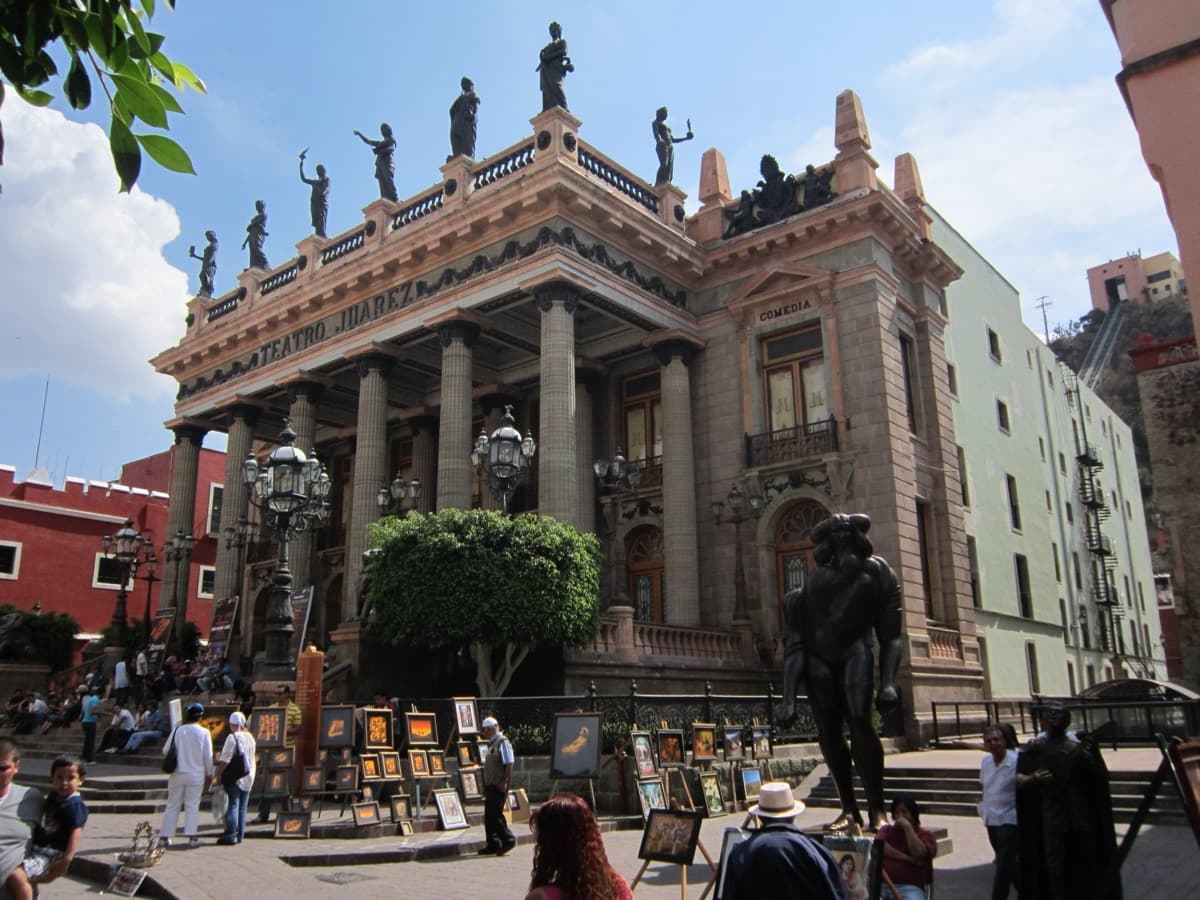
Stand in front of the Teatro Juárez and the building does not look like one thing. Twelve Doric columns rise across the front. A pediment sits above them. Eight bronze muses stand along the roofline, each holding a different attribute. The cornice is heavy. The stone is green cantera. The whole exterior is a Roman temple repurposed as a theater, the kind of building you would expect to find on the Place de la Concorde or the National Mall.
Now step inside. The lobby is dim. The first thing you see is horseshoe arches. The walls and ceilings are carved cedarwood inlaid with intricate geometric tile patterns. Gold leaf catches the light from a chandelier. The interior is not Roman. It is a reconstruction of the Alhambra in Granada, by way of late nineteenth-century European orientalist design, by way of a Mexican architect named Antonio Rivas Mercado, who had trained in Paris and was deliberately drawing on the full Spanish-Mediterranean tradition.
The exterior says Rome. The interior says al-Andalus. Both statements are made by the same building, in the same town, by the same political program. The Teatro Juárez is the single most articulate piece of architecture from the Porfiriato in central Mexico, and it is now, by historical accident, the flagship venue of the Festival Internacional Cervantino. This article is the building's history.
A theater built across thirty years
The theater was begun in 1873 under the state government of General Florencio Antillón, with a first design by the architect José Noriega. Construction proceeded slowly. Mexico in the 1870s was politically unstable, between the death of Benito Juárez in 1872 and the consolidation of Porfirio Díaz's rule after 1876. The Guanajuato state government had limited resources, and the project was repeatedly halted for funding reasons.
The theater's design was substantially revised in the 1890s by the architect Antonio Rivas Mercado, working with the engineer Alberto Malo. Rivas Mercado was, by that point, one of the most prominent architects in Mexico. He had trained at the École des Beaux-Arts in Paris in the 1870s. He had returned to Mexico and would later design the Angel of Independence on Mexico City's Paseo de la Reforma (inaugurated in 1910), the Mexico City Legislative Palace, and various other public buildings of the late Porfiriato.
Rivas Mercado's intervention in the Teatro Juárez project is the one that shaped the building as it stands today. The exterior, with its Doric columns and pediment, may follow elements of Noriega's earlier design, but the interior with its Moorish Revival decoration is largely Rivas Mercado's. The bronze muses on the roofline, cast in Mexico City and transported overland to Guanajuato, were added in the 1890s as part of his redesign.
The theater was finally inaugurated on October 27, 1903, by President Porfirio Díaz. Díaz was sixteen years into his rule. He had a few more years before the Mexican Revolution would force him into exile. The inauguration was attended by the senior figures of his government, and the event was framed as a statement about Mexico's place in the modern world. The first production was Verdi's Aida, an opera about an Egyptian princess that suited both the European-prestige function of the theater and the Moorish-orientalist interior decoration. The architectural and theatrical choices were deliberately aligned.
The two faces of the Porfiriato
Hear a stop from this walk
Museo Casa Diego Rivera
The Porfiriato was the period of Mexican history from 1876 to 1911 under the dictatorship of Porfirio Díaz. It was a period of forced modernization. The railway network expanded. Mining production was revived under heavy foreign investment, much of it British and American. Mexico City was rebuilt with broad Haussmann-style boulevards. Public buildings in the European classical style were commissioned across the country. Foreign capital flowed in. The indigenous and mestizo majority of the country was largely excluded from the benefits.
The Porfiriato's architectural program had two characteristic moves. The first was Roman or French neoclassicism, used for the public buildings that were intended to demonstrate Mexican parity with European powers. The second was a more eclectic vocabulary that drew on a wider Mediterranean tradition, including Moorish, Gothic, and Renaissance Revival elements. The two moves were not in conflict. They were complementary statements: Mexico belonged in the European tradition, and that tradition was itself broader than just Rome and Paris.
The Teatro Juárez deploys both moves simultaneously. The Roman neoclassical exterior makes the first argument. The Moorish Revival interior makes the second. The building's argument is that Mexico is connected to the full Mediterranean lineage, from the classical world through the Islamic Golden Age and the Spanish reconquest into the present. The geographical specifics are intentional. Spain is, in this lineage, the natural bridge between Mexico and the older European tradition, and Spain's own Andalusian heritage gives Mexican architecture a precedent for the Moorish vocabulary.
This is why the Moorish Revival interior is not strange in context. Mexico had been part of the Spanish Empire for three centuries. Spain had been substantially Islamic for eight centuries before that. Mudéjar architecture, the post-reconquest Spanish style that retained Islamic decorative elements, had been transmitted to colonial Mexico in churches, palaces, and civic buildings from the sixteenth century forward. Rivas Mercado was drawing on a continuous tradition, not making an exotic gesture.
Inside the auditorium
The main auditorium of the Teatro Juárez seats around nine hundred people. It is a horseshoe shape with three tiers of boxes around the orchestra level, capped by a fourth tier (the gallinero, the gallery) above. The decoration is consistently Moorish Revival, with carved wooden screens, horseshoe-arched openings, geometric inlay, and gold-leaf detail throughout. The ceiling has a painted central medallion surrounded by allegorical figures.
The acoustics are exceptional. The intimate scale of the hall, less than a thousand seats, allows orchestral and operatic performances to be heard clearly without amplification. Musicians who perform regularly at the Teatro Juárez generally rate it among the finest acoustic venues in Mexico. Part of the credit goes to the proportions of the horseshoe, part to the timber construction of the interior, part to the relatively shallow depth of the boxes, which keeps the audience close to the stage.
The proscenium frames a stage that is large by the standards of nineteenth-century provincial theaters. Productions on the Cervantino festival program range from small chamber ensembles to full operas with major international companies. The stage handles both, although productions with very large set pieces are sometimes constrained by the building's compact backstage area.
The smoking room and the foyer continue the Moorish vocabulary. The smoking room in particular is one of the more concentrated examples of the style in Mexico: walls and ceilings covered floor to ceiling in geometric tile and carved wood, with low couches and small tables in the manner of a nineteenth-century European fantasy of the Islamic-world interior. The room is, like much of the building, a piece of orientalist design produced in a Mexican context for a Mexican audience by a Mexican architect, drawing on a tradition that ran from Granada through colonial New Spain to the present.
The festival that the theater now serves
The Teatro Juárez was the cultural flagship of Guanajuato from 1903 onward, but for the first half of the twentieth century it operated as a regional opera and theater venue with limited international reach. The Mexican Revolution of 1910 to 1920 reduced public cultural budgets. The mining economy that had funded much of the city's wealth continued its long contraction. The theater stayed open, but it was not a place that drew international attention.
What changed was the founding of the Festival Internacional Cervantino in 1972. The festival, which had begun as Enrique Ruelas Espinosa's student productions of Cervantes on the steps of Plaza San Roque in 1953, was formalized by the Echeverría administration as part of Mexico's late twentieth-century cultural-diplomacy strategy. The Teatro Juárez was the obvious flagship venue. It was the largest performance space in the city. It was historically significant. It had the acoustics and the visual presence to host major international productions.
Since 1972, the theater has hosted thousands of festival performances. Orchestras, opera companies, ballet troupes, theater companies, jazz ensembles, and traditional music groups from over thirty countries have performed on its stage during the three-week October festival period. Outside of the Cervantino, the theater hosts year-round programming of opera, ballet, symphony concerts, and contemporary theater.
The combination is, in retrospect, the most architecturally appropriate possible use for the building. The Teatro Juárez was designed to be a statement about Mexico's place in the European cultural conversation. The Cervantino, anchored to a four-hundred-year-old Spanish novel, is a festival explicitly about Mexico's participation in the broader Hispanic and European literary tradition. The dictator who inaugurated the theater is long gone. The festival that fills it now does, with very different politics, the kind of cultural work the building was originally designed to do.
What to look for
Approach the building from the front, ideally from the Jardín de la Unión across the street. Stand back far enough to take in the full facade. Count the columns. There are twelve. Notice the rhythm: pairs of columns flanking the central entry, single columns running out toward the corners. The pediment above carries no figural sculpture. The decoration is concentrated in the bronze muses along the roofline. Each muse holds a different attribute: a lyre, a mask, a scroll, a globe. Identify them if you can. Calliope (epic poetry, with a scroll). Melpomene (tragedy, with a mask). Terpsichore (dance). Erato (lyric poetry). Polyhymnia (sacred poetry). Clio (history). Thalia (comedy). Euterpe (music). They are the catalogue of the arts the theater intends to house.
Then walk inside. The lobby is the first surprise. The exterior promised Rome, and the lobby delivers Granada. The contrast is the building's argument. Take time in the foyer. Look up at the ceiling. Run your eye along the geometric tile. The decoration is dense, deliberate, and remarkably well preserved.
If you can attend a performance, the auditorium is the second surprise. The horseshoe scale is more intimate than the exterior leads you to expect. The acoustic clarity is unusual. The visual experience of watching a performance in a nineteenth-century Moorish-fantasy interior, with gold leaf catching the stage light, is one of the things the Cervantino festival was designed to deliver and the only thing about the festival that Guanajuato can offer that no other festival city in the Americas can.
The theater has been doing this work for over a century. The political program that built it is long gone. The cultural program that fills it now is barely fifty years old. The building, the columns, the muses, the horseshoe arches, the gold leaf, are the part that has not changed.
Mexico eSIM· 10% off with ROAMER10
Ready to experience it?
Color, Canvas & Cervantes
85 min · 2.3 km · easy
More from Guanajuato
Explore more at your own pace.
Best Self-Guided Walking Tours in Guanajuato (2026)
Guanajuato Travel Guide: How Many Days, Getting Around, When to Go (2026)
One Day in Guanajuato: A Walkable Canyon Itinerary (2026)

What to Eat in Guanajuato: A Food Guide (2026)
The Alhóndiga de Granaditas: Where Mexico's War for Independence Began