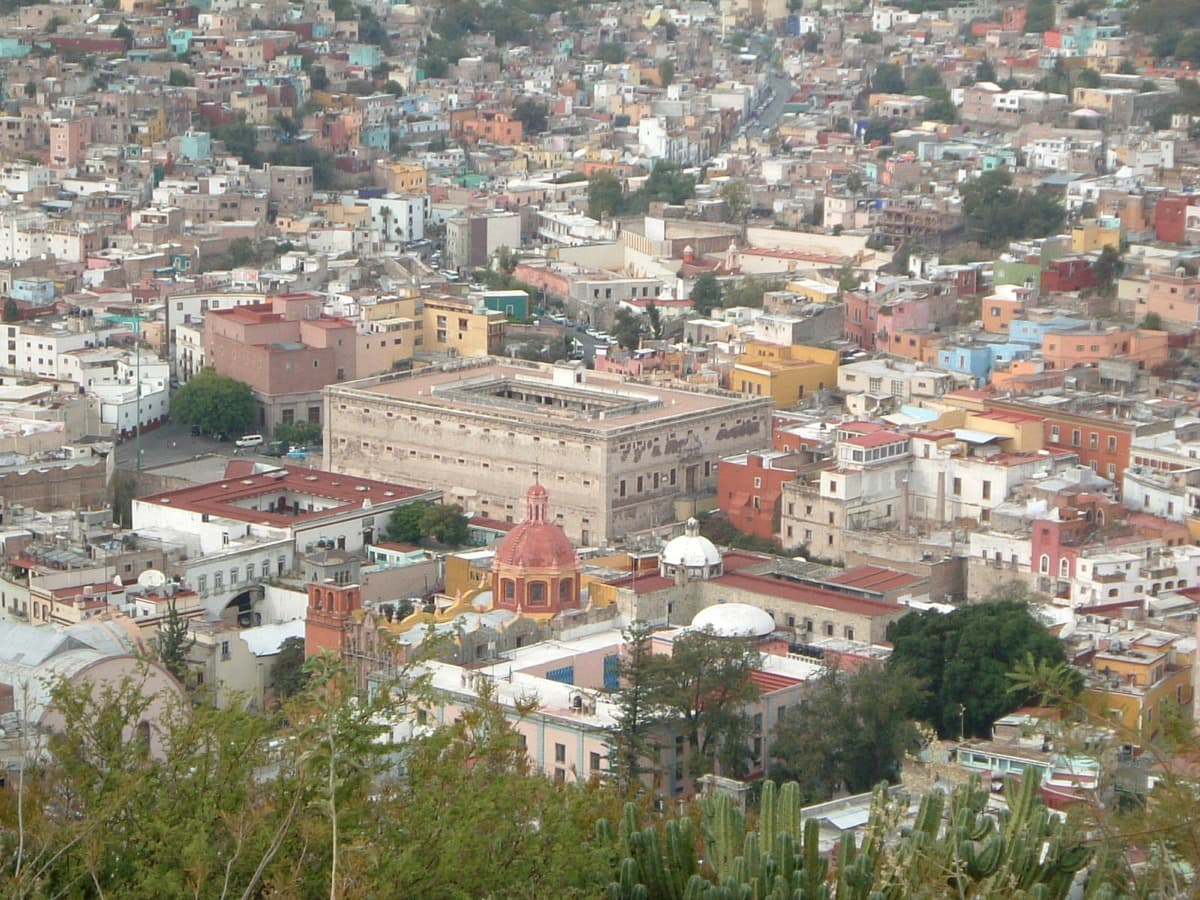
The Alhóndiga de Granaditas is a massive stone building on the north side of the historic center of Guanajuato. The walls are nearly a meter thick. The footprint is a rectangle of roughly forty meters by sixty. There is an interior courtyard. The windows on the lower floors are narrow and high, more like ventilation slits than windows. The building was finished in 1809. Within a year of completion it had been turned, briefly, into a fortress, and then into the site of the first major battle of the Mexican War of Independence. By the end of 1811, the heads of four executed rebel leaders were hanging in iron cages at its four corners. They stayed there for ten years.
Today the building is the Museo Regional de Guanajuato. The exhibitions inside cover regional pre-Hispanic, colonial, and revolutionary history. The walls, the courtyard, the staircases, and the four iron hooks at the corners are all original. This article is the building's history, told as the history of a single object.
What an alhóndiga was for
The word alhóndiga comes from the Arabic al-funduq, which entered Spanish in the medieval period through Andalusian trade and originally meant a warehouse or trade house. By the colonial period in Mexico, an alhóndiga was a municipal grain market and storage facility. The colonial Spanish government regulated grain supplies to prevent speculation and famine. An alhóndiga was where bulk grain was inspected, taxed, and stored before being released for sale at controlled prices.
Guanajuato in the late 1700s was a major colonial mining city with a population of around fifty thousand, growing with the silver economy and dependent on grain imports from the surrounding Bajío plain for survival. The previous grain exchange building, near the river at the bottom of the canyon, had become inadequate and vulnerable to flooding. The colonial intendant of Guanajuato, Juan Antonio de Riaño y Bárcena, a Spaniard of distinguished military and administrative career, ordered the construction of a new alhóndiga on higher ground.
Construction began in 1798 and was completed in 1809. The architect of record is generally given as José Alejandro Durán y Villaseñor. The building's design was deliberately massive. Thick walls and small windows are functional for grain storage, where temperature and humidity stability matter, and where rodents and bandits both need to be kept out. The building also doubled, in its design, as a defensible structure. The colonial intendant who commissioned it understood that a grain warehouse in a wealthy mining city was a potential strategic asset.
That second function became, within a year of the building's completion, its actual function.
September 28, 1810
Hear a stop from this walk
Alhóndiga de Granaditas
On September 16, 1810, the parish priest Miguel Hidalgo y Costilla issued the Grito de Dolores in the town of Dolores, roughly forty kilometers from Guanajuato, calling for an end to bad government and Spanish dominance. Within hours he had assembled the beginning of an army. Within ten days that army was approaching Guanajuato.
The Spanish intendant Riaño had a few days to prepare. He decided to defend the city not at its perimeter, which the steep canyon made impractical, but inside a single fortified building. He chose the Alhóndiga. He moved the city's silver reserves, the Crown's treasury for the region, the colonial garrison, and the families of the wealthy peninsulares and Creoles loyal to the colonial government into the granary. They sealed the doors. They prepared to hold out for relief that they expected the Spanish viceregal government in Mexico City to send.
The rebel army that reached Guanajuato on September 28 was much larger than Riaño had expected. Estimates put it at around twenty thousand, though the figure varies in the sources. It was composed of indigenous workers, miners from the surrounding pits, peasants from the towns along the route, and a small number of Creole army officers including Ignacio Allende and Juan Aldama. It was poorly armed. Most of the men carried machetes, sticks, slings, agricultural tools, or no weapon at all. A few hundred had muskets. Hidalgo himself led the army, although Allende later complained that Hidalgo's leadership was more political than military.
The siege began in the morning. The rebels surrounded the building and tried to rush the door. The Spanish defenders, with a clear field of fire from the upper windows, killed many of the attackers in the first hour. Riaño himself was killed by a musket shot in the first hour, leaving the Spanish defense without its commander. The defense continued under junior officers.
By midday the rebels had taken heavy casualties without breaking through. The wooden door of the Alhóndiga was the only realistic point of attack. The walls were too thick to breach, and the windows were too high and narrow to assault.
What changed the outcome is the part of the day that has entered Mexican national memory as the act of El Pípila. His real name was Juan José de los Reyes Martínez. He was a young miner from the surrounding pits. He strapped a flat slab of stone to his back as a shield against musket fire, crawled across the open ground in front of the granary toward the door, and set the door on fire with a torch dipped in pine resin. When the door burned through, the rebel army poured in.
What followed is harder to narrate cleanly. Over five hundred people inside the building were killed. Spanish soldiers, the wealthy Creole and peninsular families they had been protecting, women, children. The rebels looted the silver, the grain, and the building. Some of the looting was the systematic seizure of state assets, since the Crown's treasury for the region was inside the building. Much of it was not. The rebel army had been told that the wealthy of the empire were the enemy. The wealthy of Guanajuato were sealed inside that building when the door burned.
The first major battle of the Mexican War of Independence was a rebel victory and a massacre. Both descriptions are accurate.
The heads
The Spanish viceregal response to the fall of the Alhóndiga was severe. Within months, royalist forces under Félix María Calleja had recaptured most of the Bajío, including Guanajuato. Hidalgo, Allende, Aldama, and the Creole commander Mariano Jiménez were captured the following March near Acatita de Baján in the northern state of Coahuila. They were tried and executed by firing squad in Chihuahua in 1811.
Their heads were preserved in salt, packed into iron cages, transported overland by mule train back to Guanajuato, and hung at the four corners of the Alhóndiga as a warning to anyone who might think to challenge Spanish rule. The transport took weeks. The cages were heavy iron baskets, designed to display the heads while preventing scavengers from removing them. They were bolted to the upper corners of the building, where they were visible from any approach.
The heads remained at the corners of the Alhóndiga for ten years. From 1811 until 1821, the year Mexico finally achieved independence under Agustín de Iturbide's Plan of Iguala, the city's inhabitants walked past the rotting heads of four national heroes every day. The walls of the granary were thick, the streets nearby were narrow, the corners of the building were impossible to avoid without taking a longer route through the city.
When independence came in 1821, the heads were removed and eventually interred. They were finally moved to the Angel of Independence monument in Mexico City in 1925, where they rest alongside the remains of other independence heroes. The iron hooks that held the cages stayed bolted to the corners of the Alhóndiga. They are still there.
What the building became
After independence, the Alhóndiga lost its original function. The colonial grain regulation system did not survive the war, and Guanajuato's mining economy contracted in the 1820s in any case. The building was repurposed.
In 1864 it became a state prison. During the French Intervention of the 1860s, when Maximilian's imperial government briefly controlled the region, the building held political prisoners. After the restoration of the republic under Benito Juárez, it continued to serve as a prison through the Porfiriato and into the early twentieth century.
In 1955, the murals on the interior staircases and walls were painted by the Guanajuato-born artist José Chávez Morado, depicting scenes from Mexican history including the events of September 1810. Chávez Morado's murals are now part of the museum's permanent installation. They are not the work of a national-level muralist on the order of Rivera or Orozco, but they are deeply integrated into the building and represent the twentieth-century Mexican state's reclamation of the Alhóndiga as a site of national memory.
In 1958 the building was formally converted into the Museo Regional de Guanajuato Alhóndiga de Granaditas. It remains the regional history museum today. The exhibitions cover pre-Hispanic and colonial periods, the events of 1810, the nineteenth century, and the Mexican Revolution. The walls, the windows, the courtyards, and the iron hooks are all original.
The granary that was built to store grain, that became a fortress for one day, that became the site of a massacre, that became a platform for the display of executed rebels for a decade, and that became a prison for most of a century, is now a museum about all of that. The building has been many things in two hundred and fifteen years. It has remained, structurally, the same building.
What to look for
Approach the building from the southwest, where the main entrance is. The first thing to take in is the scale. The Alhóndiga is bigger than it needs to be for a grain warehouse. The walls are thicker than they need to be for any non-defensive use. The intendant who commissioned it was preparing for the possibility that grain would not be the only thing it stored.
Walk to each of the four corners. The iron hooks that held the cages are bolted into the masonry at roughly the second-floor level. They are visible from below, although the casual visitor often misses them. Each hook is a heavy wrought-iron loop, the kind of thing a working blacksmith of 1810 could have made in a day and that has stayed in place for over two centuries. They are the four most direct physical traces in the city of what happened here.
Step inside. The interior courtyard is the original. The staircases are the original, lined with the Chávez Morado murals from 1955. The exhibition halls walk you through the same history this article has narrated. The displays are good. The murals are vivid. But the building itself is the most important artifact in its own museum. The walls heard the siege. The corners held the heads. The doors that burned in September 1810 are gone, of course, but the openings they sat in are the original. The Alhóndiga remembers a day in 1810 the way few buildings can.
When you leave, stop at the corner. Look up at the hook. The cages are gone. The heads are in Mexico City. The hooks are still there. That gap, between what was once displayed and what is now only memory, is the gap the building exists to keep open.
Mexico eSIM· 10% off with ROAMER10
Ready to experience it?
Silver, Blood & Independence
100 min · 3.2 km · moderate
More from Guanajuato
Explore more at your own pace.
Best Self-Guided Walking Tours in Guanajuato (2026)
Guanajuato Travel Guide: How Many Days, Getting Around, When to Go (2026)
One Day in Guanajuato: A Walkable Canyon Itinerary (2026)
What to Eat in Guanajuato: A Food Guide (2026)
How a Silver Town Became Latin America's Stage