Guanajuato's reputation as a cultural city is roughly seventy years old. The painted facades are older than that, but as a tourist proposition they did not exist as a national identity until the city's silver economy had been gone for over a century. The Festival Internacional Cervantino, the institution that today defines Guanajuato as Latin America's largest performing arts festival, did not exist before 1972. Its origin, a university theater professor staging Cervantes' short comic plays on the steps of Plaza San Roque in 1953, is younger than most of the visitors at this year's festival.
The tour you have just walked, color, canvas, and Cervantes, treats the city as if its artistic identity is continuous and ancient. The painted houses look ancient. The baroque churches are ancient. The Quijote museum is anchored to a four-hundred-year-old book. But the synthesis of these elements into a single cultural argument about Guanajuato, that the city is the artistic capital of the Bajío, is a twentieth-century construction. This article is the history behind that construction.
Diego Rivera leaves town
Diego Rivera was born in a townhouse on Calle Positos on December 8, 1886. He lived in Guanajuato for six years before his family moved to Mexico City for political reasons. From the perspective of his biography, Guanajuato is a footnote. He left as a small child and built his career in Mexico City, Paris, and the major American cities where he was eventually commissioned for industrial murals in the 1930s.
From the perspective of Guanajuato, Rivera is something different. He is the city's connection to twentieth-century Mexican art at the highest level. By the time he died in 1957 he was widely regarded as the most important Mexican muralist of the century. The murals at the Ministry of Education in Mexico City, the Detroit Industry frescoes, the destroyed Rockefeller Center mural, all of them belong to international art history. They were also, in part, the work of a man who had spent his first six years in a colonial townhouse in a silver canyon.
The Museo Casa Diego Rivera was established in 1975, eighteen years after his death, in the same house. The connection between the city and the painter became deliberate. Guanajuato had not produced his career, but it had produced him, and a city in the second half of the twentieth century with declining mining revenue and rising tourist potential was not going to leave that asset unclaimed.
Rivera's work is not particularly Guanajuato-coded. His murals are about industry, labor, history, and the Mexican Revolution. He did not paint the canyon. But his eye for color, his interest in working-class life, and his commitment to public art aligned with the city's emerging cultural identity in a way that gave the museum more cultural weight than its modest collection would otherwise justify.
The color is older than the painter
Hear a stop from this walk
Museo Casa Diego Rivera
The color tradition in Guanajuato is not derived from Rivera or from any other named artist. It predates the muralist movement by centuries. The painted facades that visitors photograph today are the accumulated product of thousands of individual decisions made over five hundred years.
The mechanism is layered. In the colonial period, wealthy mine owners painted their mansions in expensive imported pigments. Prussian blue, vermillion, lead white, ultramarine. These pigments came overland from Veracruz or by sea from Asia. They were status markers. A mansion painted in ultramarine signaled access to the global trade network that the silver wealth bought. The working-class neighborhoods could not afford imported paint. They used lime washes tinted with locally available pigments. Iron oxide produced reds and oranges. Copper carbonate produced greens. Indigo, locally cultivated, produced blues. Cochineal, the red dye extracted from cactus insects, was a colonial Mexican export and was also used locally for the deeper reds.
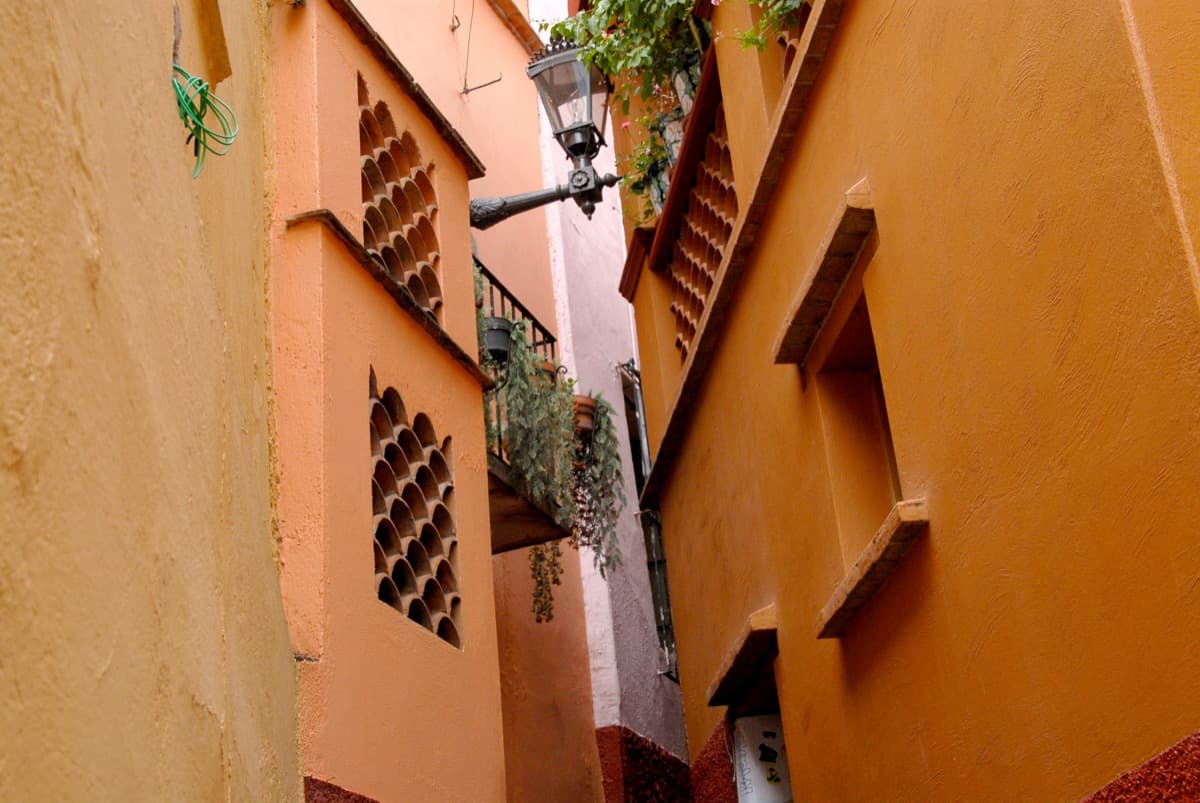
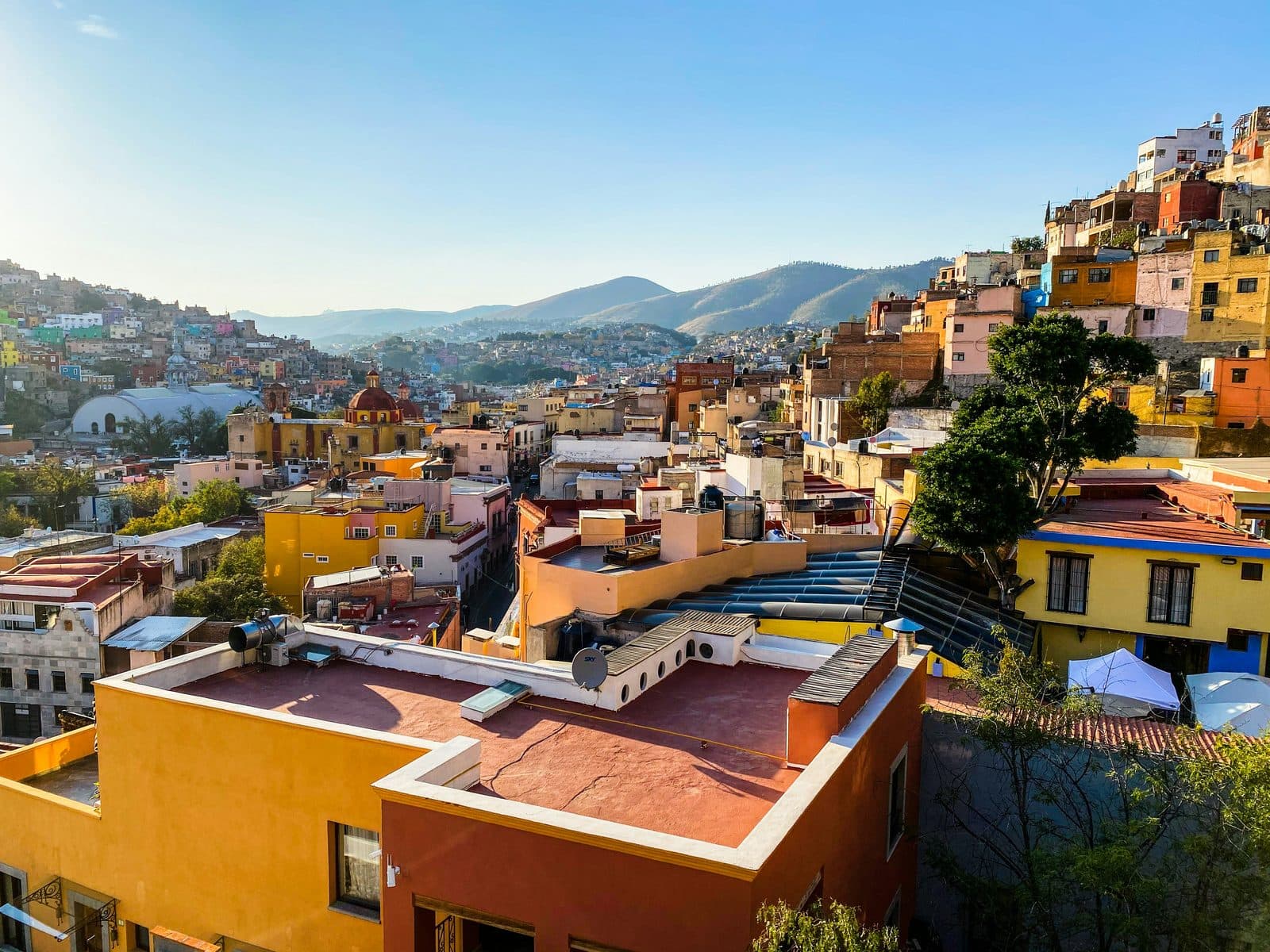
Over centuries, the practice of painting houses became the practice of distinguishing one house from another. In the dense barrios where buildings shared walls and where the alley between two houses might be sixty-eight centimeters wide, color was the way to tell whose front door you were standing in front of. The wealthy palette and the working-class palette began to converge in the nineteenth and twentieth centuries as commercial paint became cheaper and the social distinction blurred. Today the result is the canyon you can see from the El Pípila monument at dusk: a non-uniform, non-designed, accumulated palette of mustard, terracotta, cobalt, lime, fuchsia, and ochre that no single artist could have planned.
The UNESCO World Heritage designation of 1988 specifically cited the painted facades as part of the site's outstanding universal value. The colors are protected, in the sense that the visual character of the historic center is now part of an international preservation regime. The mechanism that produced the colors, individual homeowners choosing their own paint, continues. The Pastita barrio on the south side of the canyon is where the tradition is most visibly alive, because Pastita's steep callejones cannot be reached by vehicle, no urban planner imposed a palette, and the residents repaint their facades in their own time and their own colors.
The festival as deliberate construction
The Festival Internacional Cervantino was not an organic accumulation. It was constructed.
In 1953, Enrique Ruelas Espinosa, a theater professor at the University of Guanajuato, began staging short comic plays by Miguel de Cervantes, the entremeses, on the stone steps of Plaza San Roque. The entremeses are brief pieces, ten to twenty minutes each, written to be performed between the acts of longer plays in Cervantes' time. They translate well to outdoor spaces because they need almost nothing in production: a few actors, an audience close enough to hear them, no scenery.
Ruelas chose Plaza San Roque because the plaza had the right physical scale. A small sloping square with stone steps that could double as audience seating, with a small church at the top, and with the surrounding buildings providing acoustic enclosure. The actors performed in the space between the steps. The audience sat on the ground and on the stairs. The format had no curtain, no stage, no lighting rig. It was effectively a reconstruction of how Cervantes' own contemporaries would have seen entremeses performed.
The performances became an annual university tradition. By the late 1960s they had attracted enough national attention that the Mexican federal government, then in the late Díaz Ordaz and early Echeverría administrations, recognized them as a potential cultural asset. The Echeverría government was building a strategy of cultural diplomacy and Mexican soft power. A formal Cervantes festival in a colonial canyon city, with international participants, fit the strategy.
The Festival Internacional Cervantino was officially established in 1972, with federal funding, an international program, and a presence across multiple Guanajuato venues. The Teatro Juárez became the flagship venue. Plaza San Roque continued to host the entremeses every year, in the same format Ruelas had designed. The festival grew through the 1970s and 1980s and is now the largest performing arts festival in Latin America. Three weeks every October, the city's population effectively doubles. Performers come from over thirty countries. The Teatro Juárez, the Mercado Hidalgo, the Plaza San Roque, the Jardín de la Unión, and dozens of smaller venues across the city all program simultaneously.
The Cervantino did for late twentieth-century Guanajuato what silver had done for sixteenth-century Guanajuato. It pulled outside capital, outside attention, and outside talent into the canyon. The mechanism was different. The federal cultural budget replaced the colonial silver economy. But the structural role was similar. The city had again become a place that the wider world had reasons to come to.
The theater the festival rents
The Teatro Juárez, the building the festival now anchors itself to, was built between 1873 and 1903 by a sequence of architects under several federal and state governments. It was inaugurated by the dictator Porfirio Díaz on October 27, 1903, three years before his last formal re-election and seven years before the Mexican Revolution that ended his rule. The theater was, in 1903, a statement about Mexican modernity and Mexican global standing.
The exterior is Roman neoclassical, twelve Doric columns supporting a pediment, eight bronze muses along the roofline. The interior is Moorish Revival, with horseshoe arches, geometric tilework, and cedar screens that draw on the Alhambra in Granada by way of nineteenth-century European orientalist design. The architect of record for the interior is Antonio Rivas Mercado, the same architect who designed the Angel of Independence in Mexico City. The exterior says Rome. The interior says al-Andalus. The combination is intentional. The theater was meant to demonstrate that Mexico could draw on the full European and Mediterranean tradition and inflect it locally.
That the festival that revived the city in the 1970s rents the theater that the dictator who would be overthrown by the Revolution inaugurated in 1903 is one of the layered ironies of Guanajuato's cultural history. The Cervantino, formally a celebration of Spanish classical literature, takes place inside a building that was itself a celebration of Mexican imperial modernity. The Quijote museum across the city was founded by a Spanish Civil War refugee named Eulalio Ferrer who saw in Cervantes' knight-errant a personal symbol of resilience. Each layer of the city's artistic identity sits on top of an unrelated political layer underneath.
What the tour is actually walking
The color, canvas, and Cervantes tour treats the city's artistic identity as a single argument. The argument is that Guanajuato is the artistic capital of the Bajío because two unrelated lineages converged on the same place in the second half of the twentieth century: a deep, accumulated, anonymous color tradition that comes out of the canyon's working-class history, and a sharp, dated, deliberate festival construction that comes out of one professor's idea in 1953.
The tour walks through both. Rivera's birth-house is the connection to international Mexican art. The Museo del Pueblo is the connection to colonial and nineteenth-century regional painting. The Quijote museum is the literary anchor for the festival. Plaza San Roque is where the festival started. The Jardín de la Unión and the Mercado Hidalgo are the social and commercial spaces that hold the city's everyday life together. The Teatro Juárez is the festival's stage. Pastita is the painted neighborhood that shows the color tradition still operating.
Read in sequence, the stops trace the convergence. The painter who left as a child connects the city to global Mexican art history. The colonial museum connects the present back to the silver-era painting. The Quijote museum connects the local festival to a four-hundred-year-old book. The plaza where the festival started shows where the artificial construction began. The garden, the market, and the theater show the festival operating today. The barrio shows the color tradition operating tomorrow.
Guanajuato's artistic identity is younger than it looks and older than it claims, depending on which thread you pull. The tour walks both threads at once.
Mexico eSIM· 10% off with ROAMER10
Ready to experience it?
Color, Canvas & Cervantes
85 min · 2.3 km · easy
More from Guanajuato
Explore more at your own pace.
Best Self-Guided Walking Tours in Guanajuato (2026)
Guanajuato Travel Guide: How Many Days, Getting Around, When to Go (2026)
One Day in Guanajuato: A Walkable Canyon Itinerary (2026)
What to Eat in Guanajuato: A Food Guide (2026)
The Alhóndiga de Granaditas: Where Mexico's War for Independence Began