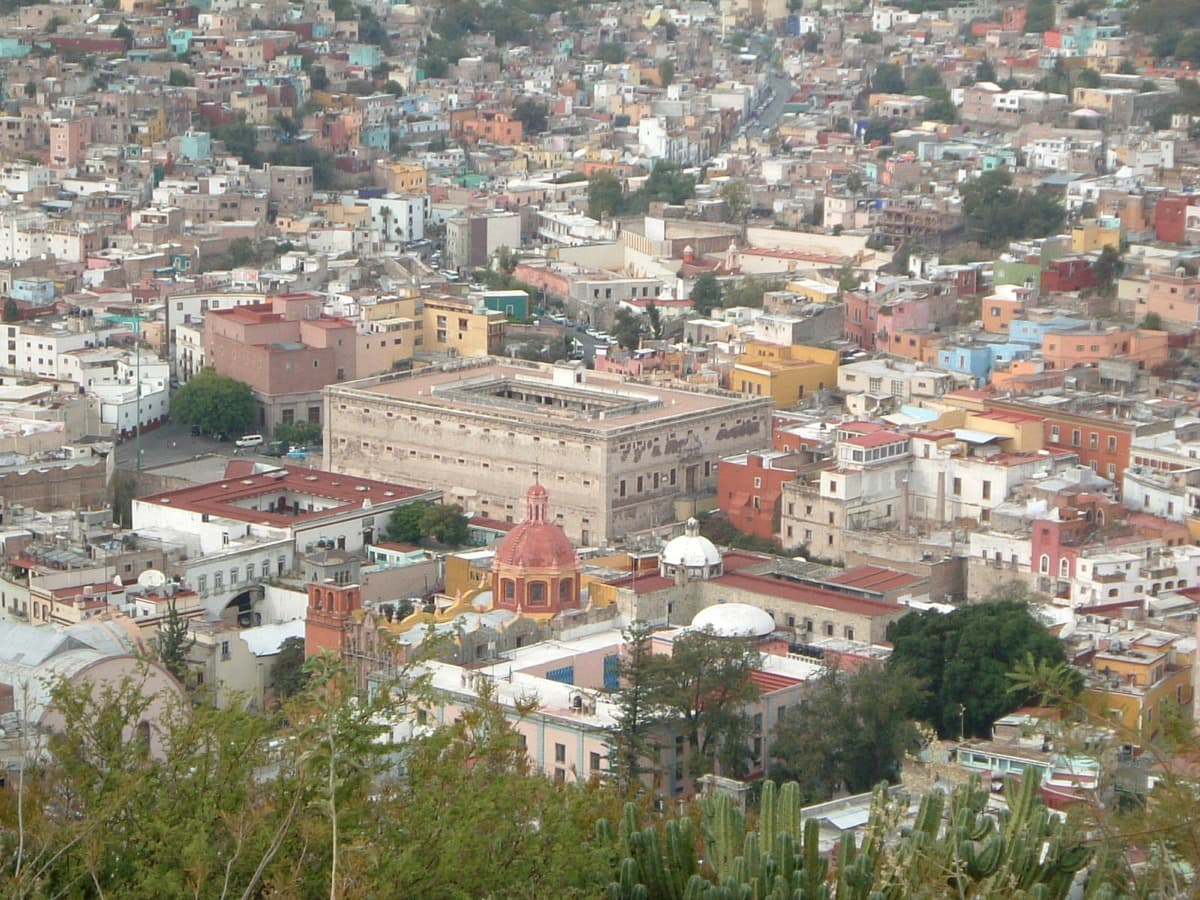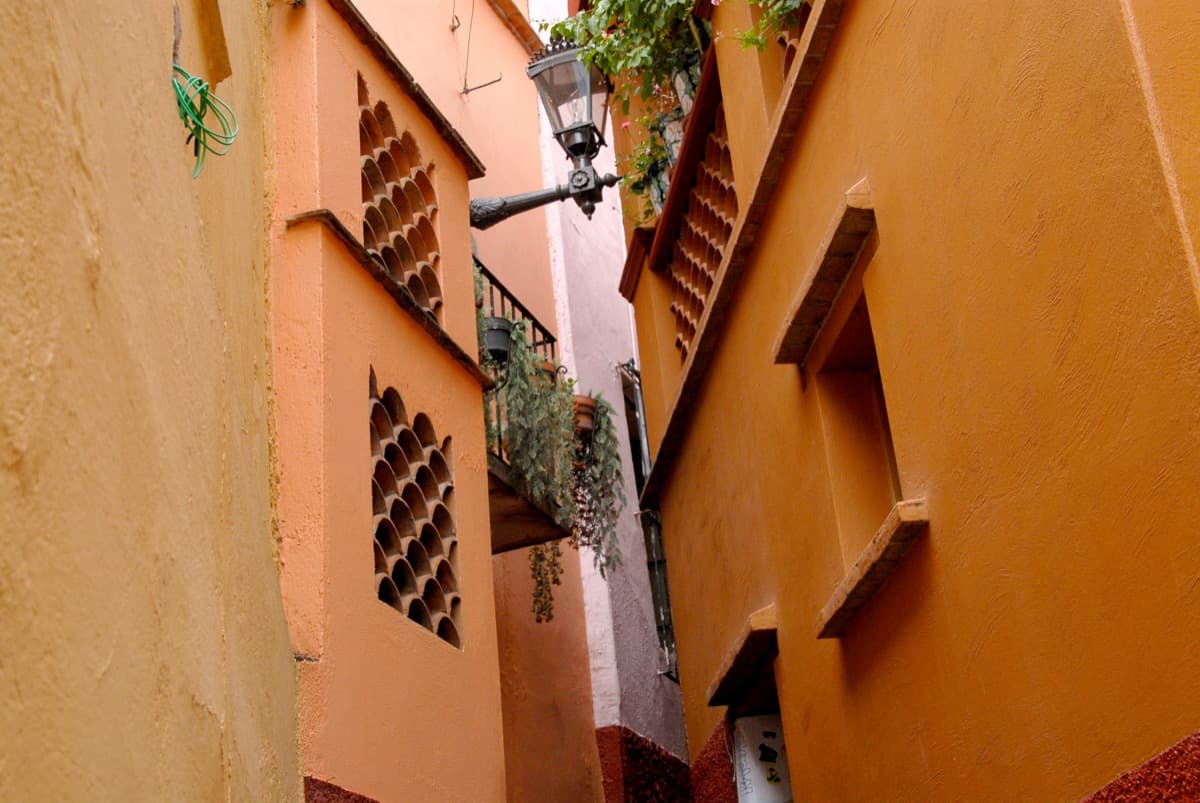
Stand at the entrance to the Callejón del Beso, on Calle del Patrocinio in the historic center of Guanajuato. The alley descends to your right and then climbs a short flight of stone steps. The two buildings on either side rise three or four stories. Their lower walls are painted in muted reds and ochres. Two iron balconies project from the second-floor windows of the houses near the top of the steps. Between them, the air is so thin that a hand from each balcony can almost touch the hand from the other.
At the narrowest measured point of the alley, the distance between the two walls is sixty-eight centimeters. The two balconies overhang the gap. Their iron railings are roughly ten centimeters apart at their closest point. A person leaning out of one balcony can kiss a person leaning out of the other balcony, with both still standing on solid floor inside their own house.
This is the geometry. The story attached to it is its own object.
The story
The legend is told in many versions, and the details vary depending on the source. The basic outline is consistent. A young woman, usually named Doña Carmen, the daughter of a wealthy and controlling father, lives in one of the two houses. She falls in love with a poor young man, usually named Don Carlos, often described as a miner. Her father forbids the relationship. He threatens to send her to a convent or to marry her off to a wealthy older Spaniard. He eventually locks her in her room.
Don Carlos, refusing to give up, rents the house directly across the alley. The balconies are close enough that they can meet at night and kiss across the gap. They do this for some time. The father discovers them. In a rage, he kills his daughter, in most versions by stabbing her through the heart. Don Carlos, watching from the opposite balcony, can only kiss her lifeless hand as she slumps against the railing. He dies himself shortly after, either from grief or by his own hand.
The earliest written record of the legend in this form dates to the late nineteenth century, although elements of it appear in earlier oral tradition. The story has the structure of a colonial-era Romeo and Juliet, refracted through the specific architecture of Guanajuato's narrowest alley. There is no historical documentation confirming the names, the families, or the events. The legend may be a literary embellishment of an earlier story, may be an invention of the romantic nationalism that swept Mexico in the late nineteenth and early twentieth centuries, or may be the surviving folkloric trace of an event the historical record never captured.
What is clear is that the legend is attached to the alley because the alley is the right shape for it. The story requires a balcony close enough to another balcony for two lovers to meet without leaving their own houses. The Callejón del Beso provides that condition exactly. Few other places in Mexico provide it as cleanly.
The geometry the story rests on
Hear a stop from this walk
Alhóndiga de Granaditas (Exterior)
The alley is sixty-eight centimeters wide at its narrowest point. The figure is repeated in every modern source and is consistent with direct measurement on site. Two adults of average build cannot pass each other in the alley without one turning sideways. A person of average shoulder width, roughly forty-five centimeters, has about ten centimeters of clearance on each side.
The width is the residual gap between two independently constructed colonial-era houses. The houses respected their surveyed property lines. The property lines respected the contour of the hillside and the buildable area on each lot. The municipal authority of the early colonial period did not enforce a minimum street width. The result was an alley wide enough for foot traffic and not always reliably even that.
The balconies are at the second story, roughly three and a half meters above the alley floor. Iron balconies of this kind, projecting from the second-floor window with a small platform and a decorative railing, were standard in colonial Mexican domestic architecture for ventilation, social display, and watching the street below. In a normal-width street, the balconies of opposing houses face each other across enough space for normal social distance. In the Callejón del Beso, the balconies face each other across about ten centimeters of air.
A few similar conditions exist elsewhere in central Guanajuato. The Callejón del Beso is the famous one because the legend landed on it. Walk the legends tour with your eyes up, and you can find several alleys where two second-floor balconies overhang a gap narrow enough to span by leaning. The condition is repeated. The story is unique.
The third step
Modern visitors line up at the entrance of the alley to perform a small ritual on the third stone step. The tradition holds that a couple who kisses on the third step will have seven years of happiness. A couple who refuses to kiss, or a single visitor who declines, will have seven years of bad luck. The third step is the one closest to where the two opposing balconies hang. The ritual concentrates the meaning of the alley into a single act on a single piece of pavement.
The third step is worn smooth from a century of feet. Photographs of couples kissing on the third step have been a fixture of Mexican tourism since at least the 1940s. The ritual is now a self-sustaining tradition. Visitors do it because other visitors did it. The line moves slowly because everyone wants the photograph.
There is no documented colonial-era origin for the third-step ritual. Like the legend itself, it is most likely a twentieth-century overlay on an older alley. The ritual has the same function as the legend: it converts an architectural condition into a participatory experience. The visitor is no longer just observing the geometry. The visitor is now part of the tradition.
What the alley tells you about the city
The Callejón del Beso is the single most photographed alley in Guanajuato and one of the most photographed urban features in Mexico. The legend is the explicit reason. The geometry is the implicit one.
The alley demonstrates, in a single measured fact, what the city's shape forced on its architecture. There was not enough flat ground in the canyon for normal streets. The houses were built on lots that respected the buildable contour of the hillside rather than any imposed grid. The residual gaps between houses became the alleys. The colonial municipal authority did not regulate the gap widths. The result was a city where some alleys are sixty-eight centimeters wide.
The legend takes that condition and turns it into a story about love crossing a barrier that is almost too small to count as a barrier. The lovers are sixty-eight centimeters apart. They cannot meet at street level without the father's permission. They can meet at second-floor level by leaning out. The physical condition is what makes the romance possible and what makes the violence at the end of the story possible too. The father can kill his daughter because she is, despite the lover's presence ten centimeters away, still inside the house he controls.
This is why the legend feels native to Guanajuato in a way it would not feel native to Mexico City or Veracruz. A wider street would not produce the same story. A narrower street would not allow the balconies. The exact dimension of the gap is the necessary condition for the legend.
Walk to the third step. Lean back and look up. The two balconies hang over your head, almost touching. The iron railings are close enough that you could reach up and touch both at once if you stood on the right step at the right height. The two houses are independent buildings. They have always been independent buildings. The closeness was an accident of property survey in the colonial period. The closeness produced a courtship geometry that the colonial period was not socially prepared to accommodate. And so the story exists. The alley is the proof.
When you leave, walk a hundred meters in either direction and the city opens up again. The streets widen. The balconies move farther apart. The Callejón del Beso is one of the most extreme expressions of the canyon's geometry, and the city has built a tourist economy around the geometry. The legend is the cover story. The measurement is what people came to see.
Mexico eSIM· 10% off with ROAMER10
Ready to experience it?
Legends of the Callejones
90 min · 2.5 km · easy
More from Guanajuato
Explore more at your own pace.
Best Self-Guided Walking Tours in Guanajuato (2026)
Guanajuato Travel Guide: How Many Days, Getting Around, When to Go (2026)
One Day in Guanajuato: A Walkable Canyon Itinerary (2026)

What to Eat in Guanajuato: A Food Guide (2026)
How a Silver Town Became Latin America's Stage