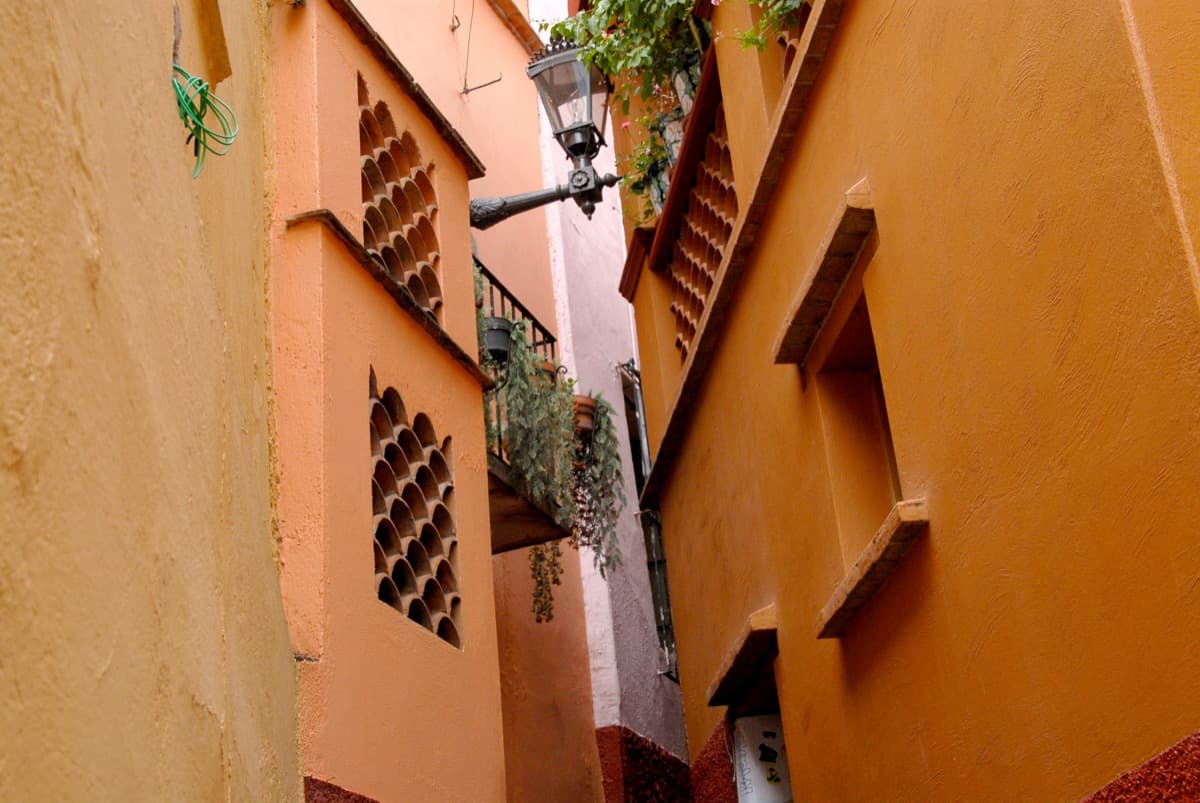
Stand in the Alley of the Kiss and put a hand against each wall. They are sixty-eight centimeters apart. That is not figurative distance. It is measured. Two adults cannot pass each other in this alley without one of them turning sideways. A second-story balcony on one side is close enough to a second-story balcony on the other to kiss across the gap, which is how the alley got its name. The Romeo and Juliet story attached to that gap, the wealthy father, the poor miner, the fatal stabbing, may be true, embellished, or invented. The alley itself is real. The distance is real. And the geometry came first.
This is the pattern that runs through every Guanajuato legend the tour walks. The ghost story is downstream of a physical fact. The Mummies of Guanajuato exist because the local cemetery's soil and sealed crypts naturally dehydrate bodies and because a nineteenth-century grave tax exhumed the unpaid. The underground tunnels exist because the river kept flooding the city and twentieth-century engineers diverted it. The dark passages where plague legends live are dark because the buildings around them are tall and the canyon walls are close. Read the city as terrain first, and every legend reads as the natural cultural product of the place.
This article is the companion to the legends tour, told from the city's bones outward.
The shape of the canyon
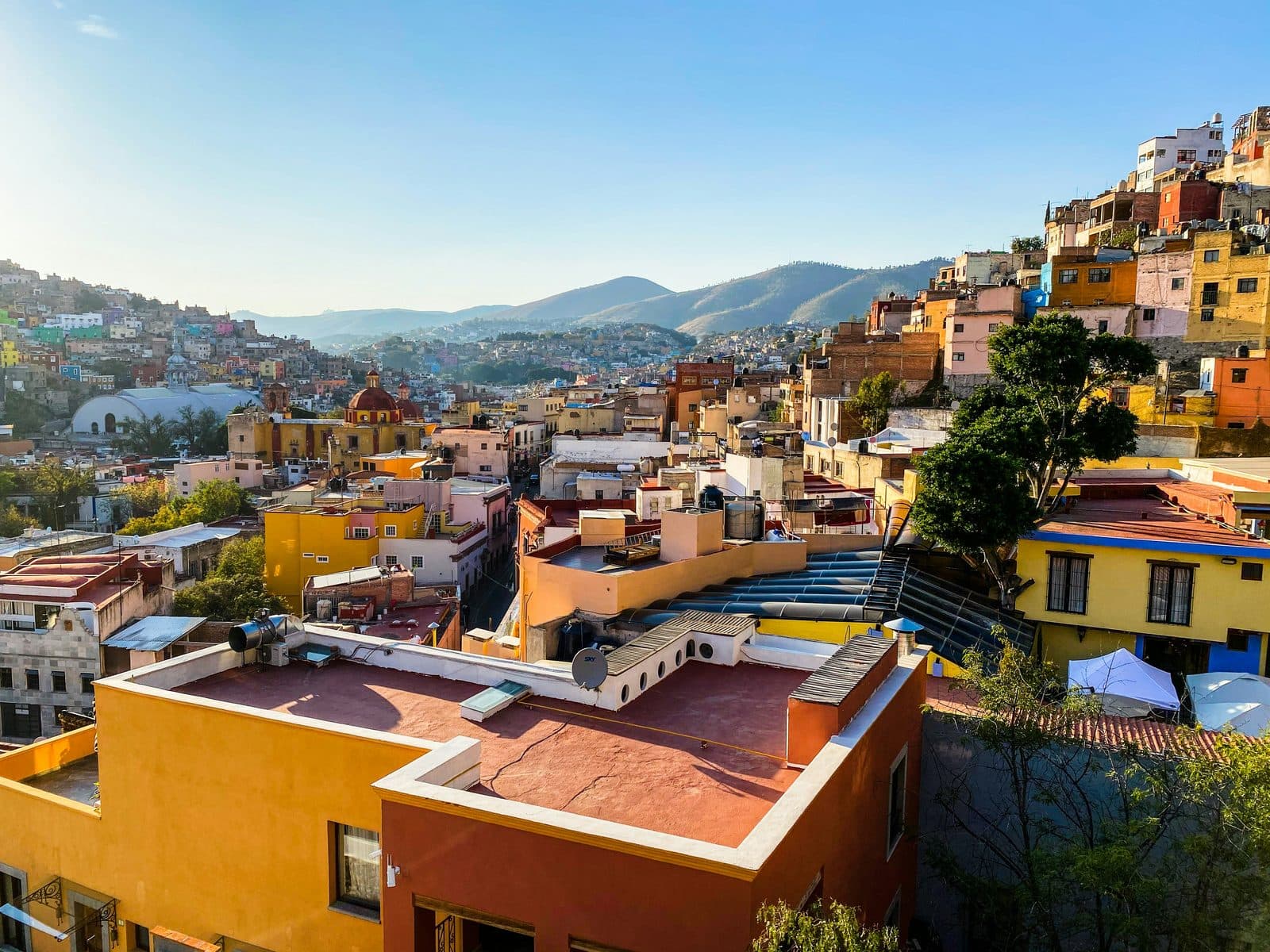
Guanajuato sits at the bottom of a steep, narrow ravine in the Sierra de Guanajuato. The flat ground at the bottom is barely a few hundred meters across. The walls rise on three sides, with the major mining hills behind. A river, the Río Guanajuato, ran through the bottom of the canyon for as long as the canyon existed. When the Spanish founded the city in 1554, they founded it along the riverbed because that was the only flat ground. Within a generation, the city ran out of flat ground entirely.
The houses started climbing. They had nowhere else to go. The terraced lots clung to the walls of the canyon, stacked sometimes five or six levels deep, with each new generation building above and behind the last. The streets between them were not planned. They were the residual gaps between buildings, narrowed wherever a wealthy family extended its property line, widened only where the slope demanded a staircase. By the seventeenth century there was no urban grid in Guanajuato because no grid was possible. The city had become a single organism of stone and lime, growing into the canyon walls.
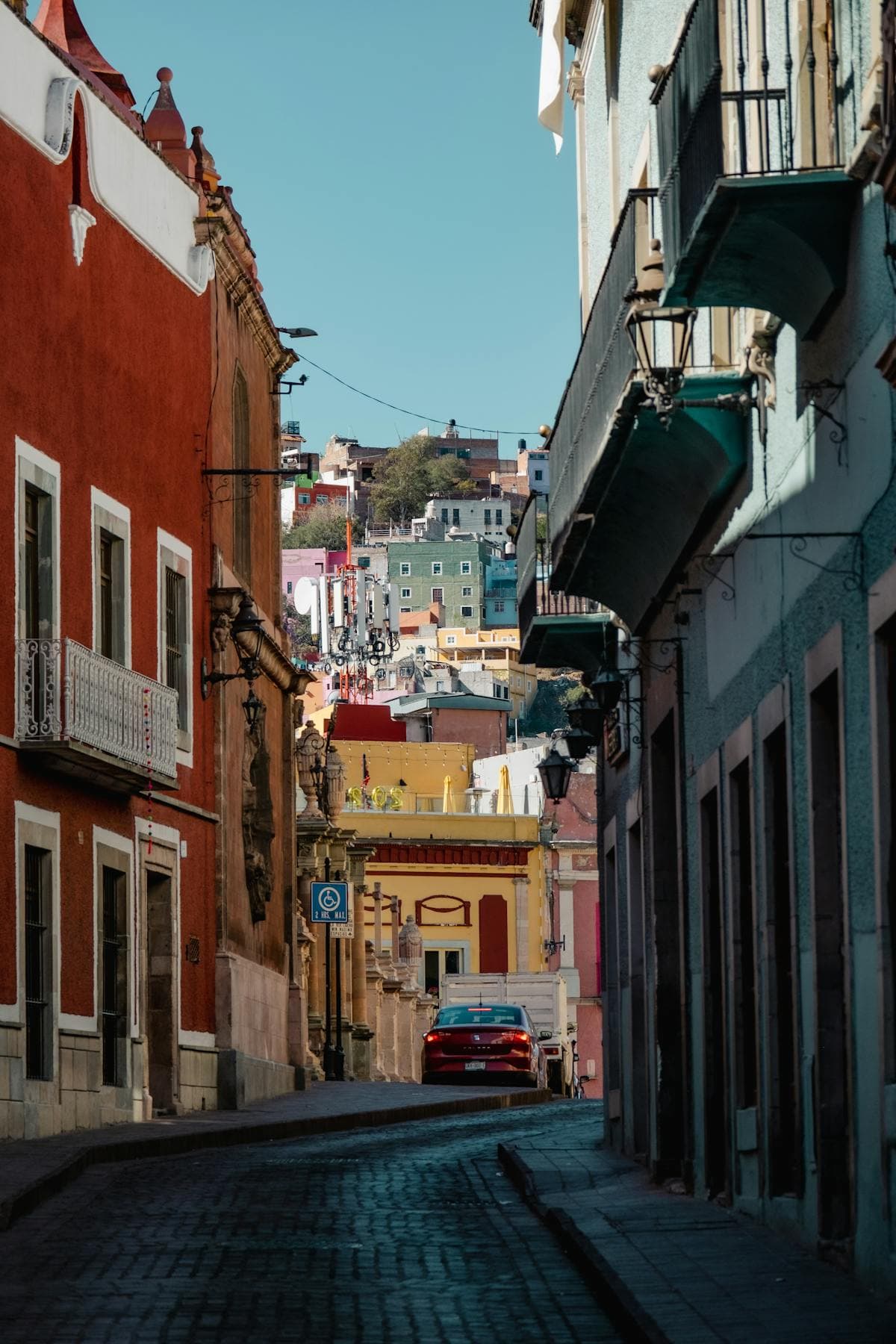
The Spanish word for these residual alleys is callejón, from calle, street. Guanajuato has hundreds of them, and almost every named alley has a story. The Callejón del Beso, the Callejón de los Muertos, the Callejón del Infierno, the Callejón del Calvario. The stories accumulated because the alleys were intimate, dark, and persistent across centuries. A wide boulevard is a stage for parades and protests. A callejón is a stage for whispers, courtships, and disappearances. The architecture produces the genre.
Why the alley of the kiss is the width it is
Hear a stop from this walk
Alhóndiga de Granaditas (Exterior)
The Callejón del Beso narrows to sixty-eight centimeters at its tightest point because the houses on either side were built independently by separate owners, on parcels that respected the surveyed property lines, and the surveyed property lines respected nothing other than the contour of the hillside. There was no minimum street width in early Guanajuato. There was no municipal authority enforcing one. The result was an alley wide enough for a man with a load on his back to squeeze through, and not always reliably even that.
The famous balconies are at the second story. The houses are about three and a half meters tall to the second-floor floor line. The balconies project about thirty centimeters from each facade. That leaves roughly ten centimeters of air between the two iron railings at their closest point. A person leaning out over each balcony can in fact touch the lips of a person leaning out over the other, with both sets of feet still on solid floor. The legend says Doña Carmen and Don Carlos used that geometry to meet. The geometry made the legend plausible.
There are over a dozen alleys in central Guanajuato narrow enough to span across at second-story level. The Callejón del Beso is the most famous because the legend got attached to it, but the physical condition repeats across the city. Walk the legends tour with your eyes up. You can find a dozen places where lovers could have made the same use of the same geometry. The story landed on one alley. The geometry made it possible everywhere.
Mummification by accident
The Museo de las Momias, the Mummy Museum, displays one hundred and eleven naturally mummified human bodies in glass cases. Some have expressions that look frozen. Some still wear fragments of clothing or have hair and fingernails intact. The collection draws over half a million visitors a year and remains, depending on whom you ask, either the strangest museum in Mexico or the most morally questionable.
It exists because of three converging facts.
The first is geology. The volcanic soil of the Guanajuato region is mineral-rich and unusually dry. Burial in this soil tends to dehydrate a body rather than encouraging the bacterial action of normal decomposition. The same chemistry that made the local hills produce silver also, by an unrelated mechanism, makes them produce desiccated corpses.
The second is the burial architecture of the Panteón de Santa Paula, the city's main cemetery during the nineteenth century. Many of its graves were sealed stone crypts built into the hillside, often above ground or partly above ground because the canyon's water table and rock structure made deep burial impractical. The sealed crypts kept out moisture and insects. The combination of dry mineral soil and airtight stone produced something close to the conditions of an Egyptian desert tomb.
The third is a tax. In the 1860s, the municipal government of Guanajuato imposed a perpetual-burial fee. Families who could not afford the fee had their dead exhumed and the crypt reused. The grave tax was roughly equivalent to a few days' wages for a miner, affordable for the comfortable classes and impossible for the poor. When the gravediggers opened the crypts to remove the unpaid bodies, they found that many of the bodies had not decomposed. They had mummified.
The first mummies were exhumed in 1865. By the late nineteenth century, the bodies were being stored in a building adjacent to the cemetery and shown to visitors for a small fee. The Museo de las Momias was formally established in 1969, but the practice of displaying the exhumed dead is more than a century older than the museum. The grave tax was eventually abolished. The exhumation stopped. The mummies that had been preserved stayed in the collection.
Every part of the story is the byproduct of something else. The soil chemistry was a fact of the landscape. The sealed crypts were a response to the canyon's geology. The grave tax was a revenue measure. The display was a commercial response to a curiosity that could not be ignored. No one set out to create a mummy museum. The mummy museum was what happened when geology, architecture, fiscal policy, and tourism interacted across a century.
A river that became a road
Walk through the underground tunnels of Guanajuato and you are walking inside the channels of the Río Guanajuato. For most of the city's history, the river ran through the bottom of the canyon, between the houses, alongside the main streets. Every rainy season it overflowed. In 1760, in 1780, in 1804, in 1905, the city was inundated. Buildings collapsed. People drowned. The Presa de la Olla, the colonial dam built in 1749, controlled the worst of the floods but never fully solved the problem.
In the 1960s, the city took a more radical step. Engineers diverted the river through new channels around the historic center and sealed the old riverbed entirely. The exposed stone channels through the heart of the city, lined with masonry walls that had been built up over two centuries to contain the floods, were paved and converted into roads. The first tunnel opened to traffic in 1964. The network has been expanded several times since, and now covers more than nine kilometers of subterranean roadway with traffic signals, streetlights, directional signs, and pedestrian sections.
Guanajuato is, by most accounts, the only city in the world with a working underground road network converted from natural river channels. The walls of the tunnels are the original riverbed, smoothed by centuries of water. The ceiling drips during heavy rains. Cars driving through the tunnels are following the path the river took for millennia.
The pedestrian sections of the tunnels are the legend-generating part. They are dimly lit. Sound carries unpredictably. The temperature is cool and constant. You can walk a section of tunnel beneath the city, climb a staircase, and emerge on a completely different street in a part of town you did not expect. The disorientation is real. The city above and the city below operate on different grids and different logics, and the moments when they cross are exactly the moments where Guanajuato's ghost stories tend to land.
The legends of the Alhóndiga, retold
The legends tour stops at the Alhóndiga de Granaditas, the granary where the first major battle of the Mexican War of Independence ended in a massacre on September 28, 1810. The historical record is in another article. The legends side is its own layer.
After Hidalgo, Allende, Aldama, and Jiménez were captured and executed in 1811, their heads were preserved in salt, transported back to Guanajuato, and hung in iron cages at the four corners of the granary. They remained there for ten years, from 1811 until Mexican independence in 1821. The walls of the granary are roughly a meter thick, and the iron hooks that held the cages are still bolted to the corners of the building.
Local legend says that during those ten years the heads aged, that hair continued to grow, that expressions changed. The literal claim is not biologically plausible. The psychological claim is exactly true. A city forced to walk past the rotting heads of national heroes for a decade builds a folklore around the sight, and that folklore tends to imagine the heads as continuing to suffer. The legend captures the moral horror of the display more faithfully than the physiological record could.
When a callejoneada, the evening musical procession led by student troupes in Renaissance costumes, passes the Alhóndiga at night, the guide traditionally stops the group, dims the lanterns, and tells the story of the heads. The singing pauses. Everyone looks up at the iron hooks. The dramatic effect is intentional, and it works because the hooks are still there. The folklore is anchored to a physical object.
What the legends tour is actually about
The tour you have walked treats Guanajuato's ghost stories as a single argument. The argument is that legend in this city is not decoration. It is the natural product of building a half a million-person culture into a ravine. The narrow alleys produced the courtship legends. The sealed crypts and the grave tax produced the mummies. The flooding river produced the tunnels, and the tunnels produced the underground disorientation that breeds ghost stories. The granary's thick walls produced both the historical massacre and the folklore around it.
Read this way, the tour is not a sequence of stops. It is a single thesis with seven examples. Each stop demonstrates a different mechanism by which the city's terrain converts itself into story.
The callejoneadas that operate every evening are the living expression of the same thesis. They lead tourists through the same alleys, point at the same physical features, and tell the same legends. The format has not changed in a century. It does not need to. As long as the canyon is the shape it is, the city will keep producing the same stories.
Mexico eSIM· 10% off with ROAMER10
Ready to experience it?
Legends of the Callejones
90 min · 2.5 km · easy
More from Guanajuato
Explore more at your own pace.
Best Self-Guided Walking Tours in Guanajuato (2026)
Guanajuato Travel Guide: How Many Days, Getting Around, When to Go (2026)
One Day in Guanajuato: A Walkable Canyon Itinerary (2026)
What to Eat in Guanajuato: A Food Guide (2026)
The Alhóndiga de Granaditas: Where Mexico's War for Independence Began