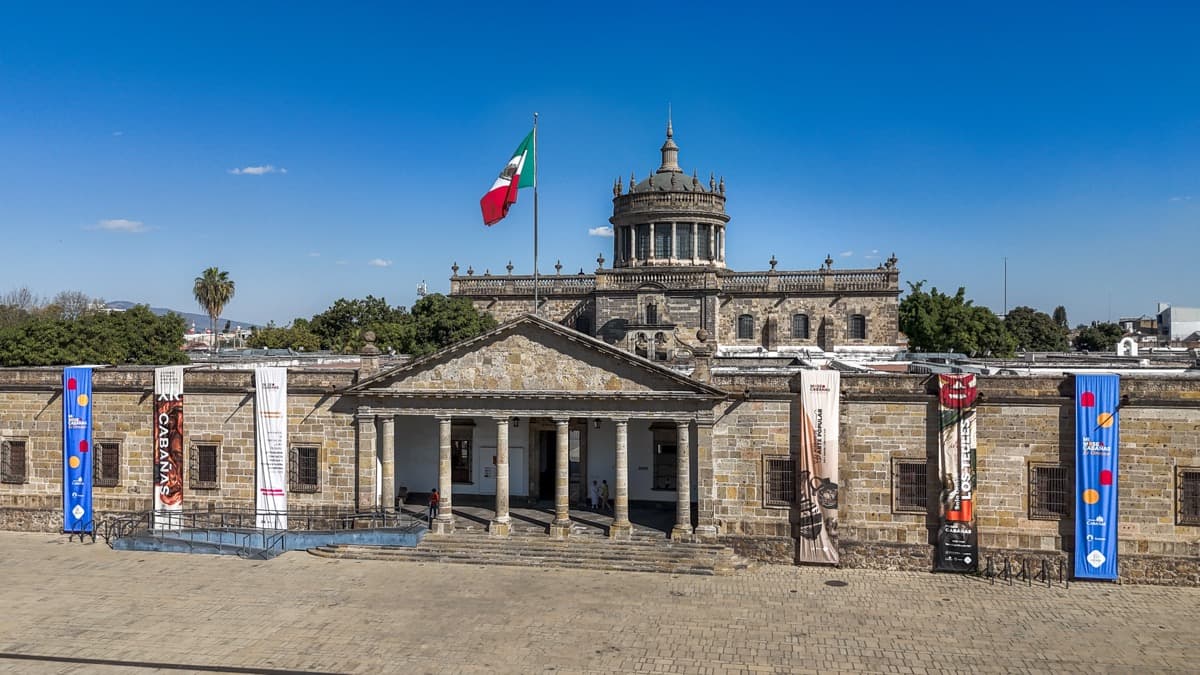
The museum sits on Calle Independencia, about a block north of the parish church, in a restored colonial house with a stone-arched courtyard and potted plants. It is free to enter, small enough to walk through in twenty minutes, and it does something most small regional museums fail to do: it gives you the technical vocabulary you need to read everything you will see in the rest of the village.
The house itself is part of the lesson. Eighteenth-century construction, two stories around a central patio, thick whitewashed adobe walls. The kind of building wealthy Guadalajara families used as summer retreats when the village was a separate settlement and the carriage ride from the city took an afternoon. The museum's collection lives inside it because the building survived, and because the state decided in the twentieth century that the village's ceramic tradition deserved an institutional anchor. The choice of building was deliberate. The collection sits in the architecture that the tradition's later customers built. Both are old. Both are the same village.
The pre-Hispanic room
The first room you enter holds the oldest pieces, ceramics produced before the Spanish arrived in the 1530s. Some of them are dated to the ninth century. A few of the pieces are older still, from the shaft-tomb culture of western Mexico that flourished between roughly 300 BCE and 400 CE and that produced figurative ceramics found in burial shafts cut as deep as twenty metres into volcanic tuff.
The technical fact to notice in this room is the absence of the potter's wheel. None of the pieces were wheel-thrown. The wheel was a European import, arriving with the Spanish in the sixteenth century, unknown across Mesoamerica before that. The vessels in this room were built by coiling. The potter rolled clay into long ropes and stacked them in a spiral, smoothing each coil into the one below with the fingers and a wet rag. The technique sounds primitive when described but produces remarkably regular forms in skilled hands. A coiled vessel can be made larger, more symmetrical, and more thinly walled than a beginner on a wheel will manage in their first year.
The firing was also pre-industrial. The Tonalteca people of this region did not use kilns in the European sense. They fired in pits dug into the earth, covered with combustibles like grass and corn cobs and sometimes dung, lit, and left to burn down over hours. The temperatures achievable in a pit fire run between roughly six hundred and nine hundred degrees Celsius, which is enough to produce a hard, watertight vessel. The colour of the fired clay in this room is the warm reddish-brown of high-iron Jalisco earth. That colour is the visual signature of pottery from the region, and it has not changed.
The most surprising survival in this room is the burnishing. Several pieces have a high-gloss finish that looks glazed. They are not. The finish was produced by rubbing the leather-hard clay surface with a smooth stone, typically a piece of quartz or polished river rock, before firing. The technique is called bruñido, burnished. The result is a surface that reflects light like glazed pottery but contains no glaze at all. This is the technique you will see called barro bruñido in studios further north on Calle Independencia, where master potters still produce it the same way. The continuity is direct.
The colonial-fusion room
Hear a stop from this walk
El Parián
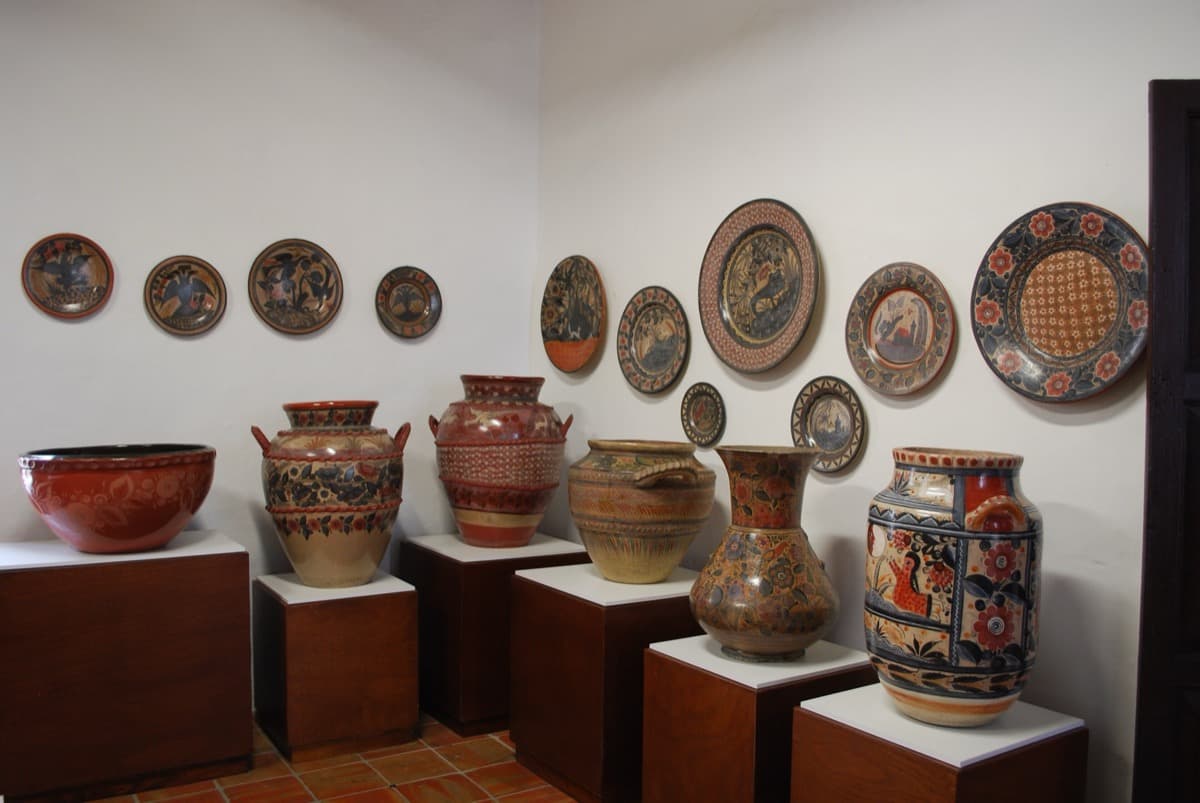
The middle room shows what happened after 1530. The Spanish arrived, the missions established themselves, and the European pottery tradition entered the village. The newcomers brought three things the local potters did not have: the kick wheel, lead and tin glazes, and the cobalt-blue pigment that would later define Talavera ware from the city of Puebla.
The local potters absorbed the new tools without abandoning the old ones. That is the fact this room documents. The wheel did not replace coiling; it joined it. Glazing did not replace burnishing; it joined it. The cobalt blue did not displace the red-on-buff slip painting that Tonalteca potters were already using; it joined it. The vessels in this room are fusion pieces. They have wheel-thrown bodies with hand-coiled additions. They have tin glaze on the outside and burnished slip on the inside. They have cobalt-blue painted decoration sitting next to indigenous geometric motifs in red and black.
The economic context for the fusion was practical. The Spanish authorities recognised the quality of the local clay and the skill of the local potters, and they established workshops to supply the colonial cities of New Spain with everyday wares. The potters were the local population. The customers were the Spanish administrators and the wealthier mestizo households. The supply chain absorbed both traditions because both produced saleable goods. What we now call Jalisco pottery, with its distinctive fusion of techniques, was the commercial product of this period.
The room also contains examples of barro canelo, the cinnamon-coloured burnished clay produced from a specific local mineral vein, and early examples of petatillo, the fine-grid decorative style that uses brushes made from human hair and produces extraordinarily detailed surface patterns. Both techniques are post-Hispanic in their developed forms but draw on pre-Hispanic underlying methods. The genealogy is visible in the cabinets.
The contemporary room
The last room shows the current generation. The vitrines hold recent winners of the Premio Nacional de la Cerámica Pantaleón Panduro, Mexico's national ceramics prize, awarded in Tlaquepaque every year. The prize is named after a nineteenth-century ceramicist from this village whose miniature figurines were so detailed that collectors compared them to European porcelain even though they were made from local clay.
The prize-winning pieces range from technically traditional to experimentally ambitious. Some winners produce burnished vessels in the same technique as the pre-Hispanic room a hundred metres back, executed at a level of refinement that pushes the technique's possibilities. Other winners produce conceptual installations, large-scale sculptures, ceramic pieces that resemble industrial objects, or hybrid works combining clay with metal or glass. The judges award based on technical mastery and on the interpretation of tradition, which means the prize spans the full range from preservation to provocation.
The function of this room is to demonstrate that the tradition is not a museum piece. It is producing new work, at international quality, today. The annual prize cycles the contemporary scene back into the village's commercial life. Many of the winners run studios on the streets immediately around the museum. Some of them, you can walk to in five minutes.
How the museum changes the walk
Twenty minutes in this museum changes the rest of the day. When you walk out and continue north along Calle Independencia, the studios stop being decorative tourist shops and become recognisable. You can see a coiled-and-then-burnished vessel and identify it as a thousand-year-old technique. You can see a petatillo piece and recognise the weeks of labour represented in the painted lines. You can see a cobalt-blue glazed bowl and locate it in the colonial-fusion period, even if it was made yesterday. The shops along the street are selling work that the museum's three rooms have just taught you to read.
The museum is also a check on the prices. A barro bruñido vessel of significant size, produced by a master potter, will cost more than a casual visitor expects. The cost reflects the days of work, the controlled firing, the burnishing time, the failure rate. Knowing what the museum's pieces represent makes the prices comprehensible. You are buying a thousand-year-old technique executed by a person whose family has been doing this for generations. That is what the museum lets you understand in twenty minutes, for free, before you walk into the first studio.
The free admission is policy. The state of Jalisco has long held the position that the ceramic heritage of the region should be available to everyone, especially to the local population whose families produced and continue to produce the work. The policy means that a visitor and a child from the village can stand in front of the same case, looking at the same vessel, with the same access. The museum's value is in that access, not in its scale.
It is a small museum. It is the most important room in the village to walk into first.
Mexico eSIM· 10% off with ROAMER10
Ready to experience it?
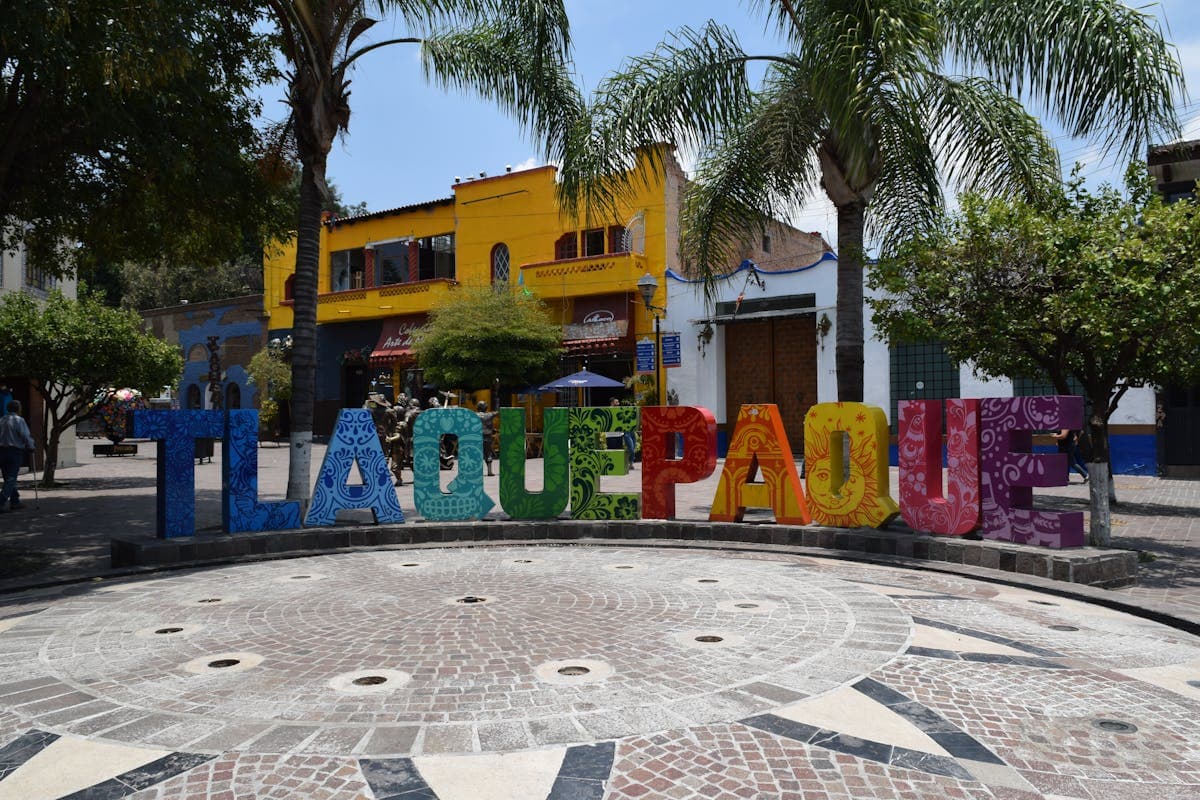
Tlaquepaque: 600 Years of Mexican Ceramic Art
95 min · 2.5 km · easy
More from Guadalajara
Explore more at your own pace.
Best Self-Guided Walking Tours in Guadalajara (2026)
Guadalajara Travel Guide: How Many Days, Getting Around, When to Go (2026)
One Day in Guadalajara: A Walkable Centro-to-Tlaquepaque Itinerary (2026)
What to Eat in Guadalajara: A Jalisco Food Guide (2026)
The City That Built Its Plaza Four Times