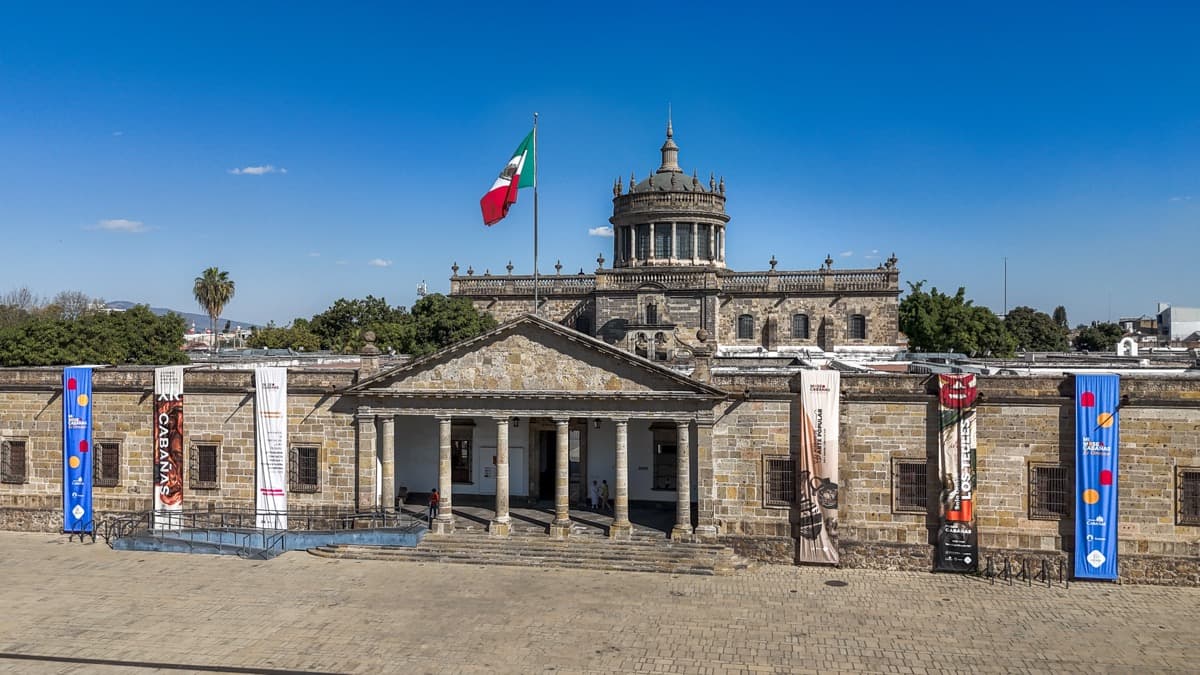
The Hospicio Cabañas stands at the eastern end of Plaza Tapatía, about half a kilometre east of the cathedral. From outside it is austere: a long single-story neoclassical façade with a central pediment over the chapel entrance, modest columns, no excess. The austerity is deliberate. The building's first architect, Manuel Tolsá, was the most disciplined neoclassicist working in New Spain at the turn of the nineteenth century, and the brief for this building was institutional rather than ecclesiastical. The Hospicio was an orphanage, a hospital, a workhouse, and a refuge for the elderly and the disabled, all in one complex. Bishop Juan Cruz Ruiz de Cabañas y Crespo, who commissioned it in 1801, wanted a self-contained city of mercy. He got one.
The complex covers more than twenty-three thousand square metres and is organised around twenty-three courtyards, arranged in symmetrical rows around a central chapel. Construction began in 1805. The bishop did not live to see it finished; he died in 1824 with the work still in progress. The complex was largely complete by 1845. The arrangement is functionally elegant. Each courtyard served a specific population, with classrooms, workshops, dormitories, and infirmaries grouped around its respective patio. The architecture used silence and proportion to do most of its work.
For one hundred and seventy-five years, the building did exactly what the bishop intended. Until 1980, it operated as an orphanage. Some Guadalajarans alive today were raised within these walls. The transition to a cultural centre came that year, and UNESCO inscribed the building as a World Heritage Site in 1997, citing both Tolsá's architecture and the murals inside the chapel as works of exceptional universal value.
Tolsá's brief
Manuel Tolsá arrived in New Spain from Valencia in 1791 to take charge of sculpture at the Royal Academy of San Carlos in Mexico City. He was thirty-four. Over the next three decades he became the dominant architectural figure in the late viceregal period. His work in Mexico City alone includes the Palacio de Minería, the equestrian statue of King Charles the Fourth, and the completion of the cathedral towers. The neoclassical style he brought, drawn from the European Enlightenment's rejection of baroque ornamentation, was austere by Mexican standards. His buildings calmed down rather than excited up.
The Hospicio Cabañas was Tolsá at his most disciplined. The single-story scheme, kept low to avoid earthquake damage in this seismically active region, was unusual for a complex of this size. The interior courtyards, the long arched corridors, the small chapel with its restrained classical façade, the workshop wings extending in symmetrical arms, all expressed the same principle: that the function was to house and educate the destitute, and that the architecture should serve that function without distraction. The bishop's vision and the architect's discipline aligned.
The chapel was the central building of the complex, sitting at the intersection of the main axes. Tolsá designed it as a cruciform space with a high dome over the crossing. The dome was structurally necessary, both to admit light and to mark the chapel as the spiritual centre of the institution. Tolsá could not have known that the dome was also the surface that would, more than a hundred years later, carry the most famous fresco in twentieth-century Mexican art.
Orozco's commission
Hear a stop from this walk
Hospicio Cabañas (UNESCO World Heritage Site)
José Clemente Orozco was born in Ciudad Guzmán, Jalisco in 1883. As a child he lost his left hand and partial sight in his left eye to a chemical accident with gunpowder. He trained as an architect at the Academy of San Carlos in Mexico City before turning to painting and political illustration. He was a generation older than Diego Rivera and David Alfaro Siqueiros, his peers in what came to be called los tres grandes, the three great muralists of Mexican modernism. Of the three, Orozco was the least sentimental and the most furious.
His major commissions in Mexico City, including the murals at the National Preparatory School in the 1920s, had already established the dark, anti-romantic register he was known for. Unlike Rivera, whose work celebrated indigenous Mexico and the revolutionary state with broad, lyrical compositions, Orozco painted suffering and contradiction. His Mexicans were not pre-Hispanic noble savages. His Spaniards were not picturesque conquistadors. The conquest was a violence done to people, and the revolution was another violence, and the industrial future was a third. He painted them all with the same anguished palette.
The Hospicio Cabañas commission came in 1936 from the Jalisco state government, which wanted Orozco to paint the chapel for its native son. He worked on the cycle between 1938 and 1939. The result is fifty-seven frescoes that cover the walls, vaults, and dome of the chapel. The sequence runs from pre-Hispanic Mexico through the conquest, through the colonial machinery of evangelisation and exploitation, through independence and revolution, to the industrial modernity Orozco distrusted. The figures are massive, twisted, often anonymous. The colour palette is restrained, much of it monochrome, with bursts of red and orange at the moments of greatest violence or transformation. There is no triumphalism anywhere in the cycle.
El Hombre de Fuego
The dome holds El Hombre de Fuego, the Man of Fire. The image is simple in description and difficult in person. A human figure, painted as if emerging upward through flames, occupies the dome's upper surface. Below the figure, in the dome's lower register, three further figures, water, earth, and air, surround the rising flame. The composition reads in the round; there is no front or back. Stand directly beneath the dome and look straight up, and the figure spirals upward through the architecture in a way that is hard to photograph and impossible to describe accurately.
The interpretive readings of the figure vary. The most common reading is that the man is humanity transcending through suffering, the painter's vision of the human condition as an upward trajectory through fire. A second reading places the image in dialogue with the pre-Hispanic Nahua myth of the Fifth Sun, in which the god Nanahuatzin throws himself into a fire and is reborn as the sun. A third reading sees the image as Orozco's response to fascism, painted on the eve of the Second World War, with the burning figure as a warning rather than a triumph. The painter himself did not commit to one reading. The figure is left to do its work.
What is not interpretive is the technical achievement. Orozco painted the dome from a scaffold, working with one hand, in fresco, which requires the paint to be applied while the plaster is still wet and which therefore has to be executed in sections, each completed in a day. A figure of this scale, painted in this medium, by an artist with one hand, in less than two years, alongside the other fifty-six frescoes covering the rest of the chapel, is a feat of physical execution as well as composition. Art historians have placed El Hombre de Fuego among the greatest frescoes of the twentieth century. The placement is defensible.
The cycle as argument
The fifty-seven frescoes around the dome are not just decoration for it. They argue. The pre-Hispanic scenes show the indigenous world as already engaged in its own structures of power and sacrifice. The conquest scenes show Spanish soldiers and missionaries as mechanical and faceless. The independence scenes show Hidalgo and his peers as figures of fire and torment, not as nineteenth-century heroes in stained glass. The industrial scenes show machines and modernity with the same suspicion the painter brought to everything. The argument is consistent: that history is a sequence of violences, that suffering is what produces transformation, and that the artist's job is to witness rather than to glorify.
This argument was politically uncomfortable in 1939, when the Mexican state was actively building a heroic nationalist narrative through public art, and it remains uncomfortable now. Orozco's work has never been as broadly accessible as Rivera's, never as photogenic on a tote bag. The Hospicio Cabañas chapel is the building where his vision is most concentrated, and the dome is its centre.
What to see
The chapel is the destination. Enter the complex through the main façade on Plaza Tapatía, pay the small entry fee, and walk through the symmetrical courtyards to the chapel. The fifty-seven frescoes are visible across the chapel walls, vaults, and dome. The Man of Fire is on the dome. Stand directly beneath it. Look straight up. Stay there for a minute or two. The optical effect of the figure rising through the dome's curve is the experience the commission was designed to produce.
The rest of the complex is worth walking. The neoclassical corridors and courtyards Tolsá designed are intact. The scale is unusual for the period; almost no other Spanish colonial institutional complex in the Americas was built at this size on a single story. The combination of Tolsá's restrained architecture and Orozco's fierce paintings inside it is the building's argument. Two visions of what Mexico is, separated by a century, agreeing only that the institution that holds them should be serious.
Mexico eSIM· 10% off with ROAMER10
Ready to experience it?
Guadalajara: A City Designed as a Cross
100 min · 3 km · easy
More from Guadalajara
Explore more at your own pace.
Best Self-Guided Walking Tours in Guadalajara (2026)
Guadalajara Travel Guide: How Many Days, Getting Around, When to Go (2026)
Mariachi, Tequila, and the Cross: How to See Guadalajara
One Day in Guadalajara: A Walkable Centro-to-Tlaquepaque Itinerary (2026)
What to Eat in Guadalajara: A Jalisco Food Guide (2026)