Stand on the West Front of the Capitol and look down the central lawn toward the obelisk. What you are looking at, almost in its entirety, was decided after 1900. The Mall's working draft is the McMillan Plan, published in 1902 and never formally adopted as a founding document by Congress. The lawn was graded between 1902 and the 1930s. The cross-axis north to the White House and south to the Tidal Basin was drawn in 1902. The reflecting pool was finished in 1923. The McMillan Plan is the working draft the city has been editing for a century and a quarter, and every monument added to the central axis since has been a successful argument against the previous monument's claim to permanence.
The Mall is the most photographed urban space in the United States. It is also the most committee-built. Almost no piece of what you see is older than the McMillan Plan that drew it. The distinction between working draft and founding document is the editorial point of the Mall tour. It is also the most useful frame for reading any individual monument on the central axis.
What the McMillan Plan actually was
The Senate Park Commission was authorized on March eighth, 1901, at the urging of Senator James McMillan of Michigan. The commission's members were McMillan, the architect Daniel Burnham, the landscape architect Frederick Law Olmsted Junior, the architect Charles McKim, and the sculptor Augustus Saint-Gaudens. They were unpaid commissioners. They traveled to Europe in the summer of 1901 to study the great planned capitals. They returned with a plan.
The plan was published in January of 1902 as The Improvement of the Park System of the District of Columbia. It rejected most of what the nineteenth century had done to the Mall. It cleared the Victorian gardens, the meandering paths, the railroad depot. It redrew the axis as a single sweep from the Capitol to the Potomac. It set the cruciform with four anchor points: the Capitol to the east, the Washington Monument at the center, the White House to the north, and the Tidal Basin to the south. It left the western and southern anchor sites open. The buildings would come later.
Per John W. Reps, in his 1967 book Monumental Washington (Princeton University Press), the McMillan plan was never formally adopted by Congress. It never had statutory authority. It has nevertheless governed Mall design for a century and a quarter, because the institutions Washington built between 1902 and now have chosen to treat it as authoritative. The US Commission of Fine Arts, created by an act signed by President Taft on May seventeenth, 1910, became the federal review body. The National Capital Planning Commission, created in 1924, added a second review room. Every monument on the central axis passed through one or both. The plan that the committee published in 1902 became the document that every subsequent committee was arguing with.
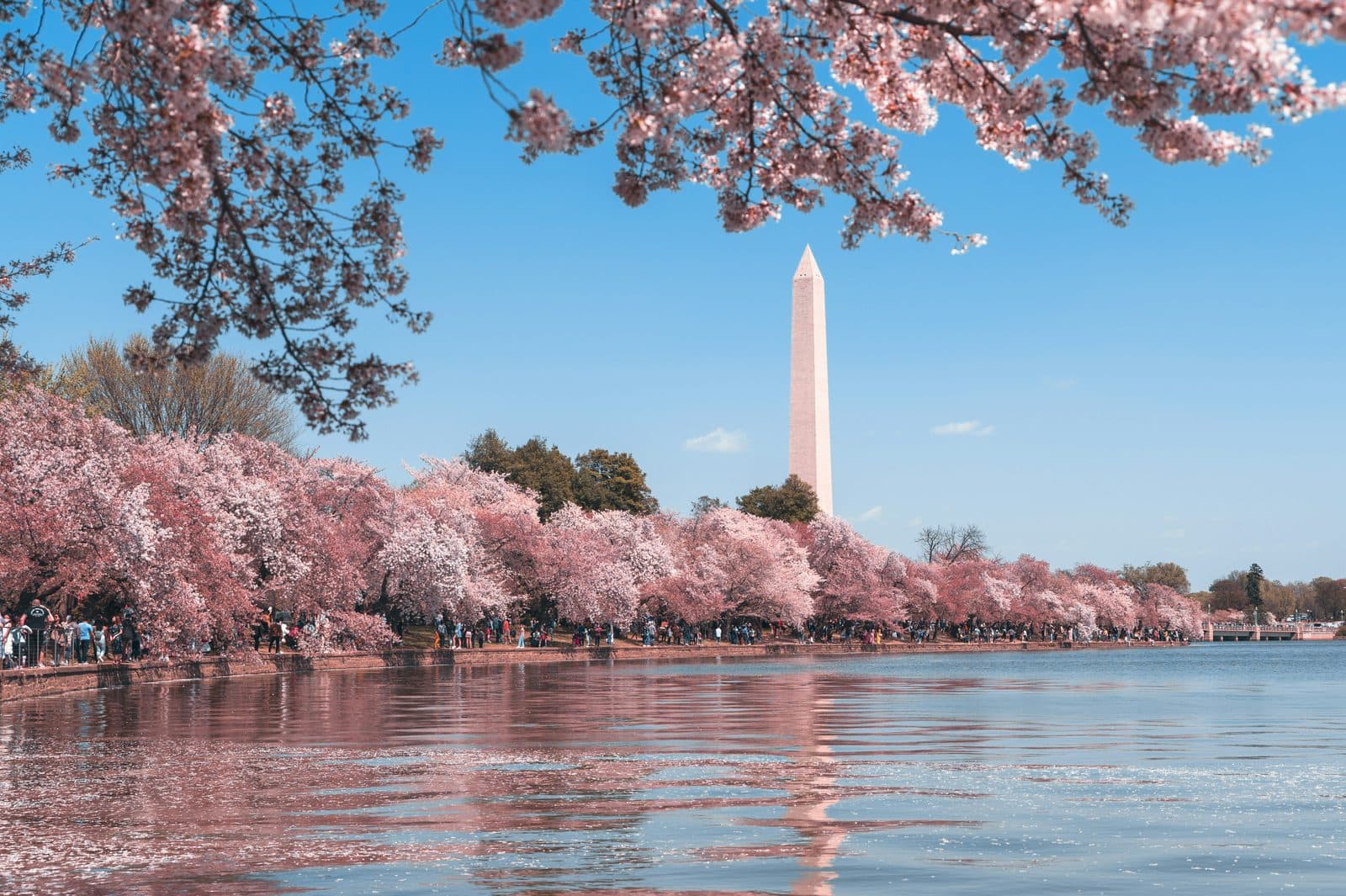
The Washington Monument is the seam between two committees
Hear a stop from this walk
Vietnam Veterans Memorial: The Counter-Monument
The obelisk is the canonical example of what the Mall does to its own plans.
The cornerstone was laid on July fourth, 1848, fifty-three years before the McMillan plan. The architect was Robert Mills. The original design included a colonnaded base with a quadriga statue of Washington in a chariot. Neither was ever built. Between 1848 and 1854, construction reached approximately one hundred and fifty feet. Then the donations ran out. In February of 1855, the anti-Catholic Know Nothing Party seized control of the Washington National Monument Society. Congress halted its two-hundred-thousand-dollar appropriation. The Know Nothings added four feet to the obelisk before surrendering control in October of 1858. The work stopped. It did not resume for twenty-one years.
In 1879, a federal effort restarted construction. The original marble had come from a quarry in Cockeysville, Maryland, known as Texas Quarry (a place in Baltimore County, not the state of Texas, despite what tour guides occasionally claim). A brief attempt in 1879 and 1880 to use stone from Sheffield, Massachusetts, produced quality problems and was abandoned. The second phase used marble from the Beaver Dam quarry, also in Maryland, warmer in tone than the original. The Monument was dedicated on February twenty-first, 1885. It opened to the public in 1888.
Look at the south side of the obelisk in late-morning or mid-afternoon light, when the sun is high enough to side-light the marble. Approximately a quarter of the way up, there is a horizontal band where the color changes, slightly lighter above, slightly warmer below. That is the seam between the 1854 halt and the 1879 resumption. The most-photographed obelisk in America is literally striped with the record of a generation when the committee that started the building could not finish the work. The seam is too high to read on overcast days. It is most legible from about ten in the morning to about three in the afternoon on a clear day.
The Monument is the Mall's first lesson about itself. The plan you start with is not the plan you end with. Twenty-five years of stoppage will write themselves into the stone. The committee that resumes the work will be a different committee from the one that started it.
The Lincoln Memorial is the McMillan plan's western anchor, finished twenty years late
The McMillan plan named West Potomac Park as the future site of a monument comparable to the Washington Monument. It did not specify what. The site was swampy ground at the edge of the Potomac flats, then being drained as part of the Army Corps of Engineers' reclamation project. For two decades the committee argued about what should go there.
Speaker of the House Joe Cannon opposed the West Potomac Park site as unstable swampland. Per Frederick Gutheim and Antoinette J. Lee, in their 2006 history Worthy of the Nation (Johns Hopkins University Press), Cannon lost the fight in 1913 when Congress approved the design and the location. The Commission of Fine Arts, chaired then by Charles Moore, approved Henry Bacon's Greek temple proposal over John Russell Pope's competing pyramid design. Groundbreaking was on February twelfth, 1914, Lincoln's birthday. The seated figure inside, nineteen feet of marble, was carved by Daniel Chester French and completed in 1920. The Memorial was dedicated on Memorial Day, May thirtieth, 1922.
Stand on the steps and look back across the Reflecting Pool toward the Washington Monument. The line you are looking along is the McMillan plan's central axis. Bacon's Memorial is what closed the western end of it. Thirty-six Doric columns, one for each state in the Union at the time of Lincoln's death. The Gettysburg Address on the south wall, the Second Inaugural on the north wall. The architectural temple is doing what the McMillan plan asked the western anchor to do: terminate the axis with a building that is at least the rhetorical equal of the obelisk at the center.
The Lincoln Memorial is also the most over-determined monument on the Mall. Its civic-religious role since 1922 has accumulated meanings the architects did not predict. Marian Anderson sang here on Easter 1939. Martin Luther King Junior delivered the closing address of the March on Washington here on August twenty-eighth, 1963. The National Park Service engraved the I Have A Dream inscription on the eighteenth step down from the statue in August of 2003. Those are the Civil Rights tour's territory. For the Mall tour, the building is the 1922 answer to the 1902 question. The civil-rights re-reading is the second document, written on top of the first.
The Vietnam Veterans Memorial is the counter-monument that broke the Mall's grammar
For sixty years after 1922, every major monument on the central axis followed Bacon's grammar. Classical. Figural. Above grade. White stone temples to specific named men. The Jefferson Memorial, dedicated 1943, closed the southern arm of the McMillan cruciform with John Russell Pope's neoclassical rotunda. The Roosevelt Memorial, the Eisenhower Memorial, and the various Smithsonian buildings flanking the Mall all worked within a recognizable classical vocabulary.
The Vietnam Veterans Memorial Fund, founded in 1979 by the wounded Vietnam veteran Jan Scruggs, ran a public design competition between 1980 and 1981. One thousand four hundred and twenty-one designs were submitted, judged anonymously by an architectural jury. The winning entry, number ten twenty-six, came from a twenty-one-year-old undergraduate at Yale named Maya Lin. The selection was announced on May sixth, 1981. Lin had been born on October fifth, 1959. She was an undergraduate at the architecture school when the jury chose her design.
The design broke every rule the Mall had been operating by. The wall would be black granite, not white marble. The walk would descend below grade. The names would be listed chronologically by date of death. No figural sculpture. No classical references. No temple. At Commission of Fine Arts hearings in 1981, critics called it a black gash of shame and sorrow. The former Marine officer James Webb withdrew his support. Interior Secretary James Watt delayed the building permit on political grounds. The compromise that broke the deadlock added Frederick Hart's bronze Three Soldiers, dedicated at the entrance plaza in 1984.
The Wall got built. The figural statue got added. Both are still there, and the difference between them is the most legible single moment of architectural argument on the federal axis. Per Kirk Savage, in his 2009 book Monument Wars (University of California Press), this is the monument that broke the Mall's vocabulary of figural-classical temples above grade. After 1982, the axis included a counter-monument. Every memorial proposal since has had to decide whether to follow Bacon's grammar or Lin's.
The Korean War Veterans Memorial, dedicated in 1995, chose to do both at once. Frank Gaylord's nineteen stainless-steel figures walk uphill in formation, ponchos catching imaginary weather. The patrol is figural, the alignment is classical, the placement is above grade. The Wall of Remembrance, added in 2022, lists thirty-six thousand six hundred and thirty-four American and seven thousand one hundred and seventy-four KATUSA names, in Lin's grammar, on the patrol's eastern flank. The committee did not choose between the two answers. It built both, half a kilometre apart, and twenty-seven years later it added the technique from the disruptive one back into the classical one.
That is how the Mall works. Every era gets the same axis to argue with.
The Second World War Memorial is the vista the McMillan plan lost
The Rainbow Pool sat at the line of sight between the Washington Monument and the Lincoln Memorial, exactly where the McMillan plan had set the spine of the central axis. The Park Service called this site the most prominent spot for a monument on the National Mall since the Lincoln Memorial opened in 1922. For most of the twentieth century, the vista was treated as sacred.
In 1997, a design competition selected Friedrich St. Florian's proposal from approximately four hundred submissions. The fundraising was led by Senator Bob Dole and the FedEx chief executive Frederick Smith. The approving bodies were the US Commission of Fine Arts and the National Capital Planning Commission. Both signed off. Architectural critics, including Witold Rybczynski, raised the vista issue and lost the argument. The Memorial opened on April twenty-ninth, 2004.
Stand at the central pool. Look east toward the Washington Monument. Then turn and look west toward the Lincoln Memorial. You are standing in what used to be one of the most carefully protected open vistas in American urban design. The Memorial fills the line. The vista is gone. The committee that had protected the line for ninety-five years voted, in 1997, to fill it.
This is the structural turn in the Mall's twentieth-century history. Every old decision is editable. The McMillan plan is the working draft, not the founding text. The federal review bodies sit in the same rooms they sat in a century ago, and they are still answering the era's question: whose memorial gets the central axis, and at what cost to the vista the previous era prized.
The next chapter is being argued now
The Mall is not finished. The Eisenhower Memorial opened in 2020 at the southwest corner of the Mall. The First World War Memorial reopened in Pershing Park in 2021. The proposed Latino American Memorial is still in early review. The Tidal Basin's seawall is being rebuilt to address rising water levels, a project the McMillan commissioners could not have anticipated.
Read each monument as a record of decisions, not as a sequence of finished objects. Each monument is the political answer of the era that built it. Each era's answer becomes the next era's argument. Ask, when you stand in front of it, who fought to put this here, who opposed it, what was removed to make room for it, and what came later to answer it. The Mall returns useful answers when you ask those questions.
Ready to experience it?
The National Mall: An Axis Designed by Committee
110 min · 7.12 km · moderate
More from Washington Dc
Explore more at your own pace.
Best Self-Guided Walking Tours in Washington, DC (2026)
One Day in Washington, DC: A Walkable Monuments-to-U-Street Itinerary (2026)
Washington, DC Travel Guide: How Many Days, Getting Around, When to Go (2026)
Best History Walking Tours in Washington, DC (2026)
What to Eat in Washington, DC: A Food Guide (2026)