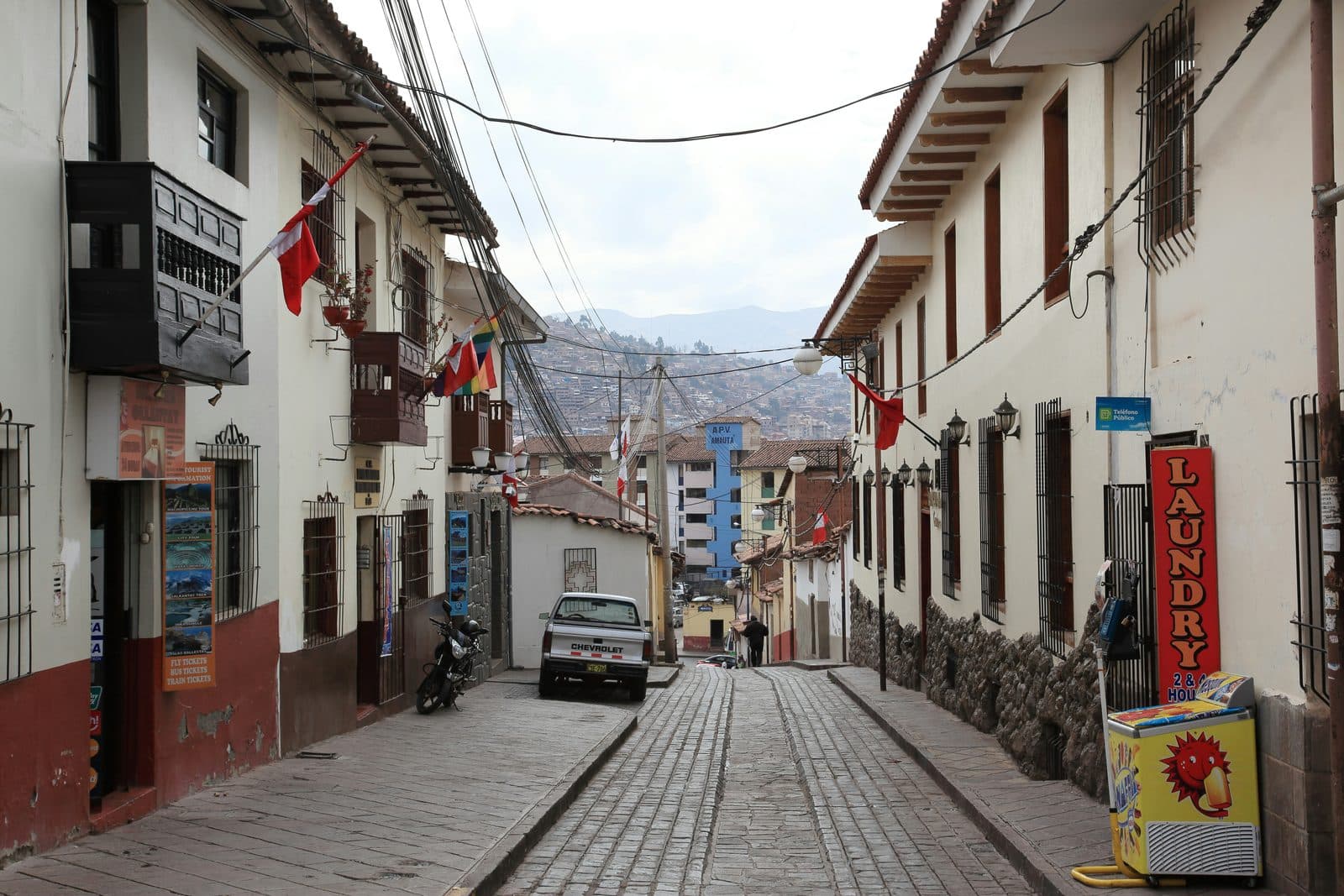
There is a useful exercise just off the Plaza de Armas in Cusco. Walk into Calle Loreto, the narrow lane that leaves the southeast side of the plaza beside La Compañía de Jesús. Look at the walls. The lower courses are not Spanish masonry. They are Inca stone, cut and fitted before the Spanish arrived, with later building on top. Once you have seen that seam, you will find it again and again across the historic center.
Nowhere in Spanish America is this seam clearer than in Cusco. To understand why, you have to follow the conquest in chronological order.
What Pizarro found
Francisco Pizarro's army entered Cusco on 15 November 1533, together with Manco Inca and native allies. Three Spaniards sent ahead from Cajamarca had already reached the city earlier that year. The Inca state had been at war with itself since the death of the emperor Huayna Capac, who died in the mid 1520s, probably in an epidemic. Two of his sons, Atahualpa and Huascar, fought for the empire. Atahualpa won the throne, then was captured by Pizarro at Cajamarca in 1532, paid a ransom, and was strangled in 1533. The great military resistance came later, in 1536, when Manco Inca besieged the Spanish in Cusco and his forces held Sacsayhuaman above the city.
What they found was a metropolis. The Temple of the Sun, Qorikancha, stood two blocks south of the main plaza, and its walls had been sheathed in gold. One Spanish chronicler, Xerez, counted seven hundred gold plates taken from "a house of Cusco"; another, Sancho, counted five hundred-odd from "that temple". According to Garcilaso de la Vega, the chambers of the Moon and the Stars were lined with silver. Pedro Cieza de León describes a garden of gold: a field of maize made of gold, and more than twenty gold llamas with their lambs, and shepherds with their slings and staffs. The great plaza, Huacaypata, had been filled with sea sand brought up from the coast; Polo de Ondegardo, who governed Cusco around 1558 to 1560, found it there, about two and a half palms deep. The four main roads of the Qhapaq Ñan started from that plaza, part of a network estimated at some forty thousand kilometers.
The Spanish stripped Qorikancha. Part of its gold was melted at Cajamarca in 1533, and most of the treasure was cast into bars for Spain, with a few pieces sent intact. The sun image known as the Punchao escaped: it was carried to Vilcabamba and only found when Tupac Amaru I was captured in 1572.
What remained were the walls.
What the walls were
Hear a stop from this walk
Plaza Regocijo: The Other Half of the Inca Square
Inca masonry of the imperial period, roughly 1438 to 1533, is not a building technique. It is a system. The stone varies; the wall on Calle Hatun Rumiyoc that holds the Twelve-Angle Stone is diorite. The stones are shaped by a long process of pecking with handheld stone hammers, fitting against an adjacent block, repecking the contact surface, refitting, until the joint is so tight that a knife blade cannot be inserted into it. No mortar. A block can meet its neighbours at many angles. The Twelve-Angle Stone is Cusco's most famous example, but twelve is not the limit: guidebooks cite a stone with thirty-two angles at Machu Picchu.
The technical achievement is the joint. The engineering achievement is the wall as a system. Engineering studies of Inca walls credit their inward lean, the interlocking of the blocks, the weight above and the even friction across the joints, which together let a wall behave as one body. Tough is not untouchable, though. When the earthquake of 21 May 1950 struck, a survey by Peru's geological institute and the US Geological Survey found the Inca walls of the city intact, with one exception: at Santo Domingo, over Qorikancha, some blocks cracked, some slipped at the corners and several turned about a centimeter, while church towers and adobe houses gave way. No source says the same of the earthquake of 1650, which the city's own painting of it says brought down temples, convents and houses across almost the whole city. And a 2022 study catalogued thousands of displaced blocks and fractures in Inca walls, partly from an earthquake in Inca times.
A wall like that is hard to take apart and very useful to keep. The Spanish did demolish a great deal. By the time Garcilaso de la Vega was growing up in Cusco, most of Huayna Capac's compound on the plaza lay on the ground, and Sacsayhuaman above the city was being razed for building stone. But across the city, colonial churches and houses kept the lower courses of Inca walls as their foundations. They could remove the upper courses. They could repurpose the lower ones.
So they built on them.
The cathedral on the palace
Construction on the Cathedral of Cusco began in 1559. The site was the palace of Inca Viracocha, the eighth Inca ruler. The surviving record of the choice is dry: on 17 May 1552 the possible sites were weighed and a lot was bought. The result is hard to read any other way, though: our god stands on top of your emperor's house. The colonial city can be read as a theological argument made in stone.
The building material made the argument louder. Stone for the cathedral was hauled down from Sacsayhuaman, the great Inca complex on the hill above the city, from the year work began, and a contract of 1646 still hires a worker to take stones from it. The cathedral that occupies the most prominent site on the Plaza de Armas is, in part, Inca stone reassembled as a Catholic cathedral. The Inca palace foundations underneath are still there. The brick vaults and the towers are colonial work.
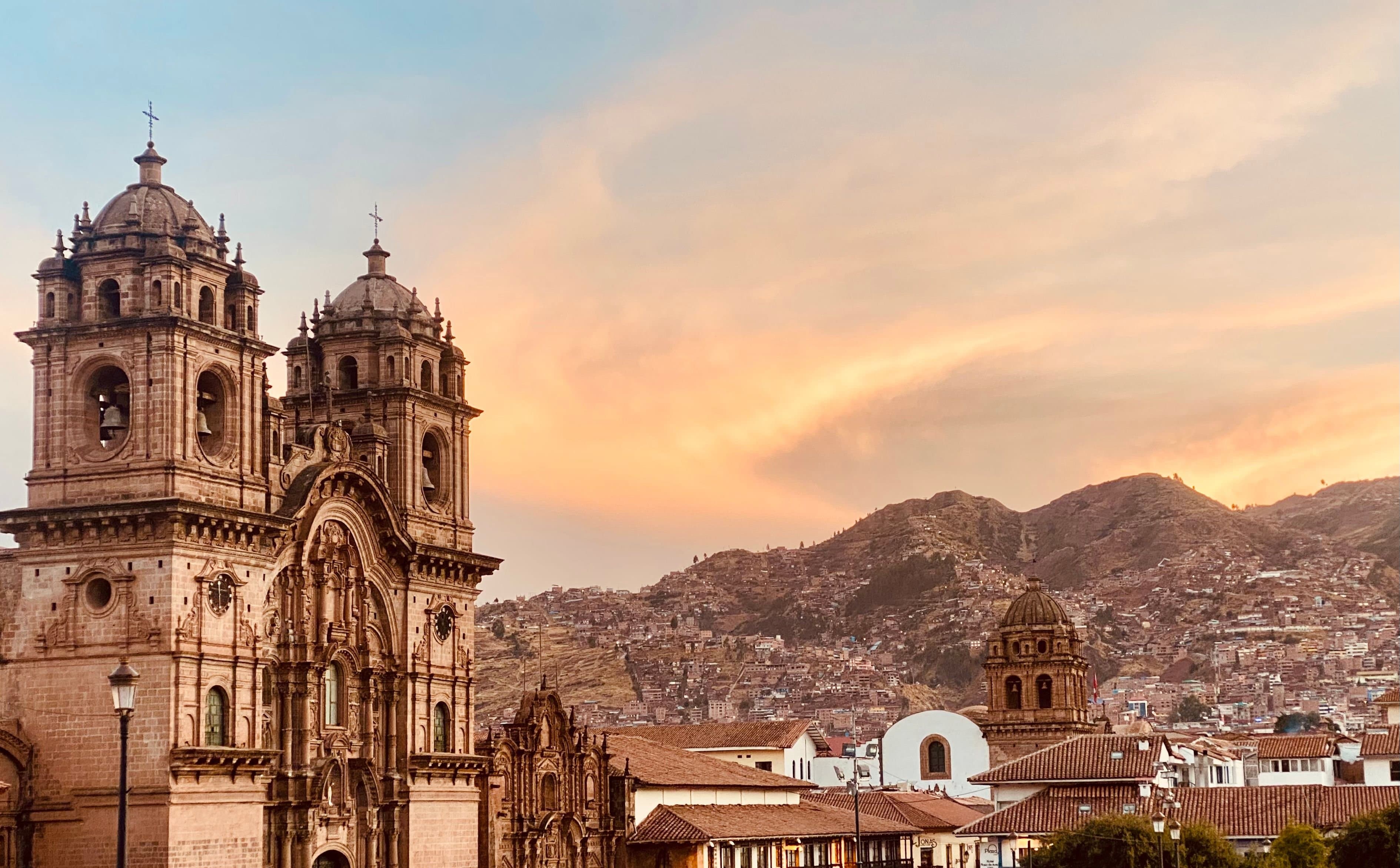
Across the plaza, the same logic plays out at La Compañía de Jesús. The Jesuit church, finished in its current form in 1668 after the 1650 earthquake ruined the first version, sits on Amarucancha, the palace of Huayna Capac. The Jesuits set out to build a church more beautiful than the cathedral, and the city's heritage record says the rebuilding went ahead only after disputes over its grandeur: the cathedral's side objected, and the Jesuits built anyway. The façade and towers were contracted in 1664. No document shows that a Pope was involved, whatever the often-repeated story of a papal decree that arrived too late. The Jesuits kept their masterpiece. It did not escape the earthquakes: in 1950 its towers were seriously damaged at the top, while the central body of the façade came through without major harm.
What you can still see
Calle Loreto, the narrow street that exits the Plaza de Armas beside La Compañía, runs between two Inca compounds. Walking in from the plaza, on the right is Amarucancha, the palace of Huayna Capac. On the left is the Acllahuasi, the house of the Chosen Women, whose long wall of fine coursed Inca stone is the one most people come to see. In the Cusco house, according to Garcilaso de la Vega, girls of royal Inca blood lived in seclusion, spinning and weaving the Inca's clothing and making the drink served at festivals. After the conquest the compound was divided among Spaniards, and in 1605 Dominican nuns arrived to found the convent of Santa Catalina on the site. When they rebuilt after the 1650 earthquake, the new building rose on the same Inca walls. The Inca institution and the Catholic institution housed two different kinds of religious women, behind the same masonry.
A few blocks away, on Calle Hatun Rumiyoc, the Twelve-Angle Stone sits in the lower wall of what tradition identifies as the palace of Inca Roca. The stone is a block of diorite with twelve cut and fitted angles, each in continuous joint with an adjacent stone. The wall is roughly five to six hundred years old. The building above it is now the Archbishop's Palace, home of the Museum of Religious Art. Look, but do not touch: in February 2025 a man struck the stone with a hammer.
Qorikancha is the deepest reading. The Dominicans received the site in the first years after the conquest and built their convent on its walls, probably from 1544; the church you see today was rebuilt after 1650. Inside, you can see Inca chambers traditionally identified with the Moon, the Stars, Thunder and the Rainbow, though Garcilaso wrote that the rooms of the Moon and the Stars were already demolished in his day. The curved wall of the temple, seen from the Avenida El Sol side, still carries the end wall of the Dominican church: the city's heritage record says the church's apse stands on the main tower of the great Inca temple. The chronicler Pedro Cieza de León wrote that he had seen nothing in Spain to compare with these walls except the Calahorra tower in Córdoba.
What the stratification means
A city whose walls are too good to waste produces a particular kind of colonial settlement. The Spanish in Cusco did not erase the Inca capital. They embedded it in the new buildings they were trying to build. The conquest in Cusco produced overlay, not replacement. The result is not a syncretism in the romantic sense, where two cultures gently merge. It is a physical stratification, where one civilization's masonry sits on another's, in continuous direct contact, separated by a line of mortar.
The cultural and economic life of the city took the shape of the walls. The painting tradition of the Cusco School, exemplified by Marcos Zapata's Last Supper in the cathedral with its centerpiece of roasted cuy, runs on the same logic. European form, Andean substrate. The Inti Raymi festival, banned under Viceroy Francisco de Toledo in 1572, was revived in the 1940s and is staged again every 24 June. The Quechua language is still the first language of more than half the people of the region: in the 2017 census, 55.2 percent of people in the Cusco region aged five and over had learned Quechua first. The walls underneath have made room for the culture to do the same thing.
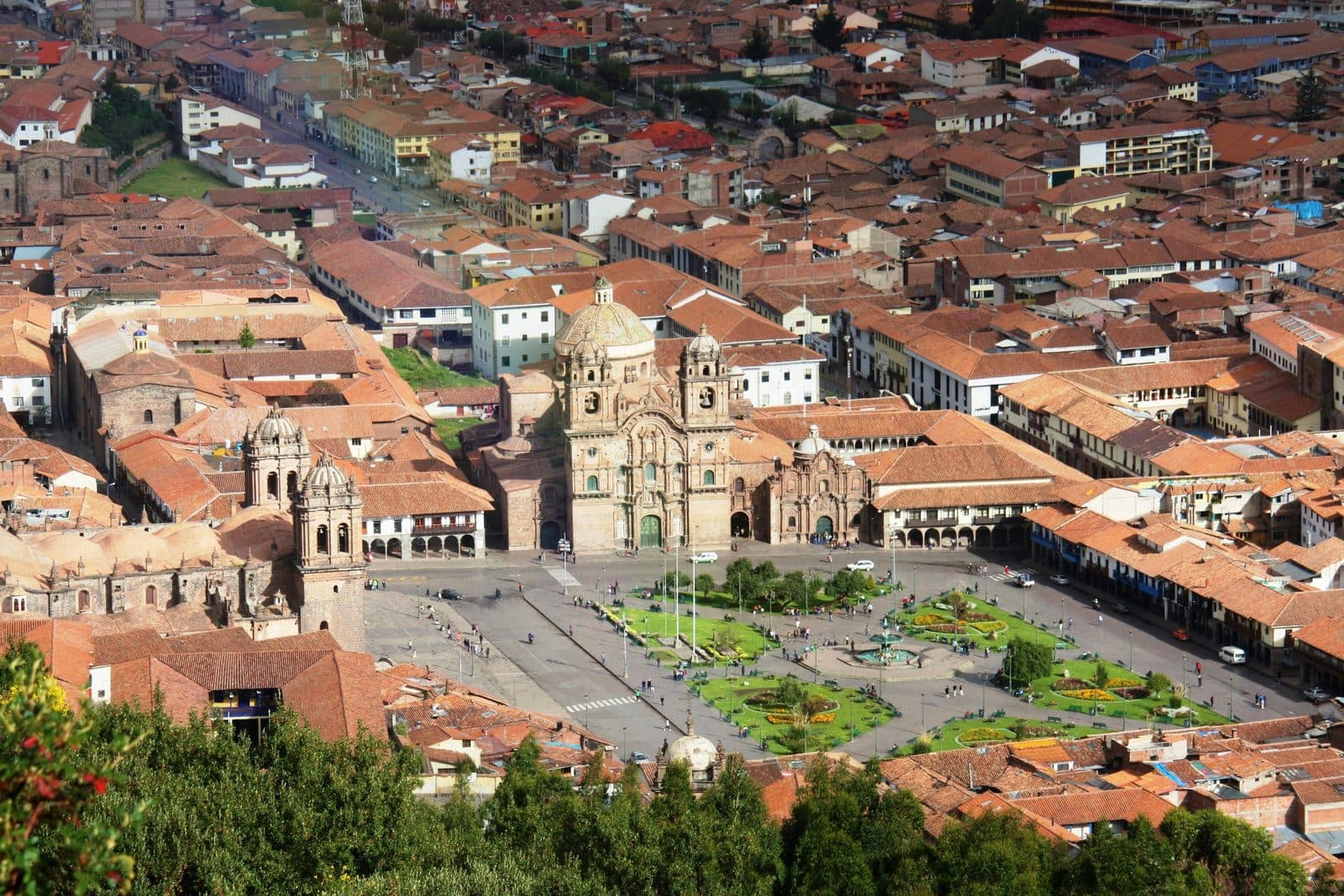
That is what the Historic Center walk, "Historic Center: The City Built on Inca Walls", is walking. Twelve stops on a loop of about 2.4 kilometers, about an hour and a half, from the Plaza de Armas past the Cathedral, the Twelve-Angle Stone, Plazoleta Santa Catalina, Kusicancha, Qorikancha and the curved Inca wall under the end of its church, then along Calle Loreto to La Compañía, and on past La Merced and San Francisco to finish in Plaza Regocijo, the other half of the great Inca square. Two civilizations in continuous contact. Once you can see the line, you cannot unsee it.
Ready to experience it?
Historic Center: The City Built on Inca Walls
90 min · 2.4 km · moderate
More from Cusco
Explore more at your own pace.
Best Self-Guided Walking Tours in Cusco (2026)
Cusco Travel Guide: Altitude, How Many Days, Getting Around, When to Go (2026)
One Day in Cusco: An Altitude-Friendly Walking Itinerary (2026)
Best History Walking Tours in Cusco (2026)
What to Eat in Cusco: An Andean Food Guide (2026)