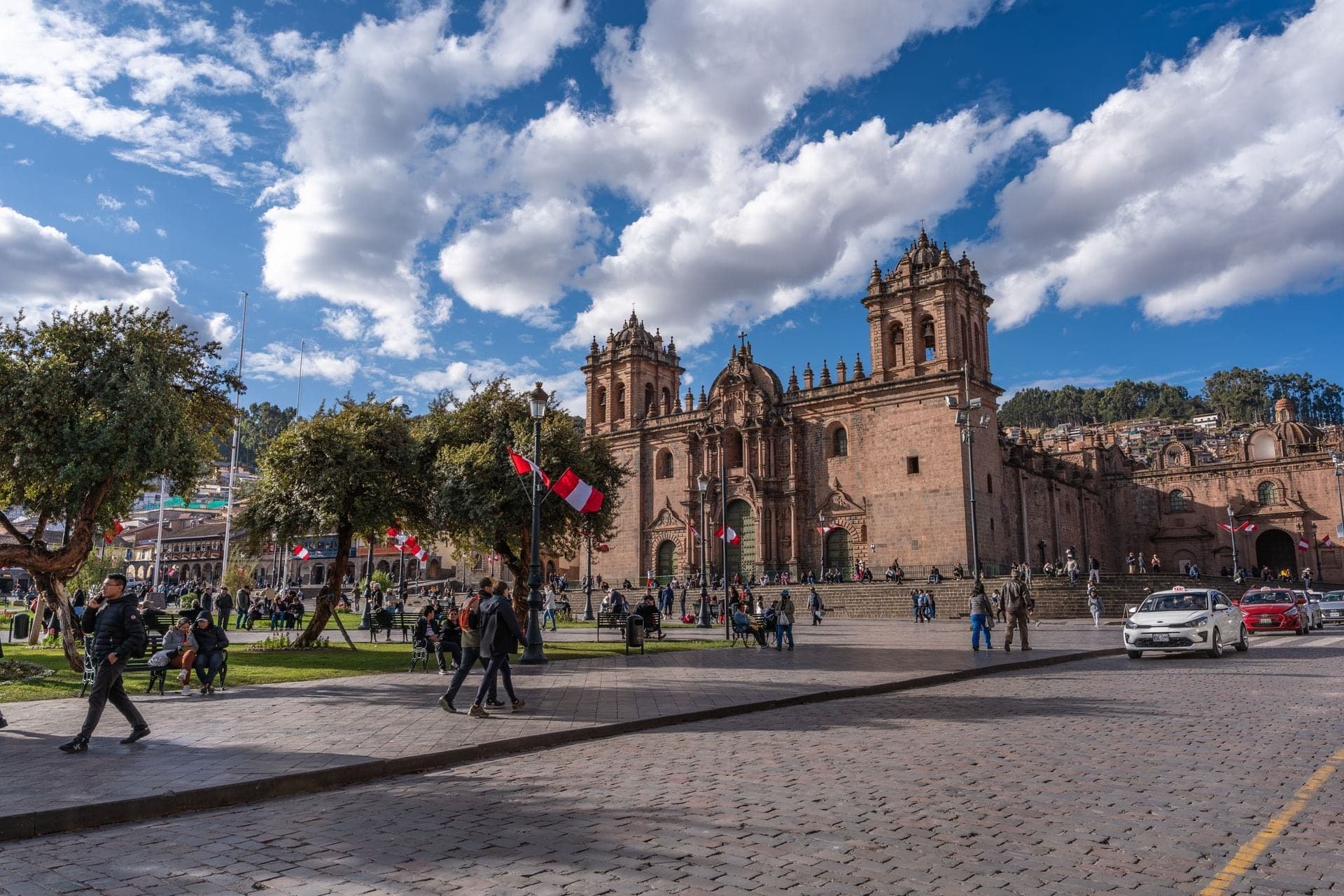
Construction of the Cusco Cathedral began in 1559. The building was in use by 1654 and consecrated in 1668. Almost a century of work. The building you see on the northeast side of the Plaza de Armas is the centre of three adjoining churches: El Triunfo on the right, which stands on the site of Cusco's first church, the city's cathedral until 1654, though the present building dates from 1729 to 1732; the Cathedral proper in the centre; and on the left the Templo de la Sagrada Familia, also called Jesús, María y José, finished in 1735. The complex is read as a single facade because in colonial planning it functioned as one.
To understand the Cathedral as a piece of political architecture, hold three facts together.
What is underneath
The site directly under the Cathedral was the palace of Inca Viracocha. Viracocha was the eighth ruler in the dynastic list of the Inca state, before the expansionist campaigns of Pachacuti redrew the boundaries of the empire. His compound, called Kiswarkancha, stood on the northeast side of the Inca plaza, which the Spanish renamed the Plaza de Armas. It did not survive the conquest intact: Garcilaso de la Vega, who grew up in Cusco, wrote that of Viracocha's houses he saw only the great hall still standing.
The record of the site choice is practical: on 17 May 1552 the possible locations were weighed and the lot of Alonso de Mesa was bought. The symbolism is still hard to miss. A royal palace was among the most prestigious addresses in the city, and putting the cathedral on it reads as an announcement that the Spanish god now occupied that address. The same pattern put Santo Domingo on the walls of Qorikancha and the Jesuit church on Amarucancha, the compound of Huayna Capac, all within a few blocks of each other.
What it is made of
Hear a stop from this walk
Plaza Regocijo: The Other Half of the Inca Square
The building stone is andesite, and stone for the Cathedral was hauled down from Sacsayhuamán, the great Inca complex on the hill above the city. Colonial documents call Sacsayhuamán a fortress. Peru's Ministry of Culture weighs that name against two others, a shrine to the thunder and the House of the Sun, and the chronicler Cieza de León wrote that the people of Cusco called it the House of the Sun. In the first decades after the conquest it was razed and its stones used as building material. The hauling of stone from Sacsayhuamán for the new cathedral began in 1559, and a notarial contract of 1646 still hires a worker to take stones from it.
The stone went into the walls. The roof is a different material: the three naves, carried on fourteen cross-shaped pillars, are covered by ribbed brick vaults, contracted in 1649.
This is not preservation. It is the opposite. The Inca complex above the city was quarried for the colonial city, and those contracts show the work going on for close to a century. The Cathedral is, in this sense, the visible inventory of that dismantling. Stone that once stood in Sacsayhuamán now stands in the walls of the Christian cathedral on the plaza below.
What is inside
Two pieces in the interior collection are central to the Cathedral's status in Andean Catholic practice and to the cultural history of colonial Peru.
The first is the painting of the Last Supper attributed to Marcos Zapata, around 1753. Zapata worked in the Cuzco School, one of the great painting traditions of colonial South America. The Last Supper canvas follows the standard European composition: Christ at the centre of a long table, the apostles flanking him.
What is on the table is the painting's argument. At the centre, instead of the lamb of the European tradition, sits a roasted cuy, a guinea pig. Around it, Peru's official tourism inventory lists chicha morada, rocoto peppers and other typical Andean foods. The painting reads as devotional. It also reads as a quiet substitution. The body of Christ is being commemorated with the foods of the people who are receiving the commemoration.
The Cuzco School operated in a regulated space. Iconographic content was supervised by the Church. Local detail was, within limits, permitted. Zapata's Last Supper sits at the edge of what was permitted, and it survives because the substitution was treated as devotional inflection rather than heresy. Whether the painter intended it as an act of cultural assertion or as straightforward visual accommodation is unknowable from the work itself. The result is the same. The Last Supper of Cusco is eaten with cuy.
The second piece is the Señor de los Temblores, the Lord of the Earthquakes, a dark-skinned crucified Christ. The figure is not carved from a single block: it is made of glued cloth and maguey, and Peru's official tourism inventory dates it to 1570. A press account adds balsa wood and linen fibre; the academic description gives a cloth body on a wooden armature with carved maguey plaques, glued cloth, parchment, straw and gesso. During the great earthquake of 31 March 1650 the image was carried in procession, and by tradition the tremors stopped. A canvas painted after the disaster, which hangs in the cathedral, records that the quake lasted as long as it takes to say the Creed three times and brought down temples, convents and houses across almost the whole city; the cathedral itself, damaged, was one of the few buildings left standing. The procession was instituted that day in memory of the quake, and after the plague of 1720 the people proclaimed the image the sworn patron of Cusco. Since 1741 it has been paraded through the historic centre on Holy Monday, the Monday before Easter.
The figure is dark not by design but by accretion. Centuries of candle smoke, and resin from the nucchu flowers thrown during the procession, have darkened it to its present near-black colour. The darkening, accidental in origin, became part of the figure's identity. The Señor de los Temblores reads as Andean, as a Christ figure with the skin tone of the population that venerates him. This is not theology; it is the result of a long ritual life. It is also one of the more honest examples of how a colonial religious image becomes local. The people who venerate the image are the ones who darkened it.
The Maria Angola bell
The Cathedral's most famous bell is the Maria Angola. Its weight and the distance it carries belong to local telling rather than record, and the figures change from one account to the next. So does the legend: one local tradition holds that gold was thrown into the molten bronze. What the building's history does record is that the towers and facade were finished on 28 February 1659, and that the bells, cast earlier, were installed soon after.
What the Cathedral is for
The building is still in active use as the cathedral of the Archdiocese of Cusco. Mass is still celebrated. The Holy Monday procession of the Señor de los Temblores continues. The Zapata Last Supper hangs in its place. The stone walls stand on an Inca palace site, built with stone from an Inca complex, around a painting of the central Christian rite in which the meat is local.
The compression in that sentence is the building's argument. Conquest is not a one-time event. It is a layered occupation of a single site, and each layer is visible at the next stop on the tour. The Cathedral is one of the densest of the layered sites in Cusco. Walk through it slowly. Every wall is two histories at once.
Ready to experience it?
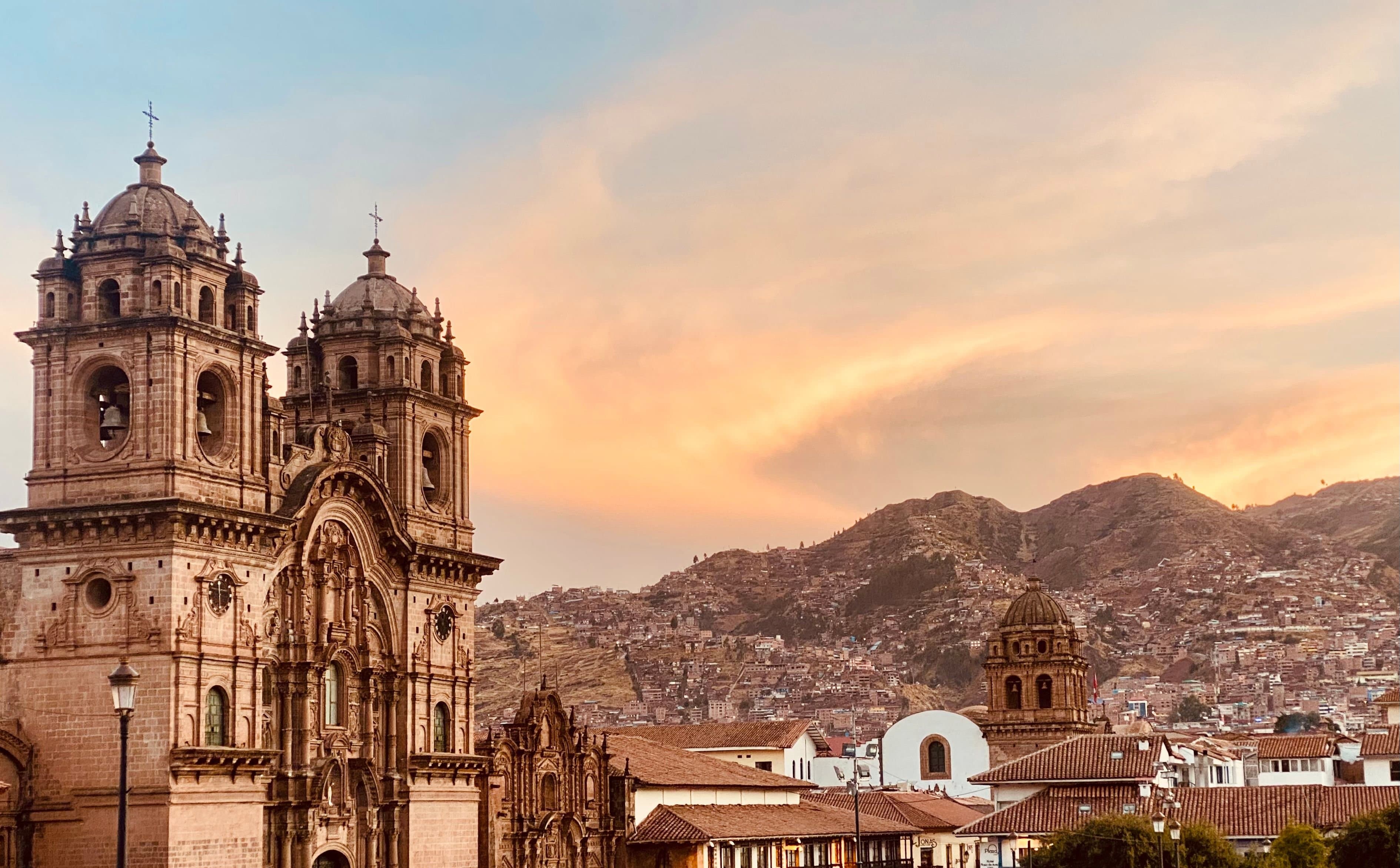
Historic Center: The City Built on Inca Walls
90 min · 2.4 km · moderate
More from Cusco
Explore more at your own pace.
Best Self-Guided Walking Tours in Cusco (2026)
Cusco Travel Guide: Altitude, How Many Days, Getting Around, When to Go (2026)
One Day in Cusco: An Altitude-Friendly Walking Itinerary (2026)
Best History Walking Tours in Cusco (2026)
What to Eat in Cusco: An Andean Food Guide (2026)