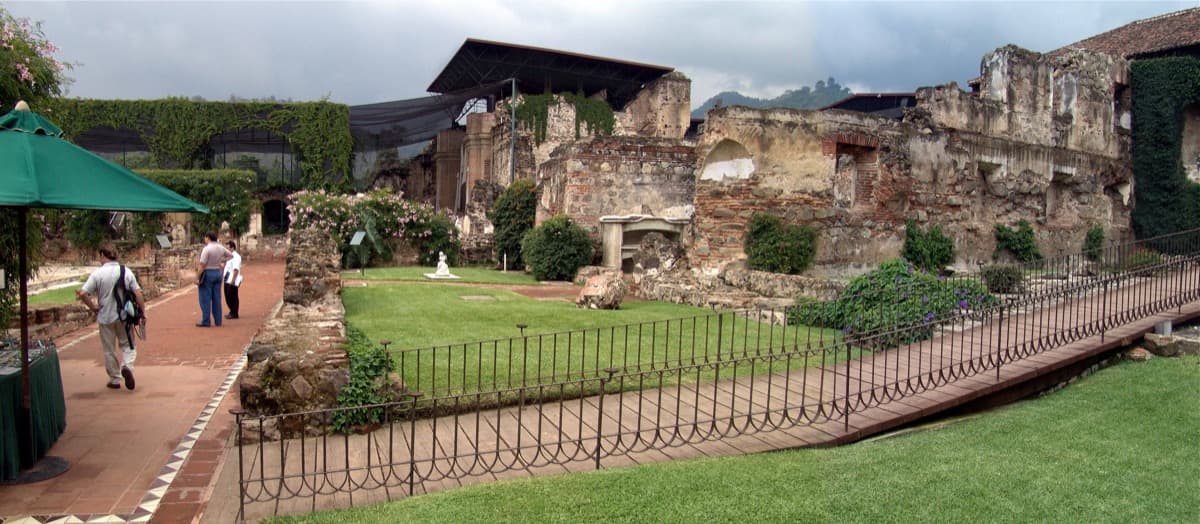
The Monasterio de Santo Domingo sits at the eastern edge of the colonial grid, on the corner of 3rd Calle Oriente and 1st Avenida Norte. A high stucco wall fronts the street. A modest gate. Behind the gate, on twelve hectares of land that the Dominican order claimed in the sixteenth century and lost in the eighteenth, sits one of the most photographed five-star hotels in Central America, built around the open ruins of what was once the largest religious complex in colonial Guatemala. The hotel is Casa Santo Domingo. The monastery is, in some sense, still here.
This stop is the turn of the Preserved by Catastrophe tour, the moment where the thesis the audio has been building gets complicated. The tour argues that Antigua survived because nobody could afford to demolish what the 1773 earthquake left behind. Santo Domingo lived through that exact pattern for two centuries. Then, in 1989, the pattern changed.
The monastery the Dominicans built
The Dominican Order of Preachers arrived in Guatemala in 1538, five years before the Spanish founded Santiago de los Caballeros on this site. They came as missionaries and as theologians. Their leading figure, Bartolomé de las Casas, was already the most influential European critic of the conquest, the man whose Brief Account of the Destruction of the Indies (published 1552) had reached Madrid and was beginning to shape royal law. The order arrived with both moral authority and institutional ambition. Within decades they had assembled one of the largest landholdings of any religious order in the colony.
The monastery on this block was built across the late sixteenth and seventeenth centuries. At its peak, it housed cloisters, dormitories, a novitiate school, an infirmary, a library that contemporary chroniclers described as the finest in the colony, and a church with two bell towers carrying ten bells. The complex extended across most of what is now the hotel campus and into adjacent lots. By the seventeenth century, the Dominicans were among the wealthiest religious orders in Central America, with sugar mills, indigo plantations, and indigenous labour tributes feeding into the monastery economy.
The architectural record is fragmentary because so much of the building came down at once. The church and cloisters were severely damaged in the 1717 earthquake, repaired, then damaged again in 1751. The 1773 Santa Marta earthquake brought down the church vaults, the bell towers, and most of the monastic buildings. By the end of that year, the Captain General had decided to move the capital. The Dominicans, like the other orders, were ordered to relocate to the new site in the Ermita valley. Most of the friars went. The monastery here was effectively abandoned.
Then independence finished what the earthquake started. The Mexican-Central American struggle for independence ended Spanish rule in 1821. In 1829, the Liberal president Francisco Morazán expelled the regular religious orders from Central America in a sweeping anticlerical decree. The Dominicans were among the orders expelled. Their property was seized by the state and, in subsequent decades, broken up and sold. By the middle of the nineteenth century, the monastery site had ceased to function as a religious house and had been split among private owners. Walls fell. Stones were carted off to other buildings. The library disappeared.
Two centuries of weeds
Hear a stop from this walk
San Francisco: The Saint at the Tomb
For most of the time between the 1773 earthquake and the late twentieth century, the Santo Domingo site looked like the Preserved by Catastrophe tour's defining image: an open ruin under a vault of sky, weeds in the cloisters, walls standing for no reason except that nobody had a strong enough reason to take them down. The historian Christopher Lutz, in his long demographic study of the city published in 1994, documents how the colonial population that stayed behind in Antigua after the move was too poor to engage in the kind of urban turnover that levels old buildings. Adobe rooms got built into the corners of surviving colonial patios. Subsistence agriculture filled empty lots. Monastic ruins persisted because they were too solid to clear and not worth the labour.
This was preservation by economic absence. UNESCO would later cite exactly this pattern, the city's slow demographic recovery and its lack of mid-twentieth-century development pressure, when it inscribed Antigua as a World Heritage Site in 1979.
Santo Domingo's ruin was inside that pattern. It sat on the edge of town. It belonged to private owners across the nineteenth century but produced no economic surplus that justified rebuilding. The site went through various marginal uses, including agricultural plots and a partial barracks during one of Guatemala's recurrent civil conflicts. The walls stayed standing. The frescoes that had survived the earthquake faded. The crypt under the church was sealed.
The 1989 reframing
In the 1980s, the site was acquired by a Guatemalan family. Casa Santo Domingo opened as a hotel in 1989, with an explicit programme to preserve the ruins rather than demolish them. The hotel buildings were inserted into and around the remaining walls. A restaurant occupies what had been the refectory. A chapel hosts weddings inside one of the surviving naves. Five small in-house museums, on pre-Columbian ceramics, colonial silver, colonial sculpture, glassware, and modern Guatemalan art, display objects that have been excavated on the property or assembled by the owners.
The hotel positions itself as a museum that also has guest rooms. The crypt has been opened to visitors. The cloisters have been cleared of weeds. The frescoes that survive have been conserved by hired specialists, including some work coordinated with the Guatemalan Institute of Anthropology and History. Almost three centuries after the earthquake, Santo Domingo is being actively maintained for the first time since the Dominicans left.
It is also, undeniably, a luxury hotel inside a UNESCO World Heritage site.
What the trade actually is
The Preserved by Catastrophe tour holds two readings of this side by side. The first reading is critical. A monastery built with indigenous labour, sustained by colonial plantation economies, ruined by an earthquake the religious order interpreted as God's punishment, and abandoned by ecclesiastical decree, has been reabsorbed into the global hospitality economy. Rooms cost what most Guatemalan workers make in a month. The crypt is a photo opportunity. Wedding receptions happen where the friars said matins. The argument here is that commerce has produced an aestheticised version of a place whose history is being smoothed over.
The second reading is structural. For two centuries, nobody was conserving anything. The walls were eroding. The frescoes were spalling. The site was deteriorating in the slow way that ruins do when nobody is paid to stabilise them. The hotel's economic interest produces a financial flow large enough to fund actual conservation work. The frescoes that you can see today are visible because someone hired specialists to consolidate them. The walls that lean over the dining tables have been engineered to stand. The crypt has been waterproofed. None of this was happening in 1950.
Both readings are correct. They describe the same site from different vantage points. The Preserved by Catastrophe tour treats the second reading as the more interesting of the two, not because it absolves the hotel of its asymmetries but because it reframes what preservation can mean for a city whose only previous preserver was poverty.
What to look for inside
If you go in, the entry includes the colonial route through the monastery archaeological remains, the museums, and the crypt. Walk the cloister first. The arches are sixteenth and seventeenth century, repaired across multiple earthquake cycles. The patio in the centre is the original Dominican cloister patio. The fountain at its centre is restored. Stand and look up at the surrounding walls. They lean slightly. Some of them have been stabilised with hidden internal armatures. The architecture conservator's hand is visible if you know what to look for, but the original masonry is what you are seeing.
The crypt under the former church is accessible by a staircase. It contains a series of funerary niches, some empty, some labelled with the names of friars and patrons. The bones are not original to the site, in most cases. They have been brought here from other Dominican burials in the city as a curated arrangement. The crypt is, in this sense, both authentic and assembled. The space is real. The contents are interpretive.
The Pre-Columbian Museum displays Mayan ceramics excavated on the property and elsewhere. The Colonial Silver Museum holds liturgical objects from Antigua's religious houses, some of them rescued from churches that were less fortunate than this one. The exhibits are small and well documented.
Why this stop is the turn
The first seven stops of the Preserved by Catastrophe tour walk past buildings whose preservation has been involuntary. The plaza is preserved because no one moved its grid. The cathedral is preserved because rebuilding the whole vault was beyond the means of the post-earthquake city. The arch is preserved because nobody had a reason to knock it down. La Merced and Capuchinas are preserved because their structural design was good enough to outlast neglect. Each of those buildings is a working answer to the question of what poverty preserves.
Santo Domingo is the question's other side. It is preserved because someone built a business model around its preservation. The model has worked for thirty-six years. The walls are still up. The conservation has been continuous. The site is the most maintained piece of colonial fabric in the city.
What the tour is asking you to hold, by the time you walk out of Santo Domingo and continue to the saint's tomb at Stop 9 and the working hospital at Stop 10, is that there is no single answer to how a colonial ruin keeps standing for three centuries. Sometimes it stands because nobody can afford to take it down. Sometimes it stands because somebody can afford to put it back up. Antigua has done both. The argument that the city is making with its earth and its history runs through both of them at once.
Ready to experience it?
Historic Center: Preserved by Catastrophe
105 min · 3.69 km · easy
More from Antigua
Explore more at your own pace.
Antigua Guatemala Travel Guide: How Many Days, Getting There, When to Go (2026)
Best Self-Guided Walking Tours in Antigua Guatemala (2026)
One Day in Antigua Guatemala: A Walkable Itinerary (2026)
What to Eat in Antigua Guatemala: A Food Guide (2026)
The People Who Stayed: A Companion to the Historic Center Walk