Historic Center: Preserved by Catastrophe
105 min · 3.69 km · easy
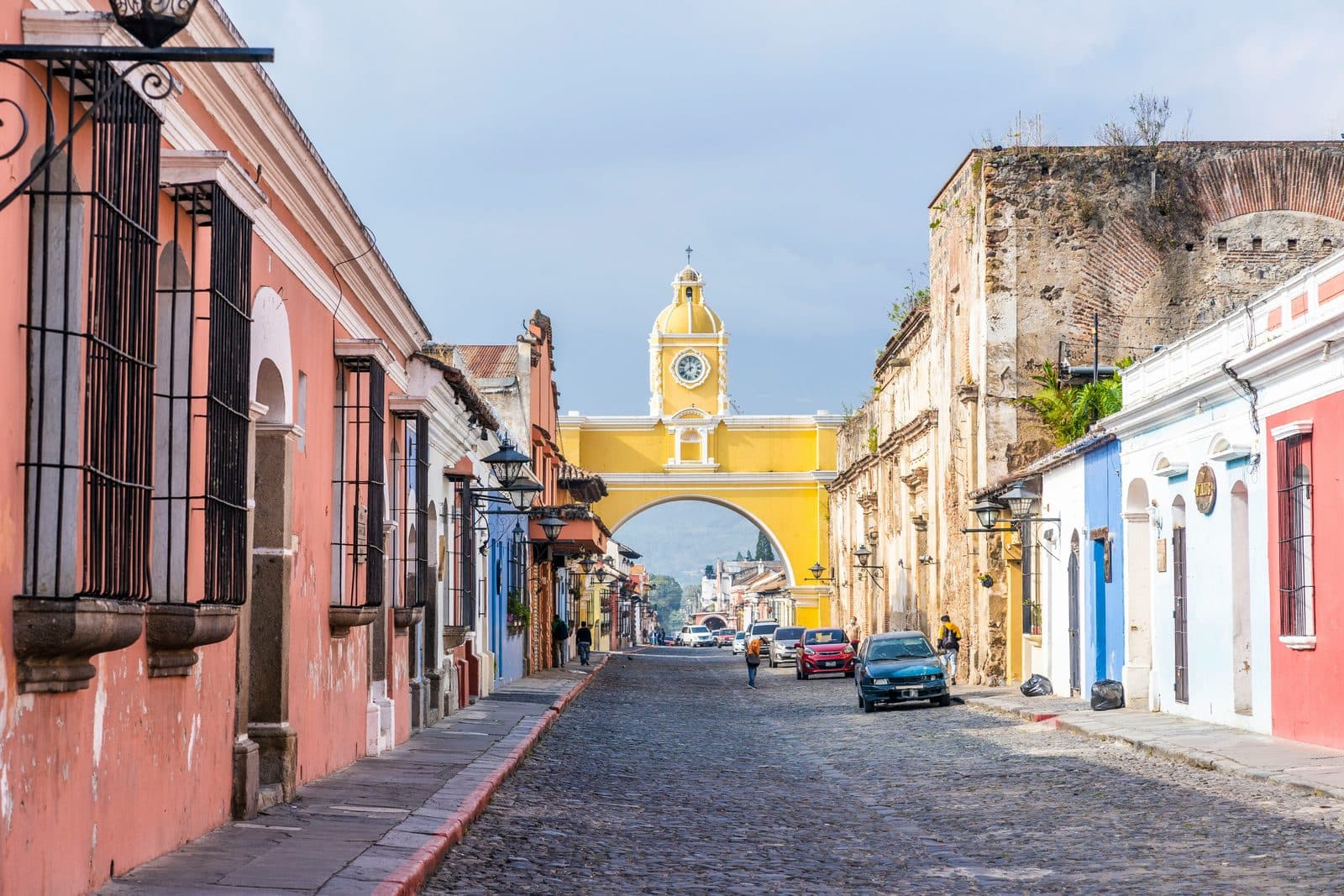
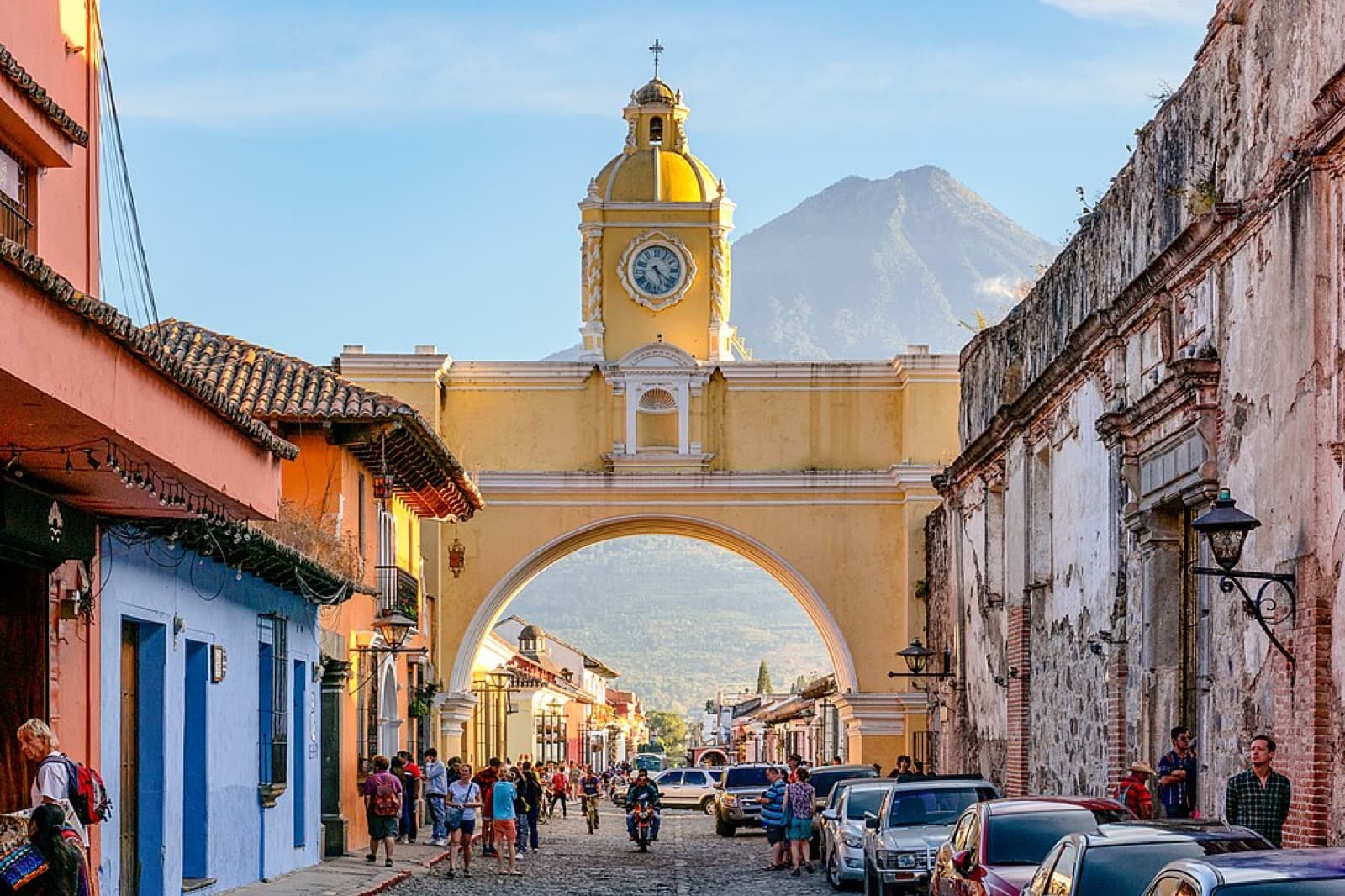
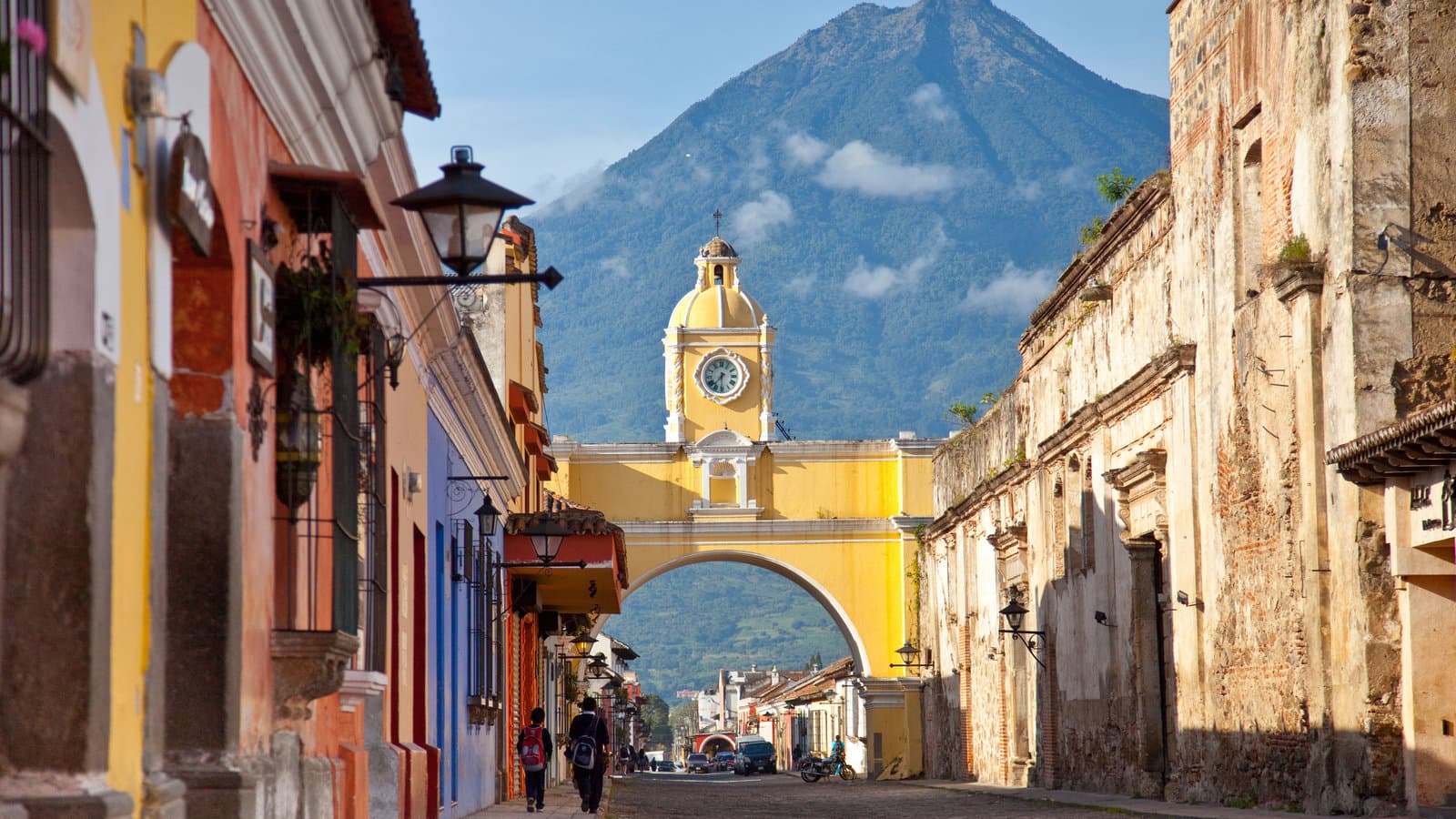
Stand on Fifth Avenue North, look south down the cobblestones, and there is a yellow arch spanning the street with a small clock at the top and a volcano framed neatly behind it. The view is on the cover of every guidebook to Guatemala, on the front of the airport postcards, on the inside of every café in the city. It is the single most reproduced image of Antigua.
The thing that produced the image was not designed for a photograph. The arch is a piece of religious infrastructure. It exists because the women on either side of it were not allowed to be seen.
The convent that needed it
The Convento de Santa Catalina, founded in 1610, was a cloistered religious community of the Order of Saint Catherine of Siena. Cloistered means literally enclosed. The Latin word claustrum, from which English gets cloister, means a place that is shut. The nuns of Santa Catalina took vows of permanent enclosure. They did not leave the convent grounds. They did not appear in public. They did not interact with men outside the order. The bars and grilles that interior visitors saw were a one-way membrane: the nuns could hear and sometimes glimpse, but they were not to be seen.
The convent grew. By the late seventeenth century, the order had outgrown its original block. The natural response in a colonial grid city would have been to acquire a contiguous lot or relocate. Both were impractical. The structures the order had built and consecrated could not be casually abandoned. The available expansion property was on the other side of Fifth Avenue, a working public street.
The architectural solution was a skybridge. Build a covered passage over the street, connecting the two halves of the convent at the second-storey level. The nuns crossed above the public. The public passed below without seeing them. The cloister remained, in the strict sense of the word, unbroken.
What you are looking at
Hear a stop from this walk
San Francisco: The Saint at the Tomb
The arch was built in 1694. The structure is a single round-headed masonry arch spanning the street, with a flat-roofed passage on top connecting the two halves of the convent. The passage is invisible from the street: you see only the underside of the arch and its decorative facing.
Three elements of the visible structure are worth noting:
The proportions. The arch is taller than it needs to be for street clearance. The extra height accommodates the passage above and allows for the small decorative elements at the top. The horizontal span is calibrated to the width of Fifth Avenue, which has not changed since the 1543 grid was laid out.
The yellow. The colour is a recurring Antigua hue, somewhere between butter and ochre, repainted regularly because tropical sun and rainy seasons strip pigment fast. Most painted surfaces in the city are repainted every five to ten years. The current yellow on the arch is not the colour the eighteenth century saw, but the building has been repainted in approximately this range for centuries.
The clock. The clock at the top is a nineteenth-century addition, more than a hundred years younger than the arch itself. The mechanism was made in France. It is not part of the original 1694 work and serves no convent function; the arch had been built and consecrated before the clock existed as an object.
The earthquake test
The 1773 Santa Marta earthquakes destroyed enough of the surrounding city to force the relocation of the capital. The arch did not fall. There is no perfect explanation for why some structures survived the quake and others did not, but for a single-span masonry arch the answer is partly geometric: a round-headed arch in compression transfers vertical and lateral loads to its abutments more reliably than a long horizontal beam does. As long as the abutments hold, the arch holds. The abutments at Santa Catalina were part of the substantial convent walls on either side. They held.
The convent on either side of the arch did not fare as well. After the earthquake and the capital's departure, the cloistered community dwindled. The Santa Catalina convent declined through the nineteenth century. The buildings on the north side now host other functions. The buildings on the south are similarly repurposed. The arch outlasted the institution it was built to serve.
The volcano
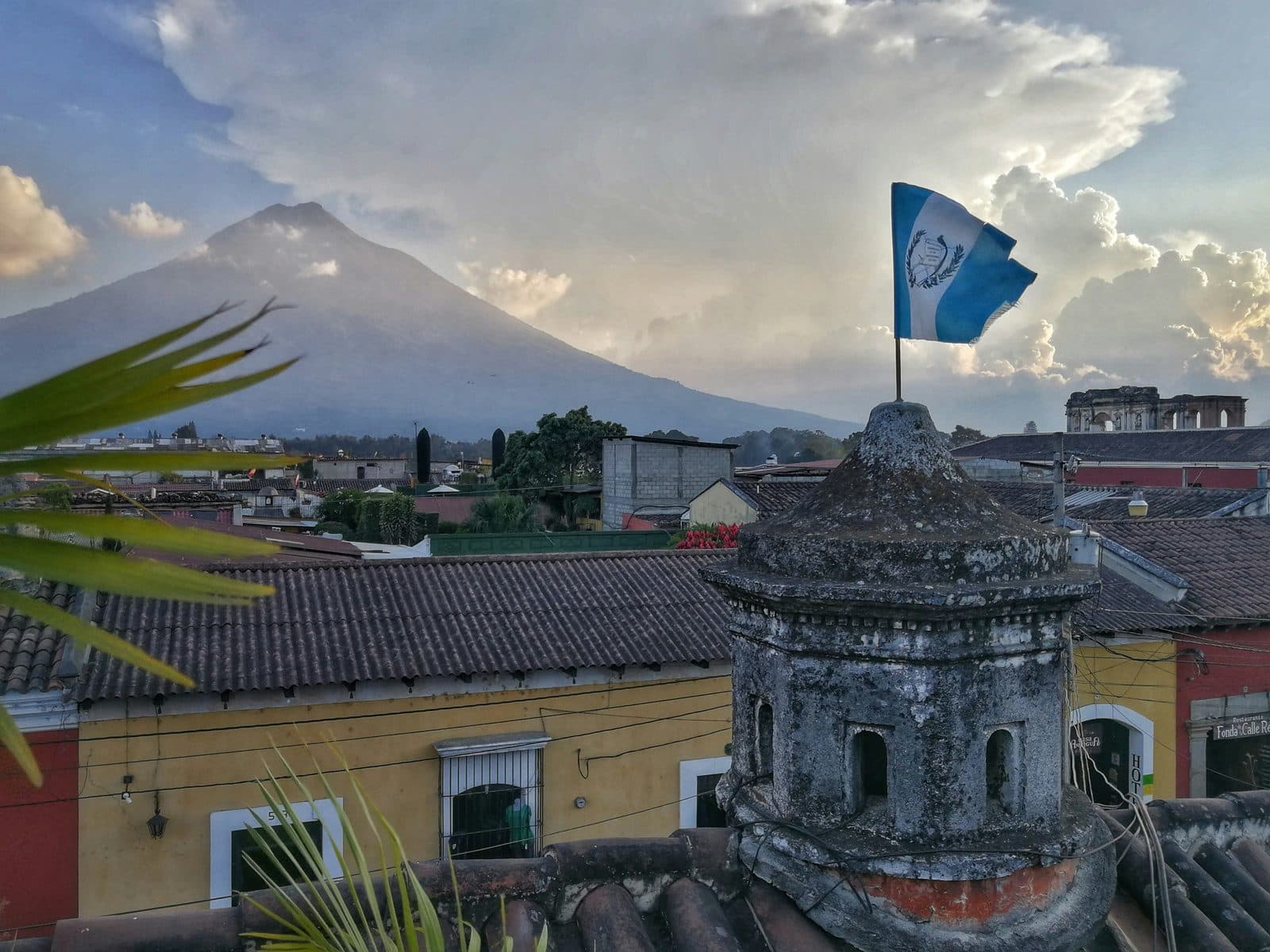
The reason the arch became the symbol of Antigua is the line of sight. From the south side of the arch, looking through it on a clear morning, the cone of Volcán de Agua is framed almost exactly inside the opening. Volcán de Agua is a three-thousand-seven-hundred-and-sixty-six-metre stratovolcano, dormant, that forms the southern boundary of the Panchoy valley. It dominates the southern horizon from every street in Antigua, but the arch is the spot where it can be photographed with a piece of colonial architecture as the foreground.
The geometry is an accident. The convent did not lay out the bridge for the volcano view. The view exists because Fifth Avenue runs roughly north-south, the arch is on Fifth Avenue, the volcano is south of the city, and the convent happened to need a passage at this particular block. Photographers worked the rest out.
What to do at the arch
The audio at Stop 4 of the Historic Center walk gives you three things to look for: the clock, the colour, the volcano. The street will be busy with other photographers. The volcano frame is best in the morning before the haze rises. The clock face is more or less always visible.
The arch is also worth understanding for what it is not. It is not a monument. It is not a triumphal arch. It is not a memorial. It is a piece of seventeenth-century cloister infrastructure that solved a specific institutional problem: how to expand a religious community without breaking the rule of enclosure. The rule of enclosure is gone. The community is gone. The infrastructure remains.
That is the recurring pattern in Antigua. Functional colonial architecture, built for purposes the modern city no longer needs, surviving because no one had a reason or a budget to take it down. The arch outlasts the cloister, the photograph outlasts the function, the volcano outlasts everything.
Ready to experience it?
Historic Center: Preserved by Catastrophe
105 min · 3.69 km · easy
More from Antigua
Explore more at your own pace.
Antigua Guatemala Travel Guide: How Many Days, Getting There, When to Go (2026)
Best Self-Guided Walking Tours in Antigua Guatemala (2026)
One Day in Antigua Guatemala: A Walkable Itinerary (2026)
What to Eat in Antigua Guatemala: A Food Guide (2026)
The People Who Stayed: A Companion to the Historic Center Walk