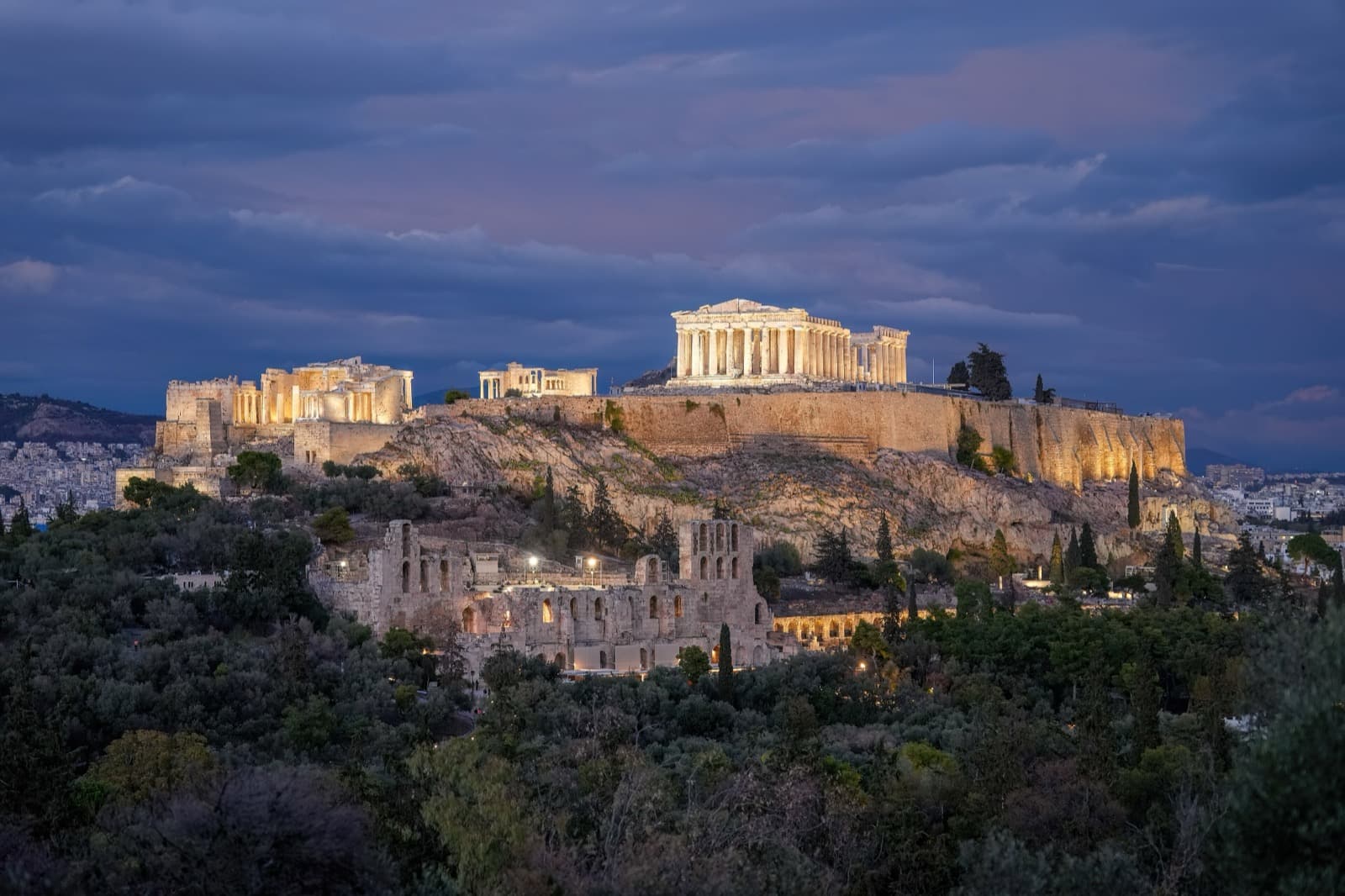
The sacred rock walked stop by stop: through the marble gateway, past the little victory temple, around the Parthenon, to the porch of the maidens, over the slope where drama was born, and down to the free courthouse hill and the museum that guards what the rock lost.
Start · Propylaea: The Marble Gateway to the Sacred Rock
DirectionsStops
- 1
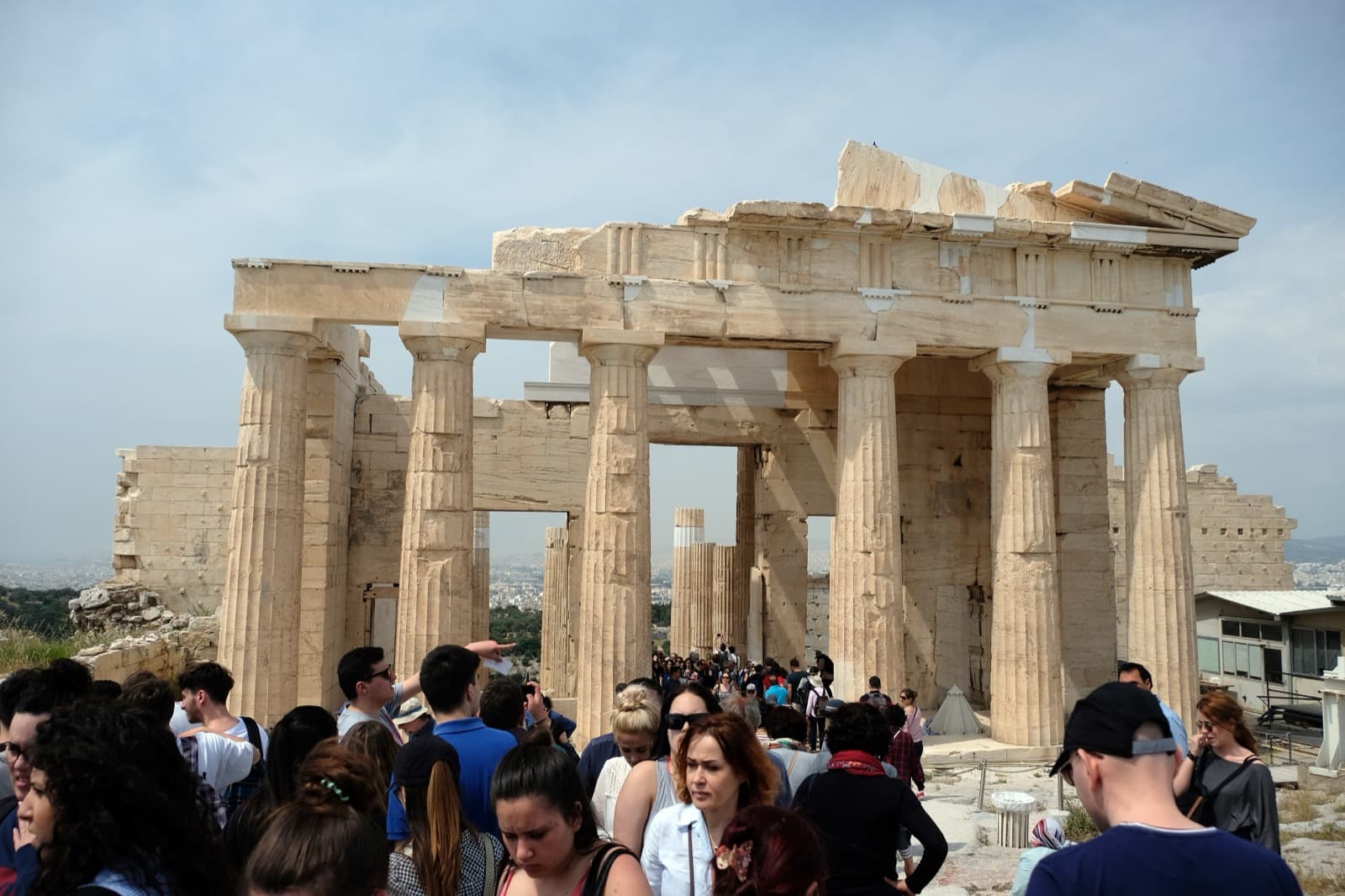
Propylaea: The Marble Gateway to the Sacred Rock
The monumental western gateway to the Acropolis, built by Mnesikles in Pentelic marble, left unfinished when war interrupted the golden age.
- 2
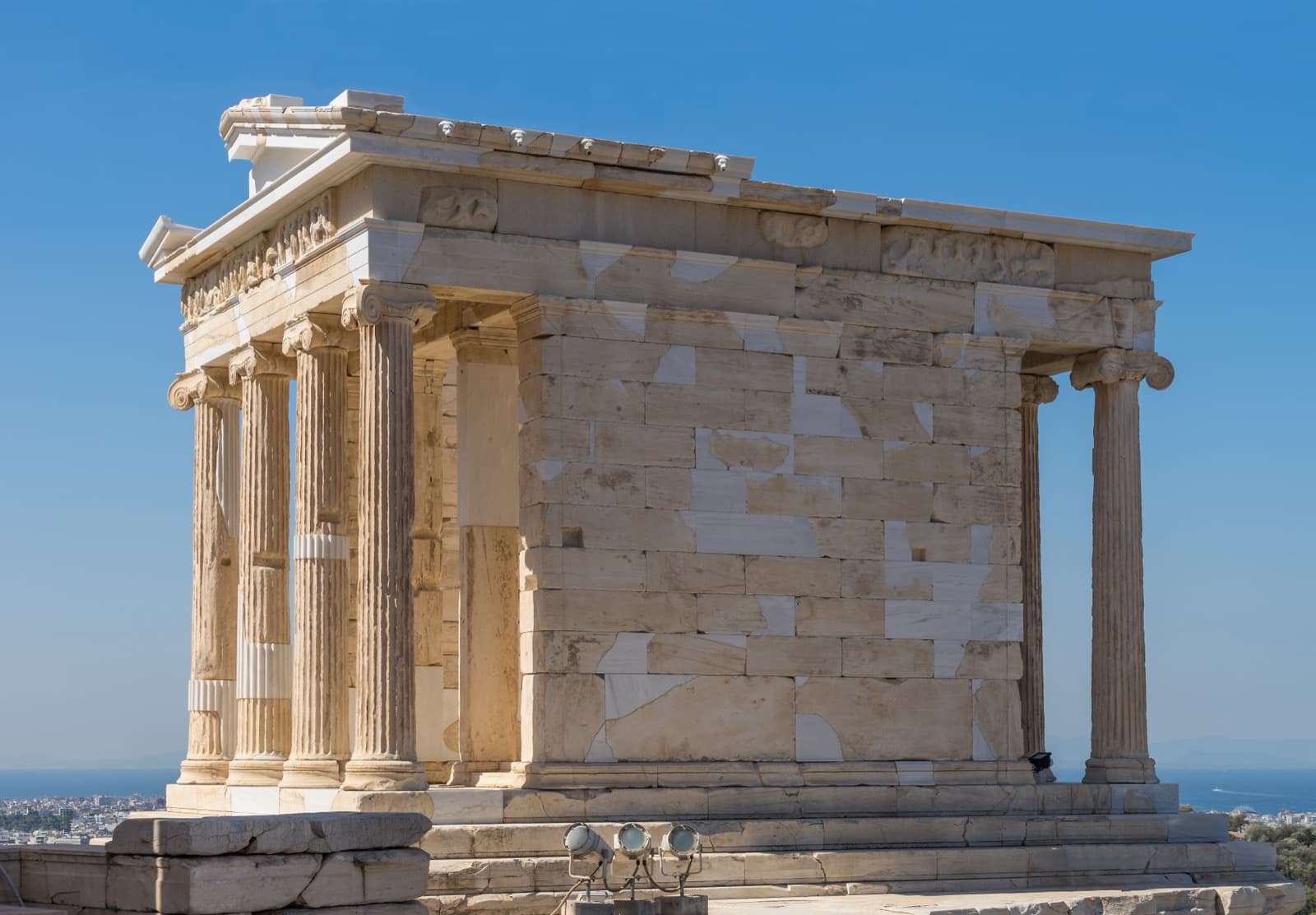
Temple of Athena Nike: The Little Temple of Victory
The smallest temple on the rock and its earliest fully Ionic one, dedicated to Athena as bringer of victory and perched on a bastion beside the gateway.
- 3
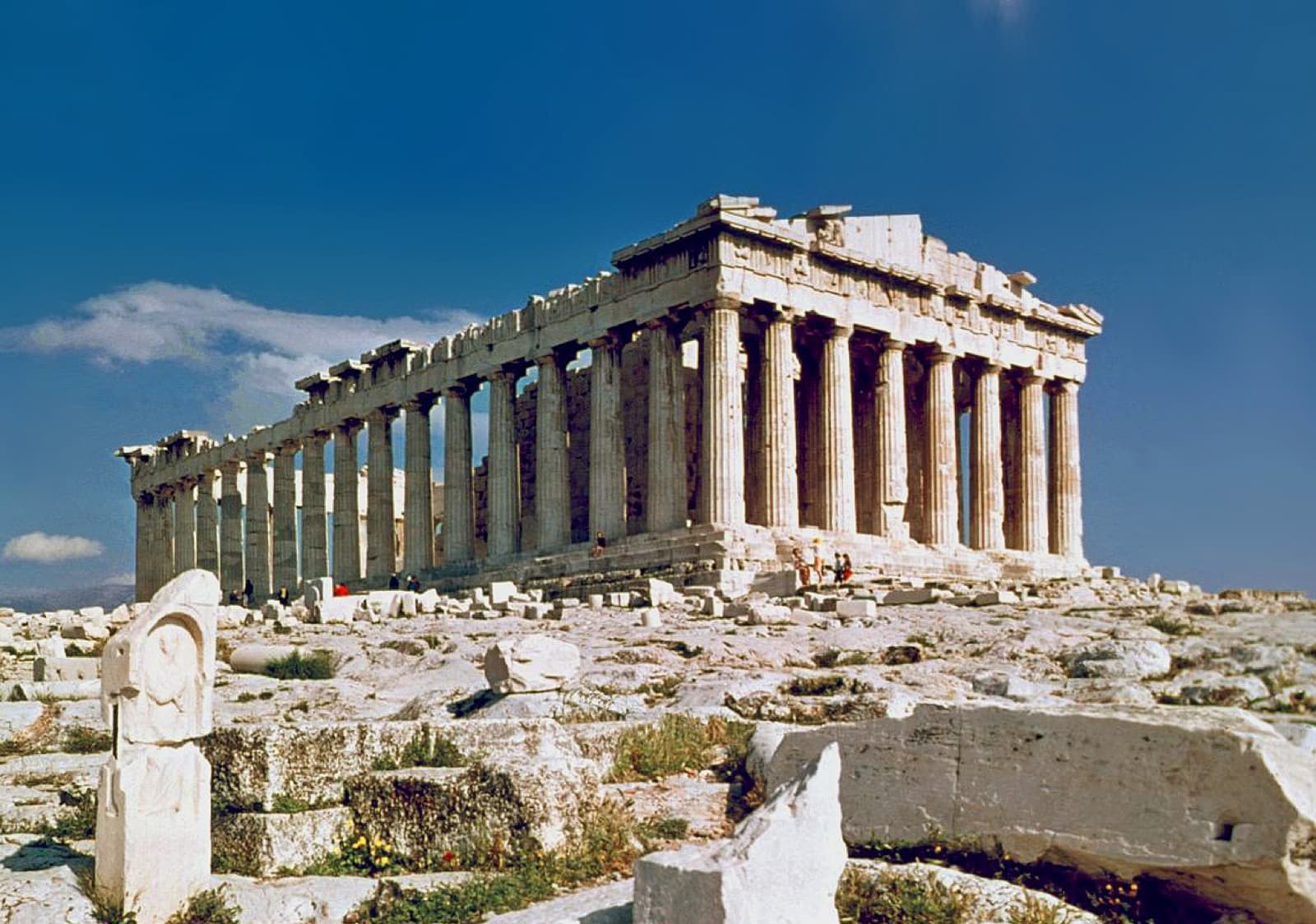
Parthenon: The Temple at the Peak of Athens
The most celebrated building of ancient Greece, raised at the height of Athenian power and once home to a colossal gold-and-ivory statue of Athena.
- 4
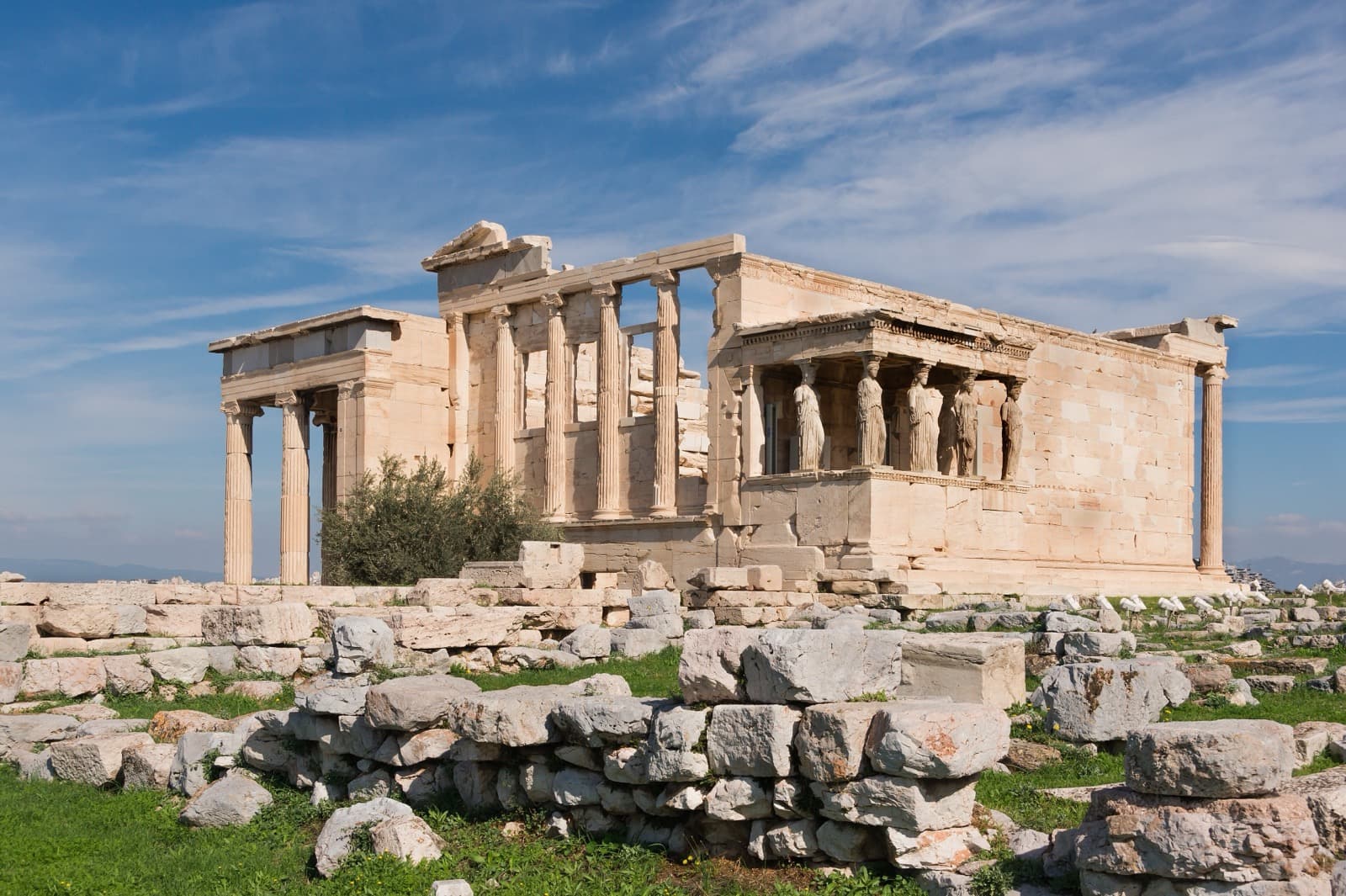
Erechtheion: The Porch of the Maidens
The Ionic temple on the summit's north edge, sacred to Athena and Poseidon, famous for the six Caryatids who carry its porch on their heads.
- 5
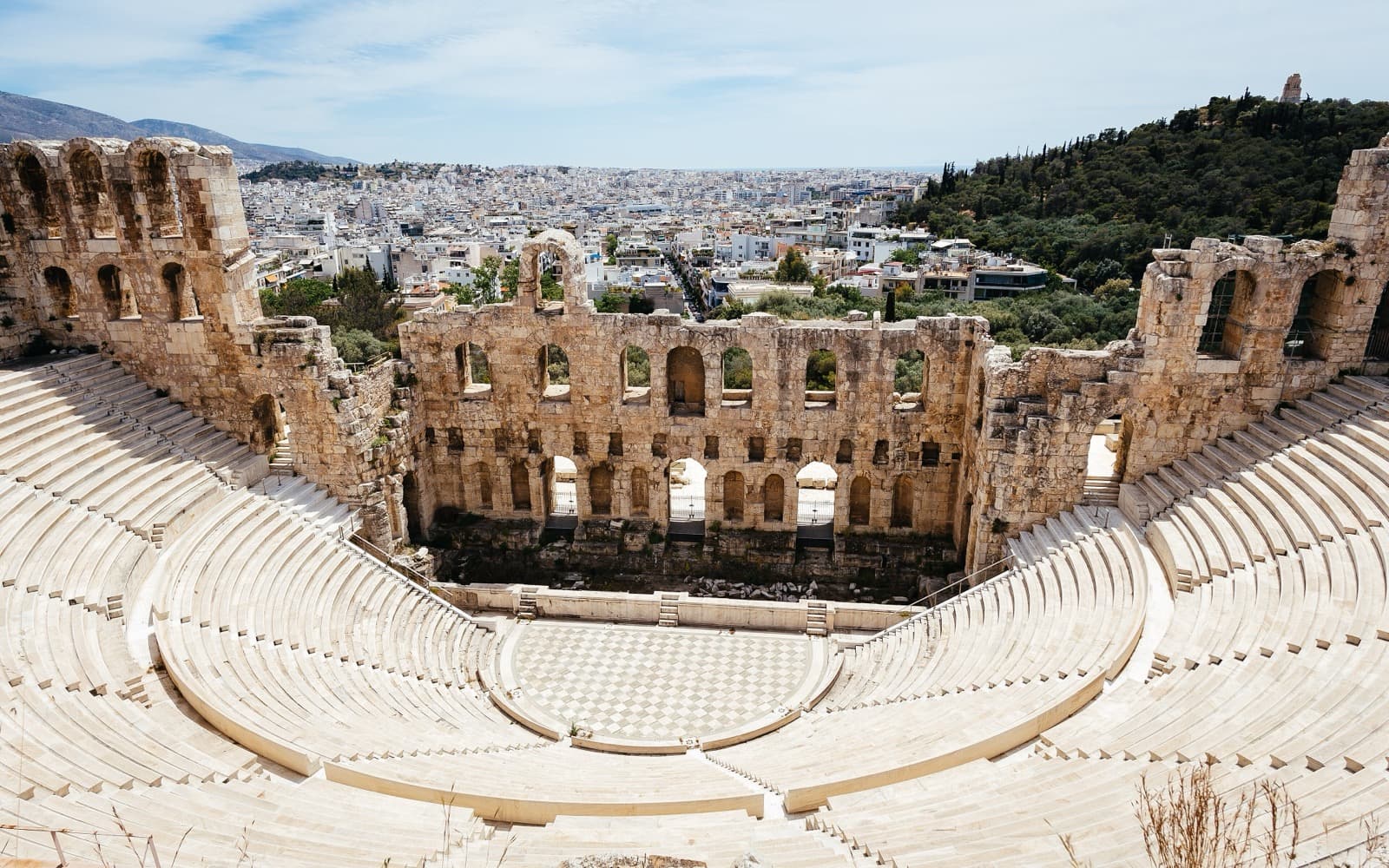
The South Slope: Where Drama Was Born
The two theatres cut into the south slope: the Theatre of Dionysus where Greek drama was born, and the Roman Odeon still hosting the Athens Festival.
- 6
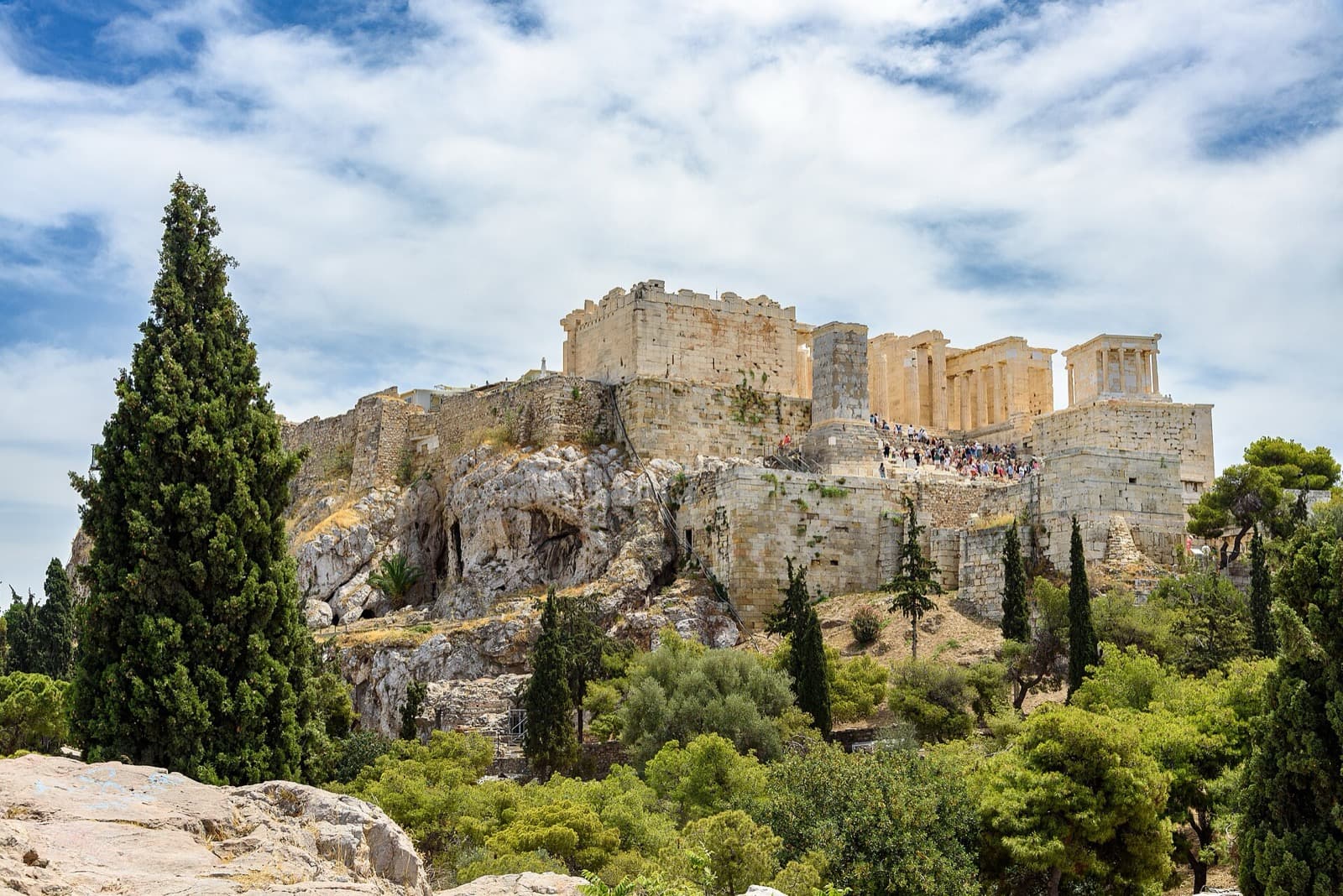
Areopagus and the Acropolis Museum: The Court and the Keeper
The free rock where Athens judged and the Apostle Paul preached, and the modern museum that guards the Parthenon frieze and the surviving Caryatids.
Details
Best Time to Visit
Right at opening or in the last hours before closing. The summit is completely exposed with no shade, so the midday sun in summer is punishing, and the crowds are heaviest in the middle of the day. Early morning gives you cooler stone, thinner crowds, and low light that rakes across the marble; late afternoon gives you golden light on the Parthenon and a cooler climb. Save the Acropolis Museum for after the rock, or for the hottest part of the day, since it is indoors and air-conditioned.
Pro Tips
- •The Acropolis ticket is €30 general in 2026, a flat price year-round now that the old combined multi-site ticket has been discontinued. Book online in advance to skip the queue at the entrance.
- •The Acropolis Museum is a completely separate ticket, €20 general in 2026, and sits about 300m southeast of the entrance, downhill on Dionysiou Areopagitou Street. Budget it as its own visit.
- •Go at opening (or in the final hours before closing) to dodge both the worst heat and the biggest tour groups. The summit is small and gets very crowded around midday.
- •There is almost no shade anywhere on the summit. Bring a hat, sunglasses, sunscreen, and more water than you think you need, especially in summer.
- •Wear shoes with real grip. The ancient marble is worn glassy-smooth and can be slick even when dry, and the paths up and around the rock are uneven.
- •The Areopagus rock is free and open, but the worn stone at the top is genuinely slippery. Use the metal staircase to go up and down rather than scrambling on the marble.
Safety & Precautions
- •The marble across the whole site is polished slick by millions of feet and is treacherous underfoot, especially the Areopagus rock and the smooth patches near the Propylaea. Step carefully and use the metal stair on the Areopagus.
- •The summit is fully exposed with no shade and no water source once you are up. Midday summer heat is intense, so carry water, cover up, and pace the climb.
- •The approach ramp and the ancient steps are steep and uneven. Take the ascent slowly, and note that stroller and wheelchair access is limited to a lift on the north side.
- •The entrance and the summit funnel large crowds through narrow points, especially around midday. Keep your bag closed and in front of you and stay aware of your footing in the crush.
Travel advisory: Exercise Normal Precautions (Level 1).
Gallery
Related Reading
Go deeper on what you'll see, hear, and walk through.
Read the walk
The full story of The Acropolis: The Rock That Invented the West, in words. Prefer to listen? Play it narrated, from home or on location.
Introduction
For a single golden generation, on one flat-topped rock above the city, the Western world set its template. Under the leadership of Pericles, a citizen democracy raised a gateway and a cluster of temples so perfectly proportioned that every column and courthouse since has measured itself against them. On these same slopes, drama was born and philosophy argued its case. This tour has six stops, and it covers about one and a half kilometres, here in Athens, in Greece. Set aside about two hours, because the summit is compact, yet every stone rewards lingering, and the crowds and the views invite you to slow down. One practical note. A single ticket admits you to the whole sacred rock, while the museum below the slope is a separate ticket, and the free courthouse hill nearby is one of the finest viewpoints in the city. What you are about to see is the origin of Western art, of politics, and of the theatre, gathered on a space you can cross in a few minutes. When you arrive at the great marble gateway at the top of the entrance ramp, begin with stop one.
1. Propylaea: The Marble Gateway to the Sacred Rock
Welcome. You are standing at the Propylaea, the monumental gateway to the Acropolis, and your first stop on this walk. This is the grand ceremonial entrance, the last in a long series of gatehouses that guarded the sacred rock, and everyone who came up to worship passed through here, as you are doing now. It was built between four hundred thirty-seven and four hundred thirty-two before the Common Era, as part of the great building program that Pericles set in motion, and its architect was a man named Mnesikles.
Look at the material under your feet and above your head. This is Pentelic marble, quarried from a mountain northeast of the city, the same fine white stone used across the whole summit. What makes the gateway clever is how it mixes two architectural orders. On the outside it wears the plain, sturdy Doric columns, six of them across its central hall, while inside, flanking the central passage, runs a double row of the more slender, scrolled Ionic columns. Notice too the darker stone set as an accent among the white: that is blue-grey limestone from Eleusis, used deliberately to draw the eye.
There is a sadness folded into all this ambition. The Propylaea was never finished. War, the long Peloponnesian War, interrupted the work, and the project was ultimately abandoned incomplete. You are looking at a masterpiece that was cut off mid-sentence. Now, as you climb through the gateway, glance up and to your right, to the small temple perched on the bastion above. That is where we go next.
2. Temple of Athena Nike: The Little Temple of Victory
Just to the right of the gateway, raised on its own bastion, stands the smallest and one of the most delicate buildings on the whole rock: the Temple of Athena Nike. Its designer was the architect Kallikrates, and it was finished around four hundred twenty before the Common Era, though the work was already underway by four hundred forty-nine. For all its small size, it holds a special place, because this is the earliest and purest fully Ionic temple on the Acropolis, the first to be built entirely in that lighter, more graceful order.
It is genuinely tiny. The temple measures only about eight metres long by five and a half metres wide, which makes it the smallest of the temples up here. It is what the builders called amphiprostyle and tetrastyle, meaning a row of four columns and a colonnaded porch at both the front and the back. Compact, balanced, complete in itself.
And think about who it honours. This is Athena Nike, Athena worshipped as the bringer of victory in war, a fitting guardian at the very threshold of the citadel. A carved parapet once ran around the bastion, and one of its panels, the famous relief of Nike bending to adjust her sandal, is among the most admired sculptures to survive from antiquity. You will not find it here now; it is protected in the museum below the slope, which we reach at the very end. For the moment, turn and look across the summit to the great temple that crowns everything. The Parthenon is our next stop.
3. Parthenon: The Temple at the Peak of Athens
Here it is, the building the whole world pictures when it thinks of ancient Greece: the Parthenon. Circle it slowly on the rock, because there is no interior to enter, and the wonder is in the proportions of the outside. It was built between four hundred forty-seven and four…
Full narration for this stop unlocks with the tour.
4. Erechtheion: The Porch of the Maidens
You have come to the north edge of the summit, opposite the Parthenon, to the Erechtheion, and this is the most tender and strange of all the buildings up here. It is an Ionic temple, traditionally dated between four hundred twenty-one and four hundred six before the Common Era,…
Full narration for this stop unlocks with the tour.
5. The South Slope: Where Drama Was Born
From the southern rail of the summit you look down onto the south slope, and here, carved into the rock below you, are two theatres that between them tell the whole story of Western performance. The nearer one is the Theatre of Dionysus, and it is holy ground for anyone who…
Full narration for this stop unlocks with the tour.
6. Areopagus and the Acropolis Museum: The Court and the Keeper
Our last stop has two halves, and both sit just off the sacred rock. First, the bare marble hill northwest of the entrance: the Areopagus, a name that means the Hill of Ares. It is free to climb, and it is one of the great viewpoints in Athens, but it is far more than a photo…
Full narration for this stop unlocks with the tour.