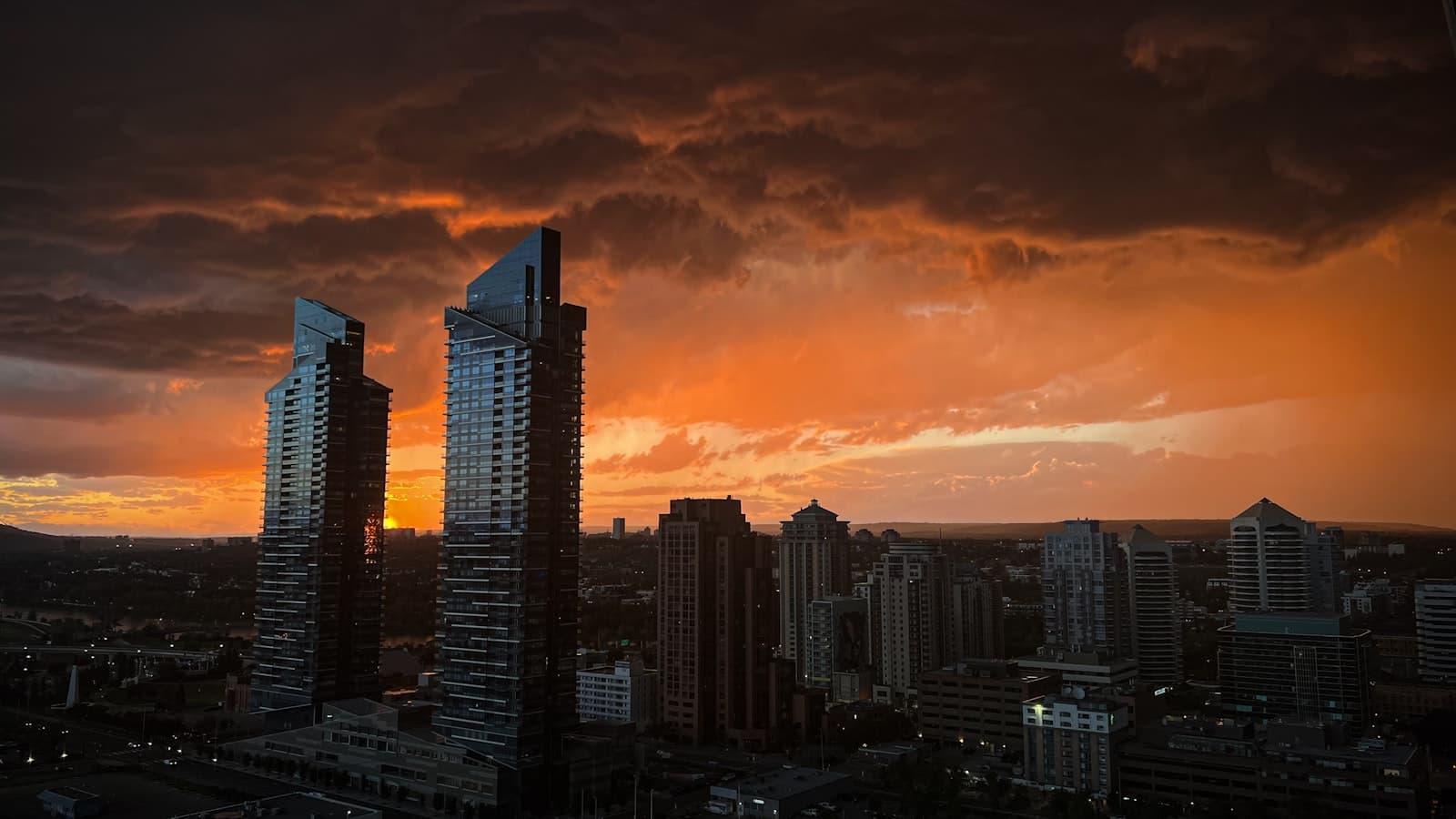
Read downtown Calgary's skyline as a chart of the oil price. Every major tower was commissioned near a crude-price peak and delivered into the next bust, a lagging indicator drawn in glass and steel.
Start · The Bow
DirectionsStops
- 1
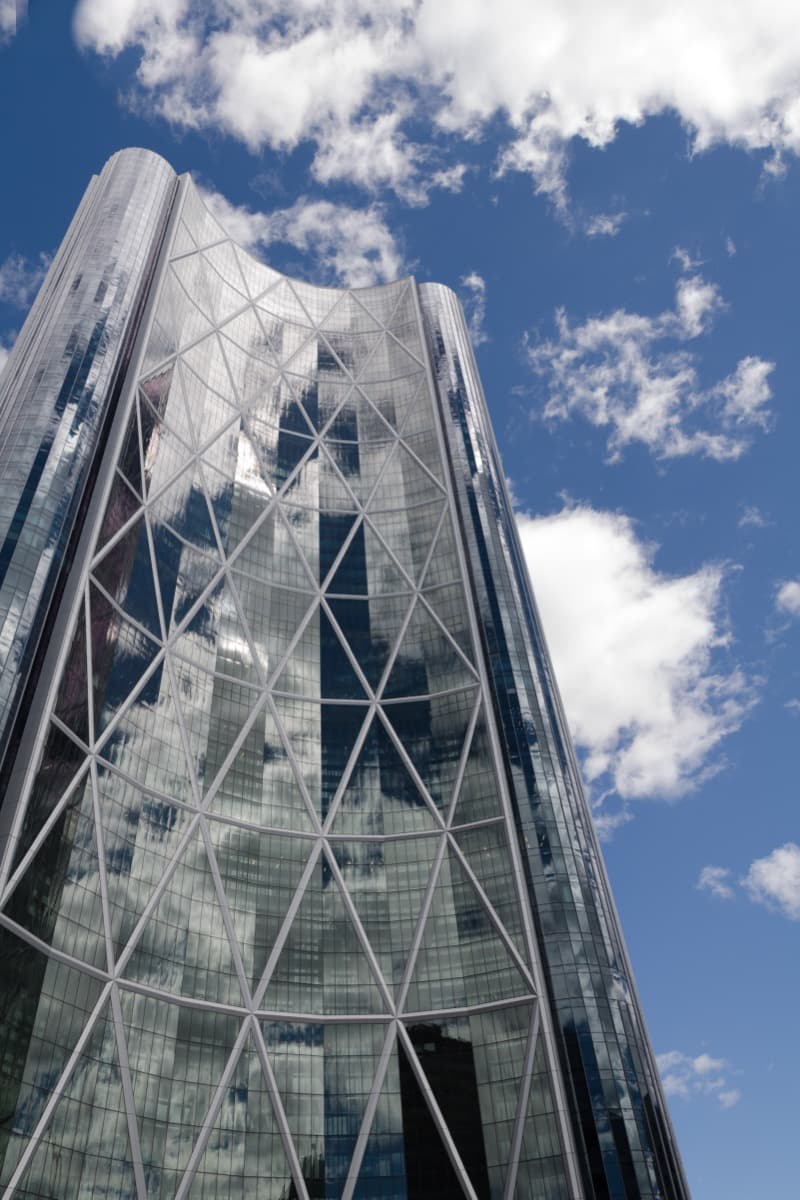
The Bow
A 236-metre, 58-storey crescent completed in 2012, commissioned by EnCana at the height of the oil-sands boom. The tallest bet on the barrel, abandoned by both companies that placed it.
- 2
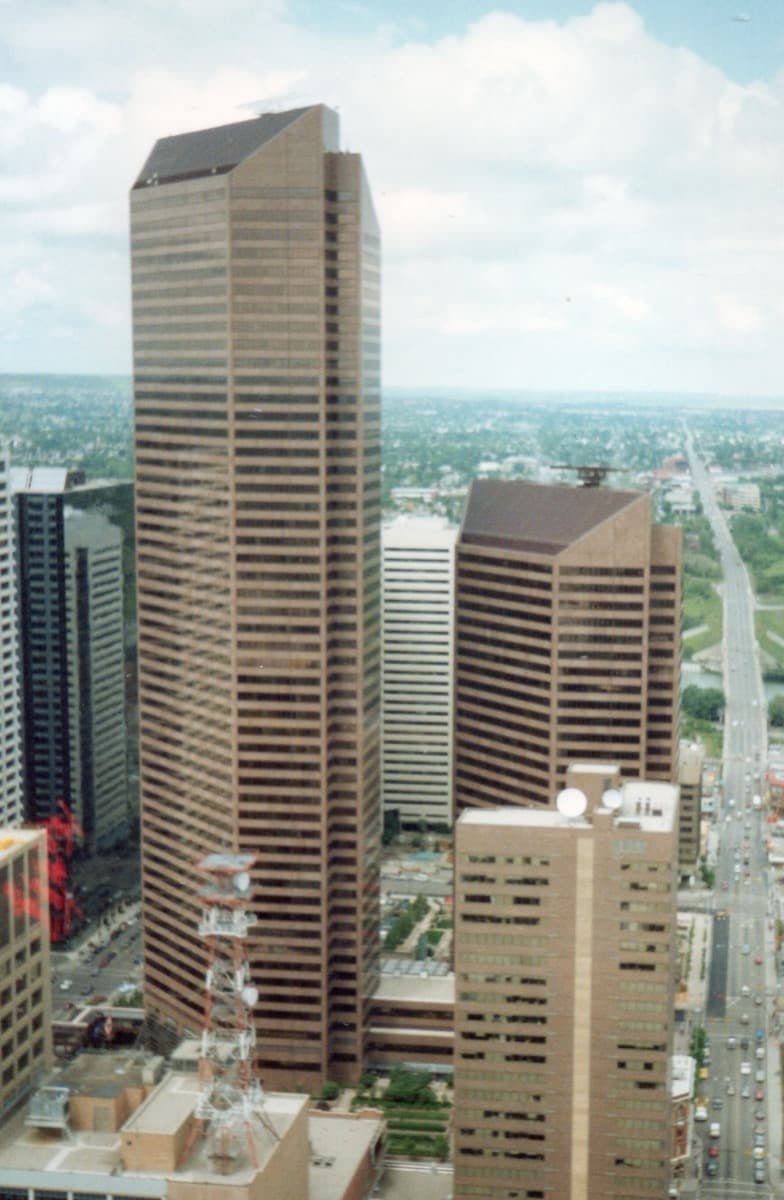
Suncor Energy Centre (formerly Petro-Canada Centre)
The 215-metre west tower completed in 1984 as headquarters for the Crown corporation Petro-Canada. Locals called it Red Square. The origin scar of the boom-and-bust skyline.
- 3
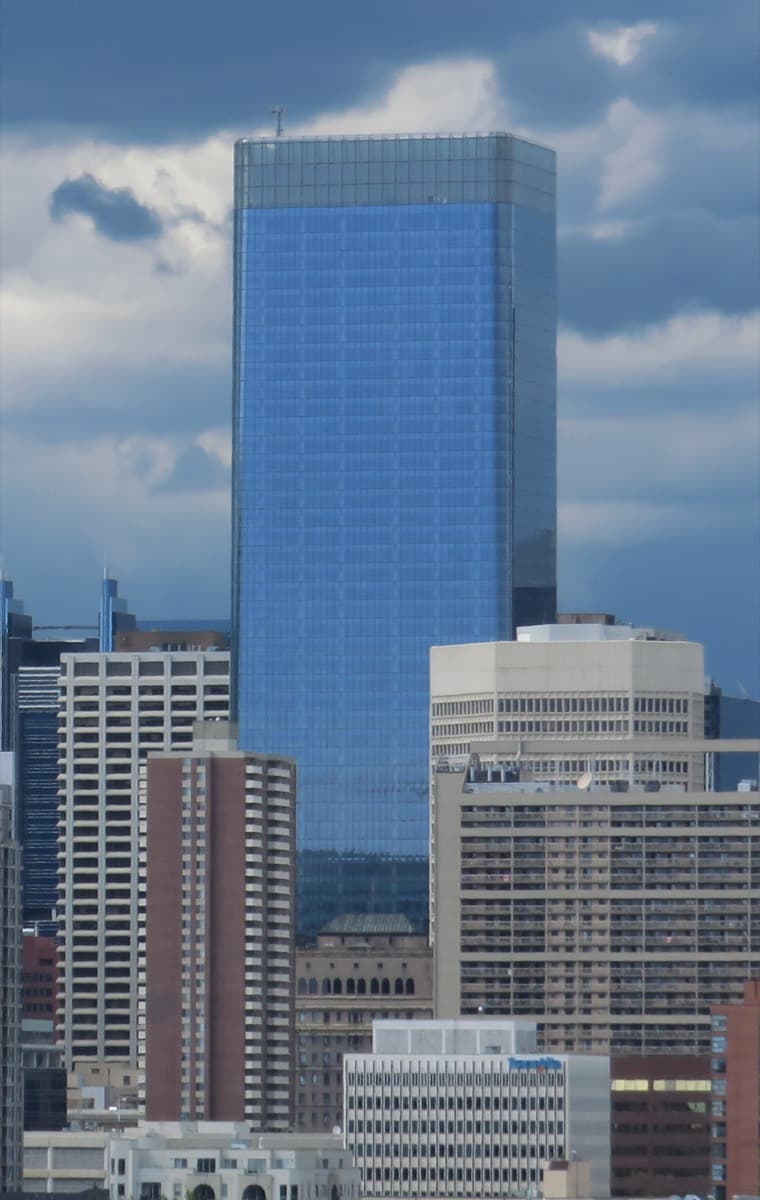
Brookfield Place East
At 247 metres and 56 storeys, the tallest building in Calgary and in Western Canada. Ground broke months before the 2014 price collapse and it topped out into a 20-percent vacancy market. The perfect lag.
- 4
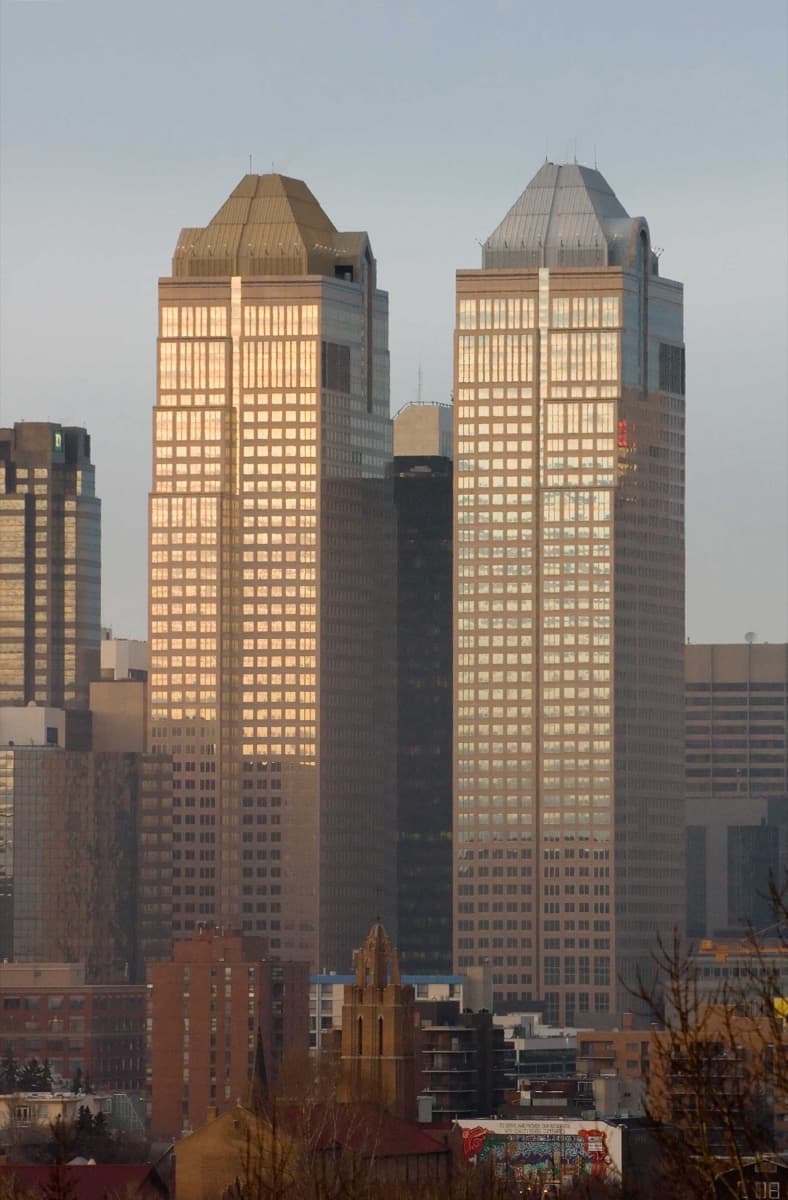
Bankers Hall
Two identical 197-metre towers, 52 storeys each, built eleven years apart. Canada's tallest twin buildings, their cowboy-hat crowns the corridor's only postmodern wink. Two recoveries printed as two towers.
- 5
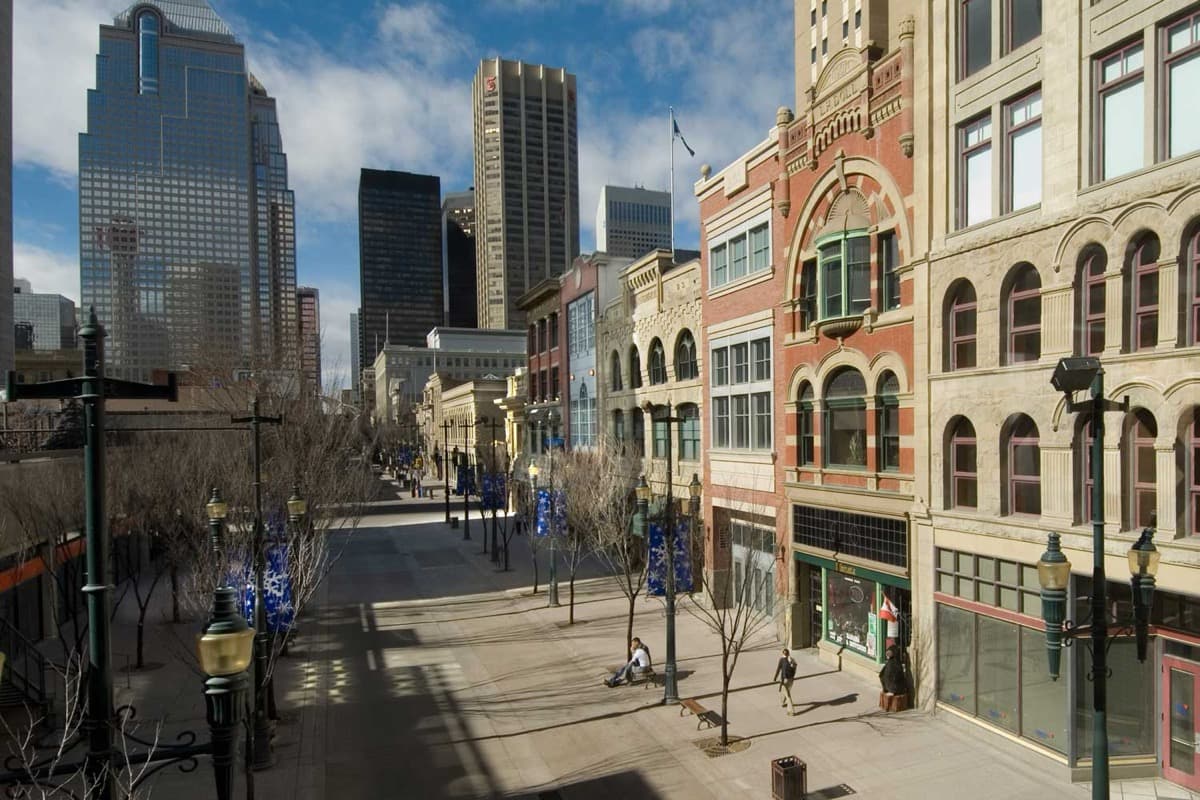
Stephen Avenue (8th Avenue canyon)
The floor of the canyon: roughly three dozen sandstone buildings from 1880 to 1930, the city before oil, a National Historic Site. At lunchtime it is where the vacancy rate becomes a street.
- 6
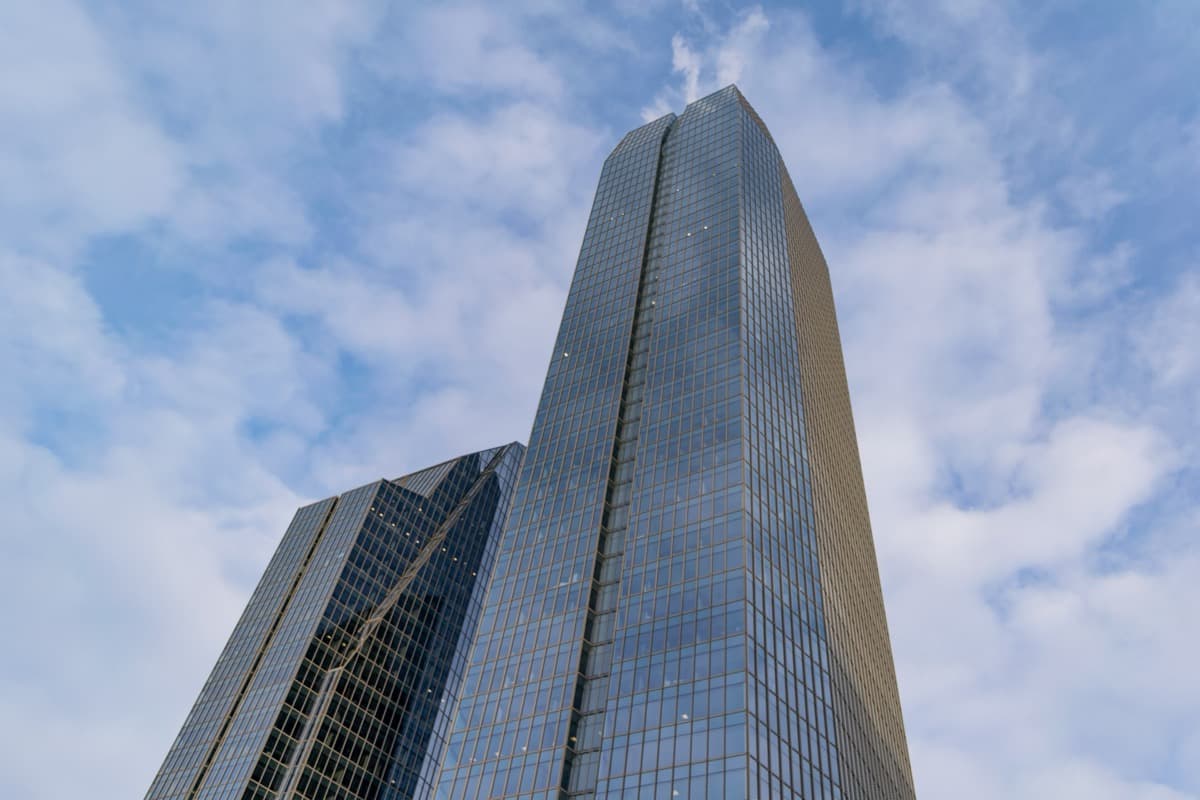
Eighth Avenue Place
The last boom tower. A 212-metre east tower opened in 2011, a 177-metre west tower in 2014, the year the oil price began its slide. LEED Platinum glass, delivered as the barrel started falling.
- 7
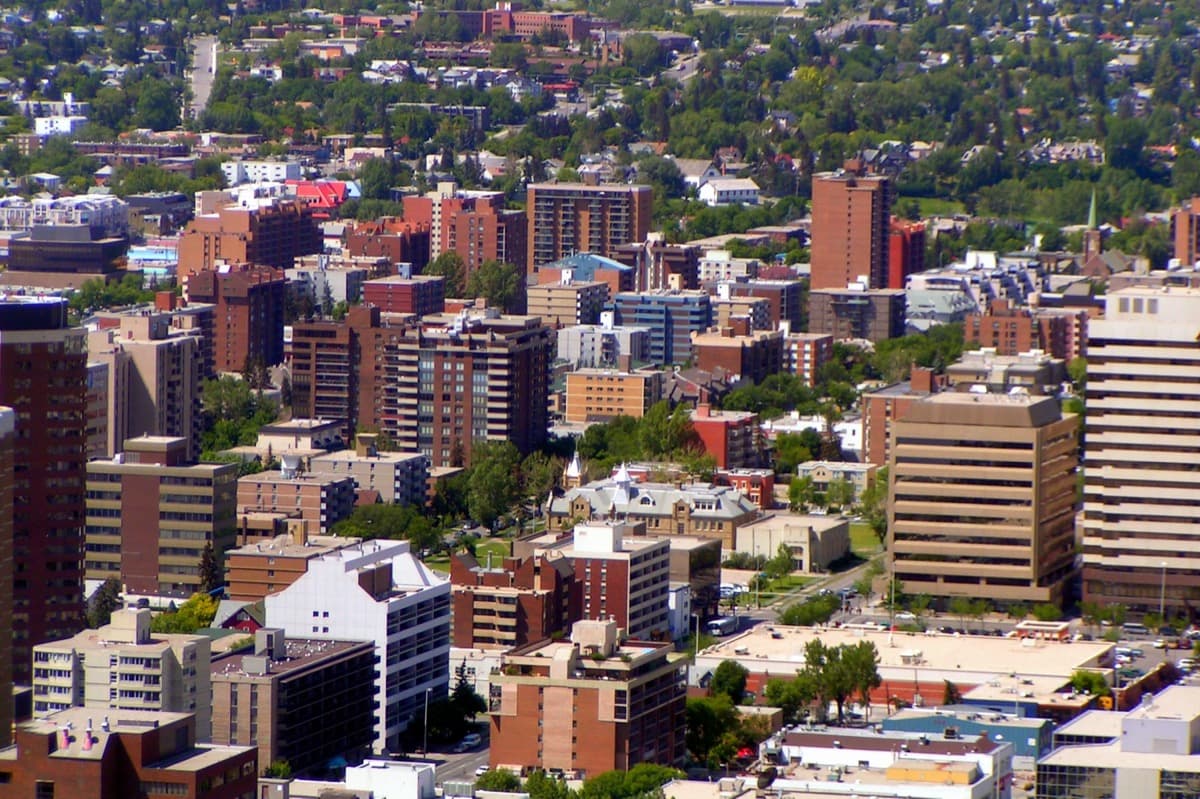
Crossing into the Beltline (CPR tracks)
The Canadian Pacific mainline is the hard seam between the office core and the Beltline. Cross it and the thesis turns forward: a 153-million-dollar program converting empty towers into homes.
- 8
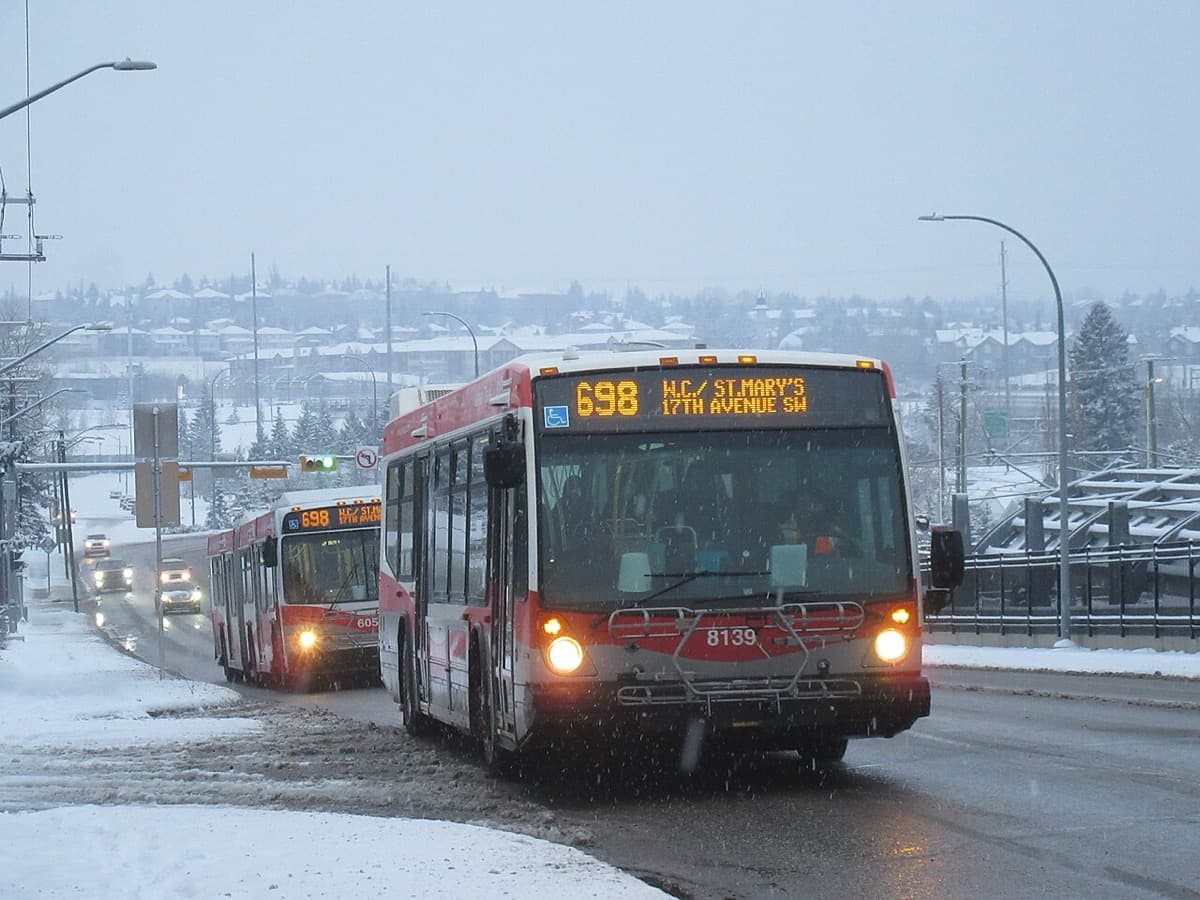
17th Avenue SW, the Red Mile
The counter-economy. In 2004 this strip spontaneously filled with up to 55,000 Flames fans and earned its name. The one part of downtown Calgary whose vitality never tracked the oil price.
Details
Best Time to Visit
Weekdays, late morning through early afternoon. The thesis of this walk depends on reading the towers as working office buildings, and Stephen Avenue at lunchtime is where the downtown vacancy rate becomes visible as footfall on the street. Weekends empty the office core almost entirely, which flattens the contrast between the glass towers above and the sandstone street below. Walk in daylight so the completion dates, the setbacks, and the crowns are all legible, and so the glass reads as glass rather than as a dark wall. The Beltline end of the route, Seventeenth Avenue, is liveliest in the late afternoon and evening if you want to end on the counter-economy at full tilt.
Pro Tips
- •The route runs north to south, from The Bow down to Seventeenth Avenue, and the towers get shorter as you go. Read the height as a timeline in reverse: the tallest and newest bets are at the start, the pre-oil sandstone city is in the middle, and the diversified street economy is at the end.
- •Stephen Avenue at Stop 5 is a pedestrian mall, open to vehicles only between 6 p.m. and 6 a.m. Walk it during the day and you have the street to yourself, which is exactly when the lunchtime footfall reading works.
- •The clearest single view of the lag is at Stop 3, Brookfield Place East. Stand back far enough to see both it and The Bow behind you. The two tallest towers in the city both broke ground on optimism and both opened into layoffs.
- •Downtown Calgary's Plus 15 skywalk network connects most of the towers on this route above street level. If the weather turns, you can read the same buildings from the enclosed walkways, though the completion dates and crowns are clearest from the sidewalk.
- •The oil price is the only economic number you need to carry. Everything else on the walk, the height, the floors, the completion date, the vacancy rate, is a reading off that one instrument.
Safety & Precautions
- •This is a downtown-core walk that crosses live traffic at several signalized intersections along Sixth and Eighth Avenue. Cross at signals and watch for turning vehicles, especially near the tower entrances at rush hour.
- •Stop 7 sits at the Canadian Pacific mainline, active railway tracks that mark the downtown edge. Cross only at the designated street crossings, never on the rail corridor itself.
- •The route is about four kilometres, mostly flat and paved, with a gentle downhill drift from the office core into the Beltline. It is easy walking, but wear comfortable shoes for the full length.
- •Calgary sits at over a thousand metres of elevation and the weather changes fast. Chinook winds can swing the temperature sharply within a single day. Carry a layer, and in winter check conditions before committing to the outdoor route rather than the Plus 15 skywalks.
Travel advisory: Exercise Normal Precautions (Level 1).
Gallery
Related Reading
Go deeper on what you'll see, hear, and walk through.
Overview
Best Self-Guided Walking Tours in Calgary (2026)
4 min
Overview
Calgary Travel Guide: How Many Days, Getting Around, When to Go (2026)
5 min
Thematic
Best Architecture Walking Tours in Calgary (2026)
2 min
Thematic
Calgary: The City the Oil Price Built and Rebuilt
5 min
Companion
The Balance Sheet Skyline: Reading Calgary's Towers as an Oil-Price Chart
3 min
Read the walk
The full story of Downtown and the Beltline: The Balance Sheet Skyline, in words. Prefer to listen? Play it narrated, from home or on location.
Introduction
At the foot of The Bow, on Centre Street, it pays to look up. Fifty-eight floors. Two of the largest oil companies in Canada raised this tower and put their names on the lease. Today the name over the door has changed, and both companies that built it have left. One moved four blocks west. The other moved its head office to Denver.
This is the newest lesson in a skyline that has taught the same one since 1984. In Calgary, a tower is a bet on the price of a barrel of oil, and the barrel does not wait for the concrete to cure. A tower takes four to five years to build. A barrel can lose two thirds of its price in eighteen months. So every major tower here was commissioned near an oil-price peak and delivered near the next trough. The skyline is a lagging indicator, drawn in glass and steel.
By the end of this walk, you will read these towers the way a geologist reads rock. Not as architecture, but as data. Height, completion date, the tenant's name, the reflectivity of the glass. Each is a dated point on a chart of the oil price.
Over eight stops and about four kilometres, roughly eighty-three minutes of walking, we start at the tallest bet and end on a street that never depended on the barrel. When you reach The Bow, begin with stop one.
1. The Bow
You are standing at the foot of The Bow, five hundred Centre Street. Look up along the curve. Two hundred and thirty-six metres, fifty-eight floors, a single crescent of glass braced by an external steel frame you can read from the sidewalk. It was completed in 2012 and opened in June 2013, designed by Foster and Partners with Zeidler Partnership. From 2010 to 2016 it was the tallest building in Calgary.
Now read the date against the barrel. The Bow was commissioned by EnCana at the height of the 2000s oil-sands boom, when crude was climbing toward its record. In July 2008, while this tower was on the drawing board, West Texas Intermediate hit an all-time peak of one hundred forty-seven dollars a barrel. By December of that year it had fallen to around thirty. The tower kept rising anyway, because a fifty-eight-floor bet cannot be called off halfway.
Here is the lag made concrete. EnCana ordered the tallest tower in Western Canada near the top of the cycle. The tower opened into the aftermath. And the story did not stop there. By 2019 EnCana had renamed itself Ovintiv and moved its head office to Denver. Cenovus, the co-anchor, had completed its move four blocks west to Brookfield Place. Both companies that raised this tower had left it.
Look at the glass again. It is the largest, newest, most expensive bet on the barrel this city ever placed, and the two firms that placed it walked away within seven years of opening. Hold that pattern. Commissioned at the peak, delivered into the fall, abandoned by the bettors. Every tower ahead of you is a version of it. Now head one block northwest, toward the older, darker tower with the flat top.
2. Suncor Energy Centre (formerly Petro-Canada Centre)
You are looking at the Suncor Energy Centre, the taller of the two dark towers, at one hundred fifty Sixth Avenue Southwest. Two hundred and fifteen metres, fifty-two floors, completed in 1984. For twenty-six years, until The Bow topped it in 2010, this was the tallest structure in Calgary.
Read the name it was born with. This opened as the Petro-Canada Centre, headquarters of Petro-Canada, a federal Crown corporation. Locals had a name for it: Red Square. The building was the physical face of the National Energy Program, enacted by the Trudeau government in October 1980 and resented across Alberta as an eastern hand on a western resource.
Now read the date against the barrel again. This tower was commissioned in the boom of the late 1970s and topped out in 1983, straight into the wreckage. Under the National Energy Program and a global price collapse, Alberta unemployment rose from around four percent to over ten. Bankruptcies climbed roughly one hundred fifty percent. Home values in Calgary and Edmonton fell about forty percent. The province was gutted while the tallest tower in the city was being finished. The program ended in June 1985. The tower stayed.
This is the origin scar. The pattern you saw at The Bow was not invented in the 2000s. It was set here, in the first great boom-to-bust the modern skyline recorded. A boom-era commission delivered straight into the bust that caught it.
One more reading. In 2009 Suncor acquired Petro-Canada, and the name over the door changed to the one you see now. The Crown corporation is gone. The tower it built still keeps the score. Now turn and look southwest, toward the tallest tower on the skyline, the one with the stepped glass crown.
3. Brookfield Place East
You are standing below Brookfield Place East, two hundred twenty-five Sixth Avenue Southwest. Two hundred and forty-seven metres, fifty-six floors. This is the tallest building in Calgary, and the tallest in all of Western Canada. Look straight up the glass to the crown.
Now read the two dates that matter, because together they are the cleanest example of the lag on this whole walk. Ground broke on October 29, 2013. At that moment crude was still near one hundred dollars a barrel and the oil-sands were running hot. Months later, in 2014, the price began its collapse. And the tower reached its full height on May 11, 2016, in the exact quarter downtown office vacancy was tearing past twenty percent, up from around ten percent at the end of 2014.
Hold those two points against each other. The building was commissioned at the top of the cycle and topped out at the bottom of the next. Its anchor tenant, Cenovus, moved in as an oil company in the middle of layoffs. The tallest structure in Western Canada opened into the worst office market in the country.
This is the thesis in one specimen. A tower takes four to five years to build. The barrel halved in eighteen months. The two clocks cannot be synchronized, and this building is what the mismatch looks like at two hundred forty-seven metres. The confidence that ordered it in 2013 was real. It simply arrived, in glass and steel, three years too late to be true.
Look at the height one more time, then remember The Bow behind you. Both of the tallest towers in the city broke ground on optimism and opened into layoffs. Now head southwest, toward the two matching towers with the pale peaked crowns.
4. Bankers Hall
You are looking at Bankers Hall, two matching towers standing side by side. Each is one hundred ninety-seven metres, fifty-two floors. They are Canada's tallest twin buildings, designed by Cohos Evamy and owned today by Brookfield Properties. Look up at the crowns. Those pale…
Full narration for this stop unlocks with the tour.
5. Stephen Avenue (8th Avenue canyon)
You are standing on Stephen Avenue, the pedestrian stretch of Eighth Avenue Southwest. Look down the street, not up. The buildings on either side of you are two and three storeys of sandstone, roughly three dozen of them, built between 1880 and 1930. This is the city that…
Full narration for this stop unlocks with the tour.
6. Eighth Avenue Place
You are standing below Eighth Avenue Place, five hundred twenty-five Eighth Avenue Southwest. Look up at the two towers. The taller east tower is two hundred twelve metres, forty-nine floors. The west tower is one hundred seventy-seven metres, forty floors. The glass is angled…
Full narration for this stop unlocks with the tour.
7. Crossing into the Beltline (CPR tracks)
You are standing at the Canadian Pacific mainline, the rail tracks that run east to west across the south edge of downtown. Look at the line itself. This is a hard seam in the city. North of it is the office core you just walked, the towers and the barrel they record. South of…
Full narration for this stop unlocks with the tour.
8. 17th Avenue SW, the Red Mile
You are standing on Seventeenth Avenue Southwest, the southern edge of the Beltline. Look down the strip. Bars, restaurants, shops, patios, low buildings full at street level. This is the counter-economy, the one part of downtown Calgary whose vitality never tracked the oil…
Full narration for this stop unlocks with the tour.