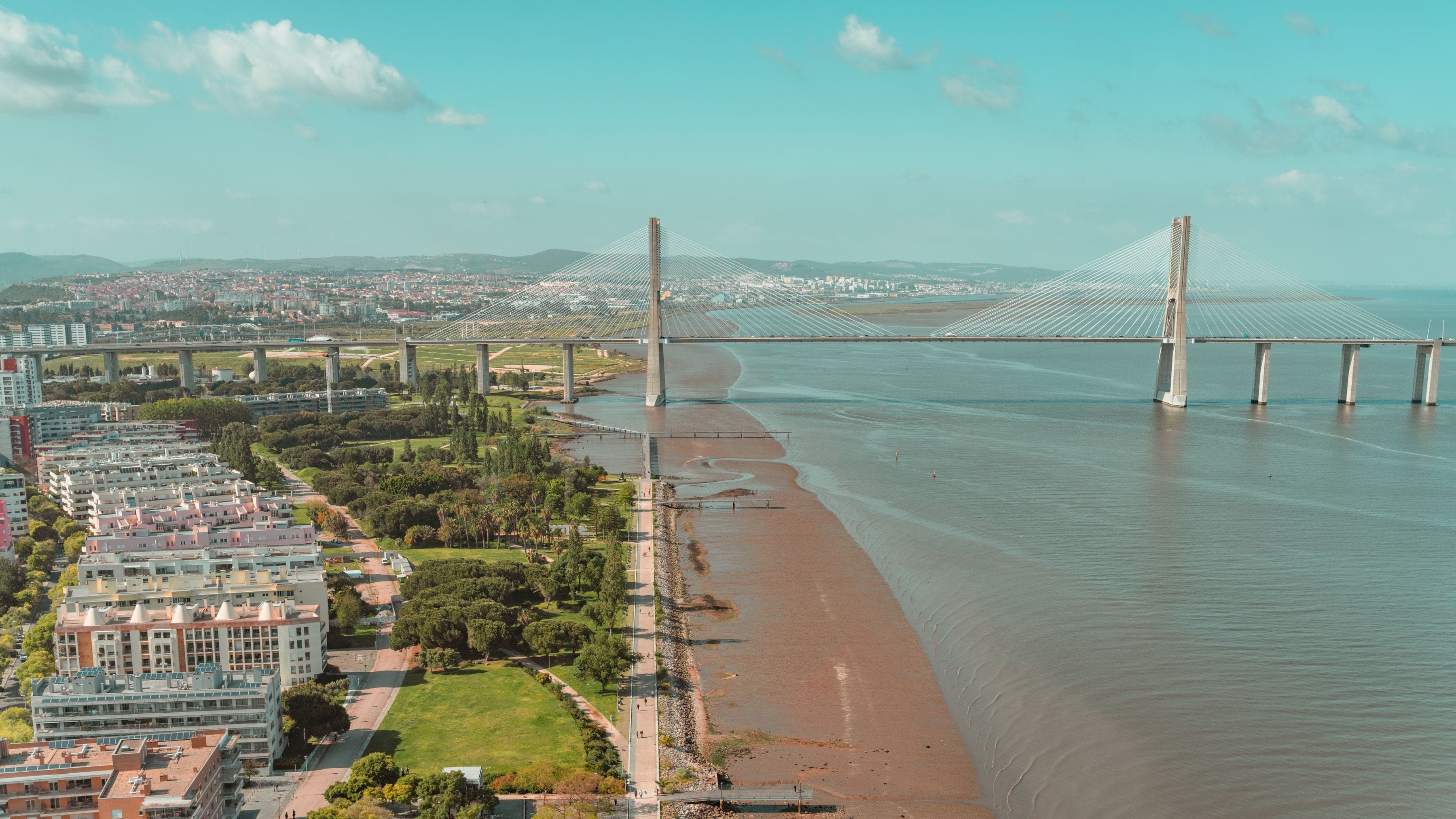
From Calatrava's Oriente station down the fair's long avenue, around the Oceanário's dock, under Siza's hanging concrete, past the arena and the Garcia de Orta gardens to the Vasco da Gama Tower and the bridge.
Start · Gare do Oriente: Calatrava's Canopy
DirectionsStops
- 1
Gare do Oriente: Calatrava's Canopy
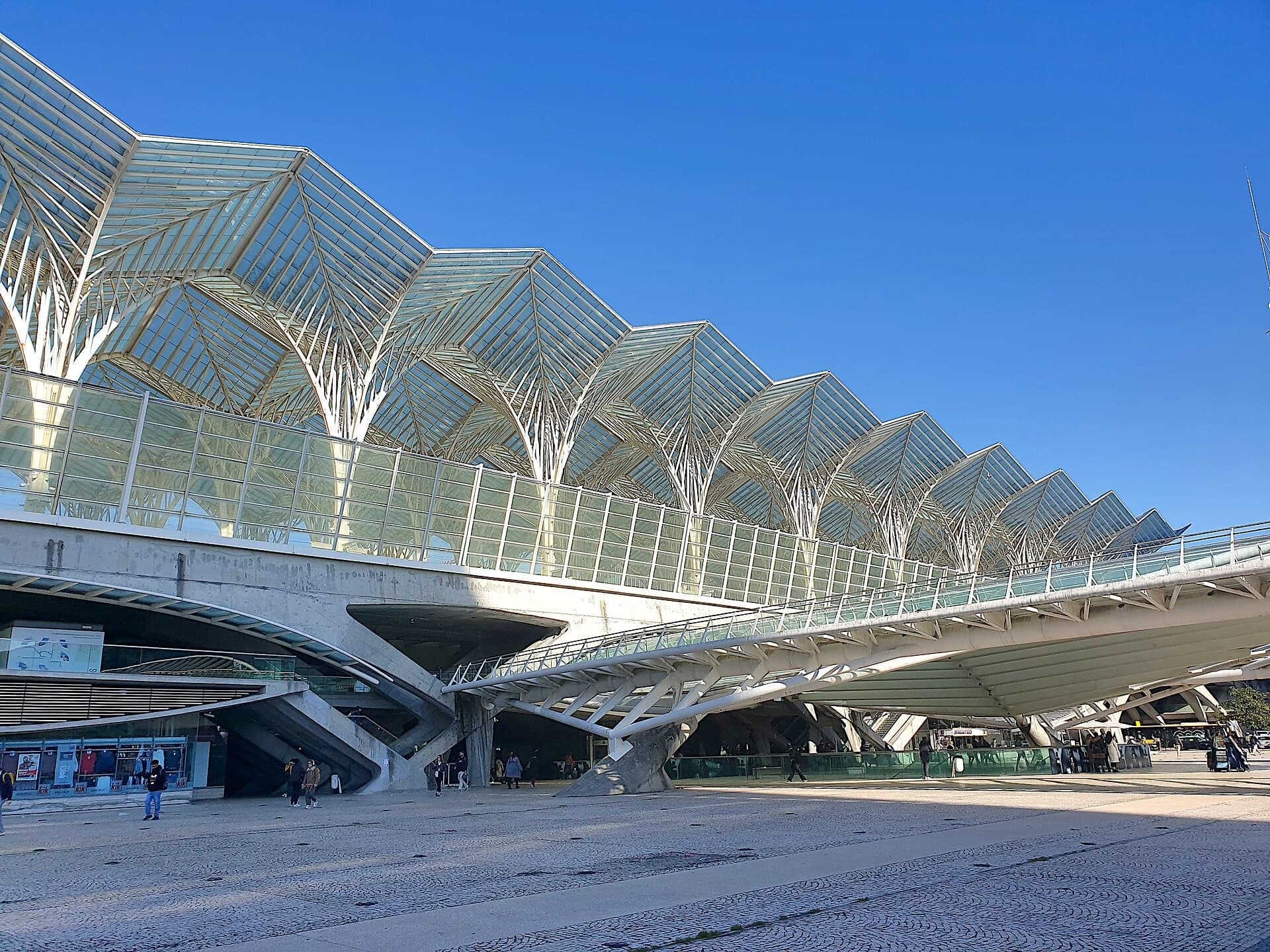
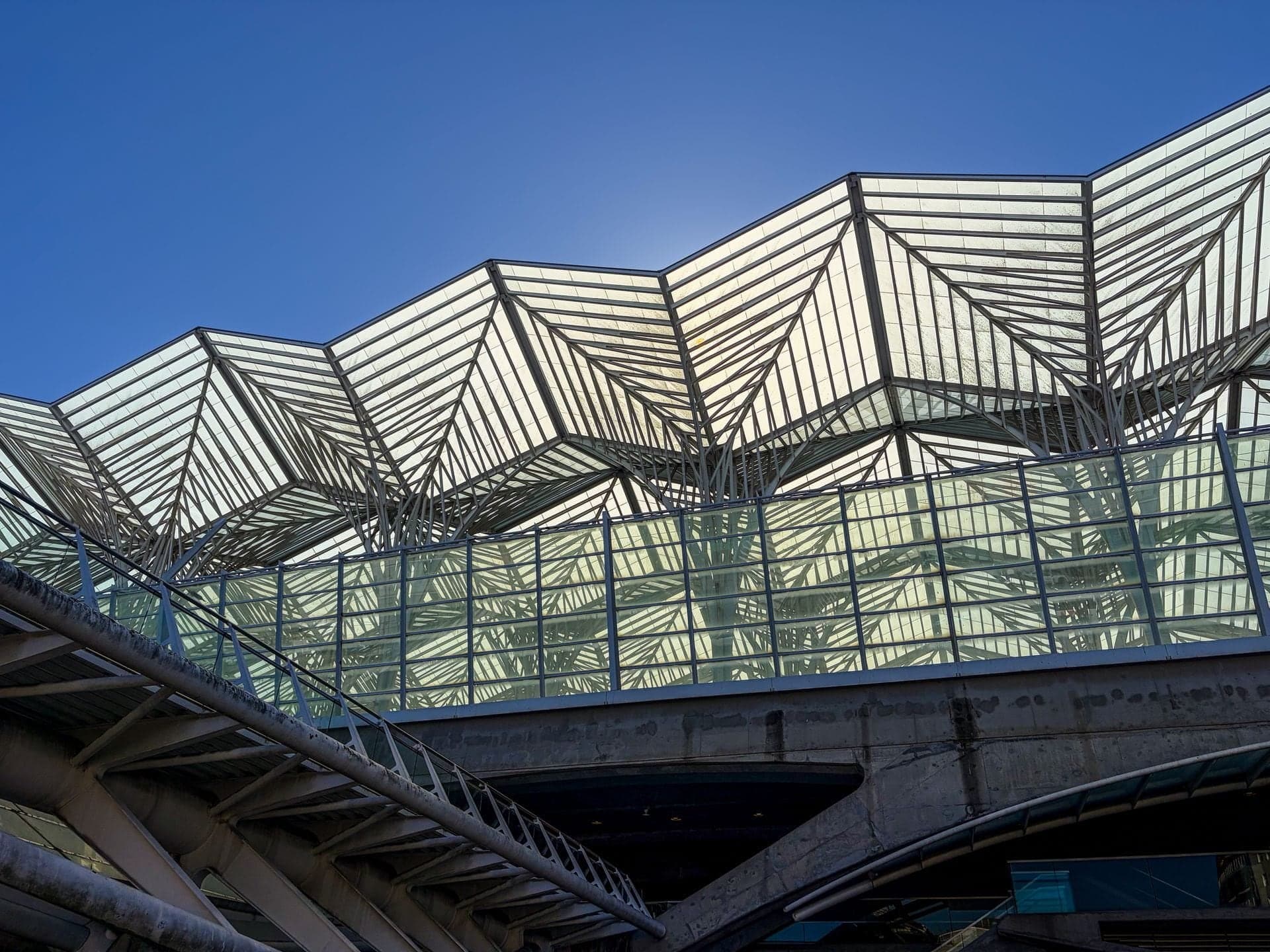
Calatrava's steel trees roof a station, built over arches cut through the railway embankment that once shut this district off from the river.
- 2
Alameda dos Oceanos: the Sun Man
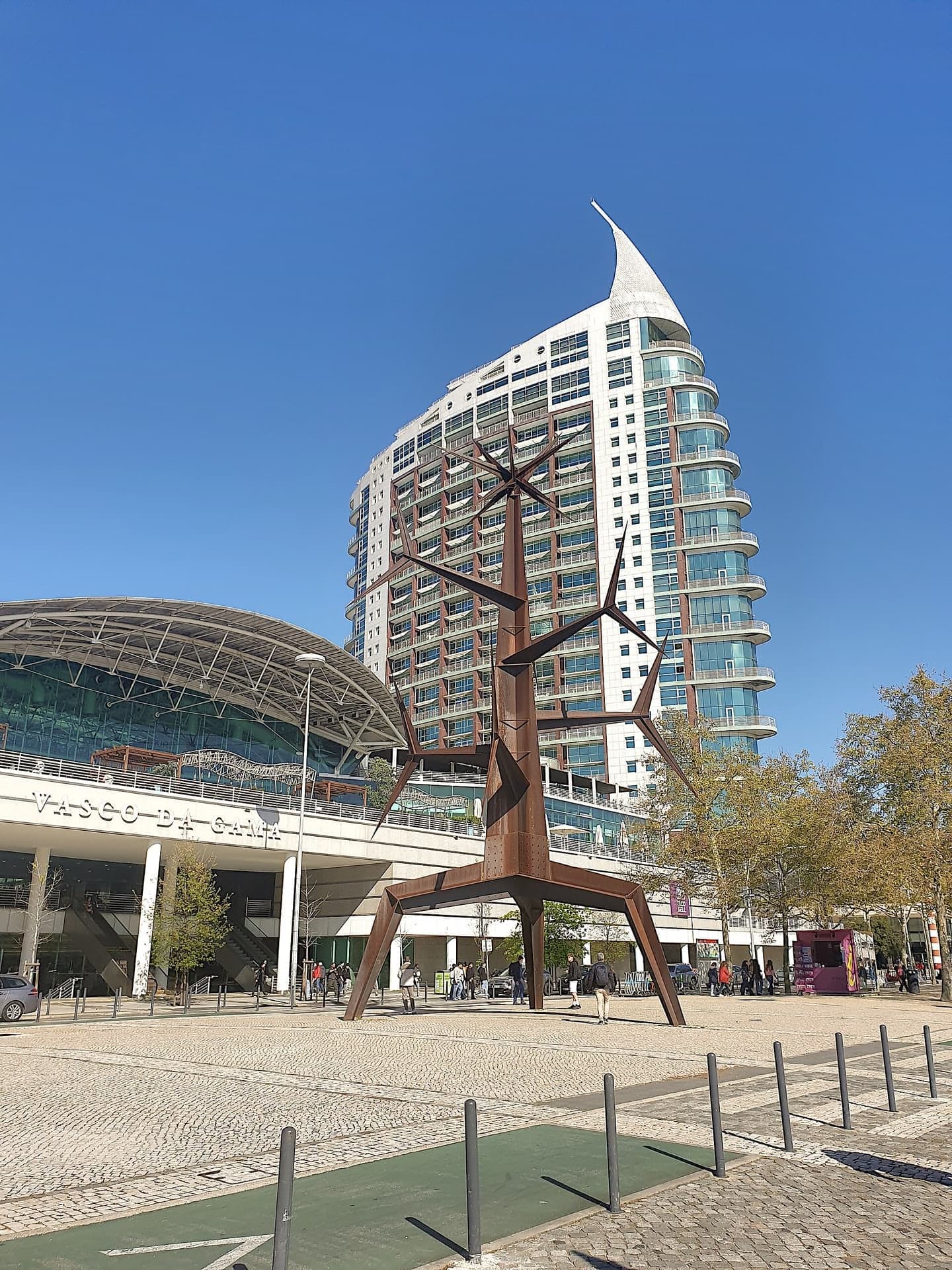
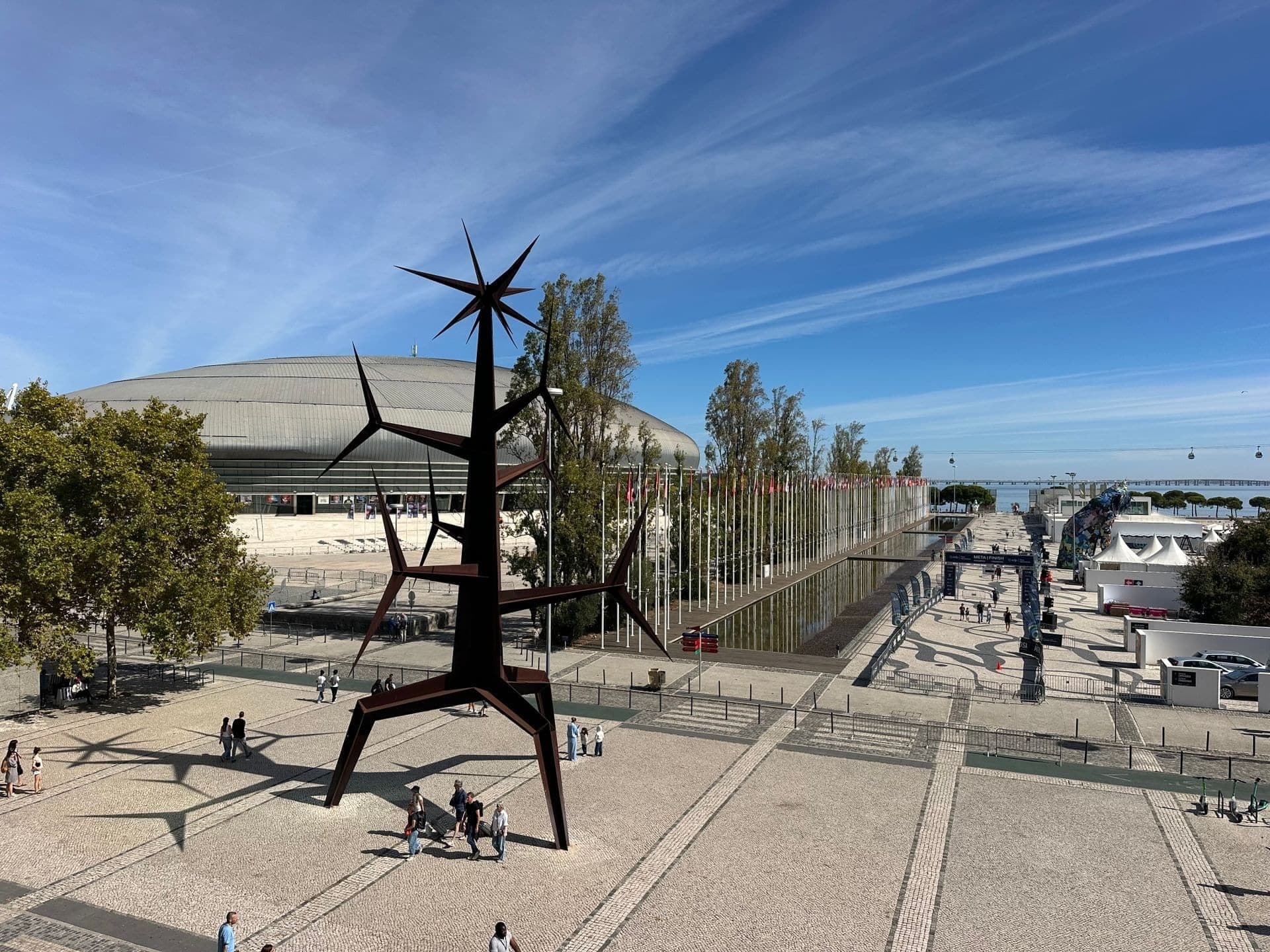
A steel giant is mostly air. Jorge Vieira's Sun Man stands about twenty meters tall on the fair's long avenue.
- 3
Water Volcanoes on the Alameda
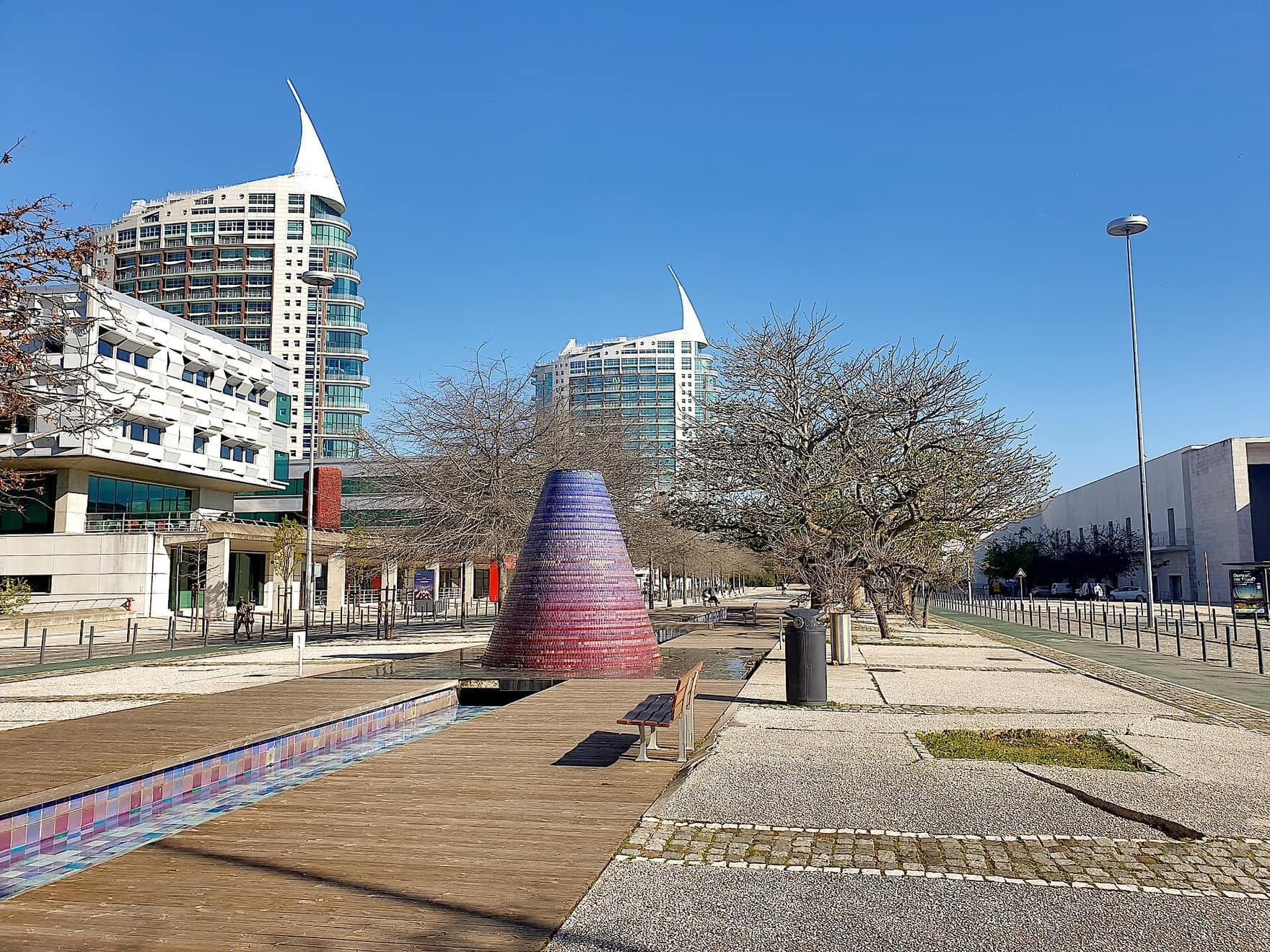
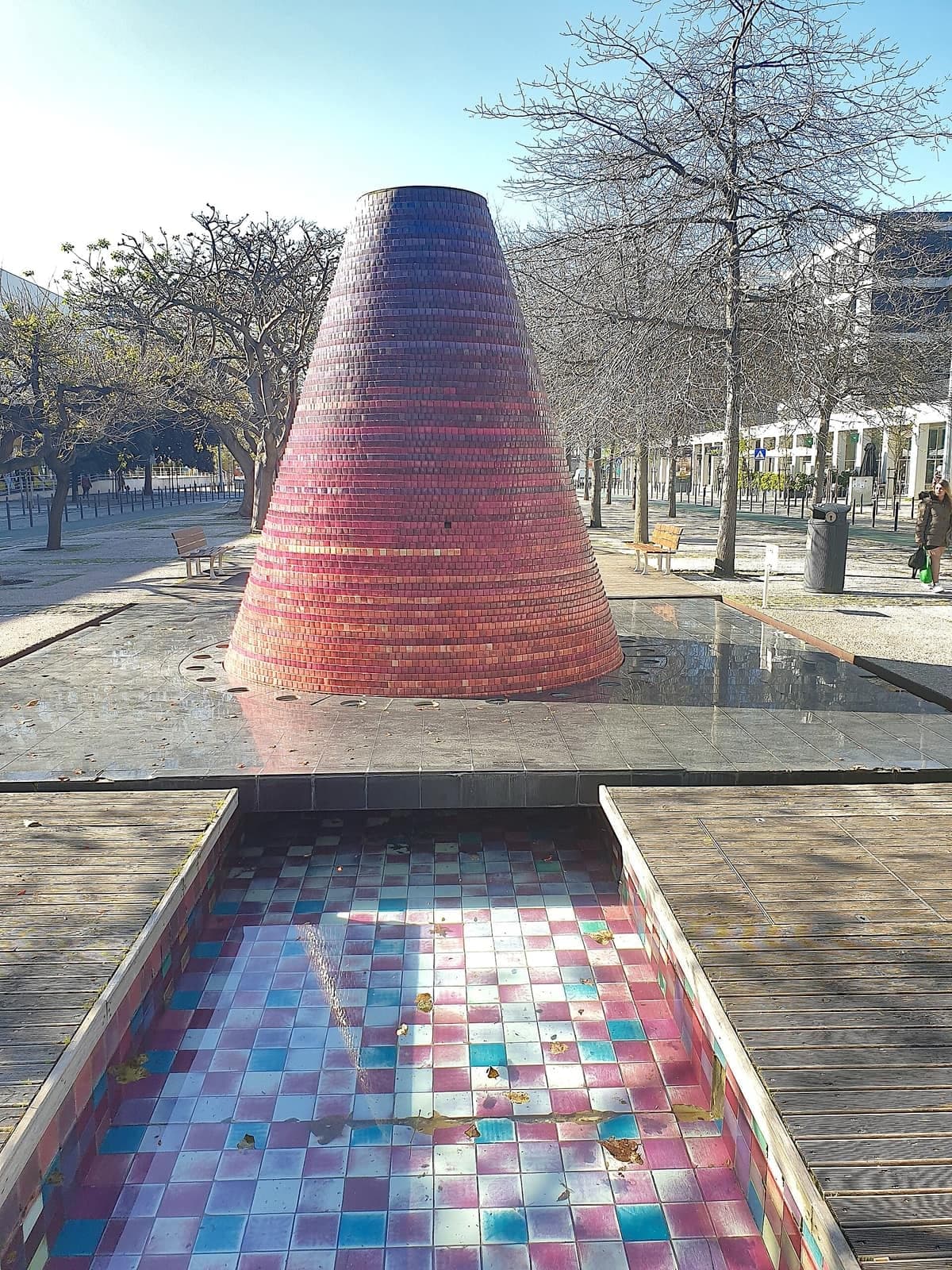
Six tiled cones were built to erupt, along this avenue, on a timer the water may no longer keep.
- 4
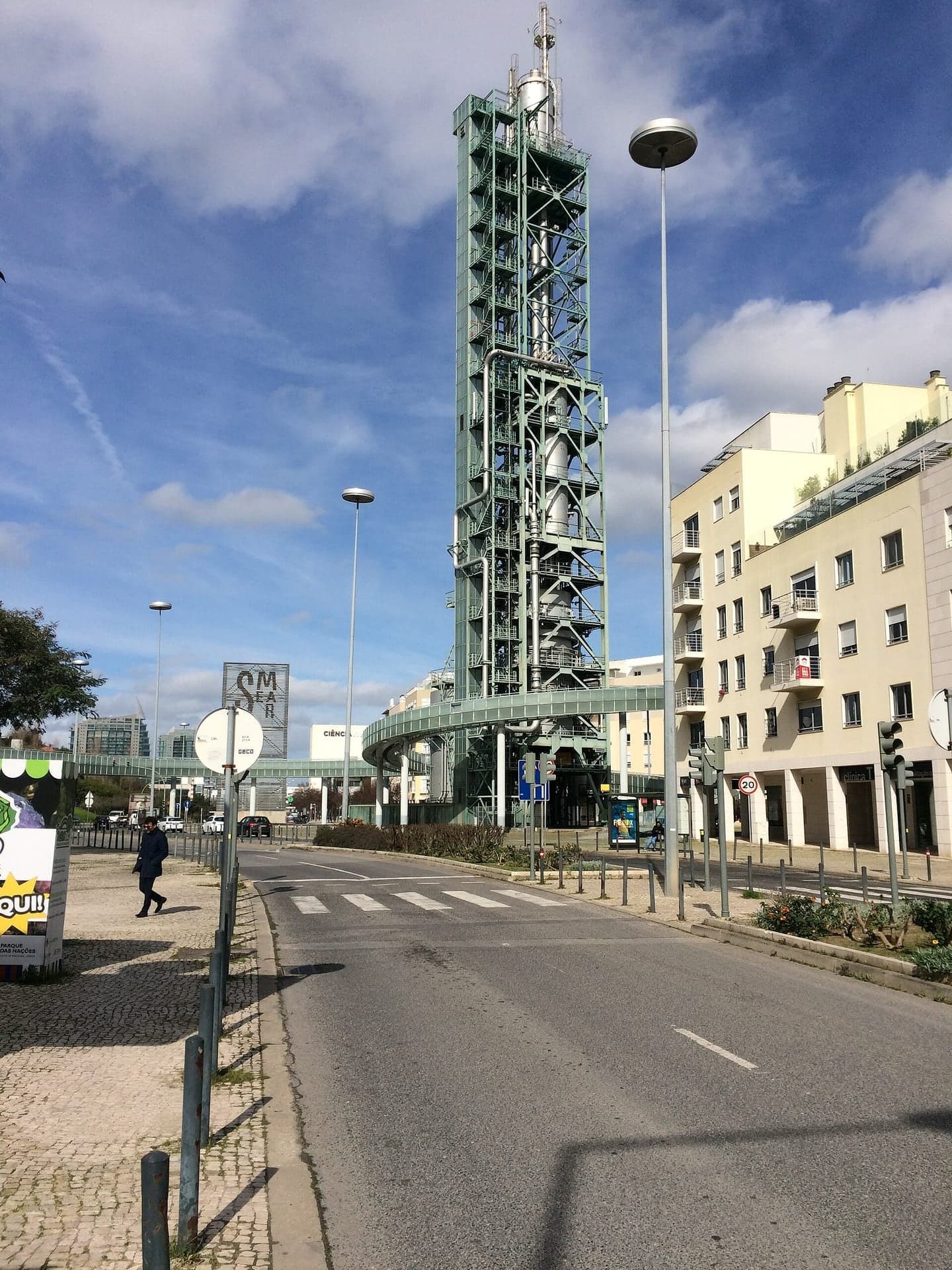
Passeio de Ulisses: The Tower They Kept
One refinery tower was kept. When the land was cleared, the steel, concrete and cobbles of what stood here went into the district around it.
- 5
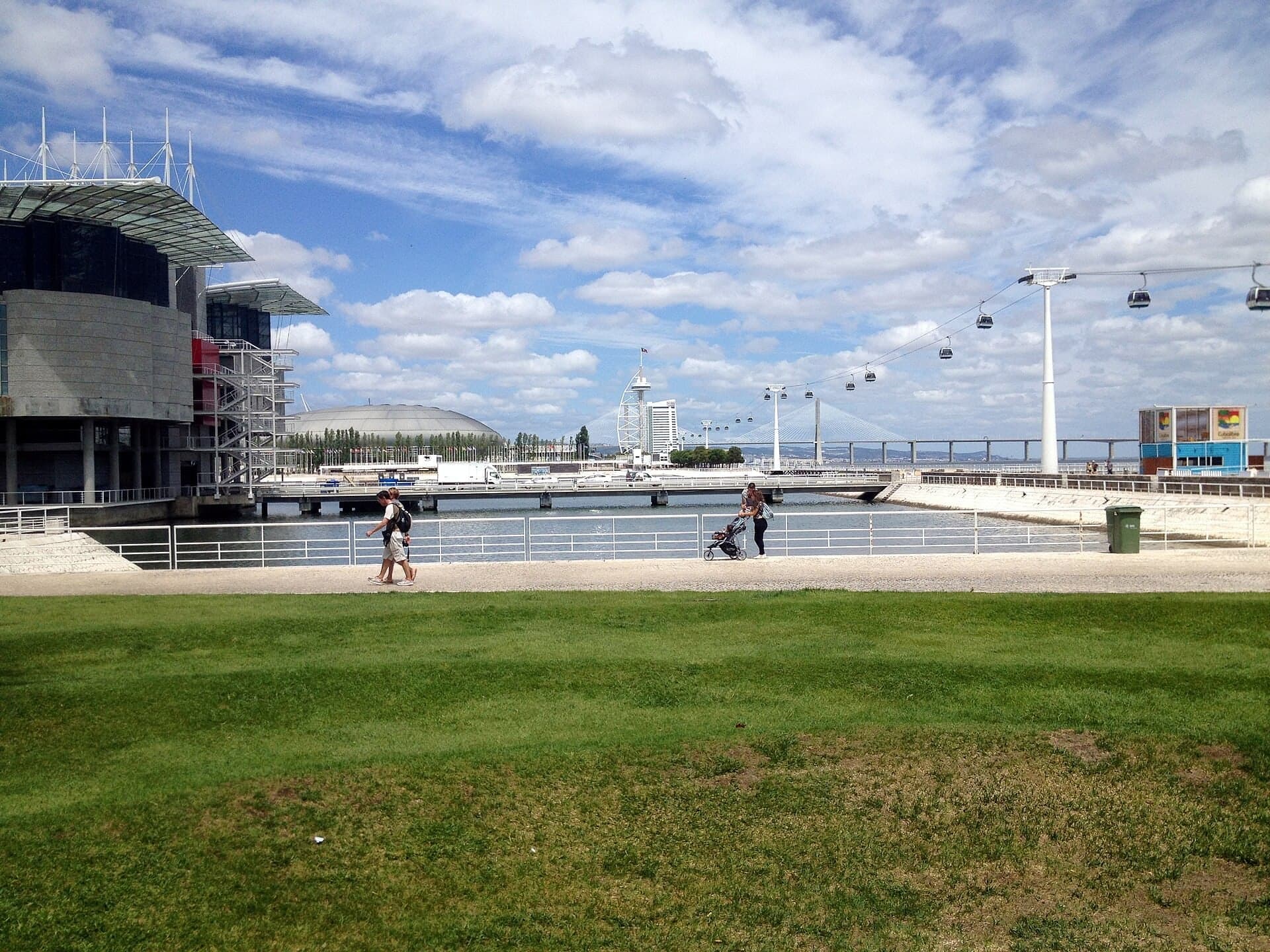
Jardim das Ondas
The ground is cut into waves, in this garden, a small piece of land shaped to the ocean's rhythm beside the Tagus.
- 6
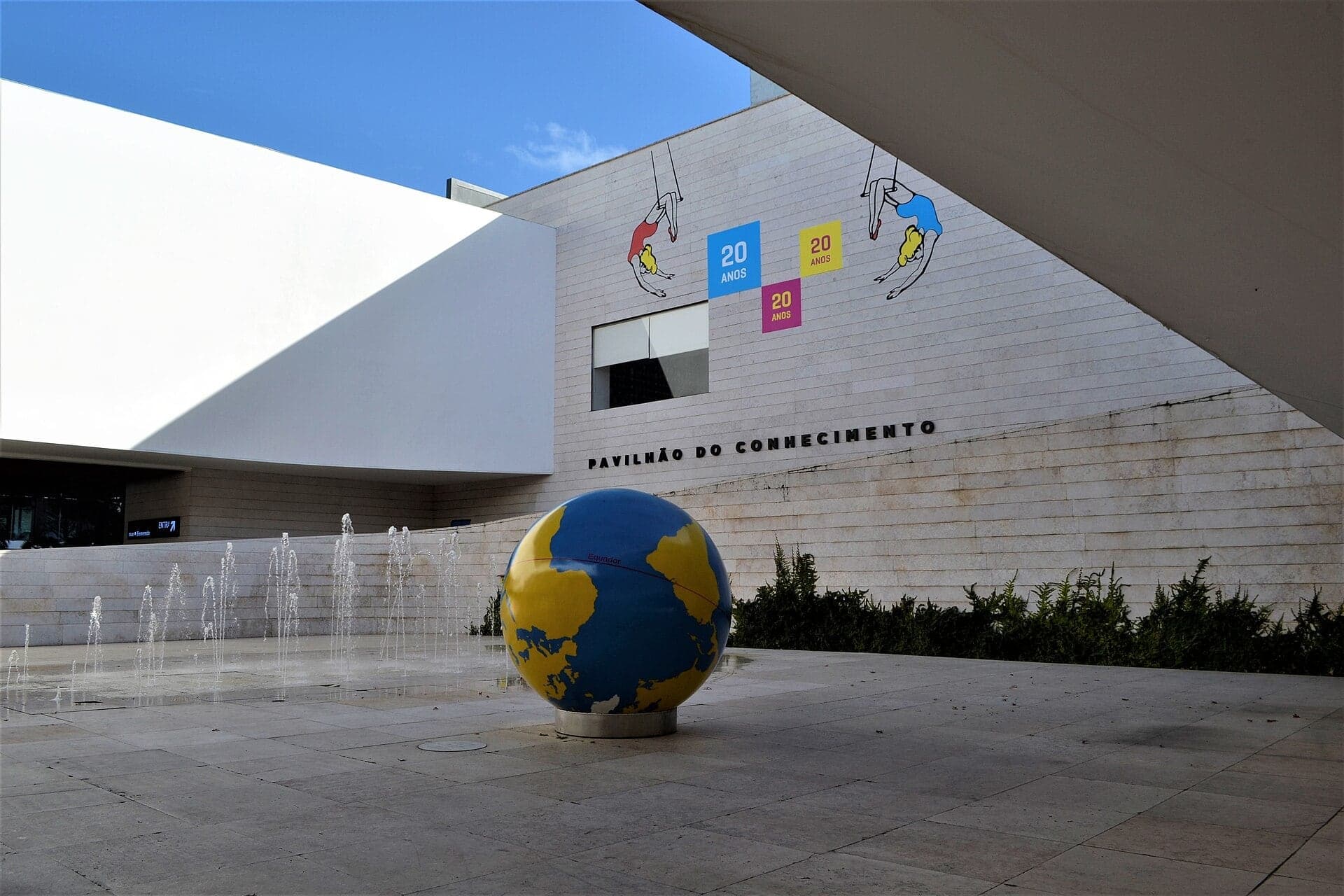
Pavilhão do Conhecimento
It was meant as a pause, a plain white pavilion, a quiet building at a loud fair that became the science center planned for it.
- 7
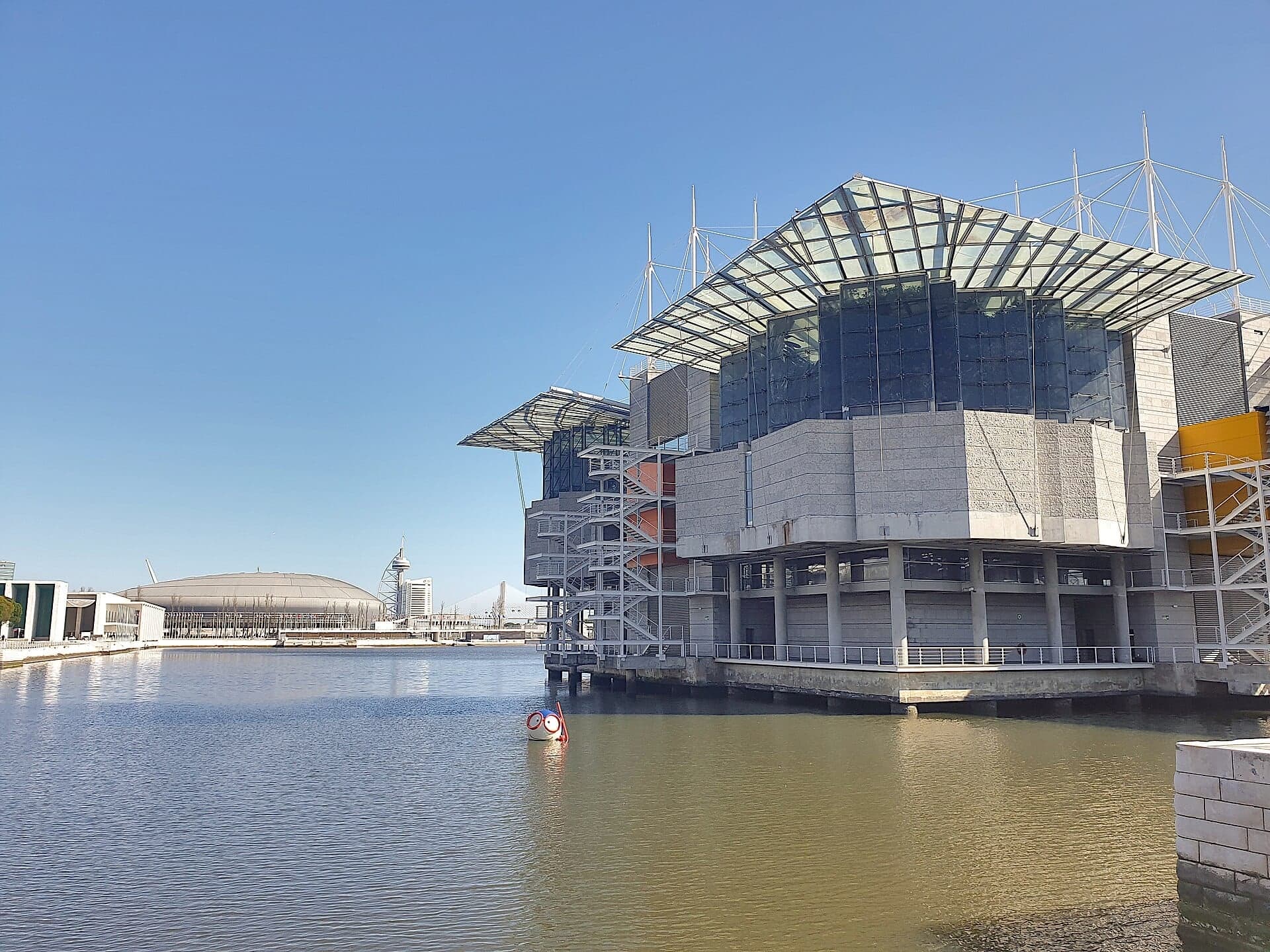
Oceanário Across the Doca dos Olivais
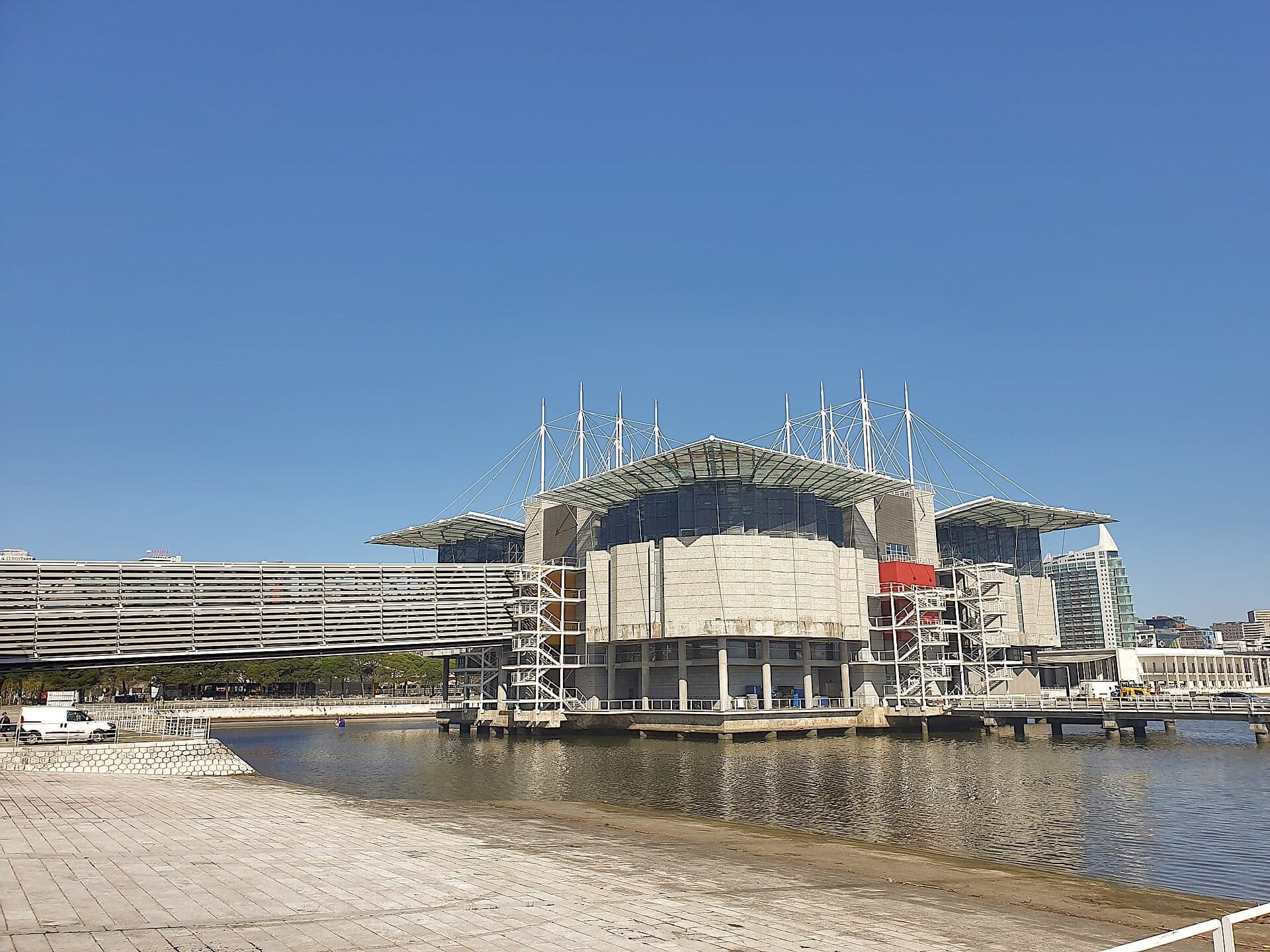
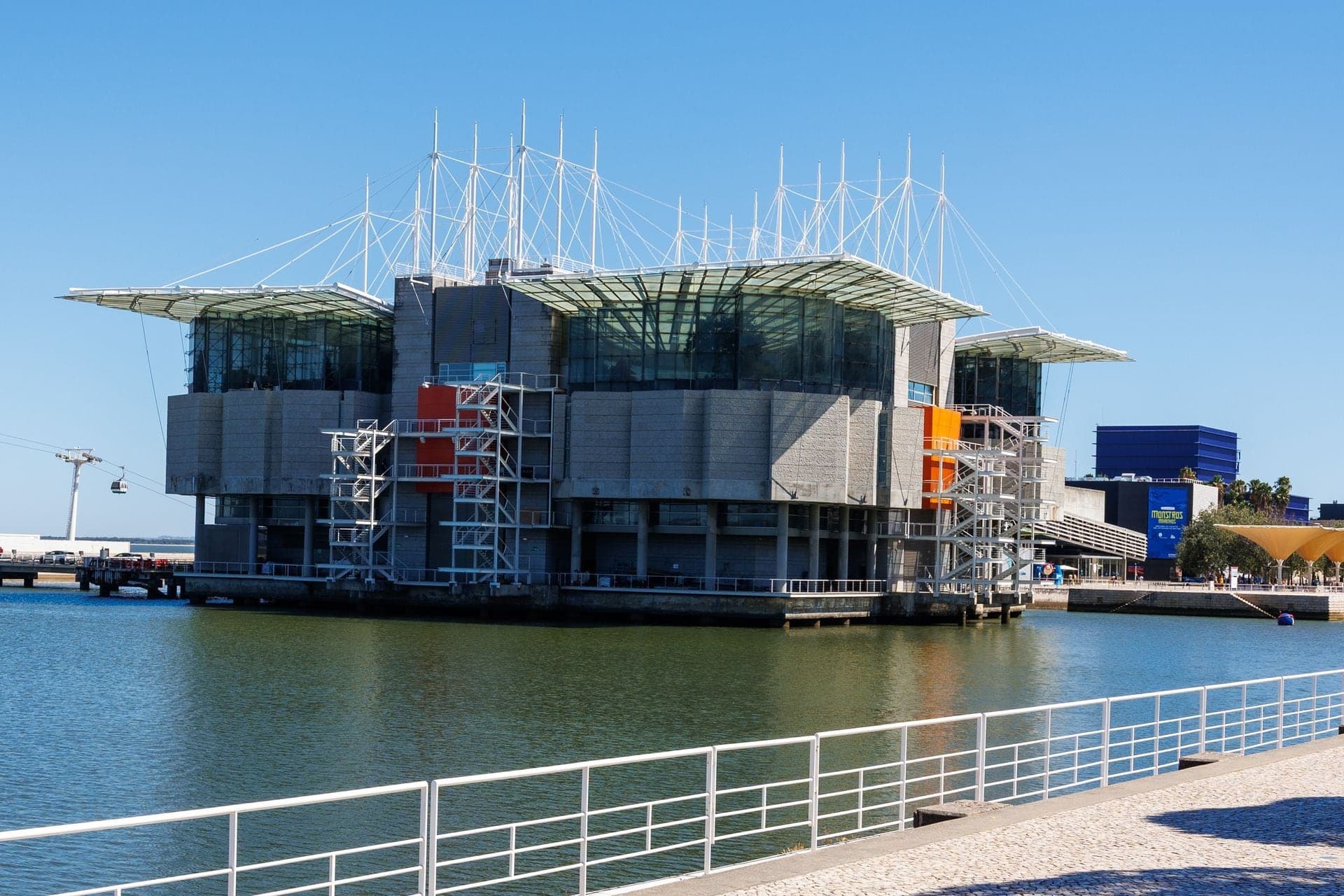
It stands in a former flying boat dock, seen free across the water, with one great tank inside its closed body.
- 8
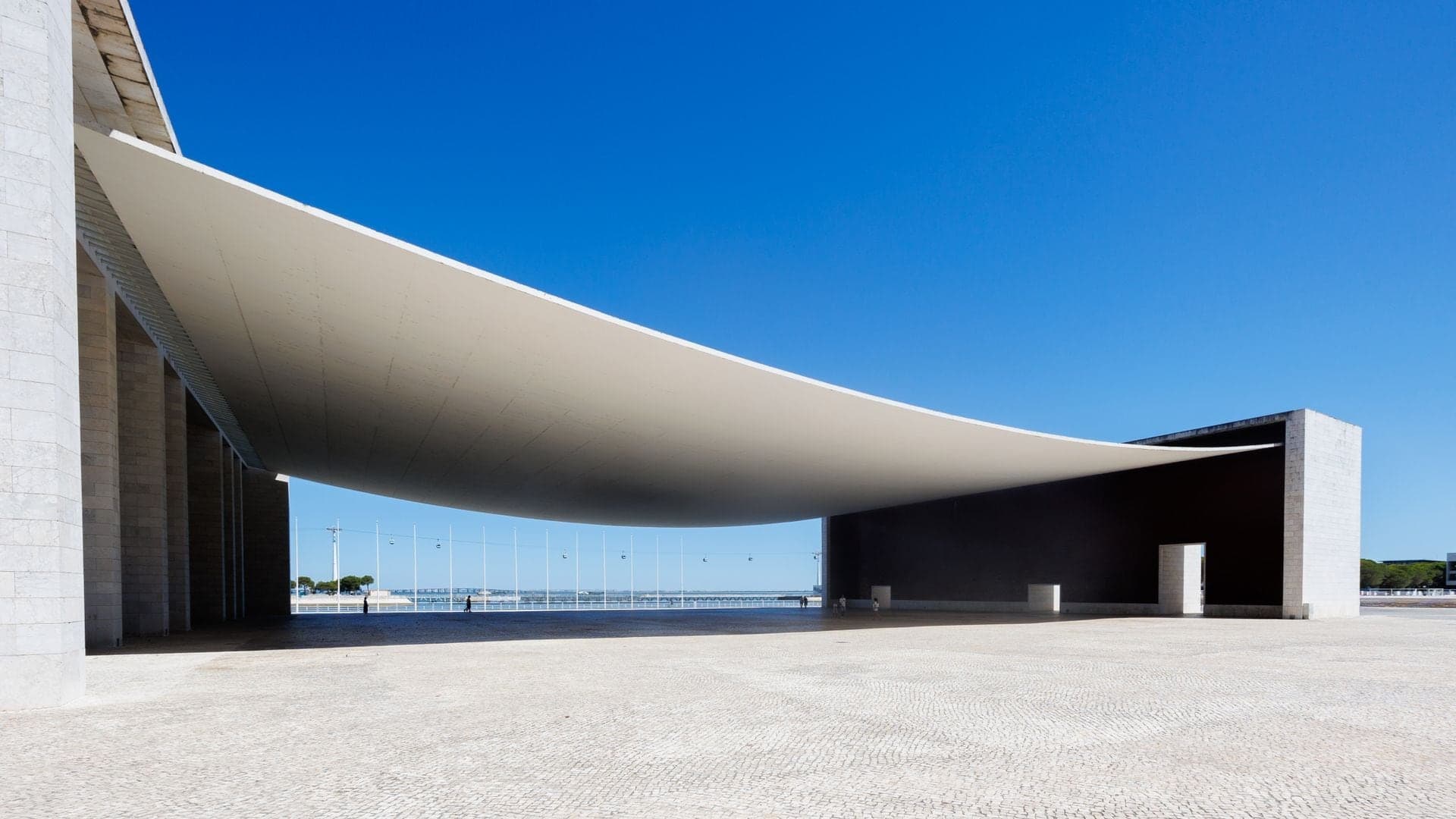
Pavilhão de Portugal: Siza's Concrete Veil
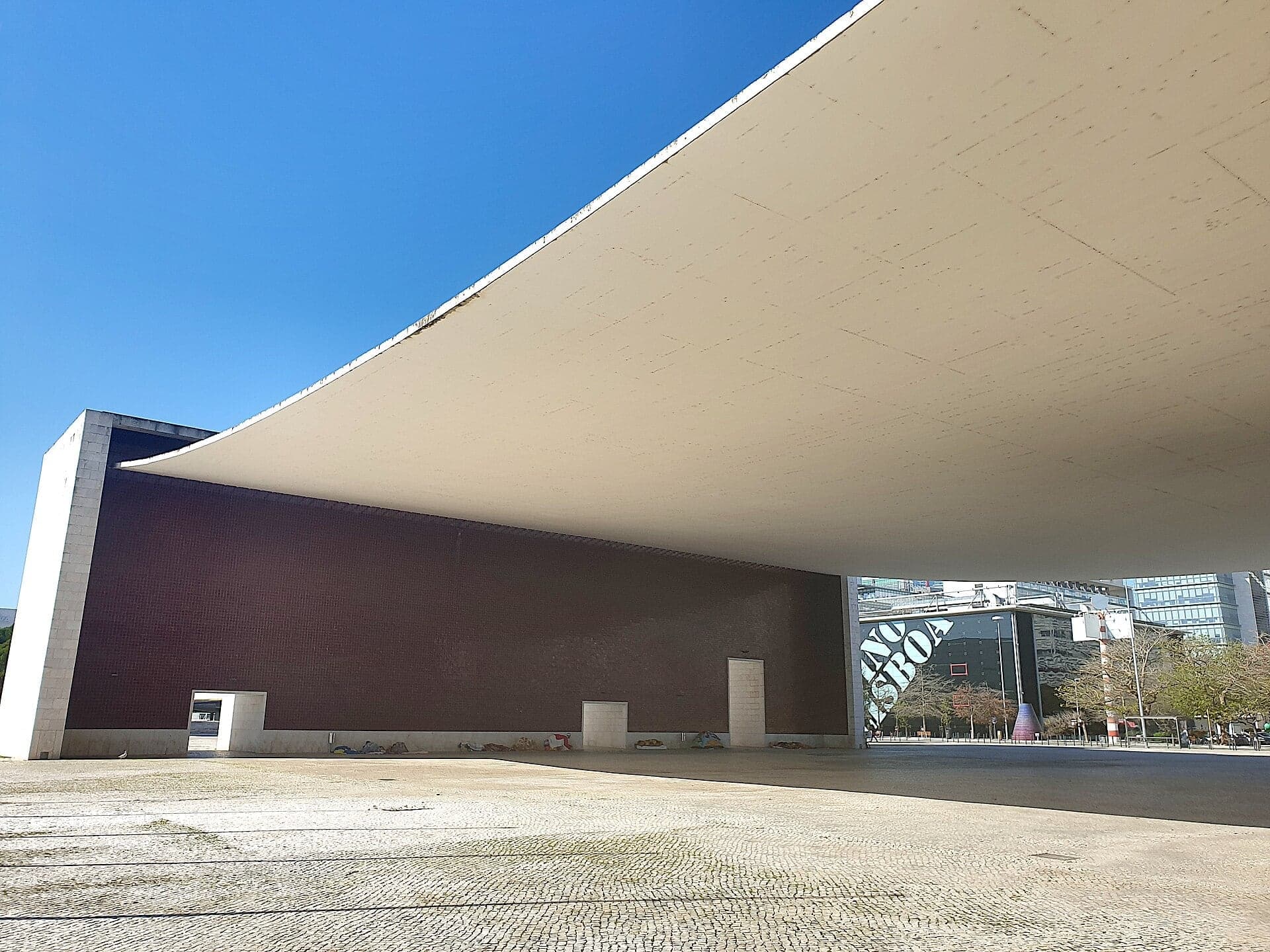
A concrete sheet hangs over a plaza, between two porticoes by Siza, like paper on two bricks, beside a building that waited more than twenty years for its new life.
- 9
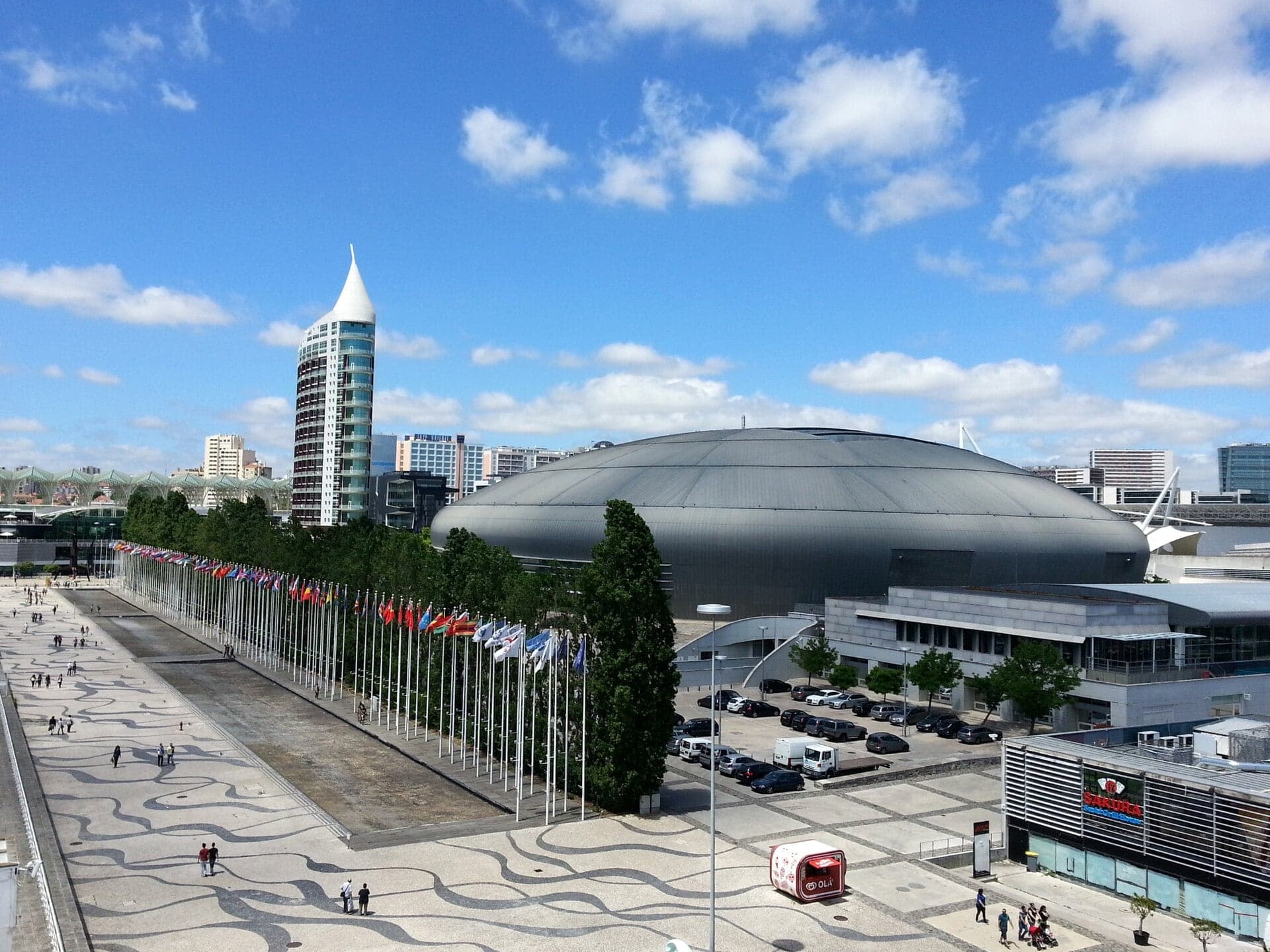
Rossio dos Olivais: MEO Arena, Built as Utopia
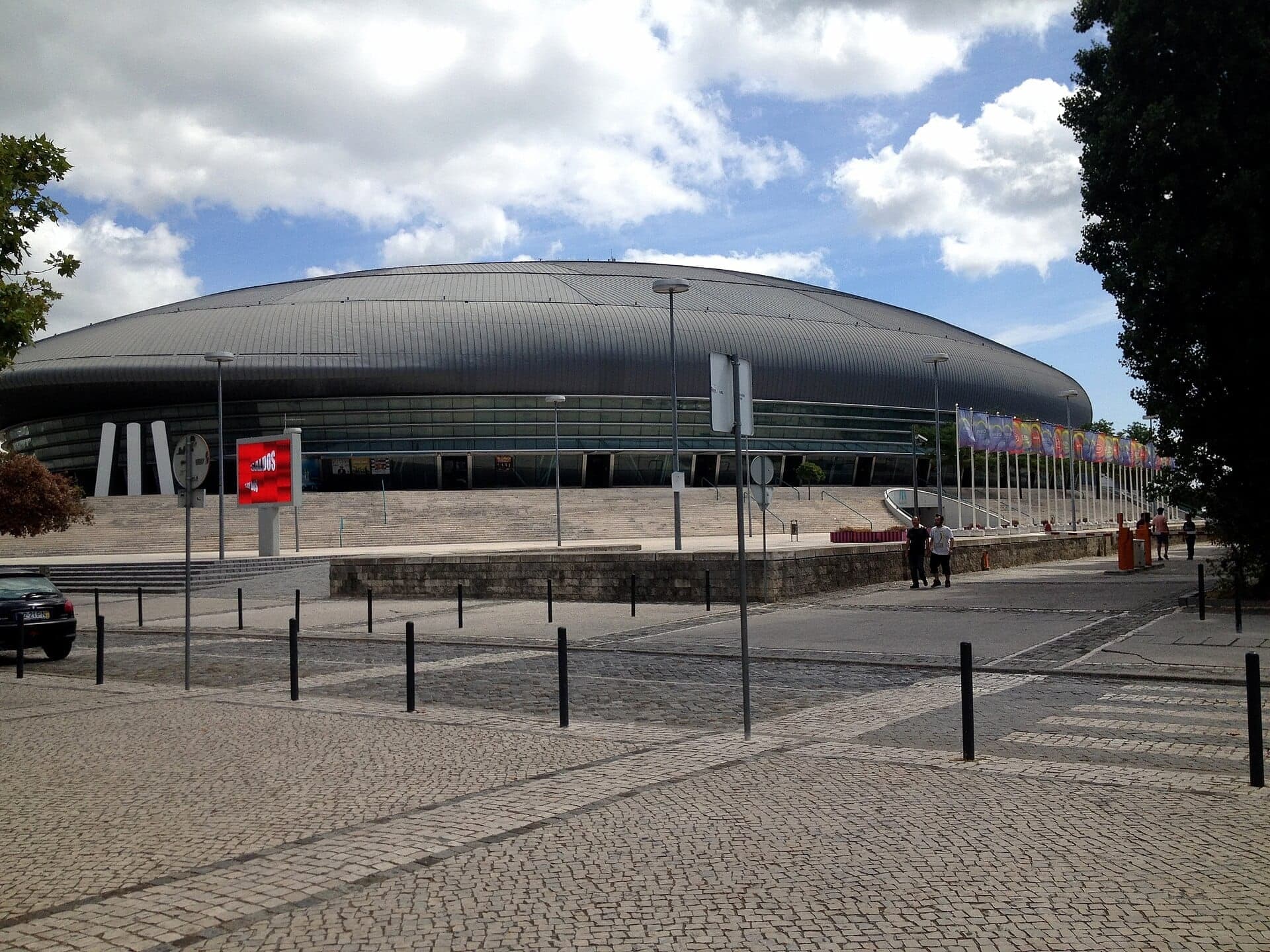
Timber ribs hide inside this arena, under its outer shell, the building whose architect refused to fake them in steel, seen across the basin.
- 10
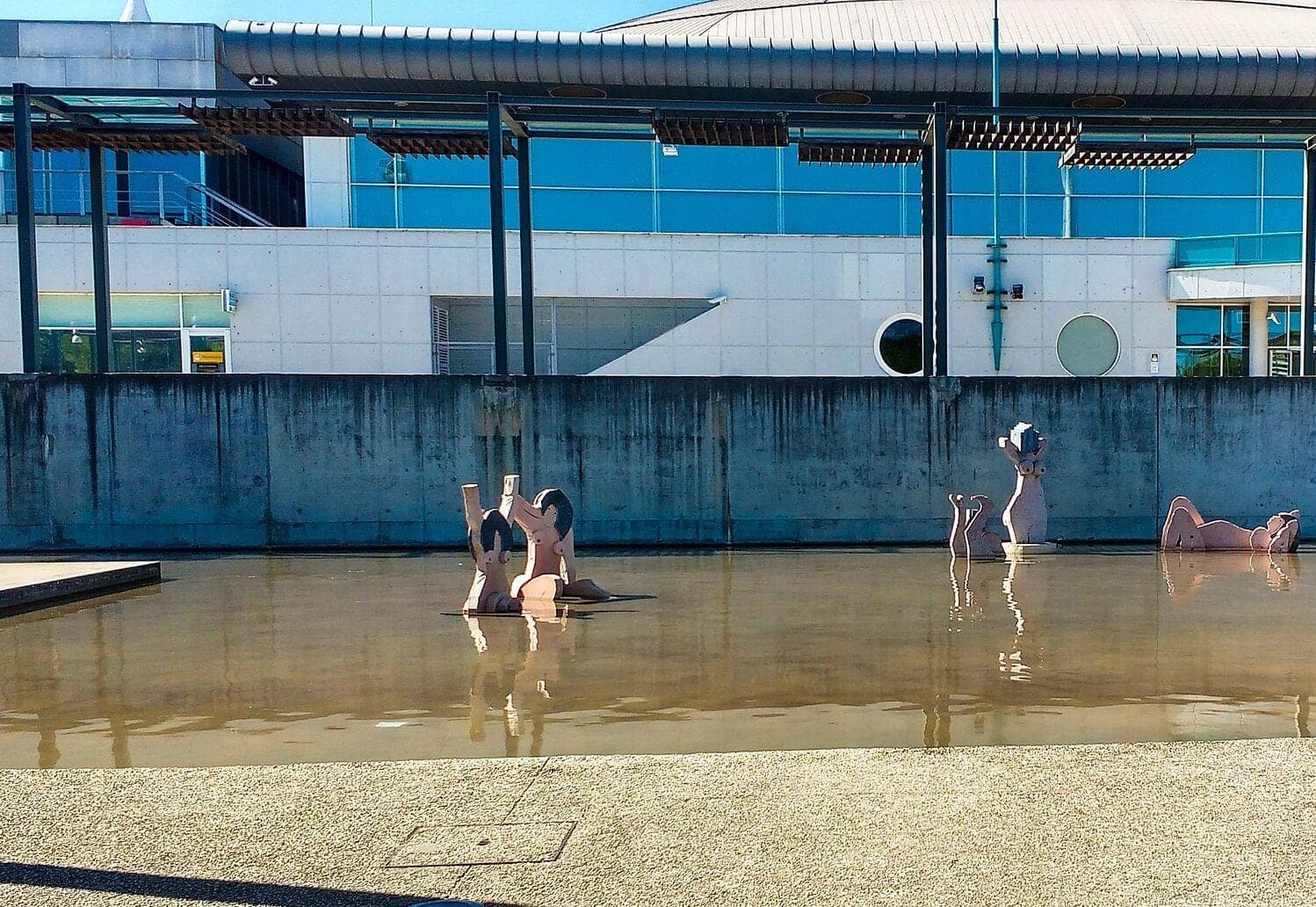
Lago das Tágides
Marble nymphs play around a Tagus boat, in a lake by the arena, named for the Tágides of Camões's epic.
- 11
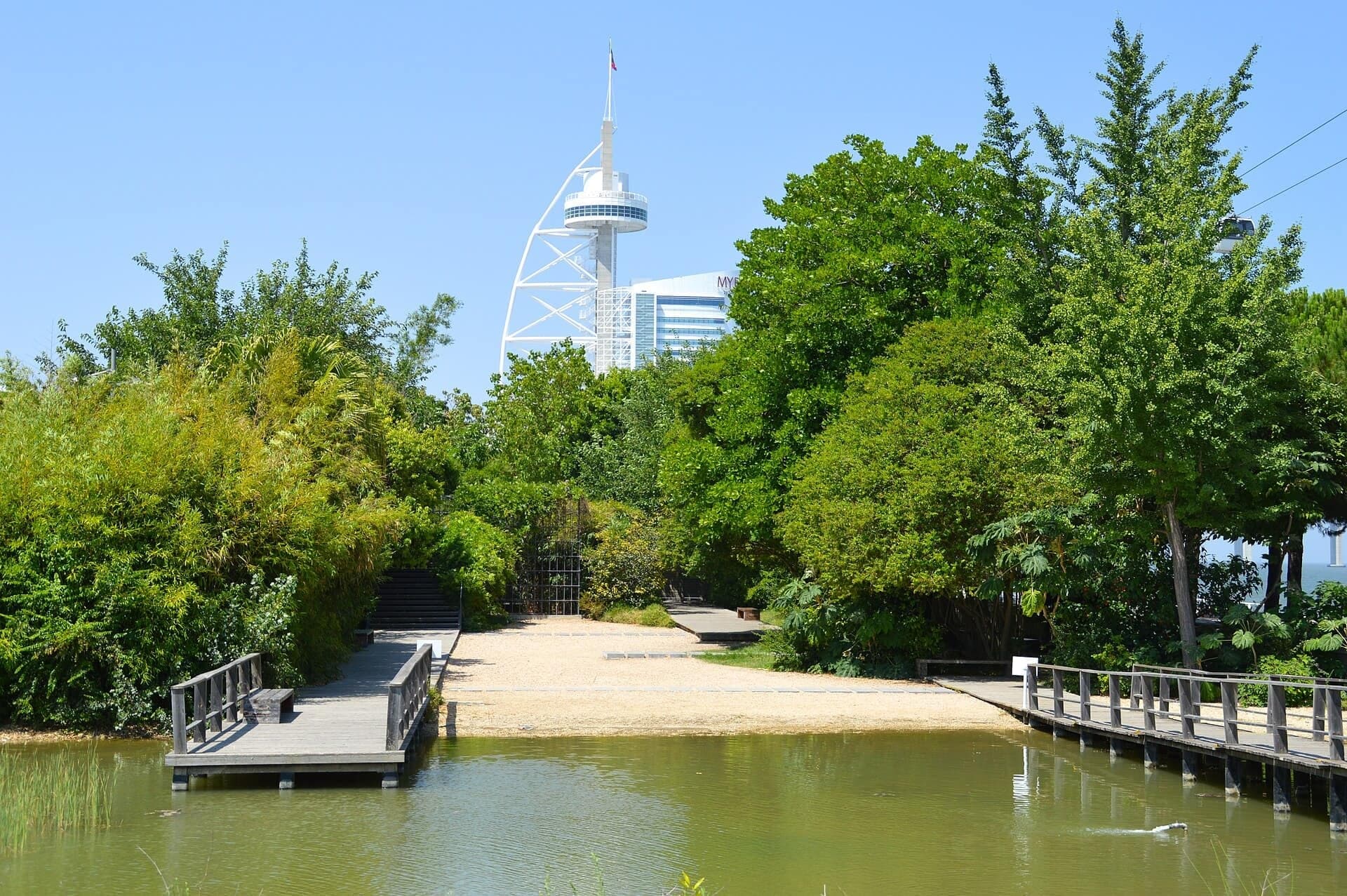
Jardins Garcia de Orta
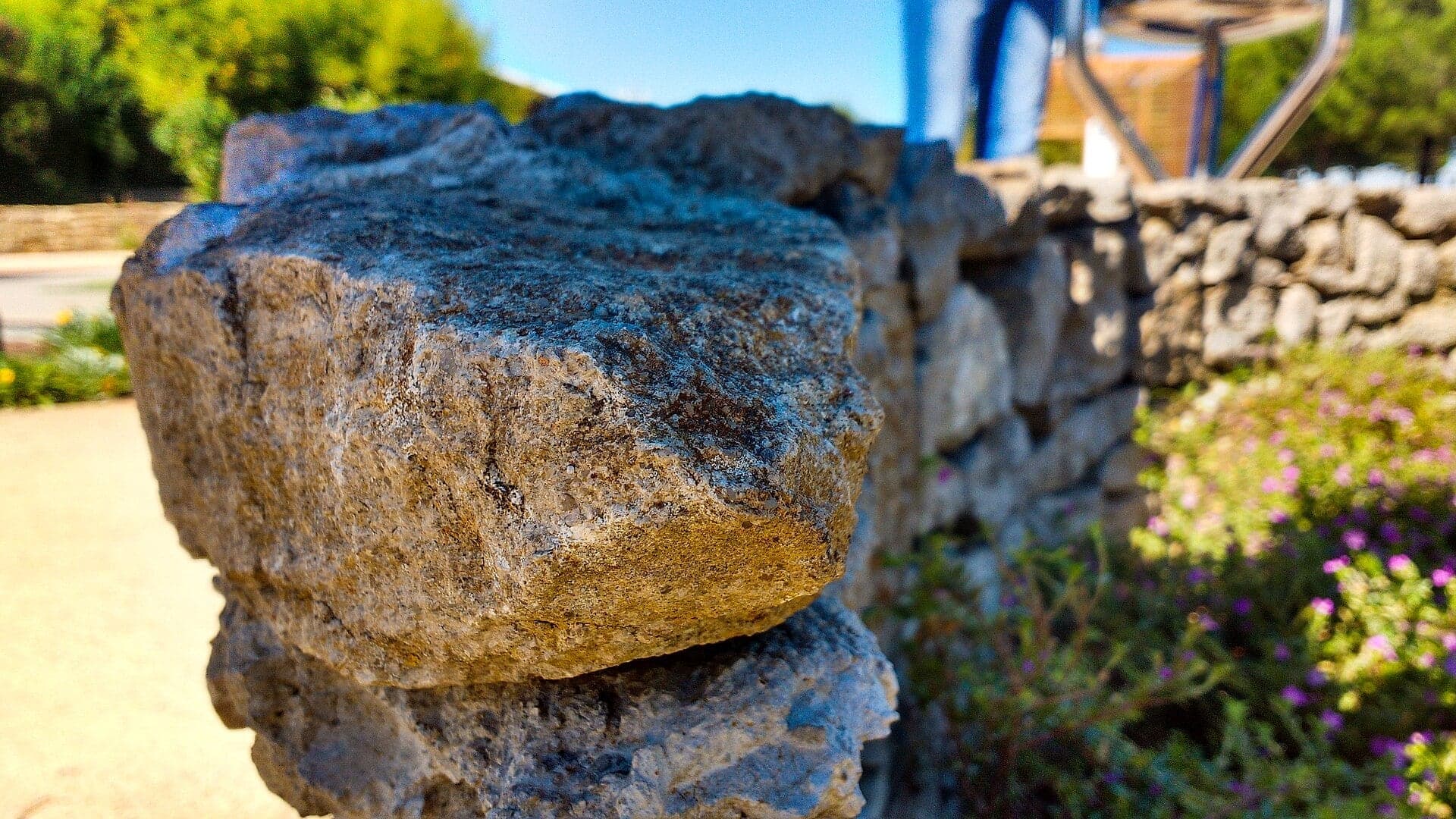
Riverside plots are planted by distant region, named for a physician of the plants of India, with most plants given by Portuguese-speaking countries.
- 12
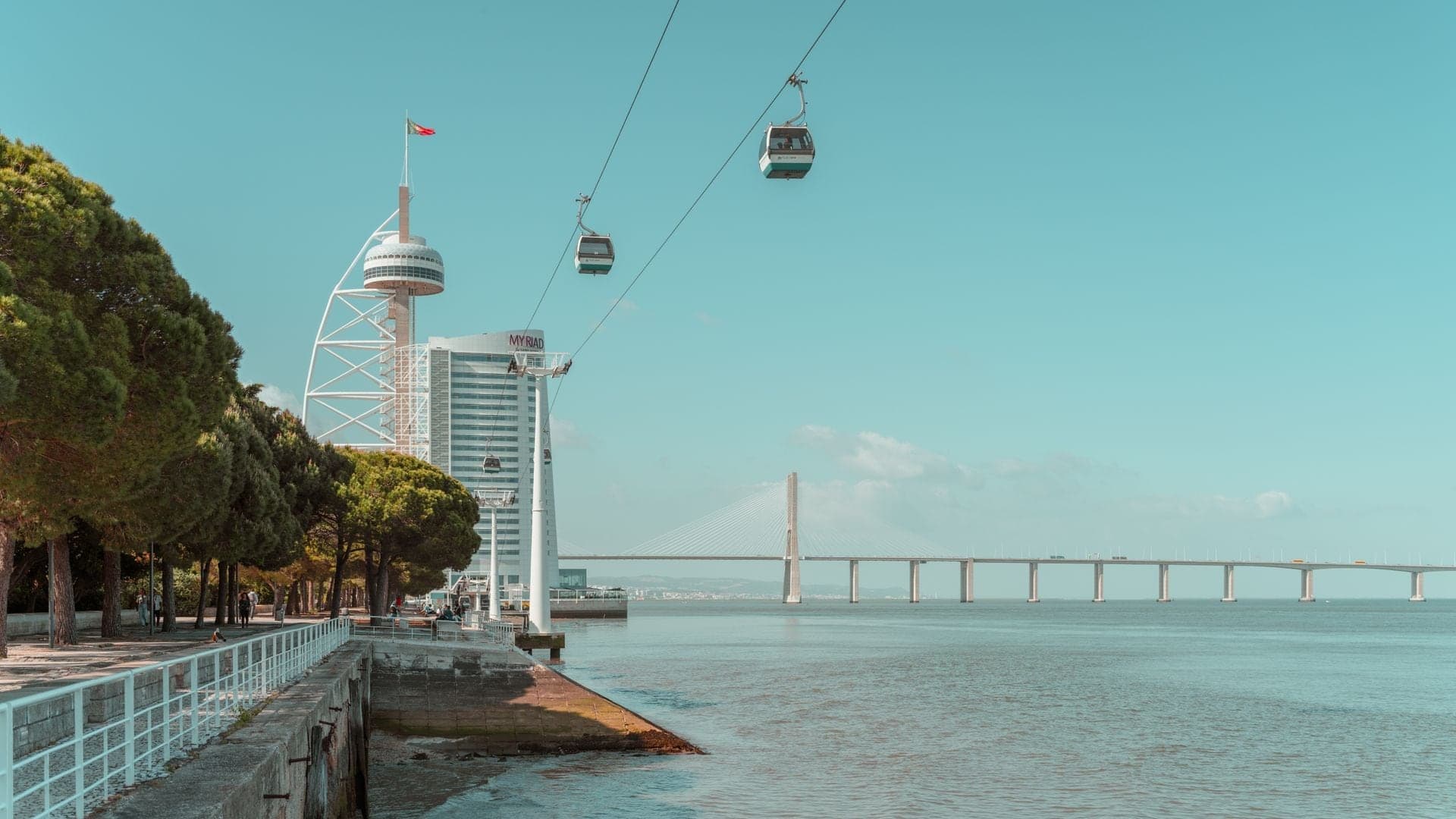
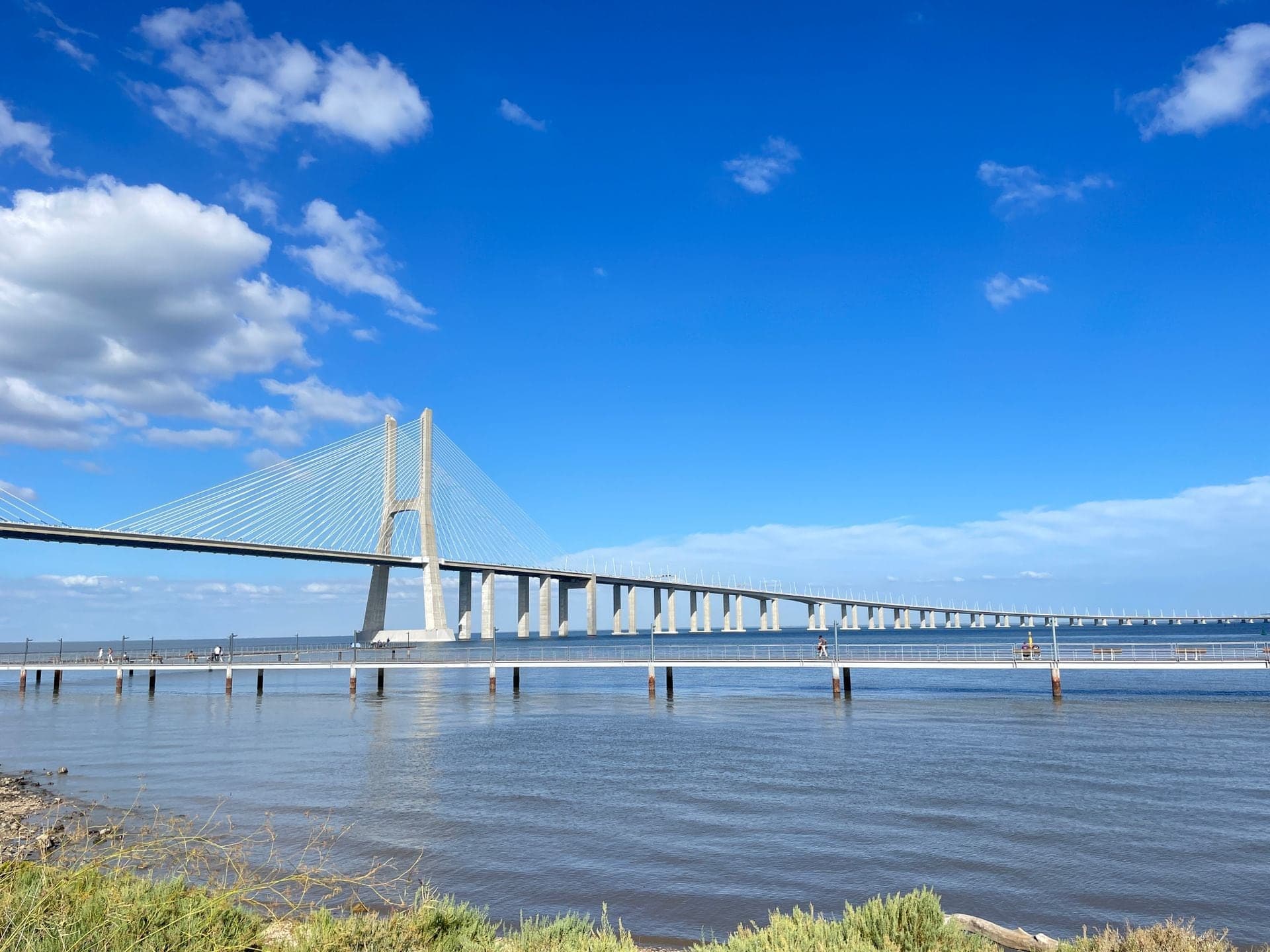
Torre Vasco da Gama and the Bridge
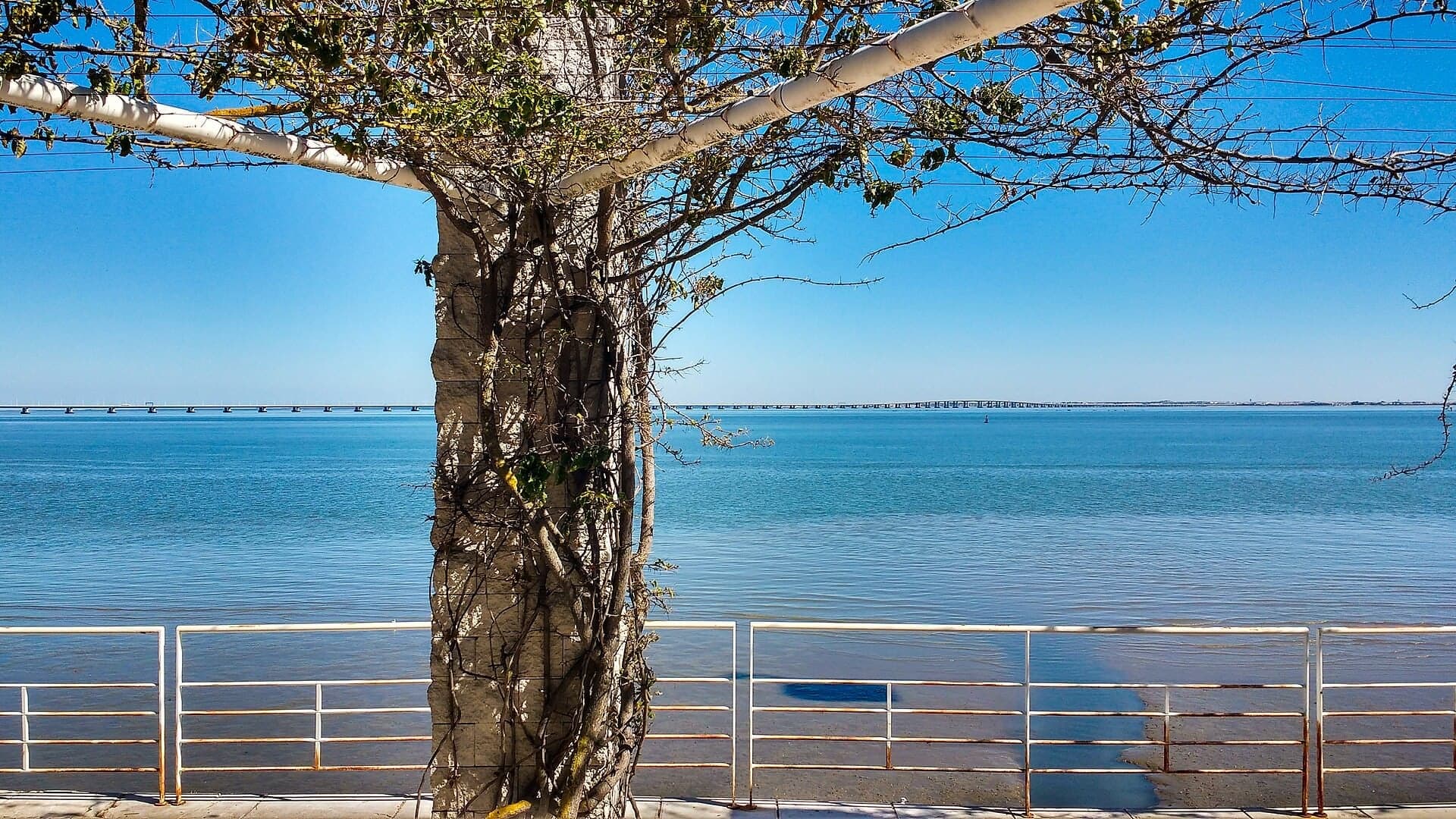
Both were built for 1998, a sail-shaped tower and a long bridge, on the wide water of the Tagus.
Details
Best Time to Visit
Any day, in daylight. An afternoon puts the light behind you at the Oceanário view (stop 7); in the morning you look toward the sun. The river strip has little shade and takes the wind, so bring water in summer and a layer in winter. The Pavilhão do Conhecimento is closed on Mondays; the Oceanário is open daily. Event nights at the arena and trade fairs bring crowds to stops 9 and 10. Checked 2 November 2026.
Pro Tips
- •Getting to the start: Oriente Metro (Red line) and Lisbon-Oriente trains are across Avenida Dom João II from stop 1. Cross at the lights (no button and no sound signal), or come through the underpass into the mall. Buses at the station include 400, 705, 708, 725, 728, 744, 750, 759, 782 and 794, by the Pavilhão do Conhecimento's list. Checked 2 November 2026.
- •Getting away from the end: Oriente Metro and trains are about 1.4 km from stop 12 on the flat, with lights at Avenida Dom João II. Carris bus 708 runs from Cais Olival to Estação Oriente and on toward Martim Moniz; the stop is about 800 meters from stop 12, with one short flight of steps with no handrail on the way. Other lines from that stop are thin at weekends. Checked 2 November 2026.
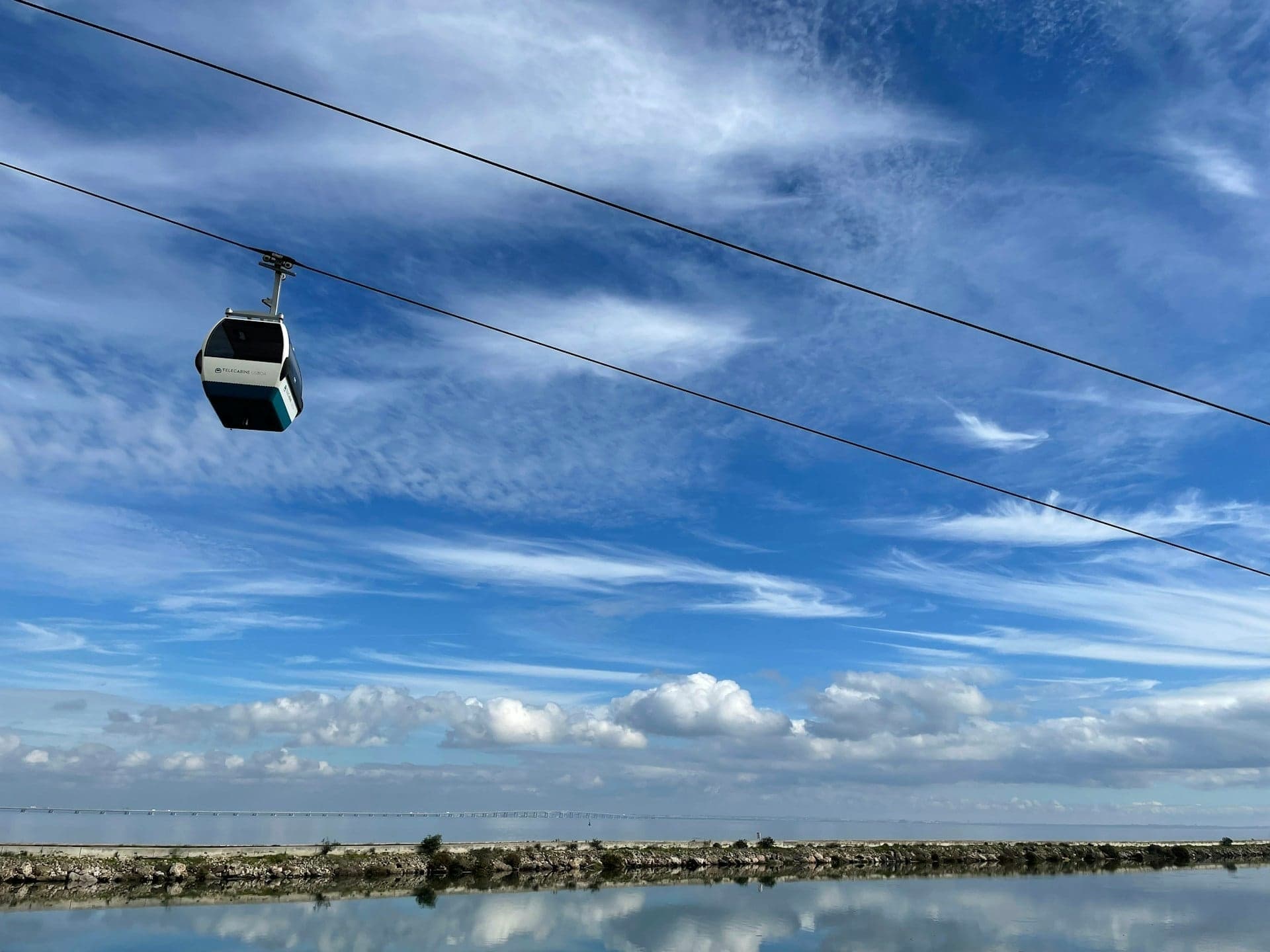
- •Telecabine (cable car): its north station is beside stop 12 and its south station by Jardim das Ondas. It is ticketed and only runs along the river, so from stop 12 it goes back south and not to Oriente. We could not read its current hours and prices on the operator's site, so check telecabinelisboa.pt. Checked 2 November 2026.
- •Oceanário (stop 7): daily 10:00 to 20:00, last entry 19:00, shorter hours around Christmas and New Year. Adult price depends on entry time, from 25.50 to 29.90 EUR. Details at oceanario.pt. Checked 2 November 2026.
- •Pavilhão do Conhecimento (stop 6): closed Mondays. Adult 15 EUR. Check hours at pavconhecimento.pt. Checked 2 November 2026.
- •Pavilhão de Portugal (stop 8): the building reopened in 2025 with exhibitions and a 24-hour library. Exhibition hours for 2026 were not confirmed, so check with the University of Lisbon. Checked 2 November 2026.
- •Gare do Oriente's platforms (stop 1): we could not confirm whether they can be reached without a train ticket. The canopy shows clearly from the pavement at stop 1. Checked 2 November 2026.
- •Two photographs worth stopping for: from the east edge of Siza's canopy looking under the sag (stop 8), and the Oceanário across the dock from the quay (stop 7).
Safety & Precautions
- •Between stops 1 and 2: three mall service lanes cross the path, unmarked, so watch for delivery vans. Then two zebra crossings with no lights, over the Alameda's local road, each with a cycle lane beside it. Watch for bikes as well as cars.
- •Water volcanoes (stop 3): they may be dry, and nothing confirms a schedule. Last evidence: dry in the morning and running in the afternoon on 26 March 2025, and not working in December 2023. If the water is on, the stone around them may be wet. Checked 2 November 2026.
- •Just past stop 3, two driveways cross the pavement, so watch for cars.
- •Garden hours: we found no official hours for Jardim das Ondas (stop 5), the Water Gardens or the Jardins Garcia de Orta (stop 11), and no gates are mapped. Stop 5 is heard from the path at its edge. At stop 11, in the evening or if a gate is shut, take the river path or stay on Rua da Pimenta. Checked 2 November 2026.
- •Between stops 5 and 6: the path passes under the Oceanário's covered entrance bridge. Queues form here, and the stretch just before it is mapped as unlit.
- •Siza's plaza (stop 8): by all evidence open ground, but no official statement says so. Cars have been seen parked on it, and events may close it. Everything at this stop can be seen from the quay at its edge. Checked 2 November 2026.
- •Between stops 8 and 9: the route follows the Pavilhão de Portugal's open colonnade on the quay, shared with cyclists. It was seen open on 26 March 2025, with nothing newer found. If it is closed, go under the canopy to the Alameda, up the Alameda and along Rossio dos Olivais toward the river, about 165 meters more. Checked 2 November 2026.
- •Arena nights (stops 9 and 10): crowds and possibly barriers.
- •Stop 11: the way into the Goa garden is a short flight of steps with no handrail. The river path skips it, and the stop still plays there.
- •Cyclists share the Alameda strip, the colonnade and the river path. Stand clear at stop 12.
- •Stone setts on the quays are slippery when wet, and Rua da Pimenta's surface is rough.
- •Oriente station and the mall doors get crowded, so keep your bag closed there. A high-speed rail enlargement of the station is planned; we found no works dated to 2026, but scaffolding is possible. Checked 2 November 2026.
- •This part of the district, north of the arena, is lived in, so keep your voices down.
Travel advisory: Exercise Normal Precautions (Level 1).
Gallery
Related Reading
Go deeper on what you'll see, hear, and walk through.
Read the walk
The full story of Parque das Nações: Built Out of What It Demolished, in words. Prefer to listen? Play it narrated, from home or on location.
Introduction
Lisbon, the capital of Portugal, held its world's fair in nineteen ninety-eight on an unlikely stretch of river front. In nineteen ninety-three, it held a refinery, fuel tanks, thousands of useless containers, an abattoir, an armaments depot and a waste tip.
The builders took it apart and used it. The steel went to the furnaces, the concrete was crushed into gravel for the new streets, and the old cobbles were laid again. Then they built with a second life in mind: a station, pavilions, gardens and a tower, planned to outlast one summer and become a new quarter of the city. Most became what they were built to become. One waited more than twenty years.
Three people will help you read it: Santiago Calatrava, who designed the station; Álvaro Siza, who hung a sheet of concrete over a plaza; and Garcia de Orta, a sixteenth-century physician whose name is on the riverside gardens.
The walk is twelve stops over about two point eight kilometers, a mile and three quarters, and takes about seventy-five minutes. It is flat, with one short flight of steps inside a garden and a river path that skips it. The Oceanário and the science center are ticketed, and every stop works from outside. The walk begins across the avenue from Oriente station and ends at the Vasco da Gama Tower, on the river.
1. Gare do Oriente: Calatrava's Canopy
Welcome to Parque das Nações, the Park of Nations. Walk to the edge of the pavement and look across the avenue at Gare do Oriente, the East Station.
Read it from the bottom up, because two things are stacked there. Lower down, a glazed shell covers the entrance hall, with a great fan of white steel ribs on each side, like wings. Above it runs a line of white railing and glass, which is the level of the platforms. Above that, along the whole top of the view, white trunks branch into pointed vaults of steel and glass.
Those are the trees. Santiago Calatrava's office calls them that: steel and glass trees, interlocked into one continuous roof on a grid of about seventeen meters. The city's archive offers two ways to see them, a wood of metal trees or the columns of a Gothic cathedral.
The bigger idea is underneath. The railway here ran on an embankment, a wall between the Olivais district and the river. Calatrava went past the competition brief and proposed cutting through it. He lifted the platforms onto a bridge, on five rows of twinned arches, about seventy-eight meters wide and two hundred sixty long, which is why this building lets you through instead of stopping you.
The station opened on the nineteenth of May, nineteen ninety-eight, three days before the world's fair opened to the public. It was the fair's main entrance, and the mall behind you stands where the main gate stood. The fair closed that September, after more than ten million visits. The station stayed, because it was never only for the fair.
Follow the route along the side of the mall, where delivery vans cross the path. Then you reach the next avenue, the Alameda, and cross its local road on two zebra crossings with no lights, each with a cycle lane beside it. Watch for bikes as well as cars.
2. Alameda dos Oceanos: the Sun Man
Finish crossing the zebras and stop on the far pavement, clear of the cycle lane. This is the Alameda dos Oceanos, the Avenue of the Oceans. Now look up the avenue, the opposite way from where this walk goes, between the end of the mall and the low office block, for a thin, dark, spiky figure on two legs, rising from a pale paved plaza.
That is the Homem-Sol, the Sun Man, made for the fair. It is about twenty meters of weathering steel and about fifteen tons, in the shape of a person, and so full of gaps that most of it is air. One account of the fair calls it a sort of testament of its sculptor's work. The rust is on purpose. That is what this kind of steel is made to do.
Now look at what it stands on. The avenue runs for more than two kilometers, and the fair lined it with water and art. A practice called Risco drew the general plan of the whole site, and with a landscape architect it laid out this avenue in stretches. Along this stretch, the central strip was planted with lines of pin oak, dotted with coral trees.
An avenue like this has two jobs to do, one after the other. In the summer of nineteen ninety-eight it had to carry the crowds. After the fair closed, it had to become an ordinary street in a neighborhood that did not yet exist. Ask the same of everything from here on: what was it built to become, and did it?
You will hear what lies under this street a little further on.
Cyclists share the strip, so keep an eye out. With your back to the figure, follow the route down the avenue. Next is a cone of colored tile.
3. Water Volcanoes on the Alameda
Walk on down the pavement and stop when you are level with a tall cone of colored tile, across one lane and a cycle lane. In leaf, the trees may screen it until you are close. There is no need to cross. The view is from here.
This is one of six water volcanoes, the Vulcões de Água. You have already passed another. Look at the skin first: small glazed tiles in rings, deep red at the base, going through magenta and violet to blue at the top, from the ceramics house Viúva Lamego. Around the cone is a square of dark stone, meant as a mirror of water, and then a long tiled channel, pink, white and turquoise.
It was built as a machine on a timer. Every twenty-five seconds the water was meant to rise about three meters, burst, and send two waves along the channels: sixteen hundred eruptions a day, for a fair about the oceans.
The water may well be off as you listen. A local architecture firm wrote at the end of twenty twenty-three that nothing was working, the basins were dry and the cladding was breaking. Photographs of this cone from March twenty twenty-five show it dry in the morning, and with water running down its sides by early afternoon. We found nothing newer.
A fair needs a set piece for five months, and a neighborhood has to pay for it every year after that. The tile keeps its color either way.
Now look at the long building beside you, on your side of the avenue. The dock is just behind it. This walk goes on down the avenue, around the bottom of that block, and back up along the water on the building's far side: a U, with hardly a step walked twice.
Follow the route on down the avenue. Next is what this land used to be.
4. Passeio de Ulisses: The Tower They Kept
Walk on to the corner where the avenue meets Passeio de Ulisses, and stop on the pavement, clear of the zebra crossing. Look straight on down the avenue to its far end, just past the corner of the office block with a big fan-shaped dish on its roof. If the trees allow, you will see a lattice of steel with galleries, standing far off, not the thin white mast nearer by. If it stays hidden, that is fine, because the story is under your feet.
That tower belonged to the old refinery. It is Torre da Galp on the map, and the city's archive dates it to nineteen thirty-nine. The refinery started work on the first of January, nineteen forty. A giant flame came from the tower, and people said that if it ever went out, there would be an explosion. That is only what people said.
You heard the fair's own list of what stood on these three hundred forty hectares in nineteen ninety-three.
They took it apart and used it. About thirty-five thousand tons of steel went to the furnaces. About one point one million tons of concrete was crushed into gravel, and under these streets is gravel made from what stood here. A hundred thousand square meters of the old granite cobbles were laid again.
The soil is the part still argued over. About four hundred thousand cubic meters of contaminated soil went into sealed cells. In twenty nineteen, an environmental group reported a new hydrocarbon deposit in the district, and a residents' association said most of the soil was never treated.
One piece of the refinery stayed, its base a gate for the fair and its top a viewpoint.
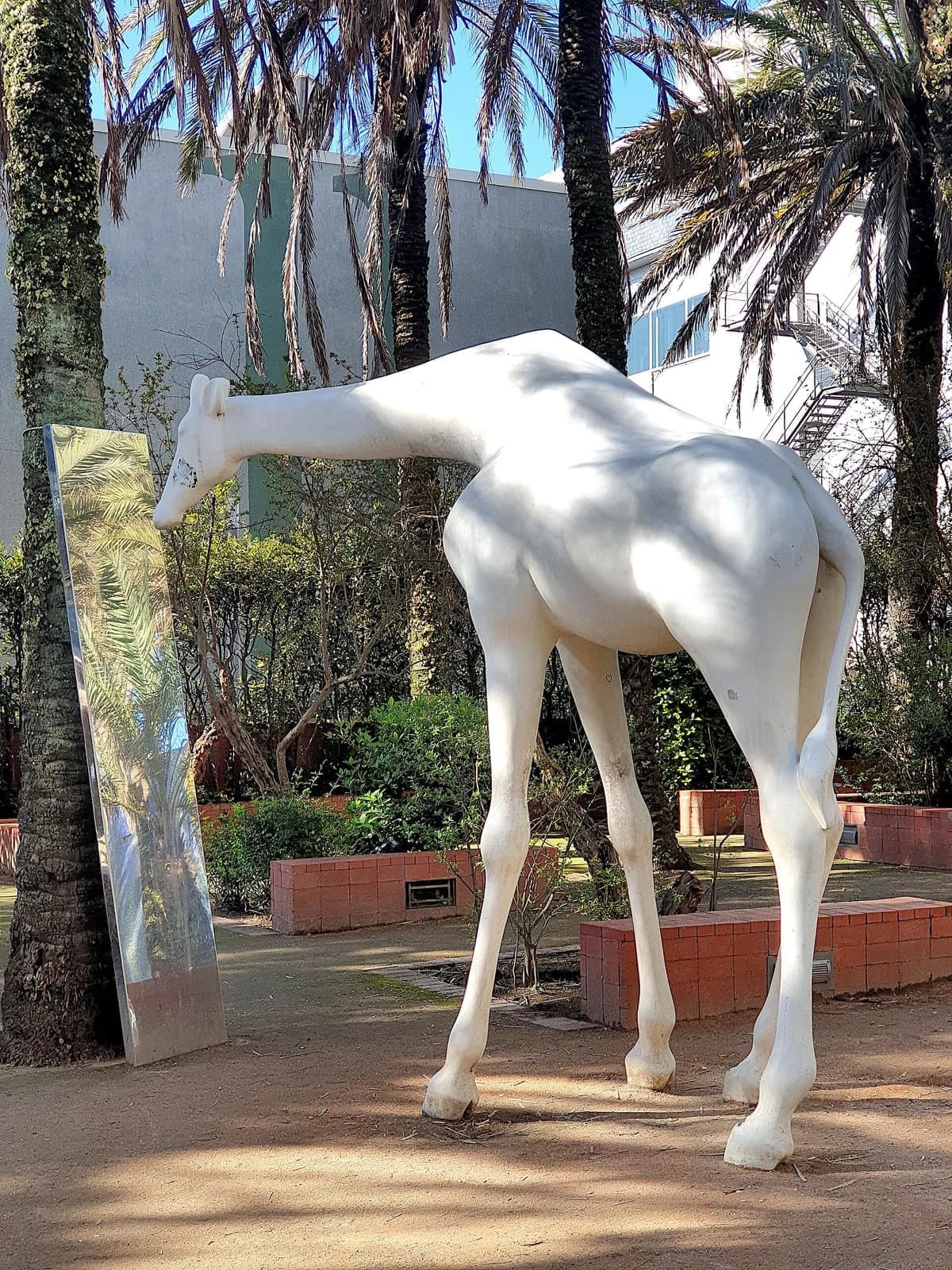
Follow the route along Passeio de Ulisses, the top edge of the Jardins da Água, the Water Gardens. Look among the palms for a white giraffe, stooping to a tall mirror.
5. Jardim das Ondas
Walk on along the path at the garden's edge and stop. On the river side, the ground rises and falls in long curves. This is Jardim das Ondas, the Garden of Waves. It is small, eight-tenths of a hectare, between the Oceanário and the Tagus river, and it has one idea. An artist…
Full narration for this stop unlocks with the tour.
6. Pavilhão do Conhecimento
Walk on into the square and stop when a big white concrete building is close beside you. This is the Pavilhão do Conhecimento, the Pavilion of Knowledge, now a science center. Going inside is ticketed, and it is closed on Mondays. The details are on this stop's card, and the…
Full narration for this stop unlocks with the tour.
7. Oceanário Across the Doca dos Olivais
Walk on along the quay and stop by the rail, looking across the water at the building standing in the dock. That is the Oceanário, Lisbon's aquarium. It is ticketed, and its way in is back at the forecourt you just came through. The details are on this stop's card. The view from…
Full narration for this stop unlocks with the tour.
8. Pavilhão de Portugal: Siza's Concrete Veil
Walk on along the quay until a huge, pale sheet of concrete sags across the sky beside you, and stop at its edge. This is the Praça Cerimonial, the ceremonial plaza of the Pavilhão de Portugal, by Álvaro Siza. Cars are sometimes parked under it and an event may close it, but you…
Full narration for this stop unlocks with the tour.
9. Rossio dos Olivais: MEO Arena, Built as Utopia
Walk on along the Rossio and stop where you can look across the long basin to the pale, curved flank of the arena, beyond the flags and poplars. Look down first. Those bold black and white waves underfoot are a pavement made in the manner of Lisbon's early twentieth-century…
Full narration for this stop unlocks with the tour.
10. Lago das Tágides
Walk on along the path beside the lake and stop, with the arena's wall close behind you. Look across at the marble figures in the water, with the Tagus beyond them. This is Lago das Tágides. They are nude women at play in the water, around a falua, a traditional boat of this…
Full narration for this stop unlocks with the tour.
11. Jardins Garcia de Orta
Walk on into the garden and stop among the plants, with the river beyond them. If you came by the river path, stop where you are, because the garden is beside you. These are the Jardins Garcia de Orta, and this plot is Goa. Garcia de Orta was a sixteenth-century Portuguese…
Full narration for this stop unlocks with the tour.
12. Torre Vasco da Gama and the Bridge
Walk on to the river's edge and stop, clear of the cycle path. This is the end of the walk, with two things to see. The tower is close, so tip your head back, or step away, to see all of it. This is the Torre Vasco da Gama, about a hundred forty meters high, with a metal frame…
Full narration for this stop unlocks with the tour.
- the monument of Chaminé da refinaria in the avenue Alameda dos Oceanos — Herbert wie, CC BY-SA 4.0 · source
- Pavilhão do Conhecimento Lisboa — Patricialaraia, CC BY-SA 4.0 · source
- Jardins Garcia de Orta et torre Vasco de Gama, Parque das Nações — Manuel Menal, CC BY-SA 2.0 · source
Images may be cropped or resized. Other photos via Unsplash and Pexels.