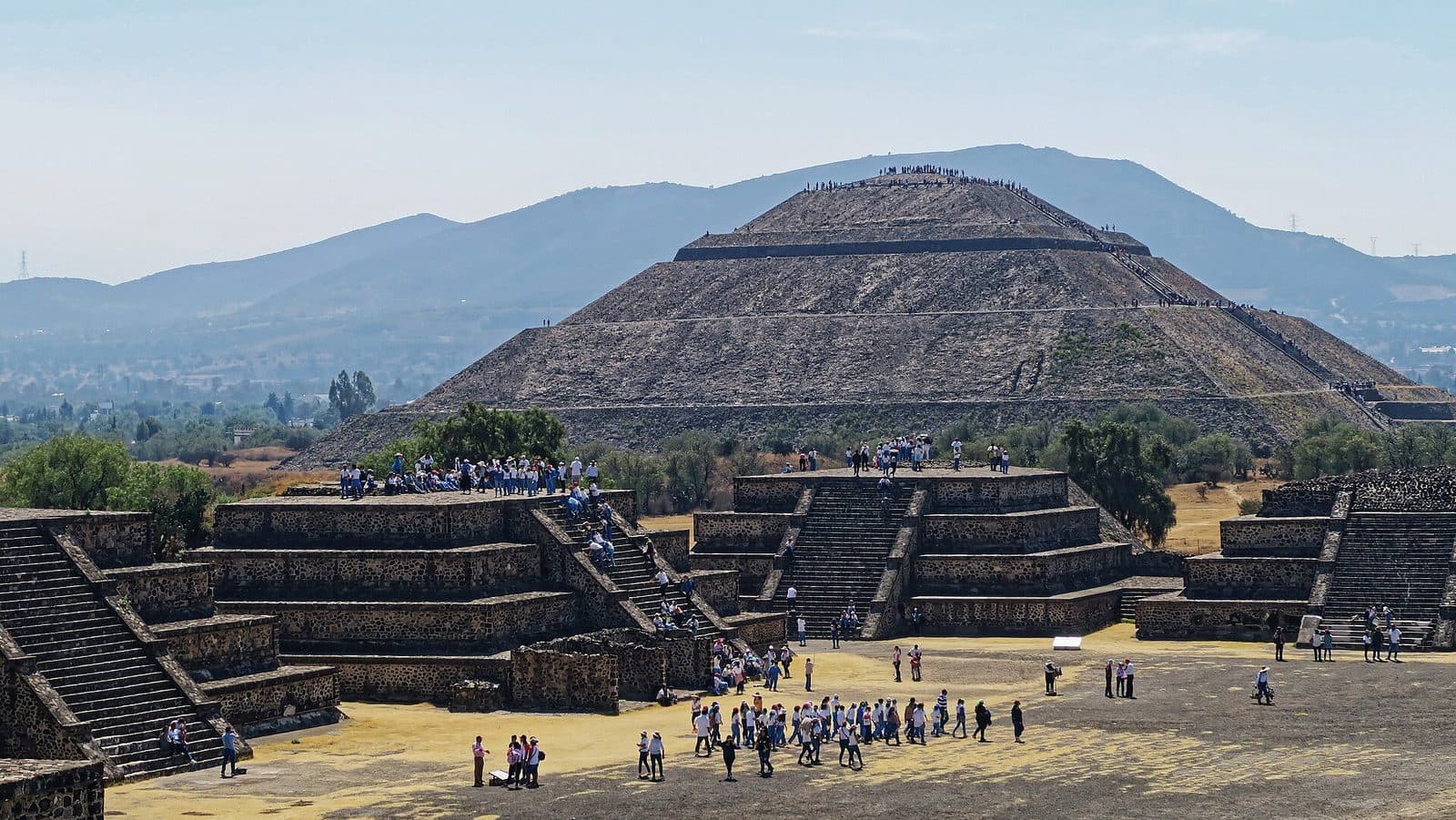
Walk forty kilometres northeast from Mexico City and you arrive at the largest city anyone built in the pre-Columbian Americas. The grid extends across more than twenty square kilometres. The central pyramid is the third-largest pyramid on Earth by volume, after the Great Pyramid of Cholula and the Great Pyramid of Giza. At its peak, somewhere between 100 and 500 of the common era, roughly 125,000 people lived inside its walls, which made it one of the six or seven largest cities in the world.
We do not know what its inhabitants called it.
That sentence is the centre of everything you need to know about Teotihuacán. The name we use is not the city's own name. It is the Nahuatl name the Aztecs gave the ruins about seven hundred years after the city was abandoned. Teotihuacán means, roughly, "place where the gods were born." The Aztecs walked through the empty avenues and decided that no human civilisation could have built such a place, that it must have been the work of the gods themselves. The naming is itself a piece of evidence about the scale of what is being looked at.
What was here
The city was built and rebuilt in phases between roughly 100 BCE and 550 CE. By the year 200, the major monuments were in place. The Pyramid of the Sun, sixty-five metres tall and two hundred and twenty metres along each side at its base, was finished in two major phases around the second century. The Pyramid of the Moon, smaller but more architecturally complex, was built in seven superimposed phases between 100 and 450, each new pyramid raised directly over the older one. The Temple of the Feathered Serpent, at the southern end of the Avenue of the Dead, was completed around 200 inside a vast walled plaza called the Ciudadela that could hold a hundred thousand people at once.
Connecting these monuments is the Avenue of the Dead, a grand boulevard 2.4 kilometres long as currently exposed, with the archaeologist George Cowgill arguing it was likely twice that during the city's peak. The avenue is oriented 15.5 degrees east of true north. The orientation is not accidental. It points directly at Cerro Gordo, the extinct volcano that anchors the northern terminus, and it aligns with specific solar events on specific dates. The Pyramid of the Sun was built to record sunsets on the thirtieth of April and the thirteenth of August, and sunrises on the eleventh of February and the twenty-ninth of October. The intervals between those four dates total exactly 260 days, the length of the Mesoamerican ritual calendar.
The grid extends from the avenue across the entire site, with every apartment compound, every wall, every floor, every street, aligned to the same 15.5-degree axis. The San Juan River, which crosses the avenue near its midpoint, did not run that way naturally. The city's builders rerouted it so it would cross the Avenue of the Dead at exactly ninety degrees. That is the kind of engineering that predates European urban planning at this scale by roughly a thousand years. Whoever built Teotihuacán did so with a coordinated cosmological vision that they had the political authority and the engineering competence to impose on the landscape.
What we do not know
The list of things we do not know about the people who built this is long enough to be disturbing.
We do not know what they called themselves. The word Teotihuacano is a modern construction, derived from the Aztec name for the ruins. The original inhabitants left no written record of their own ethnic identity.
We do not know what language they spoke. There is no decipherable script from Teotihuacán. The murals contain glyphs, but they have not been read in the way Maya hieroglyphs have been read. The few attempts to identify the language with later Mesoamerican families, Nahuan, Totonacan, Otomanguean, remain speculative.
We do not know who their kings were. No portraits of named rulers have been identified anywhere on the site. The Maya cities to the south are full of stelae with the names and reigns of specific kings carved into the stone. Teotihuacán has nothing comparable. The city's elite were either deliberately anonymous or have not yet been recognised in the archaeological record.
We do not know why the city collapsed. The collapse happened around 550 of the common era, give or take a few decades. By 650 the city was largely empty. Earlier theories proposed a foreign invasion. Recent research by Linda Manzanilla and others, including her 2015 paper in the Proceedings of the National Academy of Sciences, argues for an internal revolt: the elite palaces along the Avenue of the Dead were systematically burned, but the residential compounds of ordinary people were not. The pattern suggests that the city's ruling class was killed by its own population, not by outsiders. The argument is plausible but not settled.
What we do know is that for at least four centuries, this city was one of the most powerful political and economic centres in the Americas. Its influence reached Maya cities a thousand kilometres south. Maya-language inscriptions at Tikal and Copán refer to Teotihuacán as the source of a major political event in the fourth century, when a figure named Sihyaj K'ahk', "Born of Fire," arrived at Tikal in the year 378 and apparently installed a new dynasty. Whoever the Teotihuacanos were, they sent expeditions and probably armies far beyond their own valley.
What the Aztecs did with it
The Aztecs entered the Valley of Mexico in the thirteenth and fourteenth centuries, more than seven hundred years after Teotihuacán was abandoned. They found the ruins and built the rest of their cosmology onto them. The Fifth Sun creation myth, in which the gods gathered in darkness at Teotihuacán to decide who would sacrifice themselves to become the new sun, locates the entire origin of the current world in this city. The myth has the god Nanahuatzin throwing himself into a fire and emerging as the sun. The site of that sacrifice was, in Aztec cosmology, here.
The Aztec rulers made pilgrimages to Teotihuacán. They left offerings at the pyramids. They believed gods had built the city, and the belief became part of the official ideology of Tenochtitlán. When Cortés arrived in 1519 and entered the Aztec capital, the Mexica priests he spoke with referred to Teotihuacán as a sacred site. The veneration was already eight centuries old at that point.
The naming we now use comes from this Aztec layer. The Avenue of the Dead is Miccaohtli in Nahuatl, named because the Aztecs interpreted the platforms along the avenue's edges as tombs. They were not tombs; they were temples. But the Aztec misreading became the name we still use. The Palace of Quetzalpapálotl, a complex near the northern end of the avenue with carved columns of quetzal-butterflies, is similarly named in Nahuatl by twentieth-century archaeologists, not by its actual builders. The entire site is, in a sense, labeled in the language of people who arrived eight hundred years after the building stopped.
What the excavations have changed
The site sat largely buried from roughly 750 to 1875. For more than a thousand years, what we now see as pyramids were grass-covered hills. The first major excavations began in 1864 and accelerated through the early twentieth century. Leopoldo Batres's reconstruction of the Pyramid of the Sun in 1905 was important enough that what you see today is partly a 1905 interpretation, as Batres added a fifth tier the pyramid had not originally had.
The recent generation of excavations has been more careful. Saburo Sugiyama's work at the Temple of the Feathered Serpent in 1988 and 1989 uncovered at least 137 sacrificial victims buried beneath the pyramid, mostly young male warriors with their hands bound behind their backs. The discovery rewrote what archaeologists had previously assumed about Teotihuacano religion, which had been described as comparatively peaceful. Sergio Gómez Chávez's 2003 discovery of a sealed tunnel running a hundred metres beneath the same pyramid, containing pools of liquid mercury and over seventy-five thousand artefacts, suggested the pyramid had been built to mark a deliberately constructed underworld. Sugiyama and Rubén Cabrera's excavations at the Pyramid of the Moon between 1998 and 2004 found further sacrificial complexes, with the most violent containing twelve victims, ten of them decapitated and tossed into the pit.
The picture that emerges from the modern excavations is a city more religiously violent than the early reconstructions had imagined, and more politically centralised than the absence of named rulers had suggested. The sacrifices at the major pyramids appear to have been state-sponsored events at specific historical moments, marking phases of construction or political consolidation.
What to walk
The site is large. The natural walk climbs the Avenue of the Dead from the southern entrance, past the Temple of the Feathered Serpent and through the Ciudadela, up the avenue to the Pyramid of the Sun, past the Palace of Quetzalpapálotl, to the Pyramid of the Moon at the northern terminus, then to the Tepantitla compound off the eastern side. The Tepantitla murals, discovered by Alfonso Caso in 1942, are the only place in Teotihuacán where ordinary people are depicted. The "Tlalocan" mural shows roughly fifty tiny figures playing ball games, singing with speech-scrolls coming from their mouths, swimming, and picking flowers in a watery paradise. Everywhere else in the city, the inhabitants are invisible. The elite did not paint themselves. Their faces are not on the walls. We have the city they built, and we have one set of small figures playing ball games in a mural that may or may not depict daily life and may or may not depict the afterlife. That is the closest we will get to seeing them.
The walk is about four kilometres on flat ground at an altitude of roughly 2,300 metres. The sun is intense. The pyramids are mostly closed to climbing now, which is the correct policy after decades of damage from millions of tourists.
The thing to hold while walking is the question. This was the largest city in the Americas. It influenced Maya politics a thousand kilometres south. It was the religious centre of Mesoamerica for four hundred years. And we cannot name its builders. The Aztecs walked here six hundred years after the abandonment and decided that gods must have done this work. They were wrong about the gods, but they were right that the people who built it left no name behind. The city's most enduring monument is the silence about its own identity.
Walk it knowing you are walking through an argument that has not been resolved. The argument is whether human beings can build something so large, so well-organised, and so durable, and then disappear so completely that even the people who venerate the ruins seven hundred years later have to invent a name for them. The evidence of the site is that the answer is yes. We are still trying to learn theirs.
Frequently asked questions
- Why do we not know what Teotihuacán was called?
- The city's builders left no decipherable script recording their own name for it, and they were long gone by the time later peoples arrived. The name we use, Teotihuacán, is the Nahuatl name the Aztecs gave the ruins about seven hundred years after the city was abandoned, meaning roughly 'place where the gods were born.'
- How old is the Pyramid of the Sun?
- The Pyramid of the Sun was finished in two major phases around the second century of the common era, so it was already about a thousand years old when the Aztecs entered the Valley of Mexico and found the ruins.
- How long is the walk through Teotihuacán?
- The main axis, the Avenue of the Dead from the Ciudadela north to the Pyramid of the Moon, is about 2 km, and the full circuit taking in both pyramids and the Tepantitla murals is roughly 4 km on flat ground at an altitude of about 2,300 m. You set your own pace.
- Can you climb the pyramids at Teotihuacán?
- Only partially. Climbing the Pyramid of the Sun to its summit has been prohibited since the pandemic. The Pyramid of the Moon reopened to climbers on 19 May 2025, but only to the top of its first section. Confirm the current rules at the gate.
Mexico eSIM· 10% off with ROAMER10
More from Teotihuacan
Explore more at your own pace.
One Day at Teotihuacán: A Day-Trip Itinerary from Mexico City (2026)
Teotihuacán Travel Guide: Getting There, Tickets, and Tips (2026)
Chapultepec Park Guide: Hill, Lakes and Museum Row
El Sargento: The Dead Ahuehuete Tree of Chapultepec
The Baños de Moctezuma: The Bath That Was Never Moctezuma's