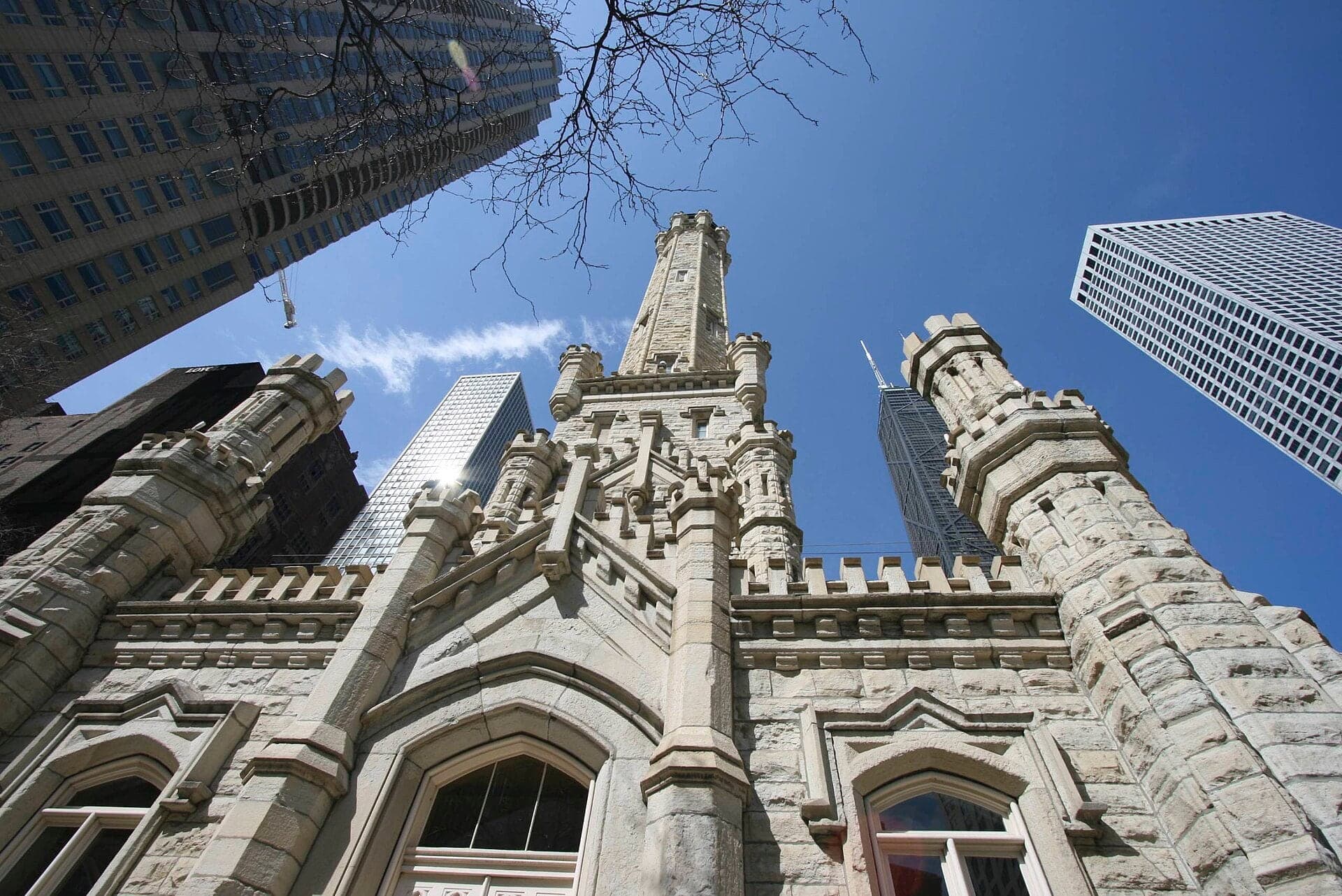
The Chicago Water Tower stands on the west side of Michigan Avenue, in a small green wedge called Jane M. Byrne Plaza. It was built in 1869 by the architect William W. Boyington, in what the City's landmark report calls castellated Gothic, and clad in cream-yellow limestone from Joliet. The shaft measures 154 feet from the ground to its battlemented top. Across the avenue stands the Pumping Station, built the same year, by the same architect, in the same stone.
On a street of twentieth-century towers, the Water Tower is the odd one out. It is here because it survived something much of the neighborhood did not. But the more interesting fact is what it was built for.
A pipe in a castle costume
The Water Tower is not a tower in the sense of a lookout or a keep. It houses a standpipe: a vertical pipe 138 feet high and three feet in diameter, added to the pump line so that excessive pressure could be relieved by the water rising in the pipe. The early pumps sent water in a series of surges, or pulsations. The standpipe calmed them. The Gothic stonework wraps a plumbing component.
The system around it was Ellis Chesbrough's. After the cholera epidemic of 1854, which the Historic American Engineering Record says killed one out of eighteen Chicagoans, the city created a Board of Sewerage Commissioners in 1855 and hired Chesbrough. From 1856 buildings were jacked up, street levels were raised and sewers installed. Pure water came through a tunnel sixty feet below the lake surface and two miles out, to a crib offshore. Work on the tunnel ran from 1864 to 1867.
The fire
Hear a stop from this walk
333 West Wacker and the Confluence: A Building Bent to the River
On the night of Sunday, October 8, 1871, a fire began on the southwest side of the city, near DeKoven Street. By Tuesday morning it had crossed the main branch of the river and burned virtually the entire North Division before dying out. The cause has never been settled, and the story about the cow is a story.
The City's landmark report says the Water Tower and the Pumping Station were the only public buildings in the burned area to survive. The tower was one of perhaps only a handful of buildings of any kind to escape, scarred but virtually intact. The Pumping Station was gutted, its walls stood, and it was quickly repaired, but the machinery was so badly damaged that the city's water supply was virtually cut off for eight days. The Chicago Architecture Center is careful to add that it is a common myth that the Water Tower was the only building left standing. It was not. The claim that holds is the narrower one: the only public buildings.
There is no line on the ground to see. The fire crossed two branches of the river. The two stone buildings stood inside what it burned.
The threats
Oscar Wilde, on his American tour in 1882, called the tower a castellated monstrosity with pepper boxes stuck all over it. Chicagoans kept it anyway. The City's report records that it was threatened with demolition in 1906, when the standpipe became obsolete; in 1918, to make way for the widened Michigan Avenue; and in 1948, when an art center was proposed. Mayor Thompson and later Mayor Kennelly stood firm. The tower was floodlit at night. It became the first American Water Landmark in 1969, and a Chicago Landmark on October 6, 1971. A repair in 1962 and 1963 used the last small Joliet quarry, with 570 new stones and 716 old ones reset.
What to look for
Stand on the west sidewalk by the plaza. The stone is a pale yellow-cream. Look at the thin octagonal shaft, the turrets and the little battlements, then turn and find the matching tall smokestack of the Pumping Station across Michigan Avenue. The stack and the shaft are twins in material, not in height.
Then look north up the avenue. Michigan Avenue here was once Pine Street, and it was widened from 1916 to 1920 as part of the city's plan to make it a shopping street. What stands north of the bridge is mostly a product of that decade, and of the ones after. The water works survived the fire and then the widening. It is a tower with a plumbing job and a reputation, and it is one of the places on the walk where you can stand in the city that was there before the avenue.
Ready to experience it?
Chicago Riverwalk: From the Magnificent Mile Down to the Water
100 min · 2.4 km · easy
More from Chicago
Explore more at your own pace.
Chicago Travel Guide: How Many Days, Getting Around, When to Go (2026)
One Day in Chicago: A Walkable Downtown Itinerary (2026)
A Sunday on La Grande Jatte: Seurat's Park of Dots, in Chicago
Art Institute of Chicago: What to See, Building by Building
Paris Street; Rainy Day: Caillebotte's Nine-Foot Street Corner