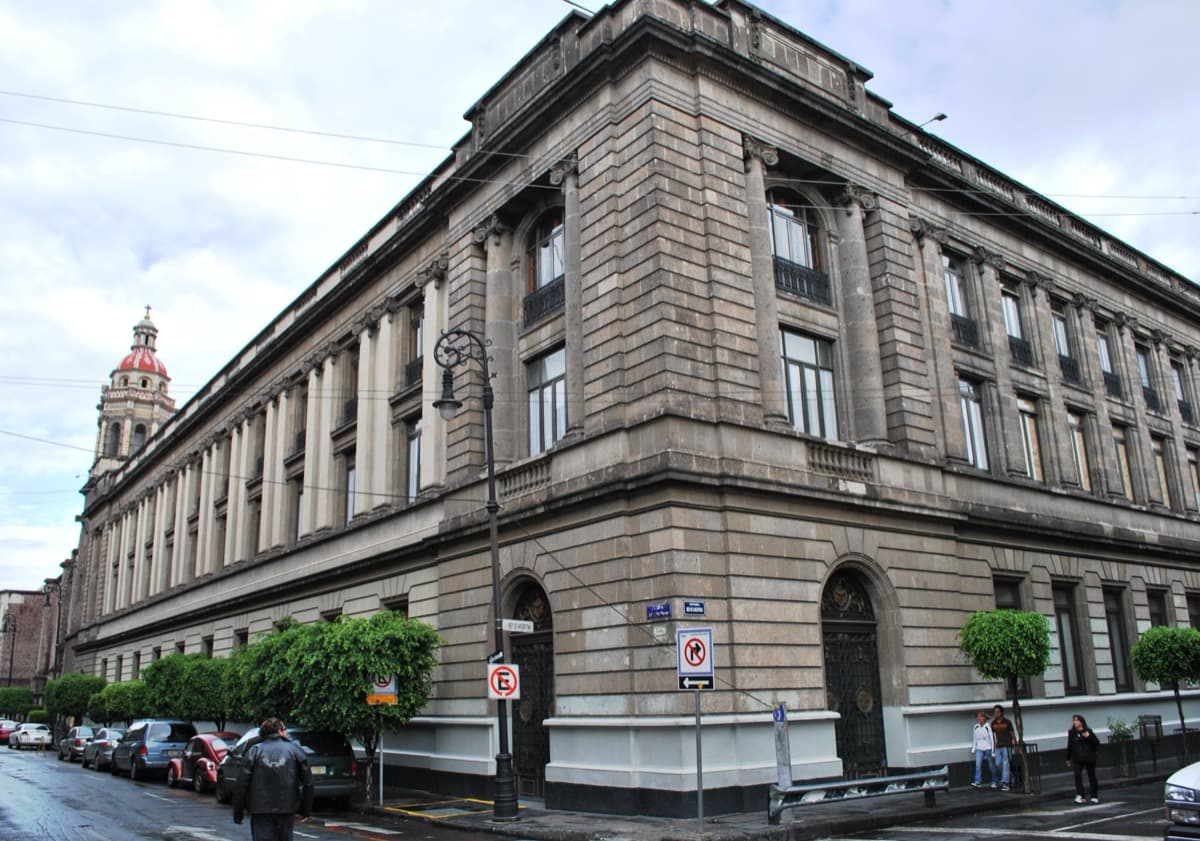
The Secretaría de Educación Pública sits on Calle República de Argentina, three blocks north of the Zócalo, in a former Catholic convent that was nationalized in the nineteenth century during the Reform laws and converted into government offices. The building is old enough to be unremarkable from the street. It has two arcaded courtyards, three floors of corridors wrapping around each, and a staircase. Almost every interior wall surface that opens onto those corridors and that staircase is painted. Diego Rivera did the painting, mostly by himself, between 1923 and 1928. The cycle runs to more than a hundred and twenty individual panels. By total surface area it is among the largest single-artist mural commissions executed anywhere in the twentieth century. Entry is free.
This is the building where the muralist program shifted from experiment to operating system.
How the commission happened
When José Vasconcelos, the post-revolutionary education minister, hired the first wave of muralists in 1921, the experimental work happened at San Ildefonso. That building was a former Jesuit college, an obvious training ground, and the murals there were a kind of audition. Rivera, Orozco, and Siqueiros each painted there. None of the work was decisively successful by the standards Rivera himself was reaching for. His Creation panel, painted in encaustic at San Ildefonso in 1922 and 1923, has stylistic borrowings from Italian Renaissance fresco that he later treated as a false start.
Vasconcelos extended the commission anyway, and this time he gave Rivera a much larger surface. The SEP had just been completed, in 1922, on a site that combined a former convent with newer construction designed by Federico Mariscal. The two courtyards were arranged like sequential chapters of a book. The Court of Labor was the eastern courtyard, three storeys tall, intended in Rivera's design to celebrate Mexico's productive life. The Court of Fiestas was the western courtyard, intended to celebrate its festival life. The connecting corridors and the main staircase became transitional zones where Rivera could pursue more allegorical and more pointed political subjects.
Rivera began painting in March 1923. He finished in late 1928. He used true fresco, plastered fresh each morning so the pigment could bond with the wet lime as it set. Fresco does not allow correction. Once the plaster dries, the painted surface is permanent. A five-year fresco cycle of this size, painted by one artist with a small team of assistants, is a logistical achievement before it is an artistic one. He painted six days a week. He travelled to research the regional scenes, returning with sketchbooks of Tehuana costumes from Oaxaca, mining gear from Guanajuato, weaving looms from Saltillo, and the specific tools used by sugar cutters in Veracruz. The murals are an encyclopedia in the literal sense. They are not generalised. Particular regions, particular trades, particular costumes appear and reappear, identifiable by anyone familiar with that part of the country.
What is on the walls
Hear a stop from this walk
Palacio de Bellas Artes: Four Contradictions Under One Roof
The Court of Labor reads from the ground floor up. At street level, Rivera painted the hard physical work that produced the country's wealth: the dyer dipping wool, the weaver at the loom, the miner emerging from the shaft. On the middle floor he painted the technical and intellectual labor that organised the physical: the rural teacher, the engineer, the chemist. The top floor moves into allegory. Industrial production is shown alongside its costs. There are panels showing capital extracting surplus from labor in iconographic language borrowed directly from medieval depictions of the seven deadly sins.
The Court of Fiestas reads similarly. Ground floor: regional festivals, with carefully observed details of food, dress, and ritual. The Day of the Dead panel is particularly well known. So is the panel of the burning of Judas figures, the papier-mâché effigies traditionally exploded with fireworks on Holy Saturday, which Rivera populates with specific recognisable faces of political enemies. The Wall Street banker Judas with the face of John D. Rockefeller appears in one of the upper-floor panels, painted in the early years of a relationship with the Rockefeller family that would later detonate during the Rockefeller Center commission in New York.
The staircase connecting the two courtyards is where the program turns most explicitly political. Rivera painted the history of Mexico as a continuous arc, from pre-Columbian agriculture to the colonial expropriation to the revolutionary struggle to a projected socialist future. The future panels include hammer-and-sickle iconography painted directly onto the walls of a ministry of the Mexican federal government during the years when Rivera was openly a member of the Mexican Communist Party.
The painted text on several panels quotes Marx, Lenin, and the corridos of the Revolution. Rivera did not soften the politics for the building's owner.
Why eye level matters
The single most consequential design decision Rivera made at the SEP was to put the murals at standing height. There are no high-staircase frescoes here in the manner of Tiepolo. There are no domed ceilings. The panels begin roughly at the level of an adult's knees and rise to about three metres, then yield to the arcade above. To see them you do not crane your neck. You walk past them. They are at the height of advertising, of shop windows, of conversation. You read them at the speed of a person walking through a corridor between offices.
This matters because the building was, and is, a working government office. In the 1920s, ministry employees walked past Rivera's panels on their way to meetings. School inspectors, the teachers, the bureaucrats of a newly literate Mexico were the actual audience. The murals were not designed for tourists. They were designed for the civil servants of the ministry charged with educating the country. Rivera's idea was that the people who were teaching Mexico to read should be reminded daily of who they were teaching and why.
That decision changed the form of the mural cycle. Eye-level painting requires a different relationship to scale. The figures cannot be giant. The detail must reward close looking, because the viewer is close. The composition cannot rely on overhead drama. It must work at the height of a face. Rivera's compositions at the SEP are denser, more figurative, more legible at conversational distance than almost any other large-scale public art of the period. The form follows the function of the building.
What survives, what gets seen
The murals at the SEP have survived nearly a hundred years in a working office building without dedicated climate control. The fresco technique has held. The pigment is largely original. There has been periodic restoration, most notably in the 1980s and again in the 2000s, but the surface is what Rivera painted. This is one of the rare cases in twentieth-century art where the conservation history is short, because the medium did most of the work.
The building is still the Ministry of Public Education. It is still open to the public, free of charge, during weekday business hours. Foreign tourists are a minority of the visitors. Most days the busiest section of the cycle is the staircase, because that is where school groups from Mexican states outside the capital come to see their own regions painted on the walls of the ministry that is responsible for their classrooms. The encyclopedia is consulted by the people whose lives it describes.
That is the rare quality of this place. The art is in the building it was commissioned for. The building still does the job it was commissioned to do. The audience still includes the people the art was painted for. Strip out the academic significance and what remains is a working twentieth-century artwork in its working twentieth-century context, with the workers and the citizens still walking past on Tuesday mornings on their way to a 10:00 meeting.
You can see the entire cycle in about ninety minutes if you walk it slowly. Take the staircase last.
Mexico eSIM· 10% off with ROAMER10
Ready to experience it?
Diego Rivera Murals: The Revolution on the Walls
80 min · 2.5 km · easy
More from Mexico City
Explore more at your own pace.
Chapultepec Park Guide: Hill, Lakes and Museum Row
Coatlicue: The Statue That Was Buried Twice
El Sargento: The Dead Ahuehuete Tree of Chapultepec
The Baños de Moctezuma: The Bath That Was Never Moctezuma's
The Tlaloc Monolith: The Stone That Crossed Mexico City in 1964