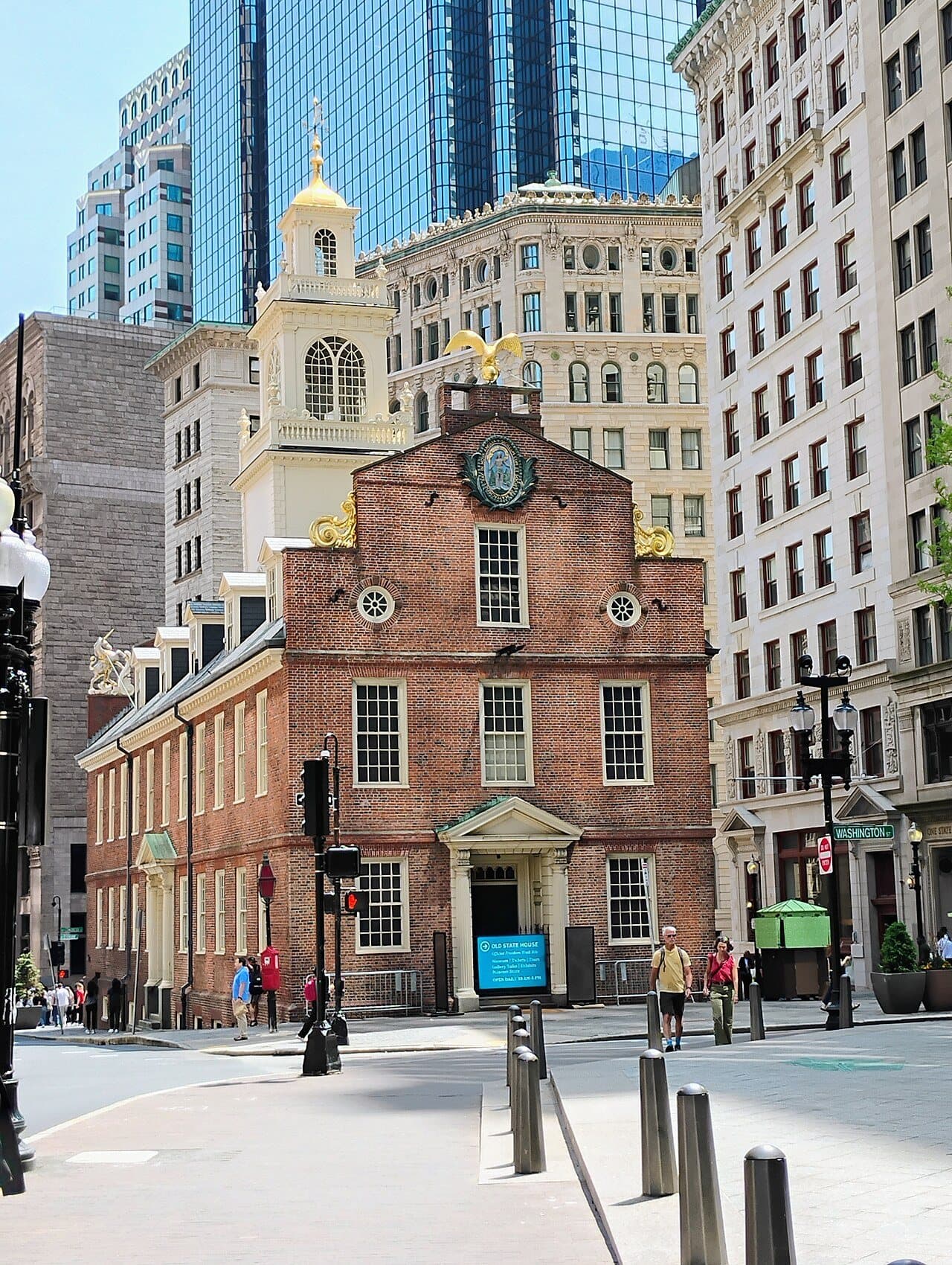
The Old State House stands at the corner of Washington and State Streets. Brick, three stories, a small tower with a clock, a gilded lion and unicorn on the eastern gable. Cars and pedestrians flow past it on three sides. The surrounding buildings are taller and newer; the Old State House looks small among them. Completed in 1713, it is the oldest surviving public building in Boston.
One brick shell carried two governments. Royal officials ran the Massachusetts Bay colony from this building for sixty-three years. On July 18, 1776, the Declaration of Independence was read aloud from the same balcony to a crowd in the same intersection. The continuity is the point. The building did not change. The authority issuing proclamations from its second-floor balcony did.
The lion and the unicorn
The two carved figures on the eastern gable are the Royal Arms of the United Kingdom. The lion is England. The unicorn is Scotland. The originals went up in 1748, when the building was rebuilt after a fire. They did not survive the Revolution: on July 18, 1776, after the Declaration was read, they are said to have been torn down and thrown into a bonfire on King Street. They were not replaced until 1881, more than a century later, when the building reopened as a museum.
The two figures you see today are replacements. Recreations went back up in 1881, and the copper pair on the gable now was made in 1901 by the coppersmith Moses H. Gulesian, in the same position as the originals. What they signify has reversed. In the colonial period the lion and the unicorn meant the king is sovereign here. After 1881 they meant this is what stood here before.
The Old State House is one of the few American buildings that still openly carries British royal symbolism on its facade. The reason is not Anglophilia. The reason is that the building's identity is a record of the change. Removing the lion and the unicorn would erase the before. The decision to put them back in the 1880s was a decision to preserve the contrast.
The Boston Massacre, one floor below
Hear a stop from this walk
Copp's Hill Burying Ground: Where the Lantern Men Rest
Step out of the building's eastern doorway and look down at the cobblestones. Set into the pavement where State and Congress Streets meet is a circular ring of cobblestones with a bronze medallion. The ring marks the Boston Massacre, March 5, 1770, though not its exact spot: the Freedom Trail Foundation notes that the marker sits a few yards from where the shooting happened, and that it has been moved twice.
That evening a crowd of Bostonians confronted a small detachment of British soldiers stationed outside the Custom House on King Street, which is the street the Old State House faces and which was renamed State Street after independence. The crowd jeered, threw snowballs and chunks of ice. One soldier was knocked down. The detachment opened fire. Five colonists were killed. Crispus Attucks, a man of African and Indigenous descent, was the first to die. The other four were Samuel Gray, James Caldwell, Patrick Carr, and Samuel Maverick.
John Adams, who would later be the second president of the United States, defended the British soldiers at their subsequent trial. He believed the men deserved a competent defense, and he won acquittal for six of the eight. Two were convicted of manslaughter, branded on the thumb, and released. The verdict satisfied no one. The event itself, regardless of the trial's outcome, became a recruiting tool for the patriot cause for the next five years.
The ring is the marker. There is no statue. The medallion was installed in 1882, more than a century after the shooting, and it has been moved twice since. It is set flush with the surrounding pavement and is easy to walk over without noticing.
The Declaration from the balcony
On July 18, 1776, Colonel Thomas Crafts read the Declaration of Independence aloud from the second-floor balcony on the eastern side of the building. The text had been adopted in Philadelphia fourteen days earlier and brought to Boston by courier. The reading was the first public proclamation of independence in the city.
The balcony is the same balcony from which royal proclamations had been read for the previous sixty years. The accession of a new king. The text of a parliamentary act. The reading of the Stamp Act in 1765. The same elevated platform, the same intersection below, the same building behind. The medium did not change. The message reversed.
After Crafts finished reading, the crowd dispersed to Faneuil Hall, the Bunch of Grapes Tavern, and other nearby gathering points to celebrate. By evening, the royal arms had come down. The eighteenth-century lion and unicorn do not survive. What survives is the building.
The brick shell
The 1713 building you see today is not unaltered. The interior burned and was rebuilt in 1748. A Simon Willard clock went into the tower in 1831, and it is still wound by hand every week. A nineteenth-century restoration recreated the figures on the gable. The building has been the colony's Town House, the first capitol of the Commonwealth until 1798, Boston's City Hall from 1830 to 1841, and, from 1881 onward, a museum, now run by Revolutionary Spaces. Since 1904 a subway station has run underneath it; its entrance is cut into the base of the building.
The rescue is the most consequential moment in the building's afterlife. In 1879 a group of citizens formed the Boston Antiquarian Club to preserve and steward the Old State House. By 1881 it had reopened as the Bostonian Society's museum, and the lion and the unicorn went back on the gable as part of that restoration. A few blocks away, the Old South Meeting House was being saved in the same years.
The argument for preservation was not nostalgia. It was that the building was a single physical object that carried two centuries of Boston government, and removing it would dissolve the connection. Seventy years later, in 1951, the Freedom Trail would link this building and the others Bostonians had chosen to keep into a single signed walk.
What to look for
Stand on the Devonshire Street side of the building, looking up at the eastern gable. Find the lion on the left and the unicorn on the right. They are replacements: recreations went back up in 1881, and the copper pair you see dates from 1901, in the same position as the eighteenth-century originals.
Now move around to face the balcony itself. It is the small projecting platform on the second floor of the eastern facade, directly above the doorway. Royal officials read proclamations from there. Colonel Crafts read the Declaration from there. The balcony's railing is reconstructed. The position is original.
Now look down at the cobblestones at your feet, staying on the sidewalk or the traffic island, out of the road. The ring set into the pavement marks a spot close to where five men died on March 5, 1770. It has been moved twice; memory has moved around this square.
Three eighteenth-century events at one building. Royal proclamation. Massacre below. Declaration from the same balcony. The building did not move. The country did.
The Old State House is the eighth of fourteen stops on the Roamer Freedom Trail: The Buildings Boston Refused to Lose self-guided tour, which follows the red line from Boston Common through downtown and the North End to Copp's Hill. The museum inside shares one ticket with the Old South Meeting House; the tour stop works from the plaza outside.
Sources
- Wikipedia, "Old State House (Boston)."
- Wikipedia, "Boston Massacre."
- Revolutionary Spaces (operator of the museum), interpretive materials at the site.
- Hiller B. Zobel, The Boston Massacre (W. W. Norton, 1970), the standard scholarly account of the 1770 event and the subsequent trial.
Ready to experience it?
Freedom Trail: The Buildings Boston Refused to Lose
120 min · 2.5 km · easy
More from Boston
Explore more at your own pace.
Best Self-Guided Walking Tours in Boston (2026)
Boston Travel Guide: How Many Days, Getting Around, When to Go (2026)
One Day in Boston: A Walkable Downtown Itinerary (2026)
Best History Walking Tours in Boston (2026)

What to Eat in Boston: A Food Guide (2026)