If you arrive in the North End on a late-summer Saturday during the Saint Anthony Feast and walk down Hanover Street with the smell of sausage and peppers and frying dough thick in the air, the procession band coming around the corner from Prince Street, the strings of bulbs swinging over the sidewalks, the elderly women on folding chairs watching the saint go past, you would be forgiven for assuming that the Italian-American North End is the founding fact of the neighborhood. It is so present. It is so visible. It is so committed to its own continuation.
It is not. It is the fifth community to live on these blocks. The Italian wave arrived around 1880 and was dominant on Hanover Street by about 1920. The neighborhood had been English colonial for two hundred and fifty years before that, an early documented free Black community at the foot of Copp's Hill, then Irish, then Eastern European Jewish, then Italian. The Italian wave is the longest-running and the most physically intact, but it is the fifth chapter, not the founding one.
The honest thing to notice about this neighborhood is not the wave on top. It is the substrate underneath.
The substrate is the housing stock
The North End is roughly six blocks across, peninsula-shaped, jutting from downtown Boston into the harbor. The street grid was laid down in the seventeenth century and has not changed since. The buildings on those streets have mostly been replaced, but the lots are the same. Most of what stands today went up between 1840 and 1900: three- and four-story brick walk-ups built on lots originally occupied by wooden Federal-period houses. The buildings, once built, did not move.
Inside them, each new community of arrivals largely took over from the last. The Irish moved into stock the English colonial population was leaving. The Jewish wave moved into stock the Irish were leaving as they went to the West End and South Boston. The Italians moved into housing the Jewish wave was leaving as they followed paths to the West End, Roxbury, Brookline, Newton. The grandchildren of the Italian wave have been leaving, slowly, since the 1970s. New arrivals, mostly young white professionals, are taking over the same units.
The most stable thing about the North End, across four centuries, has been the buildings themselves. The street grid is colonial. The housing stock is mostly Victorian. The communities living inside have turned over four times.
This is the part of the immigrant-stack story that flattens easily into a folk myth. Each wave neatly succeeds the last, melting-pot style, with everyone eventually becoming American. The reality on the ground is harder. The waves do replace each other, but the replacement is not voluntary on either end. The earlier community is displaced by rising rents or by the next wave's purchase of the storefront they had been renting. The next community takes over not because the previous one welcomed them but because they could afford the price the previous one could no longer pay. The buildings stay. The economic logic of who can live in them changes.
The earliest community on the hill
Hear a stop from this walk
Copp's Hill Burying Ground: Where the Lantern Men Rest
At the base of Copp's Hill, on the north end of the peninsula, a small free Black community lived from roughly 1650 through the mid-1800s. The Tufts University African American Trail Project, the National Park Service, and the West End Museum place the community there with cautious certainty. Some Boston residents called the settlement New Guinea, after the West African region from which many of the community's members or their ancestors had come. The discipline matters. This was one of the earliest documented free Black communities in colonial New England. It was not the largest. Philadelphia's free Black population at the 1790 federal census was substantially larger.
What this community was, instead, is one of the longest geographically continuous Black communities in early New England. Two hundred years on roughly the same ground. They worshipped at home. They worked in the seafaring economy and the trades. They buried their dead on Copp's Hill, mostly without stones. The City of Boston records a section of the burying ground, in its northwest quadrant, set aside for Black Bostonians, free and enslaved; the Freedom Trail Foundation describes a potter's field on the Charter Street side.
After 1800, the community largely moved south and west, to Beacon Hill's north slope. The African Meeting House at 46 Joy Street opened in 1806. The Abiel Smith School opened in 1835. The political organizing that would shape Boston's antebellum abolitionism happened four blocks across town, in roughly the same decade Beacon Hill itself was being built as the Mount Vernon Proprietors' real-estate venture.
This piece of the substrate is mostly invisible at street level today. The buildings the community lived in did not survive. The graves, most of them unmarked, sit inside the walls of Copp's Hill Burying Ground. The Roamer Beacon Hill and Back Bay tour opens with the post-1800 chapter of the same community's story, at Smith Court. The Roamer Freedom Trail tour, which now runs on through the North End and ends at Copp's Hill, finishes on the predecessor layer.
The Jewish shtetl under the Italian street
The chapter that gets lost most often is the Jewish one.
From about 1880 to 1910, the North End was the most densely Jewish neighborhood in Boston. Russian and Polish Jewish families, fleeing the pogroms that began in 1881, settled in a rough triangle bounded by Salem Street, Prince Street, and Endicott Street. The Boston College Global Boston project and the community-history series at NorthEndWaterfront.com count more than twenty synagogues operating in the North End in this period. Most were small shuls, each serving immigrants from a particular town in Russia, Lithuania, or Poland. The Beth Israel synagogue on Baldwin Place, founded 1888, was one of the larger. The Rabb family's Greenie Store at 134 Salem Street opened in 1892 as one of Boston's first Jewish groceries.
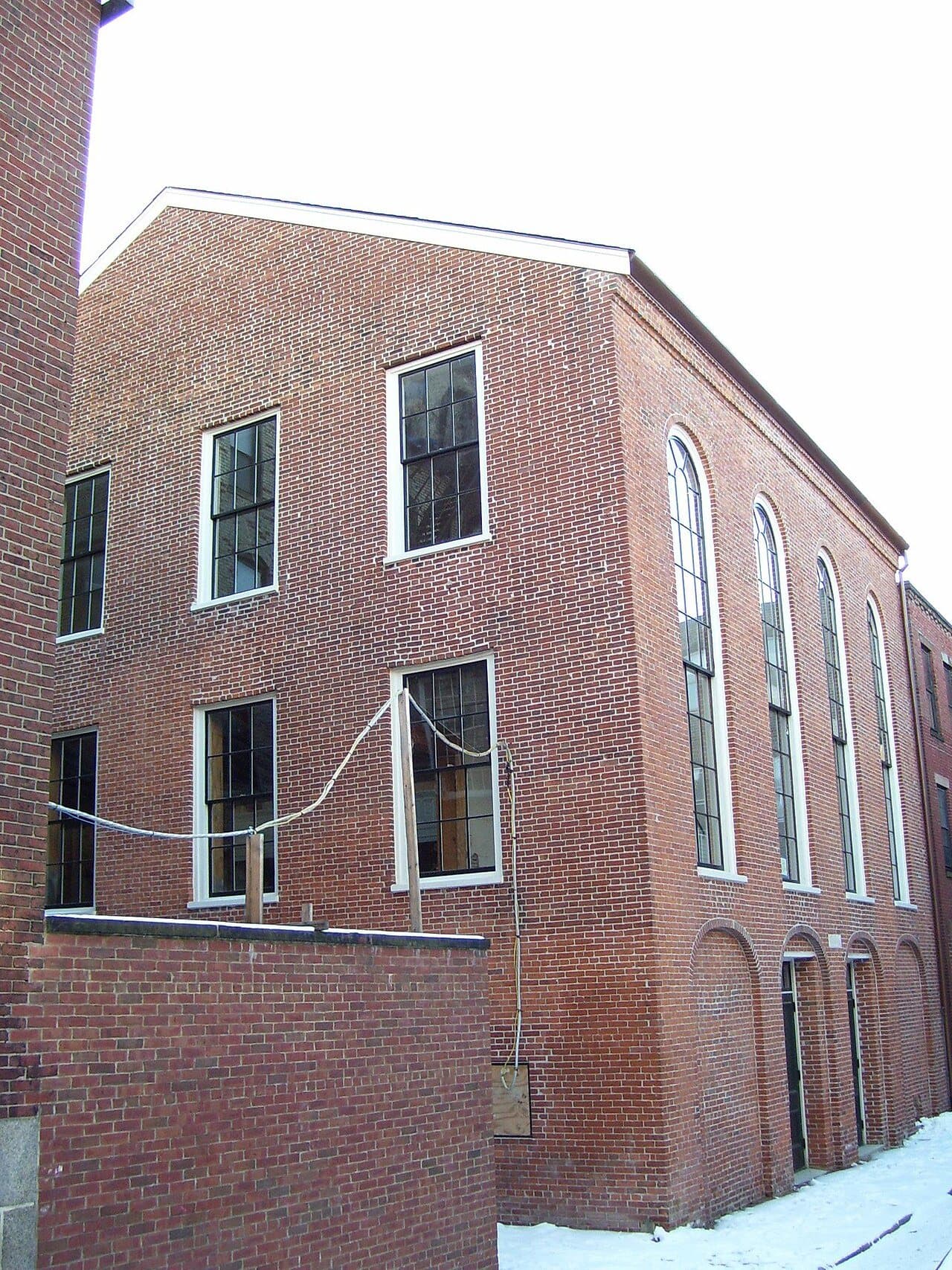
If you walk Salem Street today, between Cooper Street and Prince Street, almost nothing of this is visible. The synagogues are gone. The kosher butcher shops are gone. The pushcarts are gone. There is a small public passageway on the east side of Salem Street, between two residential buildings, with a sign that reads Jerusalem Place. The lane is the surviving fragment of one of the shuls. Around it, the storefronts are Italian. The street has been Italian since about 1920. Most people walking it on a Saturday afternoon would not know there had been twenty synagogues here.
This is how neighborhoods carry history when they are not allowed to retain physical traces of it. The substrate stays. The earlier community moves on. The current community lives in the buildings and does not, in most cases, know what was on Salem Street a hundred and twenty years ago. The Jewish wave moved first to the West End, the immigrant neighborhood that was demolished in the 1958-to-1960 urban renewal, and then to Roxbury, Brookline, and Newton, where the institutions they built in the second half of the twentieth century still operate. The thread the North End held for thirty years did not vanish. It moved.
The Italian wave that took over the same streets after 1900 did not displace the Jewish wave through hostility. The two communities mostly overlapped in time. The Italian businesses took over the storefronts the Jewish businesses were leaving because the Jewish community was, by the 1910s, prospering enough to leave the North End for slightly better housing stock elsewhere. The Italian families arriving had not yet had that decade. They could afford the rent the Jewish families were leaving behind. The displacement was economic, not communal.
The Italian wave that has lasted
The Italian wave arrived in the 1880s and reached its dominant share of the neighborhood around 1900. Stephen Puleo, in his 2007 book The Boston Italians, traces the wave year by year. The Paul Revere Memorial Association puts the turn in two dates: by 1895 the North End was one-third Irish, one-third Jewish and one-third Italian, and by the 1920s it was almost one hundred percent Italian or Italian-American, with more than forty thousand residents. It has about ten thousand today, and the Italian share has been declining slowly since the 1960s. The 2014 census measured the Italian-born share at about eleven percent, with the Italian-descended share substantially higher but well below mid-century levels.
The wave produced specific named individuals you can locate. Luigi Pastene, a Genoa-born immigrant, started with a pushcart in 1848 and opened a Hanover Street shop in 1874. Pastene Companies, the firm he founded, still operates as a major Italian-American food distributor. James V. Donnaruma, a Salerno-born immigrant, founded the Italian-language Boston newspaper La Gazzetta del Massachusetts in August 1903. The paper ran until 1940. Sacred Heart Italian Church at 12 North Square was purchased by the Saint Mark Society in 1884 and renamed by Archbishop Williams in 1888. St. Leonard's Church on Hanover Street, taken over by Italian Franciscans in 1873 and dedicated in 1899, was one of the first Italian Catholic parishes in the United States.
The Society for the Protection of Italian Immigrants, founded 1894, operated as a mutual-aid and immigration-assistance organization for sixty years. The Saint Anthony Feast, run by the Saint Anthony's Feast Society since 1919, is still held the last weekend of August. The Saint Agrippina di Mineo Feast, run by the Saint Agrippina Society since 1914, runs the first weekend of August. These are continuous community-run events, organized by societies the original immigrant communities formed and that their grandchildren and great-grandchildren still operate.
If you have only one association with the North End, it is probably the Italian wave. That association is correct. The wave is real, the community is continuous, the feasts run on schedule, the bakeries are mostly Italian-family-owned. The Italian wave is what you see when you walk the streets today. It is also, however, the fifth chapter. The substrate is older than the wave.
What a 1933 sightline did with the substrate
One stop on the Roamer Freedom Trail tour reads the wave-stack in a single civic gesture. The Paul Revere Mall, locally called the Prado, is a 480-foot brick walkway between high brick walls, running from Hanover Street to the back of Old North Church. The landscape architect Arthur Shurcliff designed it in 1933 with his son Sidney, and the name came from Havana's Paseo del Prado. Before that it was Webster Avenue, a narrow passage. The city cleared it of tenement housing and widened it to open a straight view between two old churches, Old North and St. Stephen's. Cyrus Dallin's equestrian bronze of Paul Revere, unveiled in 1940, stands at the Hanover Street entrance.
Several waves in one civic act. A 1933 project honored a colonial-era silversmith by clearing Italian-era tenements, and borrowed its nickname from a Cuban boulevard. The people whose housing came down were the community that now fills it.
The Prado is now treated, by most visitors, as a piece of Italian-American civic memory. Bas-relief plaques set into the brick walls commemorate North End figures. The feast processions move through it. The community has, in effect, absorbed the 1933 gesture and made it theirs.
That is what neighborhoods do. They absorb. St. Stephen's, across Hanover Street from the Prado, was built in 1804 and is the only Bulfinch church left standing in Boston; it is a Catholic parish now. Rose Fitzgerald Kennedy, the daughter of an Irish mayor of Boston and the mother of a President, was baptized in St. Stephen's in 1890 and held her funeral there in 1995. The same building, the same six blocks of substrate.
What to hold
The North End is not a museum of immigrant succession. It is a working neighborhood where four communities have lived in succession on the same housing stock, and where the fifth community, the mix of long-term Italian-American residents and young white professional newcomers, is operating right now under the same logic that drove the previous four turnovers. Rents are among the highest per square foot in Boston. The Italian-American share of residents is dropping. The next demographic chapter is being written on the same six blocks.
The fact to hold, walking the streets, is that no community on these blocks has ever been the final one. The buildings stay. The communities move through. To see the neighborhood as Italian-and-only-Italian is to see only the current chapter. To see it as a sequence is to see what makes it useful to think about.
The cannoli are good. The Saint Anthony Feast draws crowds for a reason. Hanover Street on a Saturday in summer is one of the most concentrated public-life experiences in any American city. But the thing to notice, walking it, is not the Italian wave. It is the substrate the Italian wave is currently the most visible tenant of, and the fact that the substrate has had four tenants before and will have a fifth after.
The North End is doing what it has done for four hundred years. It is being where new arrivals first stand.
Ready to experience it?
Freedom Trail: The Buildings Boston Refused to Lose
120 min · 2.5 km · easy
More from Boston
Explore more at your own pace.
Best Self-Guided Walking Tours in Boston (2026)
Boston Travel Guide: How Many Days, Getting Around, When to Go (2026)
One Day in Boston: A Walkable Downtown Itinerary (2026)
Best History Walking Tours in Boston (2026)
What to Eat in Boston: A Food Guide (2026)