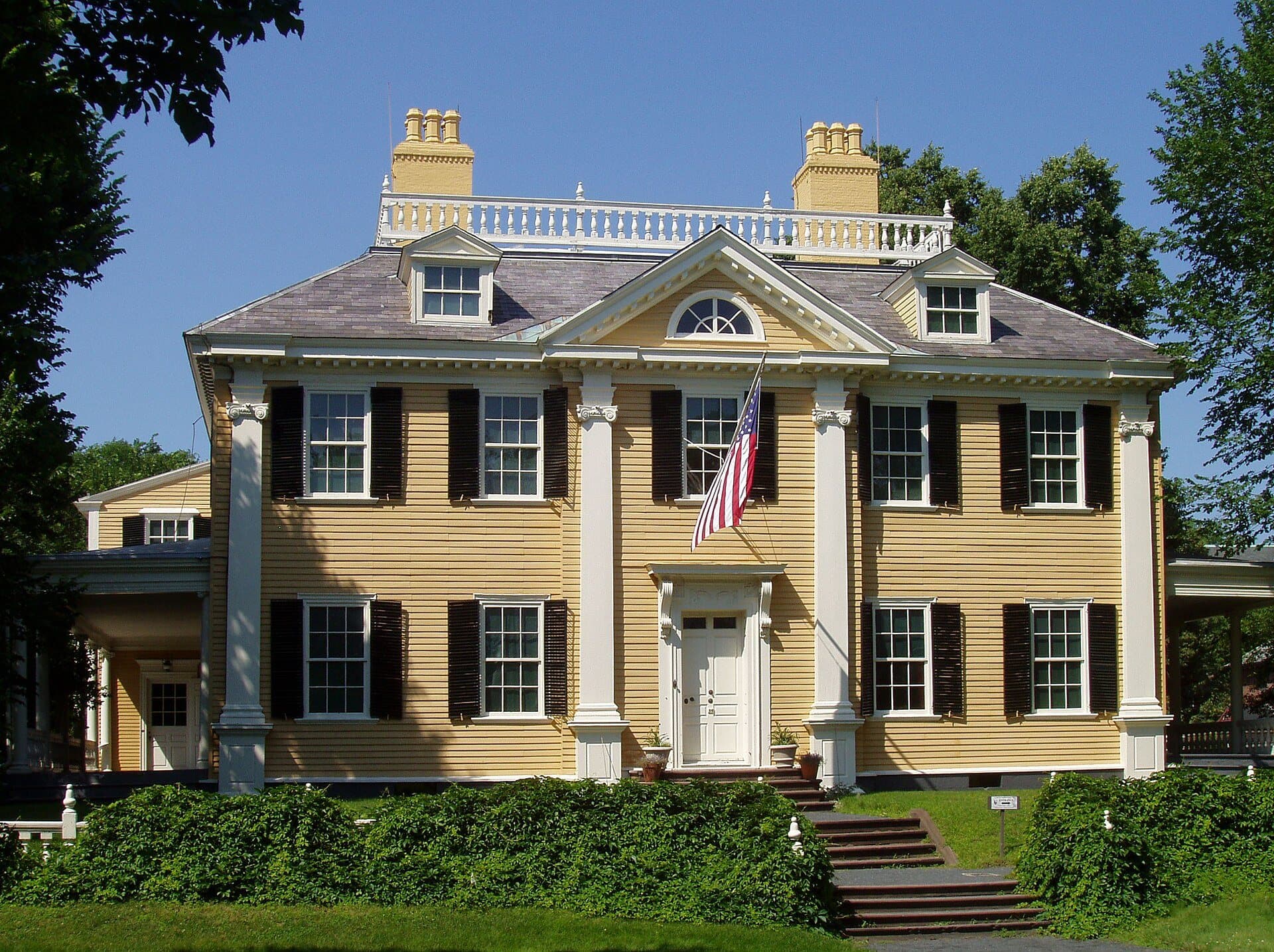
The house at 105 Brattle Street is yellow clapboard, two stories over a brick basement, with a central pediment, paired chimneys, and a small balustraded roof balcony. The lot is set back from the street, raised slightly above the sidewalk on a low terrace, with a wooden gate and a row of mature trees screening the front. The house is the most architecturally articulate of the surviving Georgian mansions on what was once called Tory Row.
Three dates carry the building.
It was built in 1759 for John Vassall Junior, the son of a wealthy Cambridge merchant family. In 1775 the Vassalls fled, the Continental Army took the house, and George Washington occupied it as his headquarters during the nine-month Siege of Boston. In 1837 Henry Wadsworth Longfellow rented rooms in the building and stayed for forty-five years, writing in those rooms the poetry that defined a generation of American literary culture.
Two centuries are compressed into the same yellow walls.
What the house was built on
John Vassall Junior was twenty-one when he commissioned the house. The Vassall family was wealthy. The family fortune came from a sugar plantation in Hanover Parish, Jamaica, worked by enslaved Africans. The Olivers, the Lechmeres, the Phipps families on the same stretch of Brattle Street had comparable Caribbean holdings. The row of mansions known as Tory Row was funded, almost without exception, by the wealth of Caribbean slave-based agriculture.
The Park Service interpretive materials at the house say this directly. The 1759 house exists because there was a plantation that produced the capital for it. The architecture, the high-style Georgian proportioning, the symmetrical pediment, the small balconied roof, the formal interior plan are not separable from the source of the money.
Vassall lived in the house with his wife Elizabeth Oliver Vassall, the daughter of a neighbouring Tory Row family, and their growing children. The household included enslaved Africans of African descent who served the Vassalls in domestic capacity. By the 1770s Massachusetts had a small but significant enslaved population, including in Cambridge, and the Brattle Street households were among the larger slaveholders. The house's east wing kitchen and the small bedroom above it housed some of these enslaved people. The Park Service's recent interpretive work has documented their lives, where it can be documented.
This is the foundation of the building. The 1759 mansion was a luxury object whose existence depended on a system of trans-Atlantic enslavement that the Vassall family neither created nor seriously questioned.
The Loyalists flee, the Army arrives
Hear a stop from this walk
Longfellow House on Brattle Street: Tory Mansion, Headquarters, Poet's Home
The Revolutionary War made Tory Row untenable. The Vassalls were Loyalists. So were their neighbours. After the battles of Lexington and Concord on April 19, 1775, the surrounding countryside was in armed revolt. The Loyalist families packed what they could and left for Boston, then for Halifax and London. By midsummer, every house on Brattle Street had been abandoned by its prewar owners.
The Continental Army moved into Cambridge to lay siege to Boston. Cambridge in 1775 was a working colonial town of about 1,500 people. The army that arrived numbered in the thousands and required housing for its officers, supply chains, hospital facilities, and command infrastructure. The abandoned Tory Row mansions were the largest, best-built houses available. They were requisitioned.
George Washington arrived in Cambridge in July 1775 to take command of the Continental Army. He made the Vassall house his headquarters from that summer until the spring of 1776, the first long-term headquarters of the war, in the Park Service's words. For nine months, the army of the new United States was directed from behind the clapboard walls you are looking at.
Martha Washington joined him in December 1775. The household at 105 Brattle for that winter included the commander-in-chief, his wife, his enslaved servants (Washington brought several enslaved Virginians with him to Cambridge), his military aides, and a steady flow of officers, couriers, and visitors. The household also included Phillis Wheatley, the formerly enslaved Boston poet, who visited in March 1776 to read her tribute poem to Washington in person.
The Siege of Boston ended on March 17, 1776, when the British evacuated. Washington moved with the army to New York in April. He never returned to the house, though he corresponded warmly with several Cambridge residents for the rest of his life.
The eighty years between
After the war, the house passed through several owners. Andrew Craigie, an apothecary who had served as Apothecary General of the Continental Army and later a Cambridge land speculator, bought the property in 1791 and lived there until 1819. Craigie added a rear wing and the distinctive open porches, or piazzas, along the sides of the house.
Craigie died in 1819 and his widow Elizabeth, in financial difficulty, took in boarders to cover expenses. The boarders were typically Harvard faculty or students. Edward Everett, the Massachusetts politician who would later be the principal speaker at the dedication of the Gettysburg cemetery on the day Lincoln gave his much shorter address, lived briefly in the house. Jared Sparks, a Harvard professor and later its president, lived there. The house, in the decades between Washington and Longfellow, was a faculty boarding house with a famous prior tenant.
The continuity matters. The building was not preserved as a Washington shrine in those years. It was a useful Cambridge mansion that happened to have housed the general. The next chapter would change that.
Longfellow arrives
Henry Wadsworth Longfellow rented rooms in the Craigie House in the summer of 1837. He was thirty years old, a recent appointment to the Harvard faculty as professor of modern languages, and just beginning his career as a poet. He was deeply conscious of living in a house that carried historical weight.
In 1843, Longfellow married Frances Appleton, the daughter of a wealthy Boston merchant. Her father bought the entire Craigie House as a wedding gift to the couple. Longfellow lived in the house from 1843 until his death on March 24, 1882. Frances died in 1861, when her dress caught fire during a household accident; Longfellow was severely burned trying to extinguish the flames. The beard he wore for the rest of his life concealed the scars.
In the front parlor and the study on the first floor, Longfellow produced the poetry that defined a generation of American letters: "Evangeline" (1847), "The Song of Hiawatha" (1855), "The Courtship of Miles Standish" (1858), and "Tales of a Wayside Inn" (1863), which opens with the poem "Paul Revere's Ride."
That last poem was published in the January 1861 Atlantic Monthly. It was written in 1860, while Longfellow lived at 105 Brattle Street, during the year that the country slid toward civil war. The poem is the source of the standard American mythology of the Revolution: the lanterns in the Old North Church belfry, "one if by land, and two if by sea," the midnight horseman rousing the countryside. The historical Paul Revere had a more complicated and less heroic ride. The poem made his ride canonical.
The Old North Church and the Paul Revere House, both stops on the Roamer Freedom Trail tour, are visited every year by hundreds of thousands of tourists. The reason those sites are visited at all, in the form they are visited, traces directly to the poem Longfellow wrote in this house.
What the building is for now
The Park Service acquired the house in 1972 and operates it as the Longfellow House-Washington's Headquarters National Historic Site. The interior is preserved in a state close to Longfellow's late nineteenth-century arrangement. The Washington headquarters period is interpreted through the rooms Washington used. The Vassall period is interpreted through the architecture and through ongoing research into the lives of the enslaved members of the household.
The collection includes Longfellow's library, his correspondence (he was one of the most extensively networked literary figures of his time, with letters to and from Dickens, Tennyson, Hawthorne, Emerson, and most of the major writers of mid-nineteenth-century Anglophone literature), and an extensive run of family papers. The papers documenting the Vassall period are sparser; what survives is largely property deeds, business correspondence, and the indirect evidence of the household's enslaved residents.
What to look for
Stand on the south side of Brattle Street, at the head of Longfellow Park, facing north to the house. The 1759 building is the five-bay block, with giant Ionic pilasters at the corners, the shallow pedimented center, the paired chimneys, and the balustrade on the roof. The open porches on both sides are Craigie's 1790s additions. Behind you, the park runs down toward Mount Auburn Street to the 1914 Longfellow memorial by Daniel Chester French and Henry Bacon.
Now look at the proportions. The five-bay Georgian center is symmetrical, with the central doorway flanked by two windows on each side and five windows above. The pediment in the center of the roofline is the visual anchor. The small roof balcony, accessible through a door on the third floor, is a feature that almost no surviving New England Georgian houses retain in original condition.
The interior is seen on free guided tours run by the Park Service. In 2026 they run from 22 May to 31 October, Friday to Monday, hourly from 10 a.m. to 4 p.m., with at most twelve people per tour (reserve by phone the same day or walk in; checked 4 October 2026). From November the house is closed until the next season, but the grounds stay open. Longfellow's library is largely preserved as he left it at his death in 1882.
The grounds and the formal garden are open daily from dawn to dusk, and they are free.
One clapboard house. The sugar money is in the walls. The Continental Army's headquarters is in its history. The poem that sent the world to Old North was written by the man who lived here. Cambridge had a city, and a substantial one, before it had a Harvard-dominated college town. This building is one of the cleanest physical records of that fact.
Longfellow House is the last of ten stops on the Roamer Harvard Square and Harvard Yard: A Past Made to Measure self-guided tour, which walks from Harvard Square through Harvard Yard, past Memorial Hall, the Washington Elm and Christ Church, along old Tory Row to this house. The stop works from the Brattle Street sidewalk whether or not the house is open.
Sources
- National Park Service, Longfellow House-Washington's Headquarters National Historic Site, interpretive materials and finding aids.
- Wikipedia, "Longfellow House-Washington's Headquarters National Historic Site."
- Wikipedia, "Henry Wadsworth Longfellow"; "Paul Revere's Ride (poem)"; "Siege of Boston."
- Charles M. Calhoun, Longfellow: A Rediscovered Life (Beacon Press, 2004).
- Ron Chernow, Washington: A Life (Penguin Press, 2010), on the Cambridge headquarters period.
Ready to experience it?
Harvard Square and Harvard Yard: A Past Made to Measure
95 min · 2.2 km · easy
More from Boston
Explore more at your own pace.
Best Self-Guided Walking Tours in Boston (2026)
Boston Travel Guide: How Many Days, Getting Around, When to Go (2026)
One Day in Boston: A Walkable Downtown Itinerary (2026)
Best History Walking Tours in Boston (2026)
What to Eat in Boston: A Food Guide (2026)