Harvard Square and Harvard Yard: A Past Made to Measure
95 min · 2.2 km · easy
The conventional reading of Cambridge places Harvard at the centre. Harvard is wealthier than the city by an order of magnitude. The university's endowment in 2024 was roughly 50 billion dollars; the city's annual budget runs around 850 million. Harvard owns more land in Cambridge than any other entity, including the city. The reading is plausible.
It is also wrong.
Cambridge was founded as Newetowne in December 1630, six years before the Massachusetts General Court voted to establish what would become Harvard College. The town came first. The college was placed inside it, on land the town granted. The city is the older fact. The universities sit inside the city, on terms the city has periodically rewritten.
The conventional reading misses this because the universities have, over four centuries, become so much larger and richer than the city that they appear to be the senior entity. They are not. They are large tenants. Cambridge has, three times in the last hundred years, made civic decisions the universities did not propose, and those decisions are why Cambridge is what it is today.
The most important was a vote, by the City Council, in February 1977.
The town that arrived early
Cambridge in 1630 was English farmland. The first settlers built a small grid of streets at what is now Harvard Square. By 1635, when the colony's General Court considered where to place the new college, Cambridge was a settled town of roughly a thousand people. The court chose it over Boston, partly because the farmland could feed students cheaply and partly because the town was close enough to Boston to be supervised but far enough to keep undergraduates from urban distraction.
For its first two hundred years, the college operated as an institution embedded in a small town. The town fed the students, housed the faculty, and provided the civic infrastructure that allowed the college to be a college rather than a self-contained compound.
When the Revolution came, the town hosted the war. The Continental Army moved into Cambridge in July 1775, occupying the Tory Row mansions on Brattle Street whose owners had fled. George Washington commanded the Siege of Boston from 105 Brattle Street between July 1775 and April 1776. The house at 105 Brattle had been built with the wealth of a Caribbean slave plantation: the Vassalls owned a sugar plantation in Jamaica. The Continental Army used the slave-funded mansions to fight the war that would, eventually, end Massachusetts slavery.
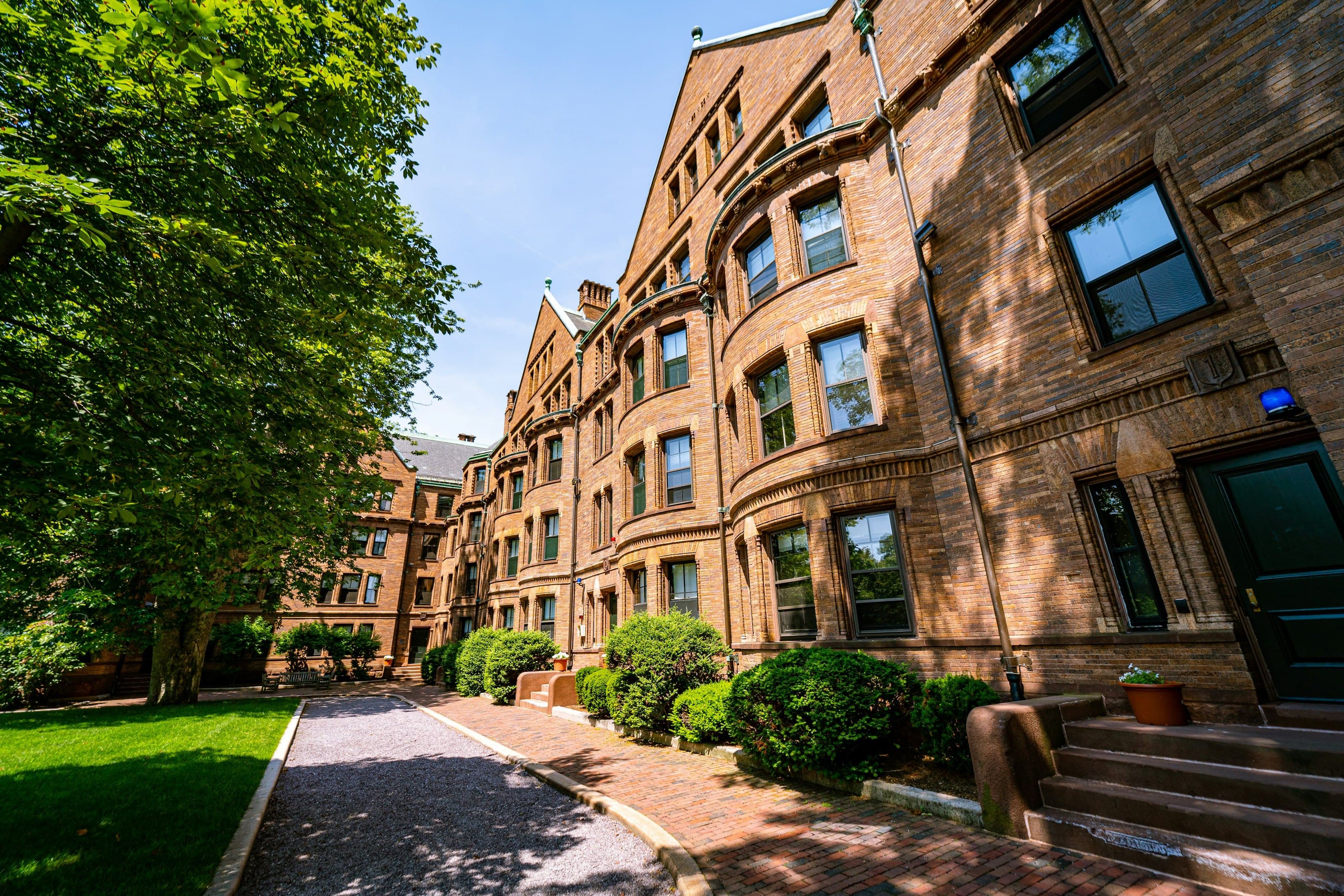
The college was tiny through this period. Harvard had roughly two hundred students in 1775, in four buildings at what is now the western end of Harvard Yard. The town was the larger fact.
This continued through the early nineteenth century. The college grew slowly. The town grew with industrial development of East Cambridge, which by the 1840s was producing glass, soap, furniture, and printed books. In 1846 the town incorporated as a city, the population having grown past fifteen thousand. The incorporation was driven by the working-class neighborhoods east of Harvard Square, not by the college.
The institution that arrived already old
Hear a stop from this walk
Longfellow House on Brattle Street: Tory Mansion, Headquarters, Poet's Home
The first decisive mutation happened in 1916.
MIT had been chartered in Boston in April 1861 by the geologist William Barton Rogers. Its mission was to teach the engineering and applied science the American industrial economy needed. For its first fifty-five years MIT operated in Boston, mostly in Back Bay, in a building the school called the New Technology. The institute outgrew it. In 1912 it bought about fifty acres on the Cambridge side of the Charles River, opposite Back Bay. The land was tidal flat that had been filled in the 1880s and 1890s. It had previously been salt marsh and a soap factory. It was cheap because it was barely solid.
William Welles Bosworth designed MIT's new campus around Killian Court, a steel and concrete structure dressed in pale limestone, Beaux-Arts in style, with the Great Dome as the visual anchor. Construction ran 1913 to 1916. The institute, in building a classical front over modern engineering for its first permanent home, was making a statement about what it taught.
MIT opened in Cambridge in 1916. It arrived already fifty-five years old, with an established faculty, an endowment, a national reputation, and a curriculum unrelated to Harvard's classical liberal-arts core. From 1916 onward Cambridge had two universities. One was nearly three hundred years old, Anglo-Protestant, humanistic. The other was fifty-five years old, engineering-oriented, and built on filled tidal flat. They were one Mass Ave mile apart and they have remained profoundly different institutions despite occupying the same city.
The civic point is that the city absorbed both. Cambridge could have refused MIT's purchase, zoned against the construction, or contested the riverfront land use. It did not. The 1916 arrival was a civic decision, however quietly made, to allow a second major university to operate inside the city limits. By doing so, the city committed itself to becoming a two-university town in a way that no other American city would become.
This was the first mutation. The pattern thereafter was set: Cambridge would absorb major institutional changes that other municipalities would have rejected, and would do so through civic processes that were unusually transparent and unusually open to public input.
The vote nobody else made
The second mutation, the most consequential, happened in 1977.
By the mid-1970s, recombinant DNA research had emerged as the most promising and most controversial frontier of biology. The technique had been demonstrated by Paul Berg at Stanford, Herbert Boyer at UC San Francisco, and Stanley Cohen at Stanford. The implications for medicine were vast. The implications for biosafety were uncertain. In 1974, scientists including Berg called a voluntary moratorium pending safety guidelines. The Asilomar Conference of February 1975 produced the first guidelines, which became the basis for the National Institutes of Health's June 1976 rules.
Harvard, in 1976, proposed to build a recombinant DNA laboratory at a facility in Harvard Yard. The proposal triggered a public response no university researcher had anticipated.
In June 1976, Mayor Alfred Vellucci, an East Cambridge populist who had served on the City Council for twenty years, convened a public hearing on whether the university should be permitted to do the research inside the city limits. Vellucci was working-class Italian-American, the son of an immigrant tailor, famously sceptical of Harvard's institutional weight. He had spent his political career picking fights with the university. The recombinant DNA hearing was a continuation of those fights. Vellucci understood, as Harvard initially did not, that the question of whether genetic engineering was safe was a civic question, not a scientific one.
The historian Sheldon Krimsky, then at Tufts, attended the hearings. His 1982 book Genetic Alchemy: The Social History of the Recombinant DNA Controversy, published by MIT Press, remains the standard account. Vellucci's lead question was whether the experiments could produce "Frankensteinian organisms." The transcript reads, in retrospect, like a foundational document for how American cities would learn to govern biotechnology.
In July 1976, the City Council voted a three-month moratorium and appointed a citizen panel, the Cambridge Experimentation Review Board. The board consisted of eight residents: three with scientific backgrounds, five without. They held public meetings across the fall and winter of 1976.
In January 1977, after seventy-five hours of testimony, the board returned a unanimous recommendation. The research could proceed under guidelines slightly stricter than the federal NIH standard. The City Council voted those guidelines into law in February 1977.
This was the world's first municipal biosafety ordinance. It established a city-level regulatory framework for genetic engineering, with permits, containment levels, public reporting, and inspection. No other municipality had passed comparable legislation. The federal government did not have a comparable regime. The international scientific community was still operating under voluntary Asilomar guidelines. Cambridge had voted itself into being the first place in the world with a legal framework for what kinds of recombinant DNA work could happen inside its limits.
The vote is the hinge. Almost everything in Cambridge biotechnology after 1977 is downstream of it.
The companies that arrived because of the vote
The ordinance had an effect Vellucci did not anticipate. It made Cambridge attractive to biotech.
Biogen, founded in Geneva in 1978 by an international group that included Walter Gilbert of Harvard and Phillip Sharp of MIT, located its U.S. operations in Cambridge in 1982. Genentech, founded 1976 in San Francisco, had been the first major biotech firm. Biogen was the second. Cambridge's location was a deliberate choice driven by the regulatory framework and the trained graduate students within a mile-radius.
The Whitehead Institute was founded in 1982 by industrialist Edwin Jack Whitehead with a hundred-million-dollar gift, affiliated with MIT. The Broad Institute, partnered between MIT and Harvard, launched in May 2004 with a hundred-million-dollar gift from Eli and Edythe Broad. The Cambridge Innovation Center, founded by Tim Rowe in 1999, became the densest small-company space for biotech and tech in the region. Vertex Pharmaceuticals moved its headquarters to Cambridge in 2014. Moderna, founded in 2010, kept its headquarters here through the period that produced one of the two leading COVID-19 vaccines.
Edward Roberts of MIT Sloan, in his 2009 Kauffman Foundation study Entrepreneurial Impact: The Role of MIT, estimated roughly sixty-nine hundred MIT-alumni-founded companies operating in Massachusetts as of the mid-2000s.
By 2010 Kendall Square had become one of the densest concentrations of life-science companies anywhere. Greater Boston was, by 2024 data, also the largest U.S. life-science cluster by total lab inventory, at approximately 62 million square feet against roughly 55 million in the San Francisco Bay Area. Density per square mile is Cambridge. Total inventory is Greater Boston. Cambridge is the dense core of the largest cluster in the country.
The cluster is downstream of the 1977 vote. Other cities did not have the regulatory framework. By the time they tried to build one, Cambridge was already a decade ahead. The first-mover advantage was civic, not scientific.
The third mutation, in progress
The third mutation, currently underway, is the post-2000 expansion of the cluster into AI, computing, and convergent science.
In 2003 MIT merged Project MAC (1963) and the MIT Artificial Intelligence Laboratory (1970), both long housed at 545 Technology Square, into the Computer Science and Artificial Intelligence Laboratory (CSAIL). CSAIL moved into the Stata Center, designed by Frank Gehry and opened in 2004. The Stata Center is the most architecturally aggressive building MIT has ever commissioned. The institute that had built the Beaux-Arts limestone of Killian Court in 1916 hired, eighty-eight years later, the architect of tilted, tumbling metal volumes. The Stata Center's problems, including leaks and sliding ice and snow, led MIT to sue Gehry's firm and the builder in 2007.
The third mutation is about what Kendall Square is becoming. The biotech cluster of the 1980s and 1990s has, since 2010, increasingly converged with computing and AI research. The Broad's genomic-data analysis runs on massive computational infrastructure. A new generation of AI-driven drug-discovery firms operates adjacent to the legacy biotech infrastructure. A convergent science is concentrating here because the existing concentration makes it the obvious place for the next one.
The city, at this writing, is working on a new generation of zoning decisions for Kendall Square and the East Cambridge waterfront. The 1977 ordinance has been amended several times. The city continues to vote on what its universities will be allowed to do inside its limits.
The pattern is legible. The city makes the decisions. The institutions live with them. The city is the senior entity.
What to hold
Cambridge is, in conventional reading, a college town. It is not. It is a city with universities inside it.
Princeton has Princeton. Ithaca has Cornell. New Haven has Yale. The relationships have settled. The relationships have stopped moving.
Cambridge has not stopped moving. Three times in the last hundred years the city has restructured its relationship with its universities. In 1916 it absorbed a second major university that arrived already old. In 1977 it voted to permit a kind of research no other municipality had a legal framework for, and attracted the foundational generation of biotech companies. Since 2000 it has been absorbing the convergence of biotech and computing into a denser cluster on the same land MIT first built on in 1916. None of the mutations were initiated by the universities. The universities responded to civic decisions.
Walk Cambridge knowing this. The Yard is not the centre. The Yard is a piece of the city that the city chose, almost four hundred years ago, to give to a college. Kendall Square is the most recent example of the same pattern. The buildings record the mutations. The mutations were votes. The votes were made by neighbors of the universities, not by the universities themselves.
That is the city the college is inside of. The college thinks it is the centre. The city, occasionally, has to remind it that it is not.
Walking it
Roamer splits Cambridge into two self-guided walks, because the two universities are a long avenue apart and read best on their own. Harvard Square and Harvard Yard: A Past Made to Measure is ten stops and about 2.2 kilometers, roughly an hour and a half: Harvard Square, Johnston Gate and Massachusetts Hall, the John Harvard statue, Tercentenary Theatre and Sever Hall, Le Corbusier's Carpenter Center, Memorial Hall, the Washington Elm on Cambridge Common, Christ Church, Radcliffe Yard, and Longfellow House on old Tory Row. It no longer goes to MIT.
MIT: The Campus That Kept Every Experiment is the other half: nine stops and about 2.4 kilometers, under an hour and a half, from the Smoot marks on the Harvard Bridge past Aalto's Baker House, Saarinen's Kresge Auditorium and chapel, Lobby 7, the Great Dome over Killian Court, Calder's big sail in McDermott Court, the Media Lab and Gehry's Stata Center, to Kendall Square, where the cluster this essay describes is all around you. The MIT walk stays outdoors; the courts are open to the public, and much of the campus is open weekdays from 6 a.m. to 7 p.m.
Ready to experience it?
Harvard Square and Harvard Yard: A Past Made to Measure
95 min · 2.2 km · easy
More from Boston
Explore more at your own pace.
Best Self-Guided Walking Tours in Boston (2026)
Boston Travel Guide: How Many Days, Getting Around, When to Go (2026)
One Day in Boston: A Walkable Downtown Itinerary (2026)
Best History Walking Tours in Boston (2026)
What to Eat in Boston: A Food Guide (2026)