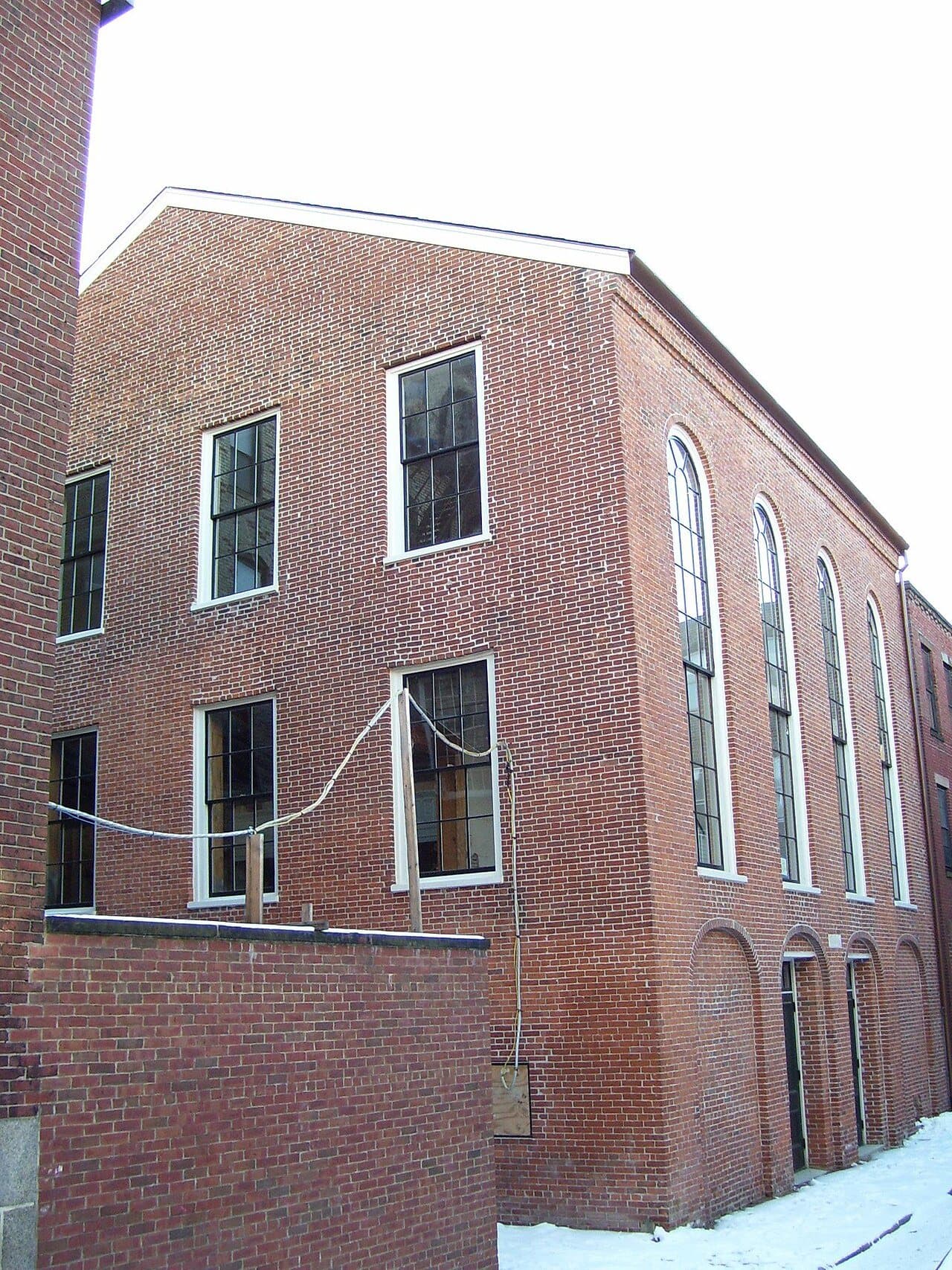
In 1832, a small group of men met inside the African Meeting House on the north slope of Beacon Hill and founded the New England Anti-Slavery Society. William Lloyd Garrison, who had launched The Liberator the year before, led it. The others were free Black and white abolitionists from the Boston community.
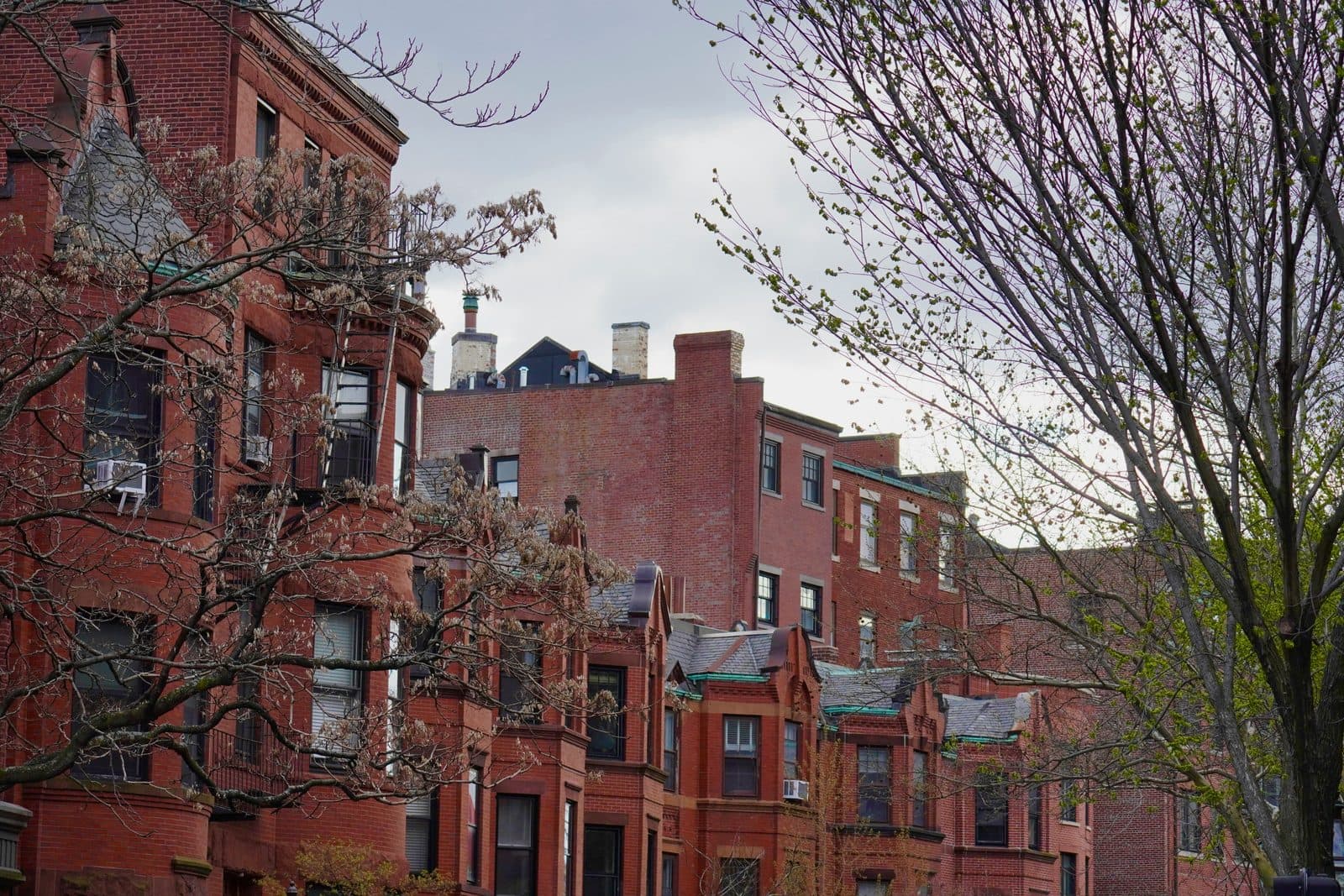
The meeting hall they met in had been built in 1806 by Black craftsmen, with a fundraising effort led by Cato Gardner, a native African who, in the National Park Service's words, personally raised $1,500. The hall sat at Smith Court and Joy Street, in the most concentrated free Black neighborhood in the northern United States. Two and a half blocks south, on the other side of Beacon Hill's ridge, the white merchants who had bought up eighteen and a half acres of John Singleton Copley's pasture in 1795 had built a neighborhood of brick row houses and an editorial circle that would shortly produce the Atlantic Monthly and the American literary canon.
Two blocks. Two centuries of dispute compressed into walkable space.
The shape of Beacon Hill is the shape of the argument. The hill is a single drumlin, two streets deep at the top, rising perhaps fifty feet above Boston Common. The Massachusetts State House sits on the highest point. From the State House gate, the south slope falls away toward the Common in one direction and the north slope falls away toward Cambridge Street in the other. The slopes are not metaphorical. They are physical. The community on each lived separated by the four blocks of Beacon, Mt Vernon, Pinckney, and Myrtle Streets running along the ridge.
That distance is what makes Beacon Hill different from every other site in American antebellum memory. The arguments about slavery, citizenship, abolition, class, and culture that the United States rehearsed between 1800 and 1865 were, in this neighborhood, argued out by neighbors. Frederick Douglass, William Lloyd Garrison and Maria Stewart spoke at the African Meeting House on the north slope. Lewis and Harriet Hayden ran the city's most active Underground Railroad safe house out of 66 Phillips Street, a few streets away. Robert Gould Shaw, the white officer who would lead the Massachusetts 54th Volunteer Infantry, came from a Brahmin abolitionist family, and his regiment marched past the State House at the top of the hill. The argument was geographic. The people arguing it crossed each other in the street.
The south slope as a real-estate venture
The south slope was, before it was a neighborhood, a hill. The Trimountain, named for its three peaks, had stood at the center of the Shawmut Peninsula since glacial recession. By 1795 Boston was running out of buildable land. A syndicate calling itself the Mount Vernon Proprietors organized to develop the western peak.
The Proprietors were a small group of Boston Federalists led by Harrison Gray Otis, with Jonathan Mason and Charles Bulfinch, the architect, among them. Hepzibah Swan, one of the few documented eighteenth-century American women to take part as a principal in a major real-estate development, joined them. Sources differ on the rest of the roster.
They paid eighteen thousand four hundred and fifty dollars for eighteen and a half acres of John Singleton Copley's land. In 1799 they carved fifty to sixty feet off the top of the western peak, Mount Vernon, and dumped the gravel into the Charles River to make more land for themselves. Then they laid out the streets and began building the brick row houses that still stand on Mt Vernon and Chestnut and Beacon today.
The State House, which Bulfinch designed, was finished in 1798. Its cornerstone was laid on July 4, 1795, on land that had once been John Hancock's cow pasture, the same year the Proprietors bought Copley's. Bulfinch was at once designing the Commonwealth's public building and taking part in the speculative residential development that would surround it. They were separate ventures, one public and one private, but the same architect stood behind both, and the dome rose over the lots the syndicate was selling.
The class that lived in the neighborhood was named, several decades later, by one of its own. Oliver Wendell Holmes the elder coined the term Boston Brahmin in a novel called Elsie Venner, first serialized in the Atlantic Monthly in 1860. Holmes was naming his own caste. Brahmin Boston was small, intermarried, Unitarian, and edited.
What it edited was a large share of American letters. The Atlantic Monthly was founded in November 1857 by a Brahmin circle that included Holmes, James Russell Lowell, Henry Wadsworth Longfellow, John Greenleaf Whittier, Ralph Waldo Emerson, and Harriet Beecher Stowe. William Dean Howells, the Atlantic's most consequential editor of the late nineteenth century, was among the residents of Louisburg Square, as were Bronson and Louisa May Alcott.
The Brahmin reputation for abolitionism is real. It is also partial. Some of the hill's families were committed abolitionists; many more were not, and Boston's merchant wealth was tied in many ways to trade with slaveholding economies.
The north slope as an organized community
Hear a stop from this walk
Boston Public Library: Free to All
The north slope developed at almost the same moment, for different reasons. By 1790 the free Black population of Boston, recently emancipated by the Massachusetts Supreme Judicial Court's 1781 ruling in the Quock Walker case, was looking for a neighborhood to consolidate in. The back side of Beacon Hill was steeper, less desirable to the Brahmin developers, and accessible at lower property cost. By 1800 the community was clustered on Joy Street, Phillips Street, and Smith Court. By 1850 it was the most concentrated free Black neighborhood in the United States outside of Philadelphia.
The institutions came first. The African Meeting House opened in 1806; the Park Service calls it the oldest extant Black church building in America. The Abiel Smith School, which the Museum of African American History calls the oldest public school in the United States built solely to educate African American children, opened next door at 46 Joy Street in 1835. The building was funded by a four-thousand-dollar bequest from a white merchant named Abiel Smith. It was a segregated school. In 1849 Benjamin Roberts sued the city on behalf of his daughter Sarah, who had been turned away from a white school nearer home; the Massachusetts Supreme Judicial Court ruled against the family in 1850. The campaign went on, led by William Cooper Nell, and in 1855 Massachusetts outlawed segregation in its public schools.
The political organizing was older and more sustained than the Garrison-centered story usually admits. David Walker, a free Black used clothing store owner who lived on Belknap Street (today's Joy Street), published Walker's Appeal to the Coloured Citizens of the World in September 1829. The pamphlet was the most explosive American abolitionist document of the decade. It called on enslaved Americans to resist by any means. It was banned and burned across the South. Walker died in 1830, possibly of poisoning. Maria W. Stewart, a member of the African Meeting House congregation, gave one of the earliest public political lectures by an American woman of any race at Franklin Hall in September 1832. The chronology is documentary. Walker first in 1829. Garrison and the New England Anti-Slavery Society in 1832. Stewart's lecture the same year.
The pattern was self-organized Black political work that the white abolitionist movement attached itself to. The New England Anti-Slavery Society held its founding meeting inside the African Meeting House because the Meeting House was the most active political space the movement had access to in Boston. The Black community organized first. The historiographic record has, in many tellings, inverted the order.
Lewis Hayden tied the political work to the operational. He had escaped enslavement in the mid-1840s and, with his wife Harriet, made 66 Phillips Street what the National Park Service calls the most active Underground Railroad safe house in the city, sheltering scores of documented freedom seekers. William and Ellen Craft stayed with the Haydens during the most dangerous weeks of 1850. The house is a private home today.
What made Hayden's work different from the secret-tunnel mythology of the Underground Railroad is that it was not secret. When slave-catchers came for the Crafts under the Fugitive Slave Act of 1850, Hayden barricaded his doorway and threatened them. (The often-repeated story of a keg of gunpowder in the basement is not in the Park Service's account or in William Craft's own narrative.) The work was defiant rather than concealed.
What happened in the four blocks
The four blocks between the slopes were where the two communities met.
Park Street Church, on the Common edge of the south slope, hosted Garrison's first antislavery speech in 1829, the year David Walker published the Appeal on the north slope. Garrison was twenty-three. He had no newspaper, no organization. He was unknown.
The Charles Street Meeting House, at the foot of the hill, was built in 1807 for the Third Baptist Church, which, the Park Service records, enforced racially segregated seating. A white abolitionist, Timothy Gilbert, challenged that in 1836. In 1876 the congregation sold the building to the First African Methodist Episcopal Church, which stayed until 1939, the last Black institution to leave Beacon Hill.
Joy Street ran straight up the slope, from the north side over the ridge to the Common. Robert Gould Shaw's parents, Francis and Sarah, were Brahmin abolitionists, the small minority openly anti-slavery from the 1830s onward. When the Massachusetts 54th Regiment was raised in 1863 under Governor John Andrew, Robert was twenty-five and a Harvard graduate. He accepted the colonelcy.
On May 28, 1863, the 54th marched past the State House on its way out of Boston to South Carolina. The march passed a few minutes' walk from the African Meeting House on Smith Court. The line that had run along the ridge for sixty years was, in formation, crossed.
Seven weeks later, on July 18, 1863, the 54th led the assault on Fort Wagner, South Carolina. Shaw was killed leading it, and nearly half the regiment was killed, wounded or captured. The regiment did not take the fort. The 54th fought on, at James Island, Olustee and Honey Hill, and came home to Boston in September 1865. Its courage, the Park Service says, helped inspire more than 180,000 Black soldiers to enlist.
Sergeant William H. Carney, severely wounded, saved the regimental flag. Decades later he was awarded the Medal of Honor for it; the Park Service calls him the first African American recipient.
The memorial on the Common edge facing the State House, by Augustus Saint-Gaudens, was meant to be a two-year commission and took him nearly fourteen; it was dedicated on May 31, 1897. At first it named only the five white officers who fell. The names of the Black enlisted men who died were added on the back in 1982.
What to hold
Beacon Hill is a tour about geography. The slopes are physical. The Roamer Beacon Hill and Back Bay: The Ground Boston Made tour now starts at the Shaw memorial, the bronze that names both slopes, then crosses the ridge to Smith Court and the African Meeting House on the north side, comes back over by Louisburg Square and Acorn Street, and goes down to Charles Street before crossing the Public Garden into the Back Bay. Eleven stops, about three kilometers, a little under two hours.
The thing the geography insists on, once you have walked it, is that proximity does not equal understanding. The Brahmin merchants and editors of the south slope and the free Black political organizers of the north slope lived a few minutes' walk apart for sixty years. Some knew each other personally. Some Brahmins were active abolitionist allies. Most were not. The canon the south slope edited rarely engaged with the political work the north slope was doing.
This is not an accusation. It is the texture of the period. The fact to hold, walking the hill, is that the argument over who counted as American was being run in real time by people physically close enough to see each other's mail. The two communities were running parallel arguments, with overlaps and alliances and gaps.
When the Civil War came, the slopes finally collaborated structurally. The 54th was a Brahmin officer corps leading a Black enlisted regiment. The pairing was the public test case for whether Black soldiers would fight as Americans. Fort Wagner answered that.
The Saint-Gaudens memorial is on the line. The State House dome and the bronze of the 54th face each other across Beacon Street. The line that ran along the ridge for two centuries is, at this corner, named in bronze.
Walk the hill once with the geography in your head. You will see how short the distances are. Then walk it knowing how long the argument took.
Ready to experience it?
Beacon Hill and Back Bay: The Ground Boston Made
110 min · 3 km · moderate
More from Boston
Explore more at your own pace.
Best Self-Guided Walking Tours in Boston (2026)
Boston Travel Guide: How Many Days, Getting Around, When to Go (2026)
One Day in Boston: A Walkable Downtown Itinerary (2026)
Best History Walking Tours in Boston (2026)

What to Eat in Boston: A Food Guide (2026)