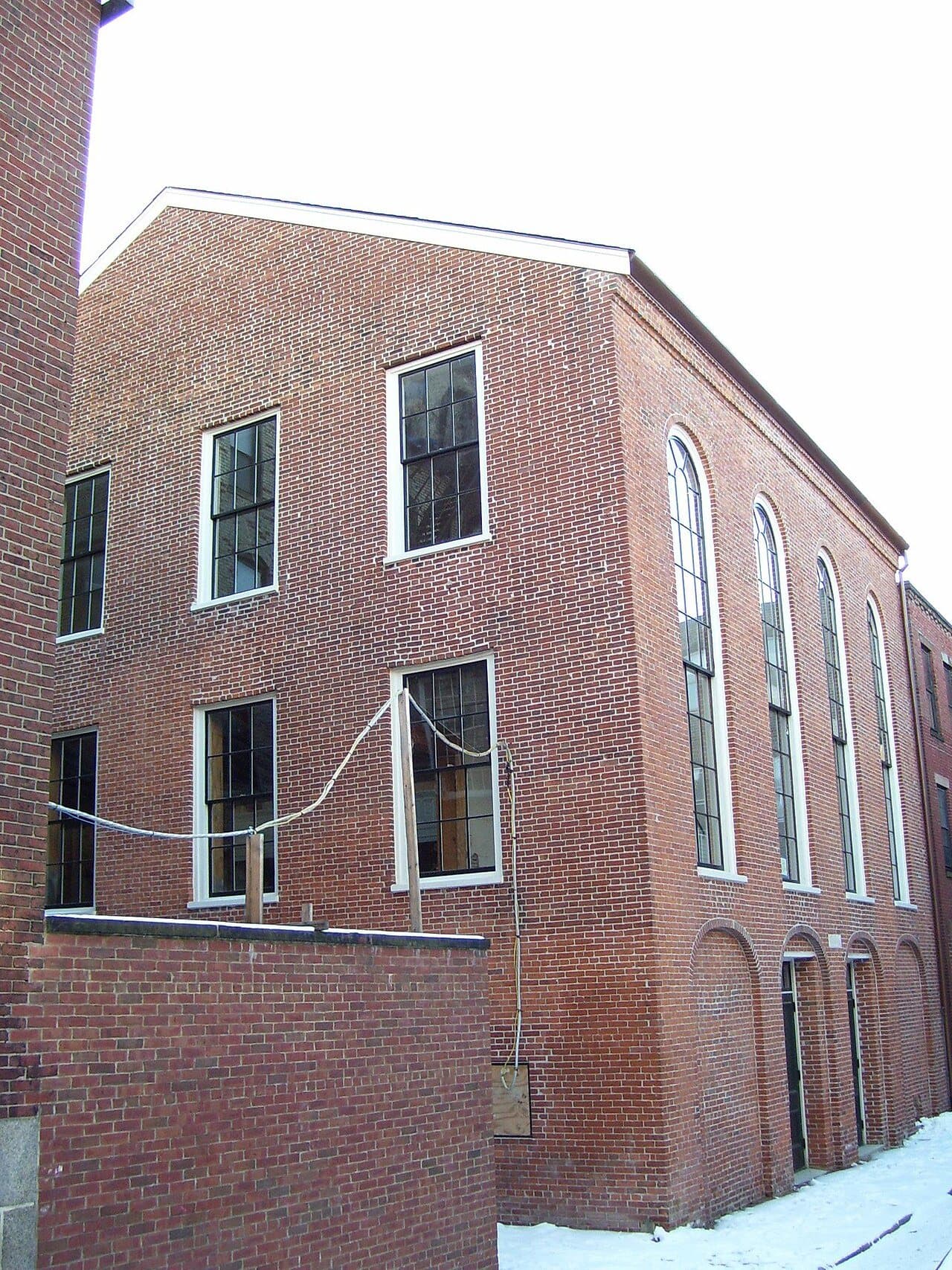
The African Meeting House stands at 8 Smith Court, on the back side of an alley off Joy Street on the north slope of Beacon Hill. Brick, three stories, modest in scale. From the street the building does not announce what it is. Step into the small courtyard and the proportions become clearer: a square, two-story sanctuary with arched windows, a basement schoolroom, a residence above. Built in 1806. Roughly twenty-five feet by sixty feet. Five thousand square feet of brick on a hill in central Boston.
The National Park Service calls it the oldest extant Black church building in America. That statement is precise. There are older Black congregations in the country. There are older church sites associated with Black congregations. The African Meeting House is the oldest building still standing that was constructed by a Black congregation for its own use.
Who built it
The Reverend Thomas Paul, a Baptist minister from Exeter, New Hampshire, organized a Black Baptist congregation in Boston in 1805. The congregation initially met in a school building on Belknap Street (now Joy Street). Within a year they had decided to build a permanent home of their own.
The single largest source of funding was the work of one man. Cato Gardner, a native African, led the fundraising and, in the Park Service's words, personally raised $1,500. African American craftsmen provided most of the labor. The remaining funds came from a combination of Black congregational members, white abolitionists, and white sympathetic donors.
The cornerstone was laid in 1806. The building opened the same year. The architect of record is not known. The proportions, the brick coursing, and the simple pedimented entrance are consistent with the work of Boston's brick masons of the early 1800s, who built similar small ecclesiastical structures across the city. No master architect is associated with the building. It was built, by and large, by the community that would use it.
What happened inside
Hear a stop from this walk
Boston Public Library: Free to All
The Meeting House's first half-century was dense in a way few American buildings of comparable scale ever were. The sanctuary on the main floor was the spiritual center of free Black Boston. The basement schoolroom was, by 1812, the first Black-organized school in Boston. The building hosted lectures, fraternal meetings, political organizing, abolitionist conventions, fund-raising events for fugitive-aid work, and the routine religious life of the congregation.
The single most consequential meeting in the building's history came in 1832. That year William Lloyd Garrison and a small group of men, including James G. Barbadoes and Joshua Coffin, formally founded the New England Anti-Slavery Society inside the African Meeting House. The society was the first sustained, militantly abolitionist organization in the United States. It demanded immediate, uncompensated emancipation. It rejected colonization (the dominant white abolitionist position, which favored relocating freed Blacks to Africa) as a moral failure.
The founding happened in this room because the African Meeting House was the only major Boston meeting hall that would reliably host integrated abolitionist gatherings. The white mainstream churches and meeting halls had refused. The Black congregation's building was politically and physically the safest space in the city for the work Garrison and his colleagues were doing.
This is a particular kind of historical fact. The building did not just witness the founding. The building made the founding possible by being the place that could hold it.
The chronology that organizes the slope
The conventional Boston abolitionist narrative names Garrison first. The actual chronological order is different. The Black community organized first.
In September 1829, David Walker, who lived on Belknap Street (now Joy Street), close to the Meeting House, published Walker's Appeal to the Coloured Citizens of the World. The Appeal was the most radical anti-slavery text published in the United States up to that point. It called for armed resistance to enslavement and indicted both the institution and the white population that supported it. The text was banned in Southern states; Walker was found dead the following summer under circumstances that have never been fully explained.
In September 1832, the same year the New England Anti-Slavery Society was founded inside the African Meeting House, Maria W. Stewart, a member of the congregation, gave one of the earliest public political lectures by an American woman of any race, at Franklin Hall downtown. Stewart's lectures combined Christian theology, anti-slavery argument, and a call for Black self-improvement that anticipated by decades the work of better-known nineteenth-century activists.
Walker, then Garrison's founding meeting, then Stewart. The Black community at the African Meeting House published the radical text, hosted the founding of the anti-slavery society, and produced the lecturer who spoke publicly, all within a thirty-six-month window. Garrison was a participant in this story, not its origin.
The historians James Oliver Horton and Lois E. Horton, in their 1979 social history of antebellum Black Boston, documented the chronology in detail. Their work is the standard reference for any claim about who organized first on the north slope.
The Abiel Smith School next door
In 1835, the Abiel Smith School opened in a small purpose-built brick building at 46 Joy Street, at the corner of Smith Court, a few steps from the Meeting House.
The Museum of African American History calls it the oldest public school in the United States built for the sole purpose of educating African American children. It was funded by a four-thousand-dollar bequest from Abiel Smith, a white merchant who had stipulated the fund be used for the education of Boston's free Black population.
The school's history is itself fraught. In 1849, Sarah C. Roberts, a five-year-old Black girl, was denied admission to the white school nearer her home and was directed instead to the Abiel Smith School. Her father sued. The case (Roberts v. City of Boston) reached the Massachusetts Supreme Judicial Court in 1850, which ruled against the family. The court's "separate but equal" reasoning would be cited by the United States Supreme Court forty-six years later in Plessy v. Ferguson. The Massachusetts legislature overturned the Roberts decision in 1855, the first state in the country to outlaw segregated public schools. The Abiel Smith School closed shortly after. The building you see today became, again, a community space, and is now an exhibition wing of the Museum of African American History.
The Hayden House, two blocks west
The African Meeting House's abolitionist work in the 1830s seeded a denser network in the 1850s. Two streets over, at 66 Phillips Street, Lewis and Harriet Hayden kept what the National Park Service calls the most active Underground Railroad safe house in the city, sheltering scores of documented freedom seekers. It is a private home today.
The Haydens were not subtle. Lewis Hayden, himself a formerly enslaved man who had escaped to freedom in the mid-1840s, sat on the executive committee of the Boston Vigilance Committee. William and Ellen Craft, who had escaped from Georgia in a dramatic 1848 cross-dressing flight, stayed with the Haydens, and when slave-catchers came to Boston for them in 1850, Lewis Hayden barricaded his doorway and threatened the slave-catchers. (A later, often-repeated story about a keg of gunpowder in the basement does not appear in the Park Service's account or in William Craft's own 1860 narrative.)
The Hayden work was not secret. The Boston abolitionist community knew where the safe house was. The federal marshals charged with enforcing the Fugitive Slave Act of 1850 knew. The neighbors knew. The work was conducted as an act of armed civil disobedience, with the explicit understanding that any attempt to enforce the Fugitive Slave Act in this neighborhood would be met with force.
The chain runs through the African Meeting House. The congregation's organizing in the 1820s and 1830s produced the militant abolitionist culture that allowed the Hayden House to operate in the 1850s with public defiance rather than hidden refuge.
The building after 1898
In 1898, the congregation moved to the South End, where Boston's Black population had increasingly relocated, and the African Meeting House was sold. For most of the twentieth century the building served as a synagogue for an Eastern European Jewish congregation. The Bulfinch-era brick exterior was preserved through this period largely because the Jewish congregation took care of it. The Hebrew lettering once visible above the entrance is part of that twentieth-century chapter.
The Museum of African American History acquired the building in 1972. A multi-year restoration returned the interior to its 1855 appearance. The Park Service designated the site, together with the Abiel Smith School and a network of related buildings on the north slope, as the Boston African American National Historic Site in 1980. The site was codified by Congress in 1990. In summer (in 2026, from 23 May to 27 September), Park Service rangers lead free walks of the Black Heritage Trail; the trail itself, which begins at the Shaw memorial on Beacon Street, can be walked on your own at any time.
What to look for
Step into Smith Court from Joy Street. The Abiel Smith School is the brick building at the head of the court; the African Meeting House is the brick building at the back, at number 8. Both are reachable in fewer than fifty paces from each other.
Look at the front of the Meeting House. The pedimented entrance, the arched windows, the proportions of the facade are 1806. The brick coursing is from the original construction. The interior is museum space. The Museum of African American History is ticketed and open Thursday to Sunday, with entry to the Meeting House by timed ticket (checked 4 October 2026). The basement schoolroom, where the first Black-organized school in Boston operated from 1812, is also part of the museum. The lane itself is public, but the small houses along it are private homes.
Now look at the location. You are on the north slope of Beacon Hill, four hundred metres from the south slope where the Brahmin merchant class lived in the same decades. The chronological geography of antebellum Boston is compressed into a five-minute walk. The slope that produced the abolitionist movement is here. The slope that produced the political and financial establishment that sometimes funded the movement and sometimes resisted it is up the hill.
One building, 1806, twenty-five by sixty feet of brick. Considered the oldest standing Black church building in America. The room where the New England Anti-Slavery Society was founded. The center of free Black Boston for ninety-two years.
Smith Court is the second stop on the Roamer Beacon Hill and Back Bay: The Ground Boston Made self-guided tour, which starts a few minutes away at the Shaw memorial and works from the mouth of the court on Joy Street.
Sources
- National Park Service, Boston African American National Historic Site, interpretive materials.
- Wikipedia, "African Meeting House."
- James Oliver Horton and Lois E. Horton, Black Bostonians: Family Life and Community Struggle in the Antebellum North (Holmes & Meier, 1979).
- Museum of African American History (Boston), institutional records and exhibitions.
- Wikipedia, "Abiel Smith School"; "David Walker (abolitionist)"; "Maria W. Stewart"; "Lewis Hayden."
Ready to experience it?
Beacon Hill and Back Bay: The Ground Boston Made
110 min · 3 km · moderate
More from Boston
Explore more at your own pace.
Best Self-Guided Walking Tours in Boston (2026)
Boston Travel Guide: How Many Days, Getting Around, When to Go (2026)
One Day in Boston: A Walkable Downtown Itinerary (2026)
Best History Walking Tours in Boston (2026)

What to Eat in Boston: A Food Guide (2026)