First Impressions
Nothing quite prepares you for walking into La Compania de Jesus. The exterior, an elaborate volcanic stone facade covered in spiraling columns and carved saints, hints at what's inside. But then you step through the doors, and every surface explodes with gold.
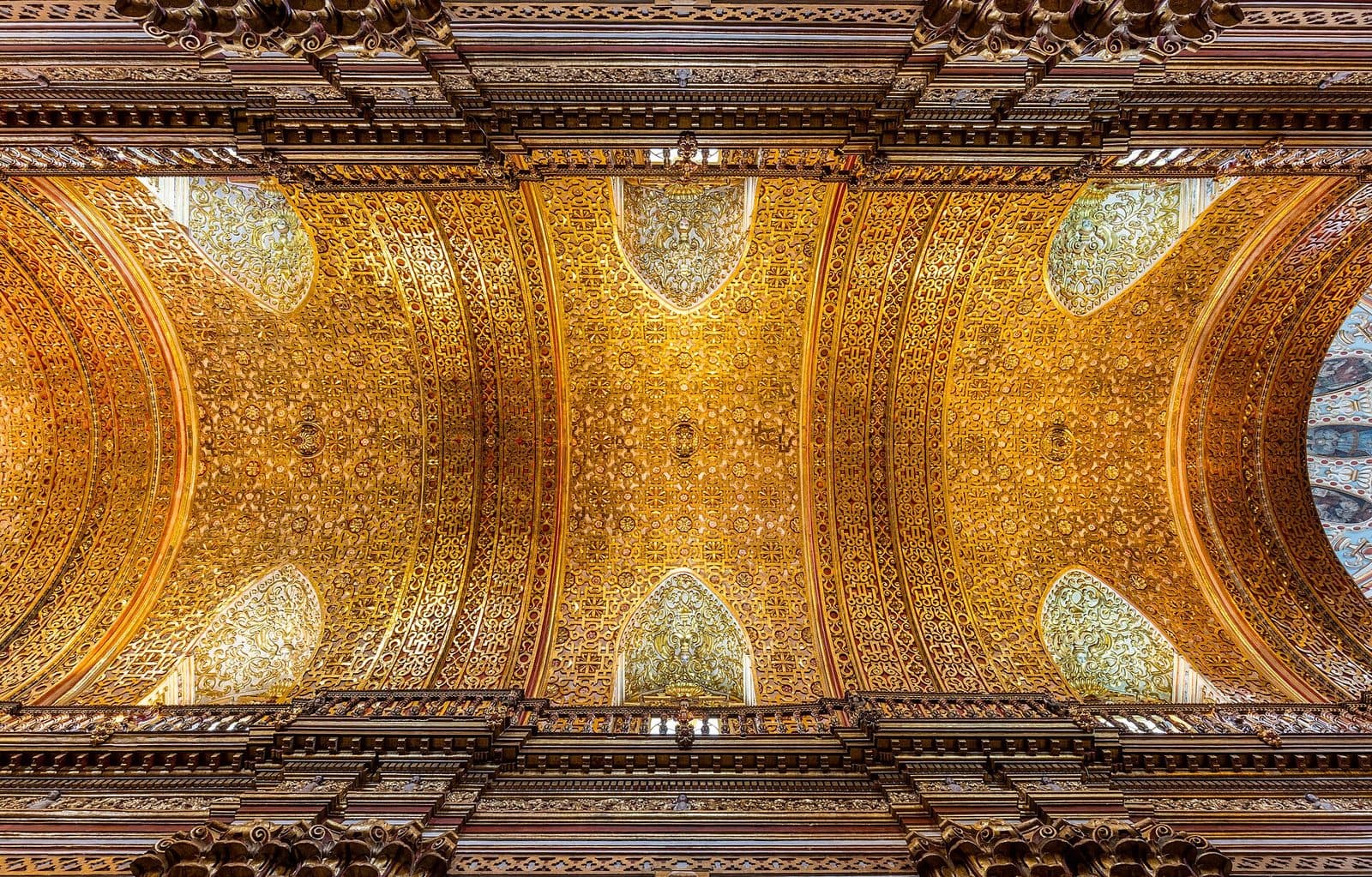
Walls, ceiling, altars, columns, arches, all sheathed in gold leaf. The effect isn't subtle. It's overwhelming by design. The Jesuits who built this church wanted visitors to feel like they had stepped into heaven itself, and more than four centuries after they began it, it still works.
The Numbers
Hear a stop from this walk
Plaza de Santo Domingo: Sucre's Square
La Compania took 160 years to complete, from 1605 to 1765. The walls, vaults and altars shine with twenty-three carat gold leaf; no source gives the weight of it, so treat any figure in tons as travel lore. The elaborate stone facade was begun in the 1720s and finished in 1765. The main nave stretches roughly 58 meters long, lined with side chapels, each an artwork in its own right.
These aren't just impressive statistics. They reflect the enormous wealth that flowed through colonial Quito and the Jesuits' ambition to build the most magnificent church in the New World.
The Facade
The stone facade is carved entirely from grey volcanic stone, in the words of the foundation that runs the church. The design draws from European Baroque and Churrigueresque traditions, the hyper-ornate Spanish style named after architect José Benito de Churriguera, but incorporates Andean motifs that make it distinctly Quiteño.
Look closely at the columns. They're Solomonic, twisted in spiraling helixes, a Baroque hallmark meant to evoke the columns of Solomon's Temple in Jerusalem, and here they borrow from Bernini's bronze canopy in Saint Peter's in Rome. The front was conceived by the German Jesuit Leonhard Deubler and finished by the Italian Venancio Gandolfi. Between them, niches hold saints, angels, and floral carvings so deep they cast dramatic shadows as the sun moves across the plaza.
The Carved Details
Indigenous and mestizo artisans did much of the carving, and their influence appears in details that would never show up in a European church. Tropical fruits, Andean sun symbols, and local plant species weave through the otherwise classical ornament. This fusion is a hallmark of the Quito School tradition.
The Interior
Gold Everywhere
The gold leaf was applied over carved wood and plaster using a technique called estofado. Artisans would gild a surface, then paint over it, then scratch away the paint in patterns to reveal the gold beneath. The result is a shimmering, textured surface that changes character with the light.
Its sheer abundance in La Compania was partly a statement of Jesuit wealth and partly a theological argument. Gold represented divine light, and covering a church in it was meant to create a space saturated with God's presence.
The Ceiling
The barrel-vaulted ceiling is covered in Moorish-influenced geometric patterns (mudéjar style), painted and gilded in intricate interlocking designs. This technique traveled from Islamic Spain to the Americas, where it merged with Indigenous geometric traditions. The result is a ceiling that seems to hover, its patterns creating an illusion of infinite depth.
The Main Altar
The retablo mayor (main altarpiece) rises the full height of the apse, a towering structure of gilded wood populated with saints, angels, and the central figure of the Immaculate Conception. It's flanked by Solomonic columns and topped with a radiant sunburst, a motif the Jesuits used throughout their missions in the Americas.
The Quito School Connection
La Compania is a showcase of the Quito School (Escuela Quiteña), the artistic tradition that made colonial Quito one of the most important art centers in the Americas. The church contains paintings by some of the school's masters, along with polychrome sculptures that demonstrate the extraordinary realism Quiteño artists achieved.
The most notable technique was encarnación, a method of painting flesh tones on sculpted figures using layers of translucent pigment that gave the wood an almost living quality. Combined with glass eyes, real hair, and fabric clothing, these figures were designed to create an intense emotional response in worshippers.
Fire, Collapse, and Restoration
La Compania has not survived unscathed. Earthquakes in 1859 and 1868 damaged the bell tower, once the tallest in the city, which was left cut down to about twenty-three metres. After the earthquake of March 1987 a restoration began that ran nineteen years, to 2005, and in January 1996, in the middle of it, a fire affected about a tenth of the church and more than half of the altarpiece of San Francisco Javier.
The restoration revealed something interesting: beneath layers of soot and later paint, original color schemes emerged that were brighter and more varied than anyone expected. The church we see today is arguably closer to its eighteenth-century appearance than it has been in over a century.
Visiting Today
La Compania operates as a museum-church. When we checked on 5 October 2026, foreign adults paid USD 6 and students USD 3, with the domes and crypts USD 3 each extra; it opens Monday to Friday 09:30 to 18:00, Saturday 10:00 to 16:00 and Sunday 12:00 to 16:00. Photography rules are posted at the door. It is the sixth stop of the Old Town: The Way the Water Runs walk, and the low-angle light in the late afternoon creates particularly dramatic effects as gold surfaces catch the sun from high clerestory windows.
Stand in the center of the nave and look up. The scale, the craftsmanship, the sheer audacity of covering an entire church in gold: it raises the same question visitors have been asking since 1765. How did they build this here, in a city perched at 2,850 meters in the Andes, using techniques from three continents?
The answer is walking the streets outside. La Compania was built by the same cultural fusion, Indigenous, Spanish, Moorish, and mestizo, that defines Quito itself.
Ready to experience it?
Old Town: The Way the Water Runs
100 min · 2.3 km · moderate
More from Quito
Explore more at your own pace.
Best Self-Guided Walking Tours in Quito (2026)
How Quito's Old Town Kept Its Shape: A Grid Laid on a Mountain
One Day in Quito: A Walkable Old-Town Itinerary (2026)
Quito Travel Guide: Altitude, How Many Days, Getting Around, Safety (2026)
What to Eat in Quito: An Ecuadorian Highland Food Guide (2026)