Mexico City is the world capital of muralism, and the best works are scattered across the city in government buildings, universities, cultural centers, and even a few unexpected locations. Unlike gallery art, these murals were designed for their specific architectural settings, which means photographs never do them justice. Here is where to find the essential ones, and what to look for when you get there.
The National Palace: Rivera's Grand Narrative
Diego Rivera's murals in the National Palace are his magnum opus. Covering the main staircase and the upper-floor corridors, they depict the entire sweep of Mexican history from the pre-Hispanic world through the Spanish conquest to the Revolution and beyond.
What to look for: On the central staircase wall, find the depiction of the Aztec marketplace of Tlatelolco. Rivera researched this scene obsessively, and it remains one of the most detailed visual reconstructions of pre-Hispanic daily life ever created. Notice how he places himself and Frida Kahlo in the crowd scenes on the upper panels, a signature move.
Practical info: Entry is free. Bring ID. Allow at least 45 minutes.
Palacio de Bellas Artes: Three Masters, One Building
Hear a stop from this walk
Palacio de Bellas Artes: Four Contradictions Under One Roof
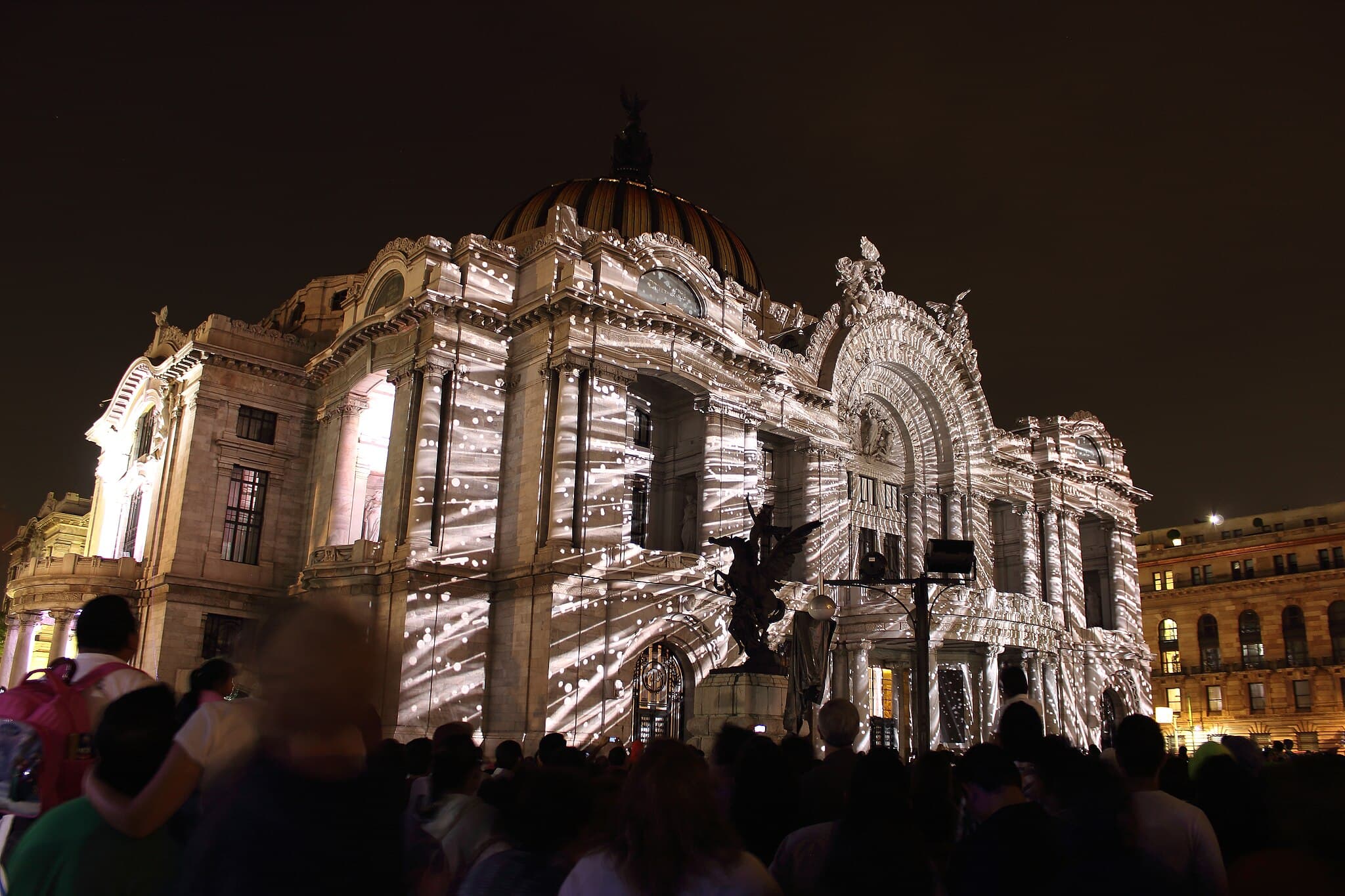
The Palacio de Bellas Artes is the only place where you can see major works by all three of Los Tres Grandes (Rivera, Orozco, and Siqueiros) under a single roof.
Rivera's "Man, Controller of the Universe" is the recreation of the mural originally commissioned for Rockefeller Center in New York. The Rockefeller family had it destroyed in 1934 because Rivera refused to remove a portrait of Lenin. Rivera repainted it here, larger and even more politically charged, adding a portrait of John D. Rockefeller drinking with socialites near a panel depicting syphilis bacteria.
Orozco's "Catharsis" is a violent, expressionistic vision of societal collapse. The contrast with Rivera's controlled optimism is striking.
Siqueiros' panels demonstrate his experimental techniques. Note how the figures seem to project outward from the wall, an effect achieved through careful manipulation of perspective and industrial paints.
Practical info: Museum entry required. Check hours, as the building also hosts performances.
Secretaria de Educacion Publica: Rivera's Encyclopedia
Rivera's earliest major mural cycle covers two floors of courtyards at the Ministry of Education. Over 120 individual panels depict Mexican labor, festivals, and daily life organized thematically: agriculture, industry, science, the arts.
What to look for: The ground-floor panels showing Day of the Dead celebrations are among Rivera's finest genre scenes. On the upper floor, a series depicting revolutionary corridos (ballads) includes portraits of Frida Kahlo and Tina Modotti distributing arms.
Practical info: Free entry. Often overlooked by tourists, which means you may have the courtyards nearly to yourself.
Antiguo Colegio de San Ildefonso: The Birthplace
This former Jesuit college is where Mexican muralism effectively began. In 1922, Orozco, Rivera, and Siqueiros received their first government commissions to paint its walls.
What to look for: Orozco's early panels here are rawer and more experimental than his later, more polished work. "The Trench" and "The Trinity" show an artist still figuring out how to translate revolutionary politics into visual form. The evolution visible between these early works and his later masterpieces is itself a lesson in artistic development.
Practical info: Small entry fee. Excellent bookshop.
UNAM Central Library: O'Gorman's Mosaic Epic
Juan O'Gorman's mosaic murals covering all four sides of the UNAM Central Library are the most photographed murals in Mexico. Made from millions of colored stones rather than paint, they depict pre-Hispanic cosmology, colonial history, the modern university, and an atomic-age future.
What to look for: The murals work at two scales. From a distance, they read as bold graphic compositions. Up close, they reveal intricate symbolic details: Aztec calendar elements, scientific equations, and historical figures woven into the stone patterns.
Practical info: The UNAM campus is a UNESCO World Heritage Site. The library exterior is visible anytime; the interior requires university ID.
Polyforum Cultural Siqueiros: Total Immersion
Siqueiros' last major work, "The March of Humanity," is a 360-degree mural environment covering the interior and exterior of the Polyforum. Siqueiros called it "a new kind of public art," sculpture and painting fused into architecture. The interior floor rotates slowly while the walls and ceiling surround you with imagery.
What to look for: The use of metallic and industrial paints creates surfaces that shift depending on your viewing angle. This is Siqueiros at his most experimental, and nothing else in Mexico City (or anywhere) looks quite like it.
Practical info: Check current status before visiting, as the building has undergone periods of renovation.
Walk the Murals
These works were made for walls, not screens. The texture of the paint, the scale of the figures, the way light falls across curved surfaces: none of this translates to photographs. Roamer's Murals & Masterpieces tour connects the major mural sites in the historic center and cultural district with GPS-triggered audio commentary at each stop, providing the historical and artistic context that transforms looking into understanding.
Mexico eSIM· 10% off with ROAMER10
Ready to experience it?
Diego Rivera Murals: The Revolution on the Walls
80 min · 2.5 km · easy
More from Mexico City
Explore more at your own pace.
Chapultepec Park Guide: Hill, Lakes and Museum Row
Coatlicue: The Statue That Was Buried Twice
El Sargento: The Dead Ahuehuete Tree of Chapultepec
The Baños de Moctezuma: The Bath That Was Never Moctezuma's
The Tlaloc Monolith: The Stone That Crossed Mexico City in 1964