Roma & Condesa: Earthquake, Exile, Reinvention
90 min · 2.3 km · easy
The colonia of Roma was founded by a circus owner. The Hipodromo de la Condesa was laid out on the ghost of a horse racing track. The earthquake of 19 September 1985 brought down 472 buildings inside Roma alone. None of those three sentences was the original plan for these neighbourhoods, and yet each of them, in turn, became the foundation of what they are now. The story of Roma and Condesa is the story of a piece of ground that was repeatedly designed for one population and inherited by a different one.
The pattern is what holds them together. To understand the neighbourhoods, walk them as a sequence of inheritances.
Wave one: the Porfirian fantasy, 1902 to 1910
The land that became Roma was a farm called the Potrero de Romita, on the southwestern edge of Mexico City. In January 1902, a British showman named Edward Walter Orrin, who had been famous across Mexico in the 1880s for introducing electric lights to circus tents, acquired the property. His partners were an American engineer named Casius Clay Lamm and a Mexican lawyer named Pedro Lascurain, who would later serve as president of Mexico for approximately forty-five minutes in February 1913, in the brief constitutional handoff between Madero and Huerta. Their plan, formally approved on 30 November 1902, was to build a residential colonia for the Porfirian elite that would imitate the boulevards of Paris and the palazzi of Rome. The avenue now called Alvaro Obregón was originally called Jalisco, forty-five metres wide, lined with a tree-planted median.
The fantasy worked. By 1910 Roma was the most fashionable address in the capital. Sugar barons, bankers, ranchers, the families that had grown wealthy under the long dictatorship of Porfirio Diaz built mansions in French, Italianate, Gothic, and Moorish styles, often within metres of one another. The Casa de las Brujas on the Plaza Rio de Janeiro is one of the earliest survivors, finished in 1908 by the British engineer R. A. Pigenon and commissioned for the centennial celebrations of Mexican independence. Casa Lamm, the family's own commission, was finished in 1911 by the same architectural community and rented immediately to the Marist Brothers as a school. The developers, in a small detail that captures the entire period, did not move into their own buildings.
Across the next decade the fantasy collapsed twice. First the Revolution dismantled the political class that built it. Then, between roughly 1925 and 1940, the wealthier surviving families left Roma for the newer colonias of Polanco and Las Lomas de Chapultepec, looking for larger lots and modern utilities. The mansions were left to whoever would rent them.
Wave two: the Ashkenazi, 1920s onward
Hear a stop from this walk
Plaza Rio de Janeiro: The Circus Owner's Stage
The first new wave came from Eastern Europe. Ashkenazi Jewish families, fleeing the violence and economic collapse that followed the First World War and the Russian Revolution, began arriving in Mexico in significant numbers in the 1920s. Many settled in Condesa, the newer colonia immediately west of Roma, which was being built on the site of the former horse racing track. The Nidje Israel community, founded by Yiddish-speaking immigrants from the Pale of Settlement, opened the synagogue at Acapulco 70, which was inaugurated in 1941 and remained the centre of Ashkenazi religious life in the capital until the 1960s.
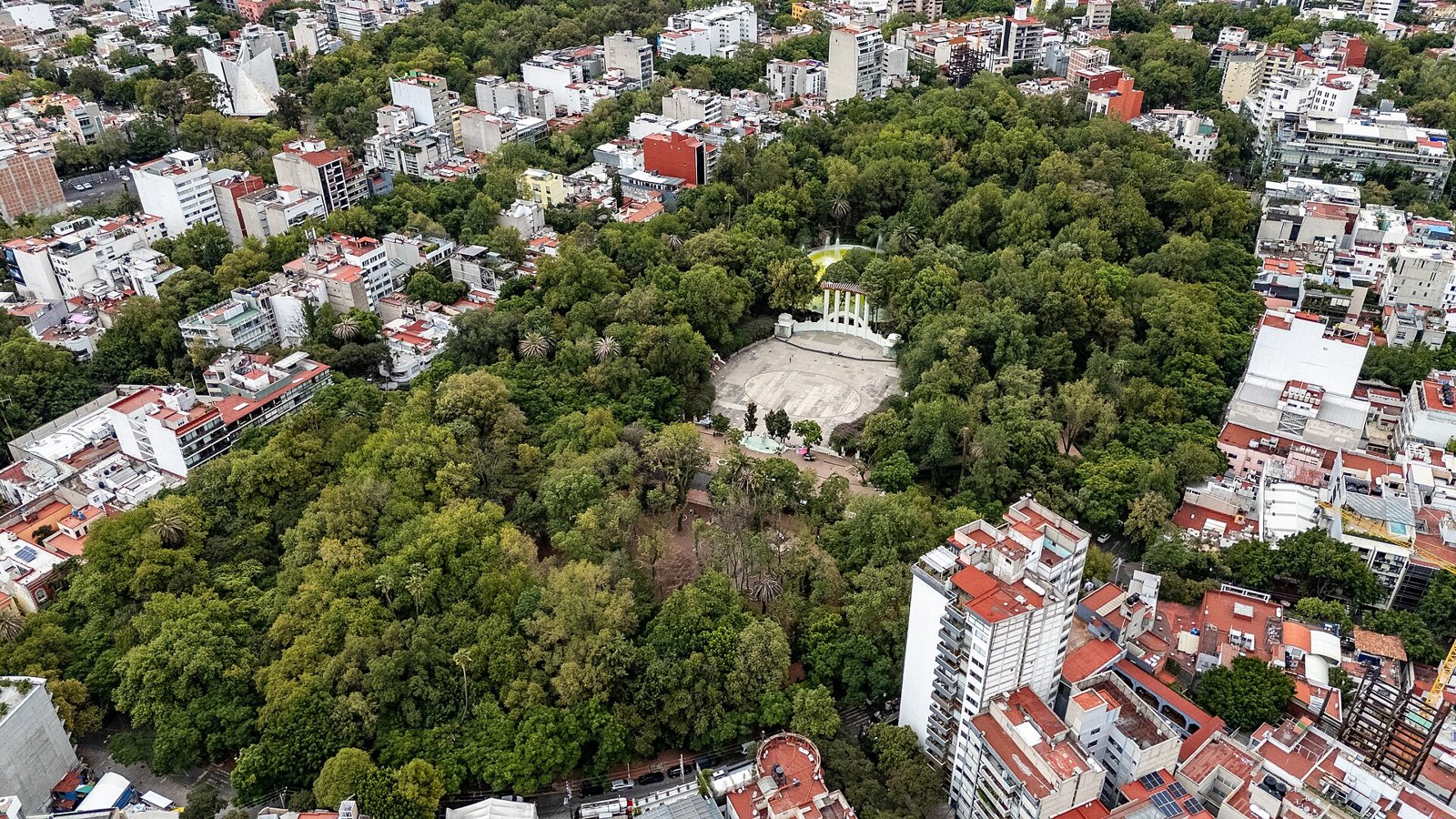
The community's day-to-day life happened in Parque México, the Art Deco park designed by Jose Luis Cuevas and completed in 1927 at the centre of the new Hipodromo colonia. For roughly two decades, Yiddish was the working language of the park. Families gathered there in the afternoons. Children played there in the mornings. The pathways of an Art Deco park, named for a Latin American country, in the middle of a Spanish-speaking capital, were a Yiddish-speaking commons. The Ashkenazi were the first major community to settle in Roma and Condesa who had not been planned for. They inherited what the Porfirian elite had built and used it as a refuge.
President Claudia Sheinbaum, elected in 2024, is a granddaughter of this wave. Her family came from Lithuania and Bulgaria.
Wave three: the Spanish Republicans, 1939 onward
The second consequential wave arrived in 1939, when the Spanish Civil War ended with the fall of Madrid and the consolidation of power by Franco. Republicans, intellectuals, professionals, doctors, teachers, and academics faced imprisonment or execution at home. The United States imposed strict quotas. France interned refugees in camps near the Pyrenees. Britain accepted very few. Mexico, under President Lazaro Cardenas, accepted between twenty and thirty thousand refugees, the largest organised reception of Spanish exiles anywhere in the world.
Cardenas's decision was structural, not symbolic. He founded La Casa de España en Mexico in 1938 to employ refugee academics. By 1940 it had been renamed El Colegio de Mexico and is now one of the leading research institutions in Latin America. The refugees who came on the Sinaia, the Ipanema, and the Mexique brought a level of professional and intellectual capital that demographers and economic historians have measured directly in subsequent studies. Mexican universities, publishing houses, hospitals, and architectural firms in the 1940s and 1950s were significantly staffed by Spanish exiles.
A large share of the Spanish Republicans settled in Roma. They moved into the cheap, abandoned Porfirian mansions that had been built to look Spanish. The irony was not lost on the refugees themselves: the fake Spain became real Spain in the same buildings. Bookshops opened on Alvaro Obregón. The Centro Asturiano, the Centro Republicano Español, and the Ateneo Español de México became gathering points for an exile community that had brought its own newspapers, theatre, and political culture with it. The cultural infrastructure those institutions built in Roma is what later writers would call the bohemian foundation of the neighbourhood. None of it was planned by anybody who designed the colonia.
Wave four: the earthquake and what came after, 1985
At 7:19 on the morning of 19 September 1985, a magnitude 8.0 earthquake struck Mexico City. The epicentre was 350 kilometres away near the Pacific coast at Lázaro Cárdenas, but the ancient lakebed under the capital amplified the seismic waves at a frequency that resonated catastrophically with mid-rise buildings, six to fifteen stories tall. Short buildings survived. Skyscrapers swayed and held. Everything in between fell. In Roma, 472 buildings collapsed partially or completely. Most were on the streets of Morelia, Mérida, Córdoba, and Puebla. Around 15,000 Roma residents lost their homes. The Multifamiliar Juárez, a large public housing complex on the southeastern edge of the neighbourhood, lost nine structures.
The Mexican federal government's response was slow and visibly inadequate. In the vacuum, civil society organised itself. Earthquake victims called themselves damnificados, the displaced. They formed coordinating bodies, occupied empty land, demanded reconstruction. The most visible figure was Superbarrio Gómez, a masked wrestler character created by the activist Marcos Rascón as a folk symbol of the housing rights movement. The civic organising that began in Roma and Tlatelolco contributed directly to the political fractures that eventually ended seven decades of unbroken PRI rule in the capital. Cuauhtémoc Cárdenas, son of Lazaro Cárdenas who had welcomed the Spanish Republicans fifty years earlier, was elected the first opposition mayor of Mexico City in 1997, on a coalition that included many former damnificados.
The neighbourhood itself, however, fell into a long depression. From 1985 to roughly 2000, Roma was a place of empty lots, abandoned buildings, and collapsed rents. Wealthy families avoided it. The mansions that survived the earthquake had no obvious buyers. The Porfirian commercial blocks on Alvaro Obregón were half-empty.
Wave five: artists, restaurateurs, and the word for what happened next
That depression was the precondition for the most recent wave. Beginning in the late 1990s and accelerating sharply after 2000, the cheap rent and the surviving early-twentieth-century architecture began drawing in artists, photographers, graphic designers, and the small businesses that follow them. Galleries opened on Colima and Orizaba. The bookshops that had been Spanish-Republican institutions in the 1950s were joined by cafés, mezcal bars, and restaurants. Foreign residents arrived. By 2015 the colonia had become one of the most-discussed neighbourhoods in Latin America, in the same global conversation that produced Williamsburg in Brooklyn and Palermo Soho in Buenos Aires. The word for this is gentrification, and it has been disputed in Roma since the early 2000s, particularly during the post-pandemic surge of remote-working foreign residents.
Whatever you call the most recent wave, it is the fifth wave to inherit these blocks, and its arrival follows exactly the pattern of the four that preceded it. A community arrives, finds cheap space inside beautiful buildings that someone else built for someone else, and turns the inherited architecture into something the previous occupants did not intend. The Porfirian mansions are now cafés. The Spanish-Republican bookshops are now design studios. The Ashkenazi commercial blocks on Tamaulipas are now restaurants. The park where Yiddish was the working language is now where digital nomads use their laptops.
The thesis of the tour is the same as the thesis of this article. Roma and Condesa are not neighbourhoods that were designed. They are neighbourhoods that happened, in waves, on the same piece of ground. The architecture is the inheritance. The people are the latest tenants. Walk slowly and you can see all five waves on a single block.
Mexico eSIM· 10% off with ROAMER10
Ready to experience it?
Roma & Condesa: Earthquake, Exile, Reinvention
90 min · 2.3 km · easy
More from Mexico City
Explore more at your own pace.
Chapultepec Park Guide: Hill, Lakes and Museum Row
Coatlicue: The Statue That Was Buried Twice
El Sargento: The Dead Ahuehuete Tree of Chapultepec
The Baños de Moctezuma: The Bath That Was Never Moctezuma's
The Tlaloc Monolith: The Stone That Crossed Mexico City in 1964