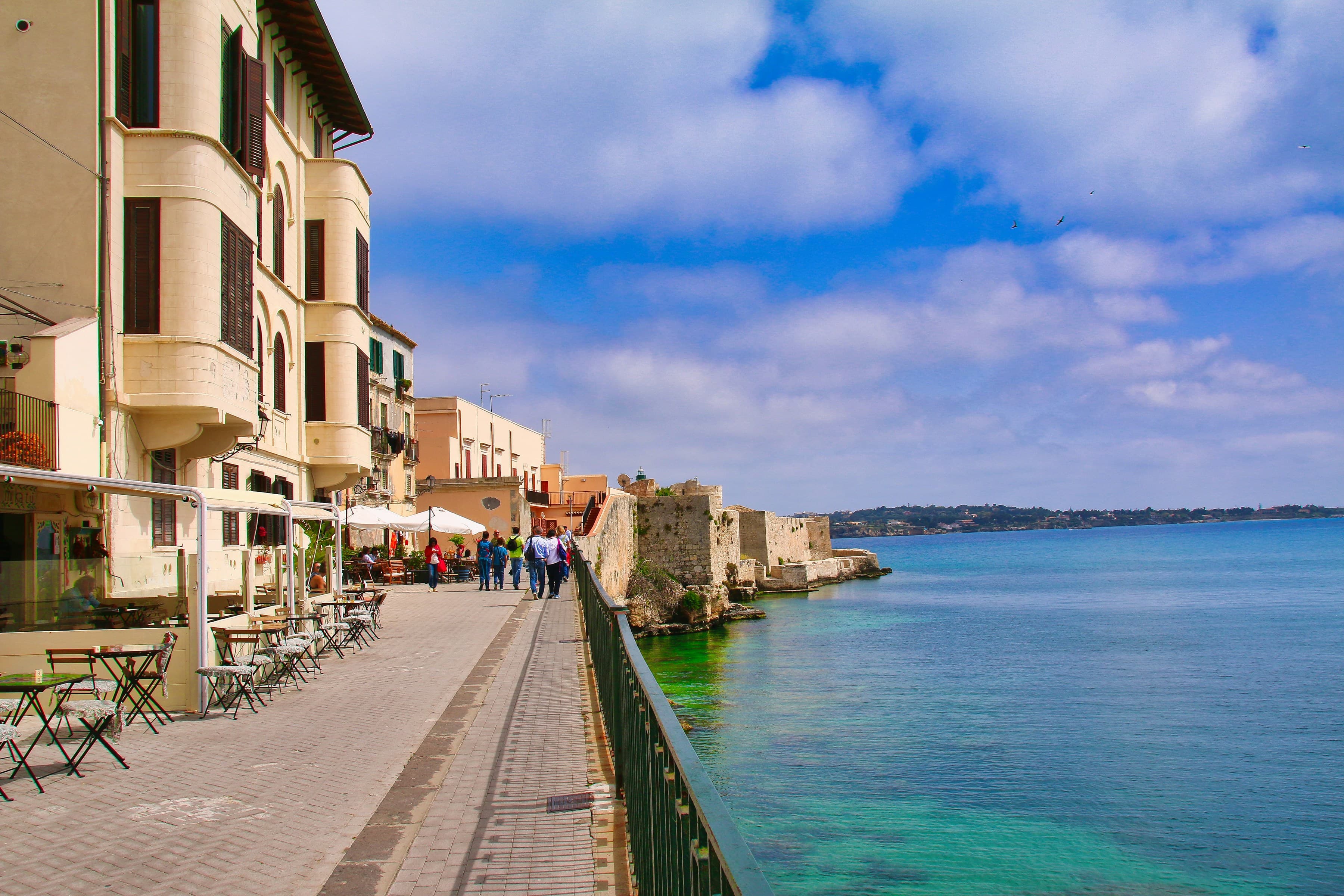
Walk Ortigia, the old island heart of Syracuse in Sicily, from the Archimedes statue and the Temple of Apollo past Spanish sea walls and the Giudecca to Arethusa's spring and the cathedral built inside a Greek temple.
Start · Ponte Umbertino: Archimedes on a Puzzle
DirectionsStops
- 1
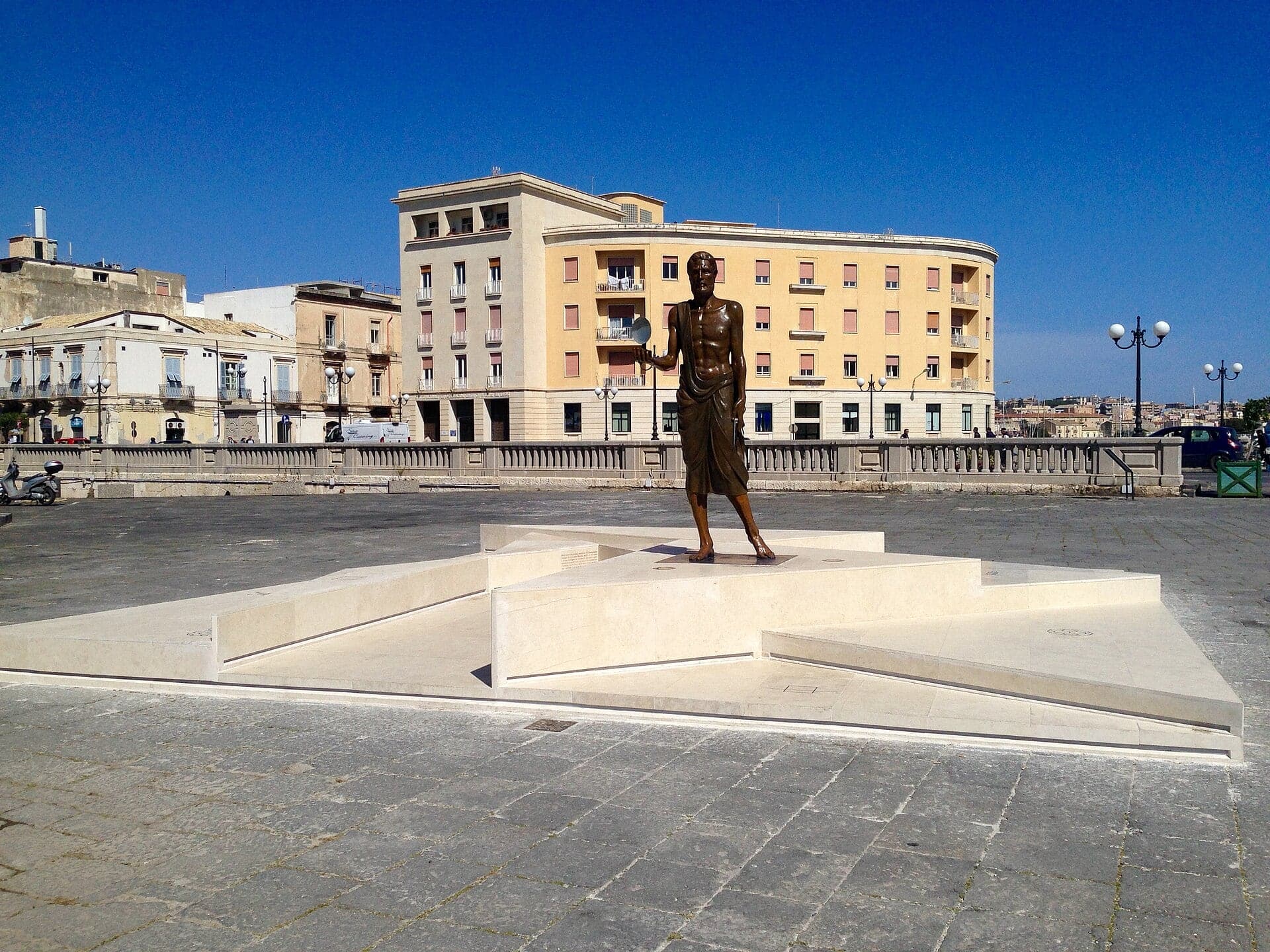
Ponte Umbertino: Archimedes on a Puzzle
A bronze Archimedes stands on a small island beside the bridge, on a base cut like his puzzle.
- 2
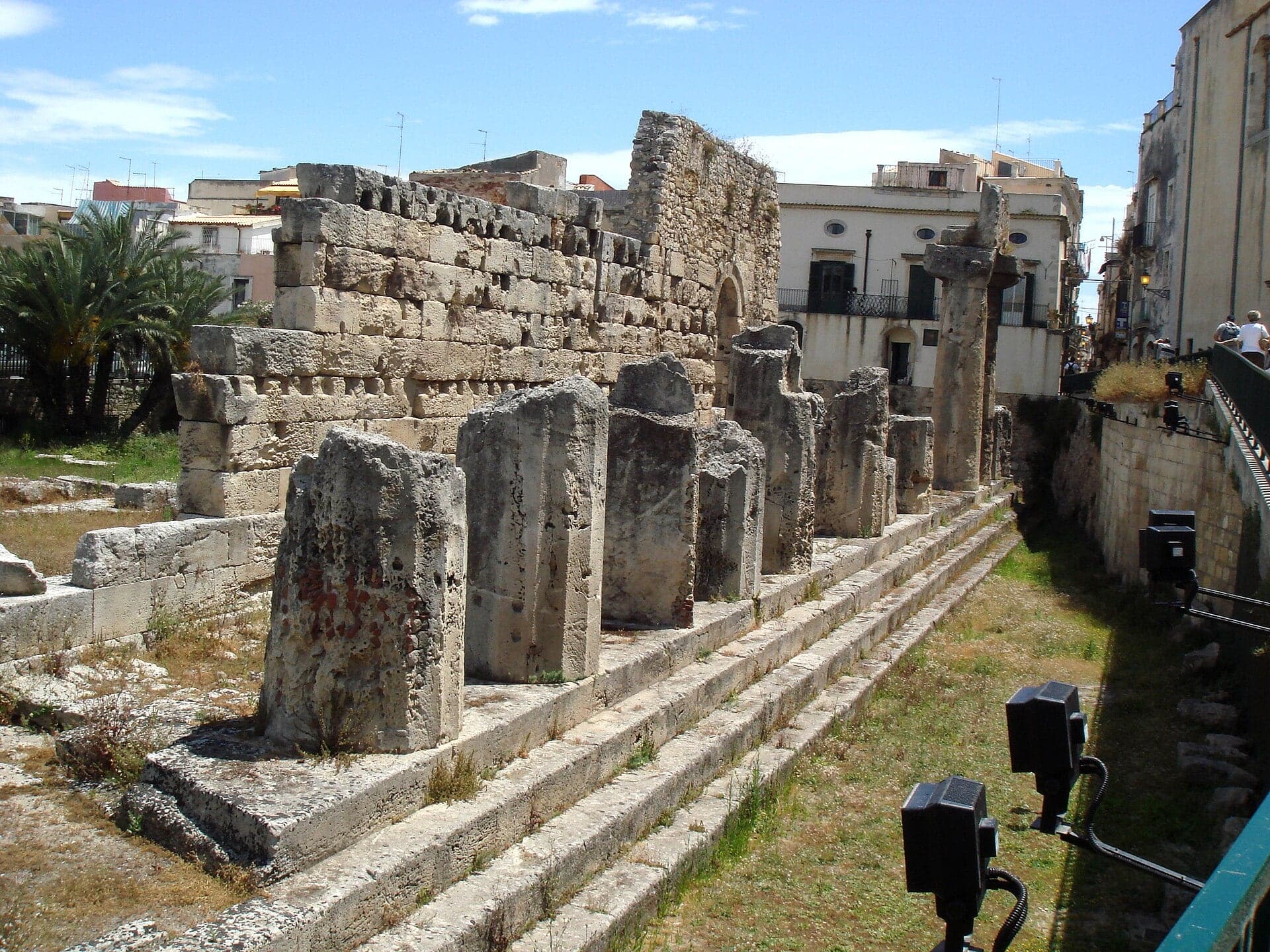
Temple of Apollo: The Builder Who Signed the Step
This early Greek temple later served as a church and barracks, and a builder signed its step.
- 3
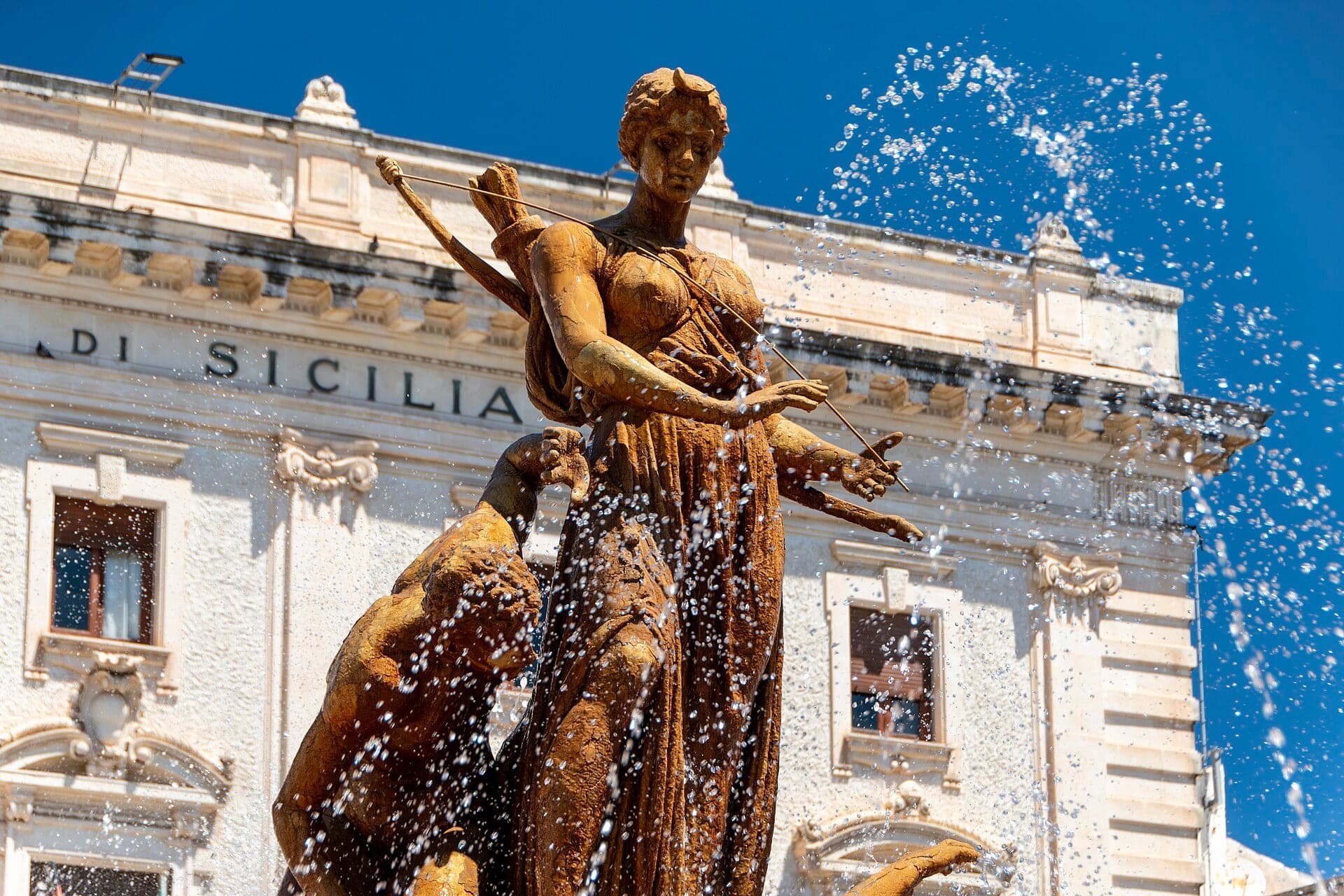
Piazza Archimede: A Fountain of Rusting Concrete
The Fontana di Diana is made of reinforced concrete, not stone, and the square around it was made by demolition.
- 4
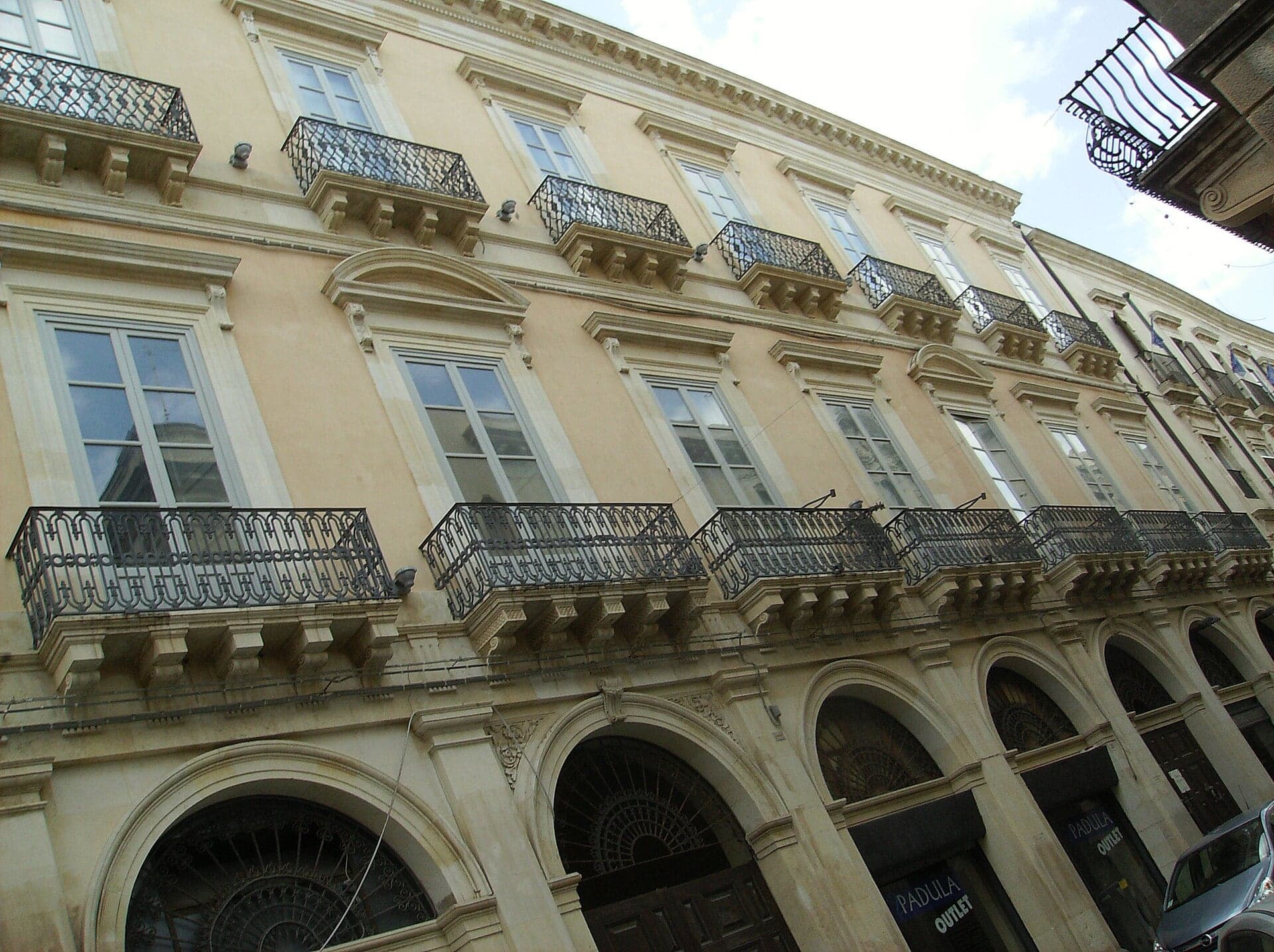
Via della Maestranza: Balconies on Stone Brackets
Iron balconies on carved stone brackets line the street of the craftsmen.
- 5
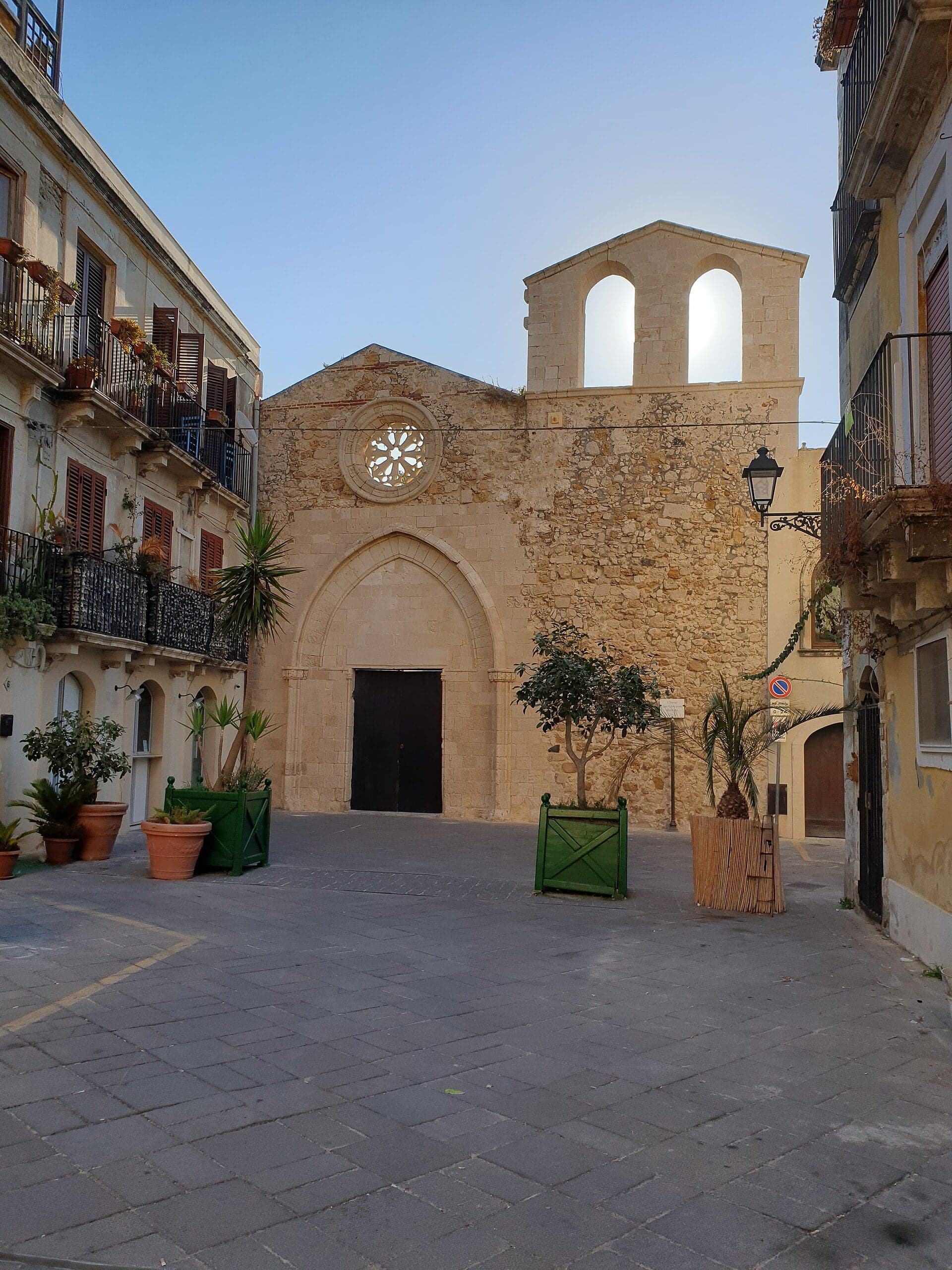
San Giovannello: The Church With No Roof
This church has had no roof since the earthquake of 1693, and may once have been the quarter's synagogue.
- 6
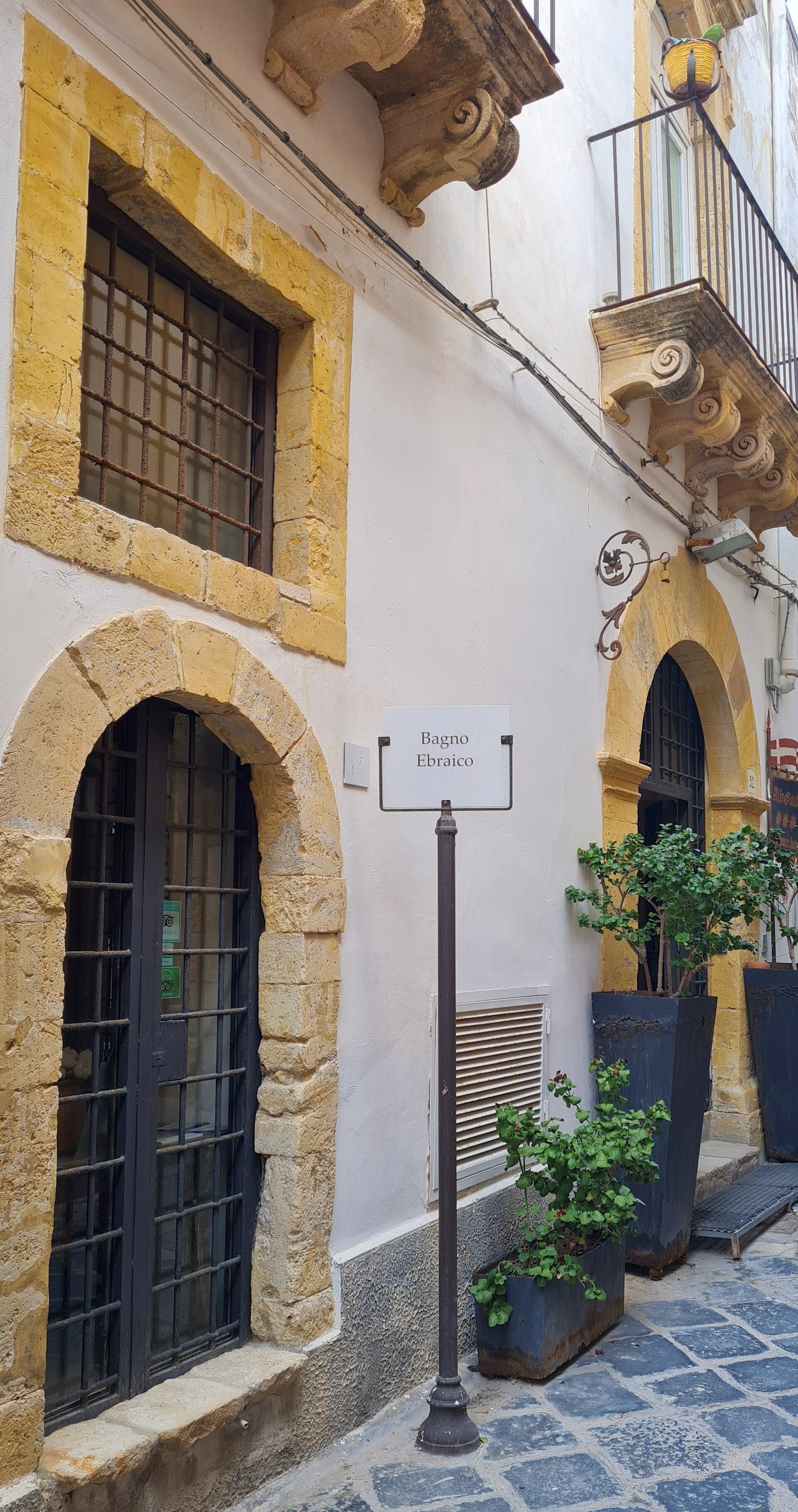
The Giudecca Lanes: A Quarter Emptied in 1492
Ortigia's Jewish quarter emptied in 1492, but a rock-cut ritual bath survives below.
- 7
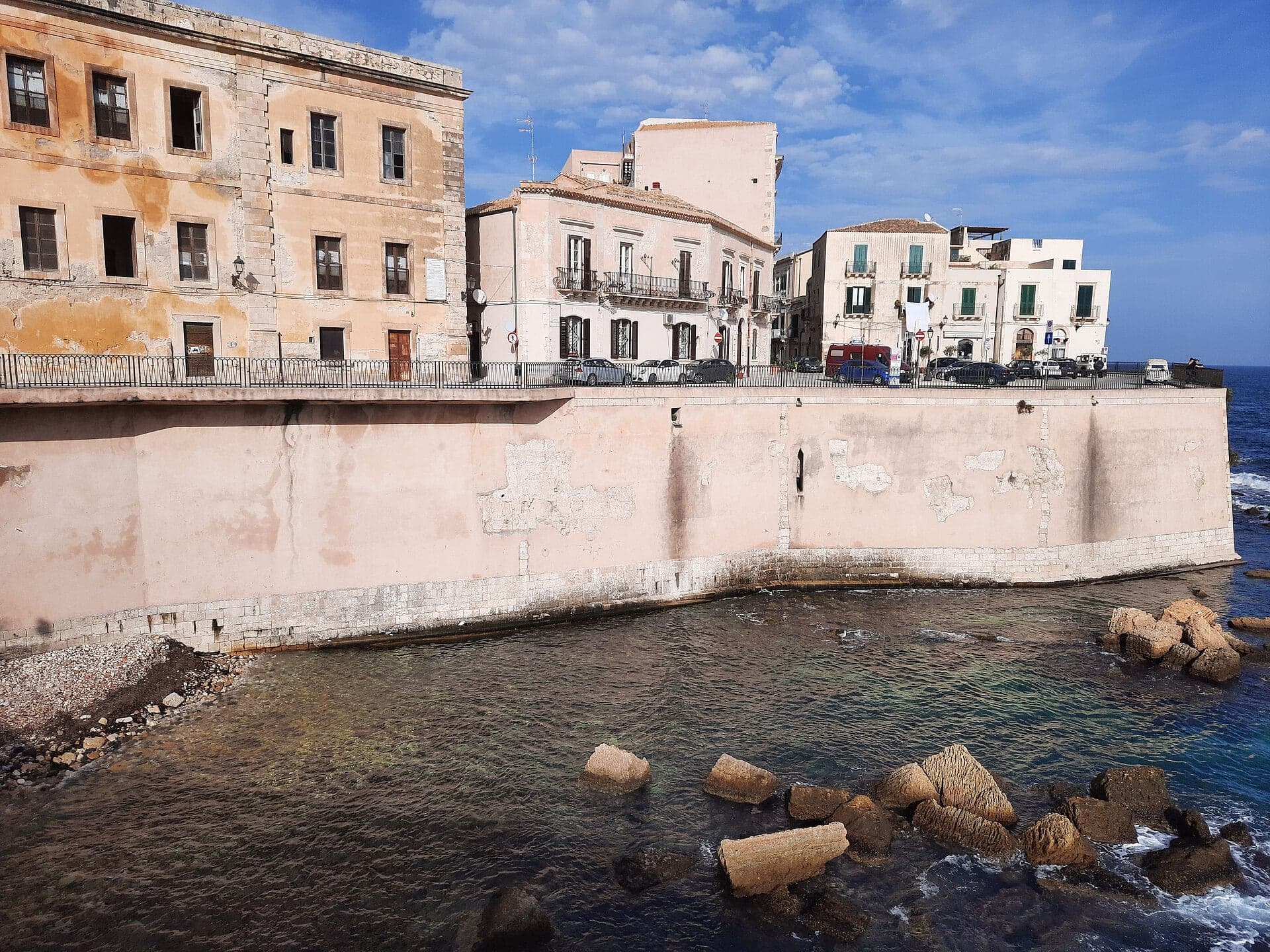
Belvedere della Turba: A Sea Wall Turned Terrace
A Spanish sea wall is now a terrace above the Ionian Sea.
- 8
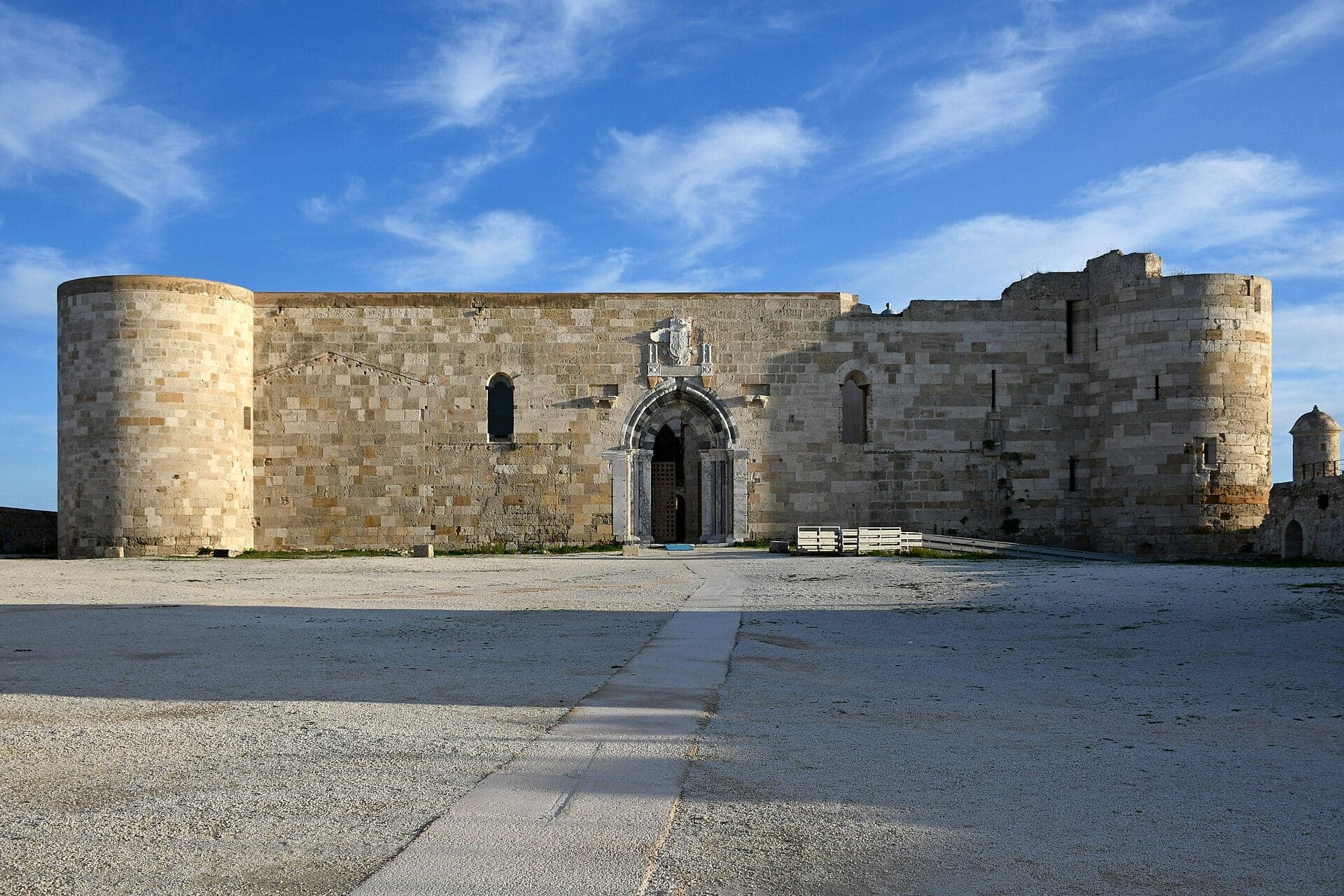
Castello Maniace: The Emperor's Castle at the Tip
Frederick II built this castle at the island's tip in the 1230s.
- 9
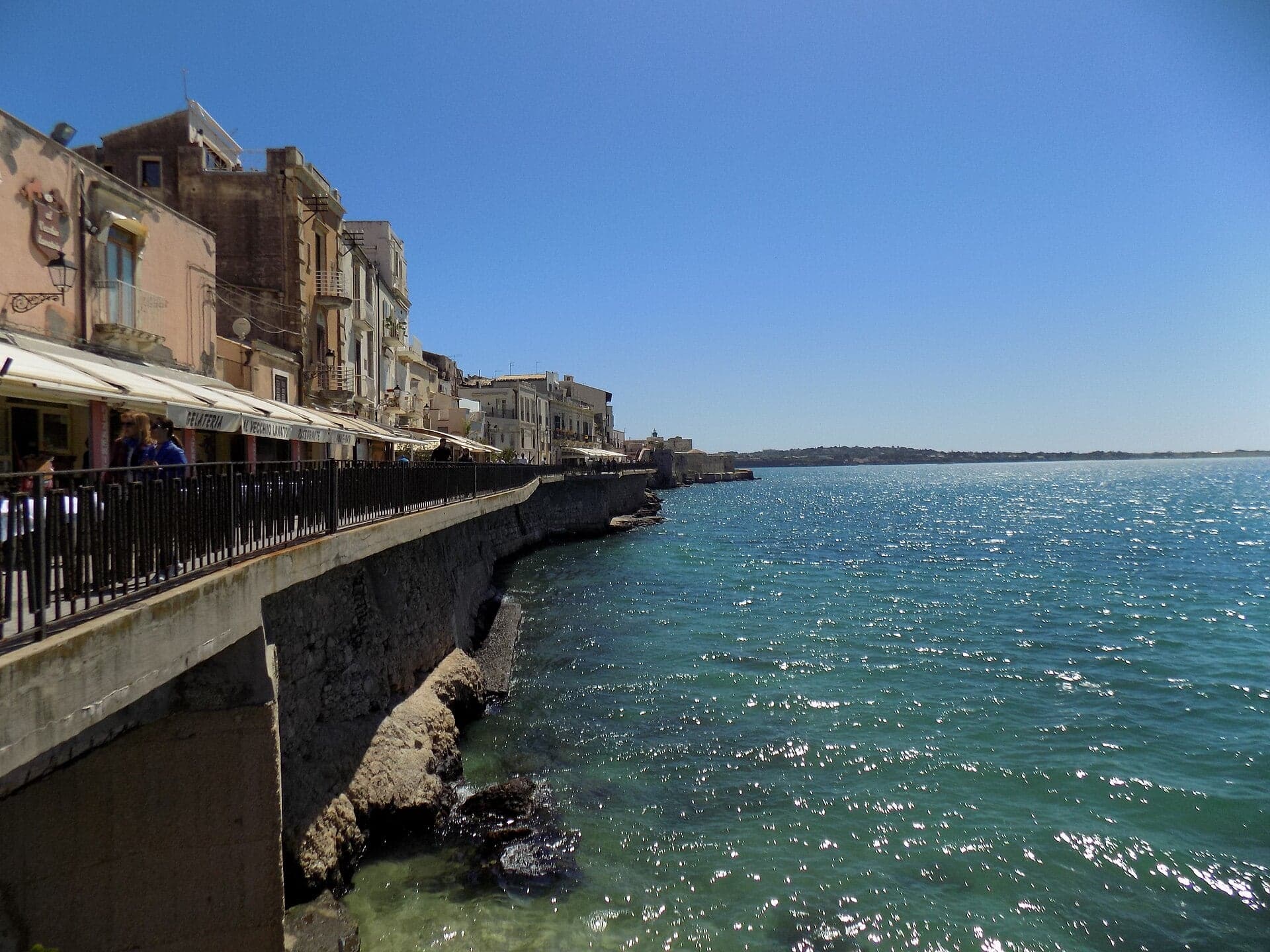
The Great Harbour: Two Hundred Ships in One Bay
In 413 BC nearly two hundred ships fought in this bay.
- 10
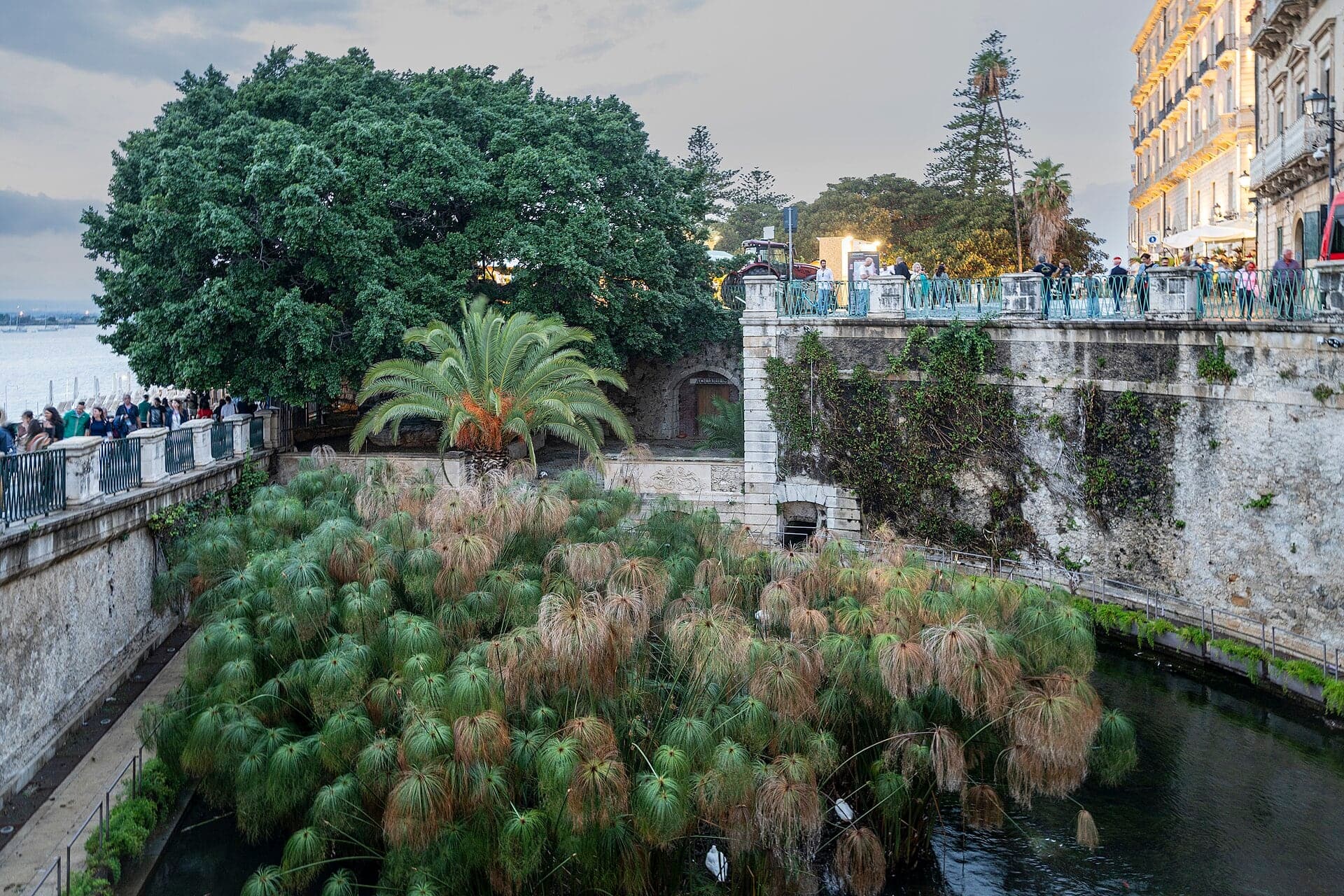
Fonte Aretusa: A Spring, a Myth and a Nelson Letter
Water rises beside the sea here, and poets explained why.
- 11
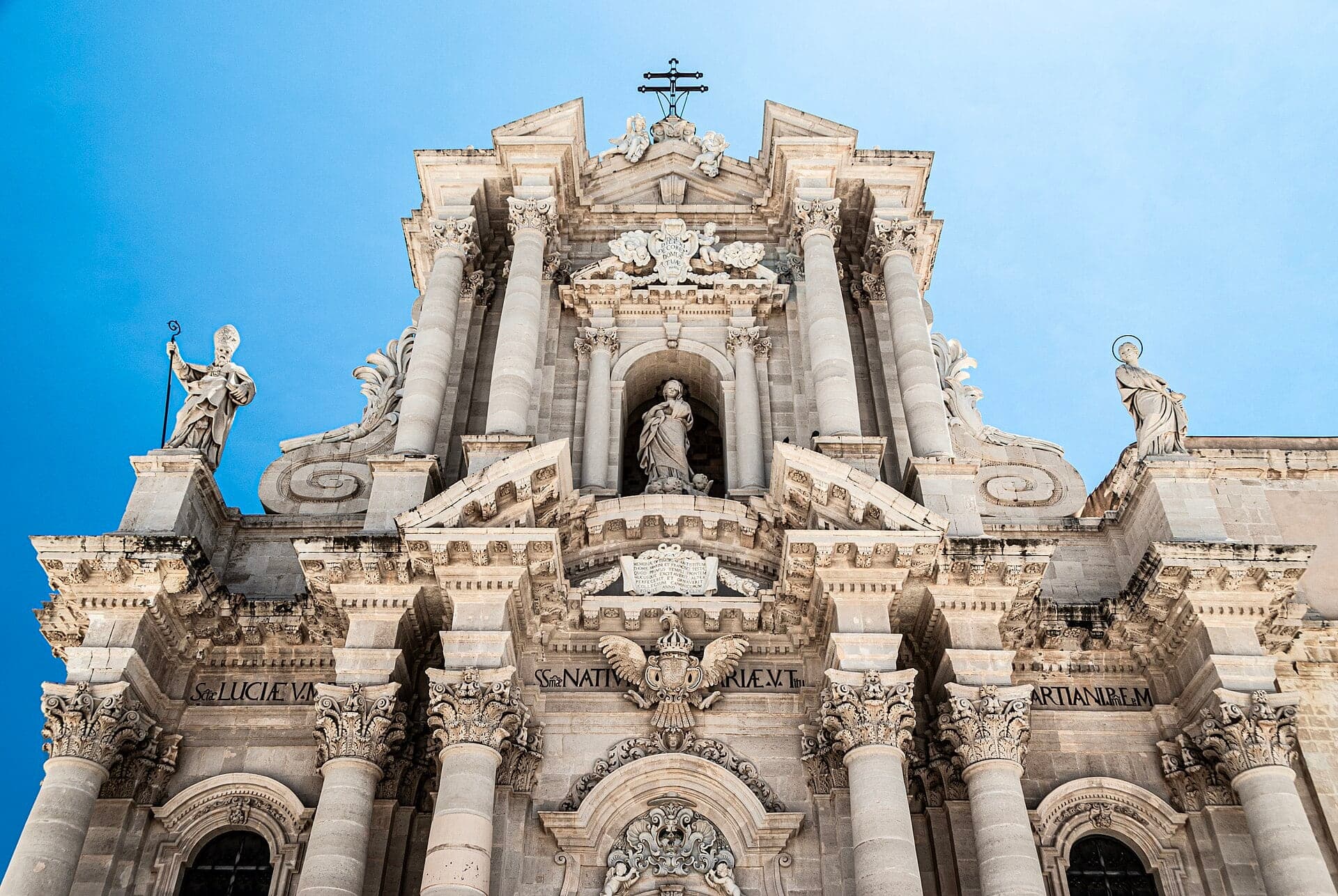
Piazza Duomo: Metal Lines and a Stage-Set Facade
Metal lines in the paving trace buildings found beneath this square.
- 12
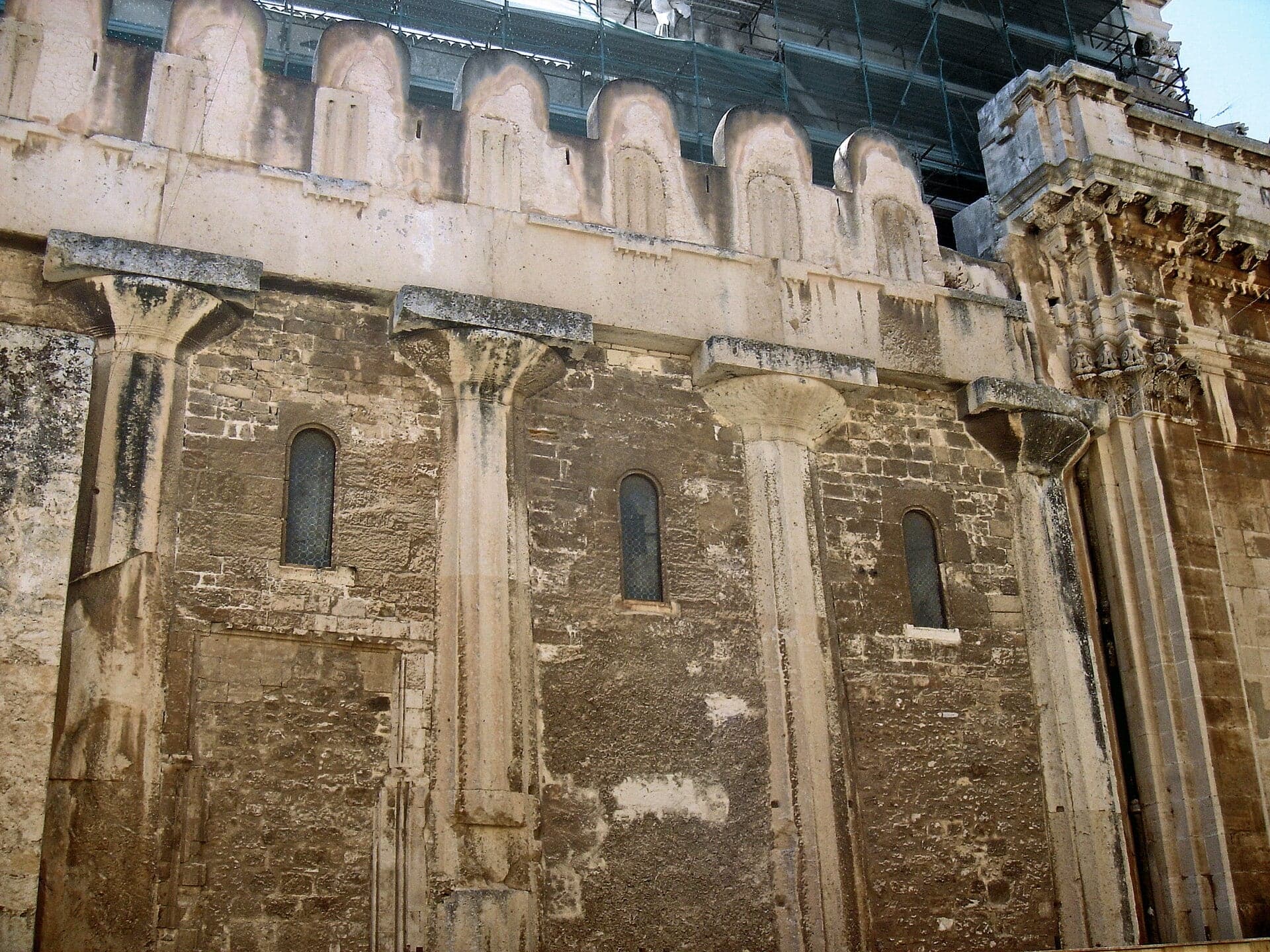
Via Minerva: The Temple Built Into the Cathedral
Greek temple columns still stand in the cathedral's side wall.
Details
Best Time to Visit
A Tuesday to Saturday morning, starting around 9:30 a.m.: the cathedral opens at 9:00 (closed Sundays), the market fills the streets in the morning, and the light on the sea walls is soft. Avoid Sunday if you want to go inside the cathedral. In summer, go early, because the island has little shade.
Pro Tips
- •The Temple of Apollo can be seen from the pavement at any hour and cannot be entered (checked 3 October 2026).
- •The Alla Giudecca ritual bath at stop 6 is a guided visit every 30 minutes, 10:00 to 13:00 and 15:00 to 18:00 daily (last guided tour at 18:00, 18:30 from 2 June), EUR 7, per the municipal page updated 1 June 2026. Phone 0931 21467.
- •Castello Maniace's price and hours were not confirmed for 2026 (the municipal page shows EUR 6 / EUR 3 and hours from early 2025). Check at the door.
- •The Fonte Aretusa walkway is EUR 5; opening hours differ between sources, so check at the entrance. The view from the free parapet needs no ticket (checked 3 October 2026).
- •The cathedral interior is EUR 2 plus a EUR 1 booking fee, open 9:00 to 17:30 October to December, closed Sundays and during services, with closures on 8, 11, 12, 13 and 25 December 2026 (checked 3 October 2026).
- •The open-air market runs most mornings except Sunday; source hours range from about 7:00 to 14:00, so go before noon.
- •Ortigia is a limited-traffic zone, but local vehicles still use its narrow streets: keep to the walls.
Safety & Precautions
- •The Fontana di Diana lost decorative friezes in early September 2026 (press, 2 September 2026). You may see barriers or gaps on arrival at stop 3.
- •Via della Maestranza and other lanes have no pavement and are shared with local vehicles. The coast road toward the castle is one-way with traffic: keep to the pavement on the sea side. On the quiet streets after the Giudecca, keep to the side, away from cars.
- •The ritual bath at stop 6 involves about 58 steep steps and is not suitable for reduced mobility.
- •Castello Maniace: the gate into Piazza Federico di Svevia at stop 8 was not confirmed open at all hours. If it is closed, listen to stop 8 from the road just outside it.
- •The cathedral facade and the Piazza Minerva side were being worked on in spring 2026; check for scaffolding or netting at stops 11 and 12.
- •Sea-wall railings and edges on the Lungomare are old: take care at the drops. Wear flat shoes with grip for the worn paving.
- •The Ipogeo of Piazza Duomo (an underground site open on set mornings) and the Artemision are not part of the route.
Travel advisory: Exercise Increased Caution (Level 2).
Gallery
Related Reading
Go deeper on what you'll see, hear, and walk through.
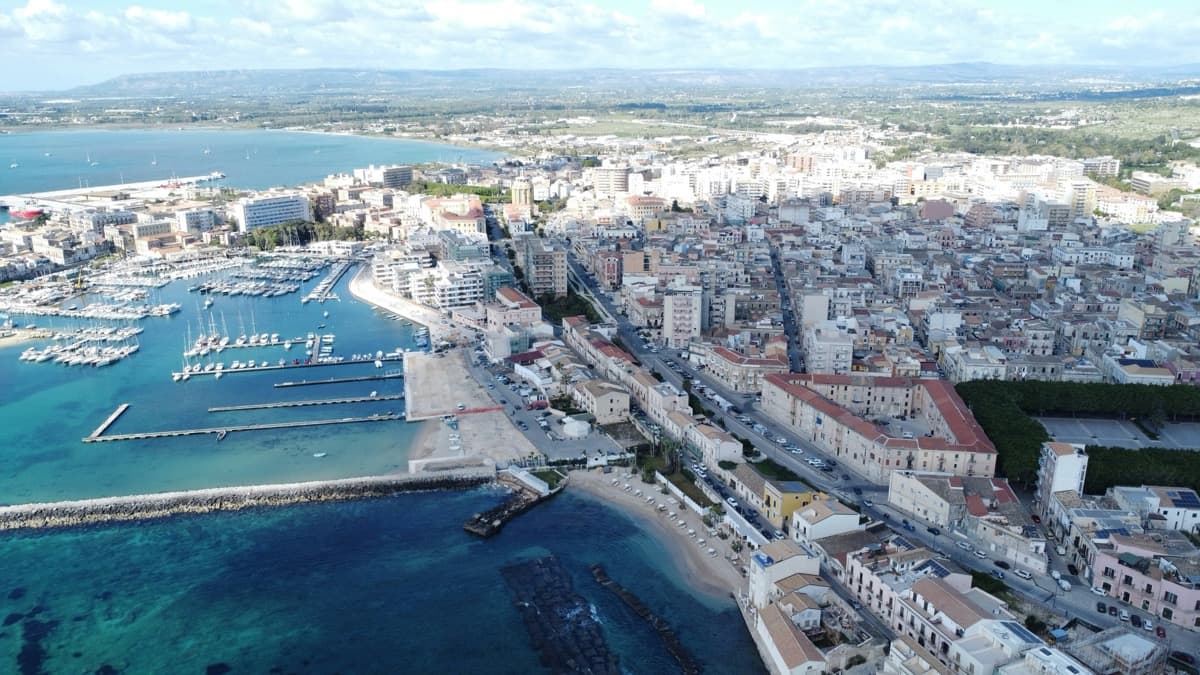
Read the walk
The full story of Ortigia: The Island That Built on What Was Already There, in words. Prefer to listen? Play it narrated, from home or on location.
Introduction
Syracuse, on the island of Sicily in southern Italy, began on a small island of its own. Greek settlers from Corinth chose it, by tradition in the eighth century before Christ, and its old heart is still called Ortigia. It has been a Greek colony, a Roman prize, a Spanish fortress and a baroque town, and it kept a great deal of each.
Over twelve stops and about two point seven kilometres, this walk crosses the bridge onto the island, passes a Greek temple and a fountain of concrete, and follows streets of balconies into the old Jewish quarter. It runs along the Spanish sea walls to a castle at the island's tip, then back up the harbour front to a spring from a Greek myth, and ends at a cathedral built inside a temple. It takes about an hour and forty minutes at an easy pace, longer if you go into the paid sights, which are optional.
Three names recur. Archimedes, the mathematician whose statue stands by the bridge. Cicero, the Roman orator, who in seventy BC accused a Roman governor of looting Sicily and described what was taken. And the emperor Frederick the Second, who built the castle. An ancient Greek historian, Thucydides, is quoted twice.
As you go, notice how often something here has been given a second job, and what was cleared away to make room for it. No group, no fixed start: linger, or skip whatever you like. When you arrive at the Ortigia end of the Ponte Umbertino, begin with stop one.
1. Ponte Umbertino: Archimedes on a Puzzle
Welcome to Ortigia, the old island heart of Syracuse. You are at the Ortigia end of the Ponte Umbertino, the bridge that joins the island to the mainland city.
Look down beside the bridge, at the small island below the road. A bronze Archimedes stands there, the mathematician of ancient Syracuse, with a compass in one hand and a small mirror in the other, turned toward the sea. The statue was unveiled in twenty sixteen. Look at the base rather than the bronze. It is pale limestone cut into fourteen irregular tiles at different heights, like a puzzle broken apart. That shape is a real puzzle called the Stomachion, which Archimedes wrote about, and symbols are carved into the tiles.
The mirror is a legend. The story says he burned a Roman fleet with mirrors during the siege of Syracuse in two hundred and twelve BC. The surviving accounts of that siege, by Polybius, Livy and Plutarch, describe his war machines but never mention mirrors. The earliest writer we know of who offers them is Anthemius of Tralles, around the year five hundred, about seven centuries later, and he says only that it might have been done.
Now the island itself. The Greek historian Thucydides, writing about four hundred BC, says the first settlers drove out the people living here, on the island where the inner city stands, though it is, in his words, no longer surrounded by water. Even then it was tied to the shore. Later the Spanish ringed it with walls and cut channels to make it an island again, and this bridge once ended in a drawbridge. From the eighteen sixties the walls began to come down. This channel and this little island are what was kept, and the five stone arches of the bridge date from those years.
Follow the route along the bridge and onto the island. Next, a Greek temple.
2. Temple of Apollo: The Builder Who Signed the Step
Walk on along the lane beside the temple fence and stop at its far corner, with the old columns rising beside you.
This is the Temple of Apollo, one of the oldest Greek temples in Sicily, from the early sixth century BC. You can look at it from the pavement at any hour. You cannot go inside the fence.
Start with the columns. Look how fat they are, and how tightly packed. Each is a single block of stone, and they stand little more than one column's width apart. The usual explanation is that the builders were still learning stone, and did not trust it to span a wide gap, so they packed the columns in.
Now the signature. Cut into the top step of the temple's east front, the end nearest you, is a line of letters about eight metres long. It says that a man named Kleomenes made something for Apollo, and raised the colonnades. His name is partly broken, and scholars still argue over the exact wording. Do not expect to make it out from the lane; it is a small cut line on a low step. It came to light in eighteen sixty-three and sixty-four, when a small church built on that spot was taken down.
That church was one of many lives. The temple was a Byzantine church, by old accounts a mosque, a Norman church, and from fifteen sixty-two a Spanish barracks for around seven hundred soldiers. The rest was cleared in the nineteen thirties and forties, under the Fascist government, in the same years as the broad avenue nearby, Corso Matteotti, was cut through the old streets. Missing pieces of the two standing columns were rebuilt in concrete.
Follow the route on past the east end of the temple, then south down the pedestrian street toward the old centre. Next, a square with a fountain.
3. Piazza Archimede: A Fountain of Rusting Concrete
Walk on along the pedestrian street into the square, and stop facing the big fountain.
This is Piazza Archimede, named for the mathematician from the bridge. The fountain, though, is not ancient. Giulio Moschetti made it, beginning in nineteen oh six. In the middle stands the goddess Diana. At her feet the nymph Arethusa is turning into water, as the river god Alpheus chases her, and tritons and sea horses ring the basin. You will meet the real spring of Arethusa later on this walk.
Now look closely at the stone. It looks carved, but the main material is reinforced concrete, and the steel inside it has been rusting for a century. That is why pieces keep coming off. Press reports on the second of September twenty twenty-six said decorative friezes had fallen from the fountain, and were gathered up to be restored. If you see barriers or gaps, that may be why.
The square itself is not old either. It was made from eighteen seventy-two by pulling down religious buildings, and it took its final shape in the nineteen thirties, when old streets were cleared to open Corso Matteotti, finished in nineteen thirty-six. Sources say Greek and Roman remains turned up during the works.
Around the square stand the buildings that frame it. One is a plain bank of nineteen twenty-eight with heavy, rough-cut stone blocks. Another is a palace with a curved front, Palazzo Pupillo, built from the seventeen seventies.
So the fountain tells an old island myth in a modern material, in a square made by demolition.
Follow the route past the fountain toward the narrow street of Via della Maestranza. Next, a street of balconies.
4. Via della Maestranza: Balconies on Stone Brackets
Walk on along the street, and stop where a narrow lane opens off the street, out of the way of any traffic.
This is Via della Maestranza. Its name comes from the workshops of artisans and merchants, and from the houses of noble families who settled along it.
Look up. Along both sides of the street, iron balconies rest on carved stone brackets. Look for scrolls and faces among them. The steady rhythm of those balconies is the design of the street. Below the balconies, at street level, are deep rooms that were once workshops.
Most of what you see dates from after the earthquake of the eleventh of January, sixteen ninety-three, which damaged much of Syracuse. But Syracuse was only partly rebuilt. The national catalogue notes that, unlike other towns in this region, the city received baroque and rococo fronts on top of medieval and Renaissance buildings. So a baroque balcony may sit on a much older house.
The older layers go back to when the city belonged to the queens of Sicily. From thirteen oh two until fifteen thirty-seven, Syracuse was the capital of the Camera Reginale, a set of towns that Sicily's kings gave to their wives. Gothic windows and doorways from those centuries still turn up in the old streets nearby.
Ahead, where this street meets the old Jewish quarter, stands a church with a curved front, San Francesco all'Immacolata.
Take care in this narrow street, which has no pavement and is shared with local traffic. Keep close to the wall.
Follow the route on toward the church with the curved front, and keep close to the wall at the corner, where the route turns down into the old Jewish quarter. Next, a church with no roof.
5. San Giovannello: The Church With No Roof
Walk on to the little square and stop facing the church with open sky above its door. This is San Giovannello, the church of Saint John the Baptist, and it has had no roof since the earthquake of sixteen ninety-three. Look above the doorway. The upper front and the roof fell…
Full narration for this stop unlocks with the tour.
6. The Giudecca Lanes: A Quarter Emptied in 1492
Walk on along the lane to its end, and stop at the last street before the sea. This is the Giudecca, the old Jewish quarter. A ritual bath under a hotel here is a guided, ticketed visit, and worth it. The details are on this stop's card. The bath is cut into the rock at number…
Full narration for this stop unlocks with the tour.
7. Belvedere della Turba: A Sea Wall Turned Terrace
Walk on to the paved terrace above the sea, and stop near its edge. Look at the paved terrace above the sea. It is the top of a Spanish bastion, a thick sea wall built to defend the island. The city calls it the Belvedere della Turba, and the Cannamela bastion. A cantilevered…
Full narration for this stop unlocks with the tour.
8. Castello Maniace: The Emperor's Castle at the Tip
You have walked the length of the Spanish wall to the island's tip. The castle ahead, Castello Maniace, is a paid visit, and a good one for its history; the details are on this stop's card. Walk on to the gate at the corner of the old barracks and, if it is open, a few steps…
Full narration for this stop unlocks with the tour.
9. The Great Harbour: Two Hundred Ships in One Bay
Walk on along the sea-front promenade and stop where the wide bay opens out beside you. This is the Great Harbour of Syracuse. Back at the island's tip stands the castle of Emperor Frederick the Second. Here, the water opens out across the whole bay. In four thirteen BC, the…
Full narration for this stop unlocks with the tour.
10. Fonte Aretusa: A Spring, a Myth and a Nelson Letter
Walk on along the lane beside the pool, and stop at the wall where the spring comes into view. Looking at the spring from the wall is free. A walkway around the pool is a ticketed extra, and the details are on this stop's card. Look at the pool, a semicircle sunk below the…
Full narration for this stop unlocks with the tour.
11. Piazza Duomo: Metal Lines and a Stage-Set Facade
Walk on to the middle of the great square and stop, then turn to face the baroque front of the cathedral. The square and its facade are free to see. The cathedral's inside is a paid visit, and so is the Artemision, a Greek temple under the town hall. Both are worth it, and the…
Full narration for this stop unlocks with the tour.
12. Via Minerva: The Temple Built Into the Cathedral
Walk on along the street beside the cathedral's long side wall, and stop there. Look at the wall. Set into it is a long line of fat, fluted stone columns, with the gaps between them filled in with later masonry. This is the outer ring of a Greek temple of Athena, and the…
Full narration for this stop unlocks with the tour.
- The Arethusa promenade on Ortigia's west front — Alain Rouiller, Unsplash License · source
- File:Statua Archimede Pietro Marchese 2.jpg — Davide Mauro, CC BY-SA 4.0 · source
- File:0415 - Siracusa - Tempio di Apollo - Foto Giovanni Dall'Orto - 21-May-2008.jpg — Giovanni Dall'Orto, Attribution · source
- File:Fountain of Diana, Siracusa.jpg — Julian Lupyan, CC0 · source
- File:Syracusa-Palazzo del Governo.JPG — Abxbay, Public domain · source
- File:Chiesa di san Giovanni Battista SR.jpg — SanFilippoApostolo, CC BY-SA 4.0 · source
- File:Mikvah (Syracuse) 08.jpg — Derbrauni, CC BY 4.0 · source
- File:20211107.Syrakus.Altstadt.-034.jpg — Bybbisch94, Christian Gebhardt, CC BY-SA 4.0 · source
- File:Siracusa - Castello Maniace 3243.jpg — Phyrexian, CC BY-SA 4.0 · source
- File:Syracuse, Sicily.jpg — puffin11k, CC0 · source
- File:Sicily, Syracuse – Fonte Aretusa.jpg — Cayambe, CC BY 4.0 · source
- File:Cathedral of Syracuse.jpg — Julian Lupyan, CC0 · source
- File:Lateral duomo.jpg — No machine-readable author provided. Luis-utp assumed (based on copyright claims)., Public domain · source
Images may be cropped or resized. Other photos via Unsplash and Pexels.